Field Guide · The Divided Kingdom
Elijah & Elisha
In the north's darkest years God sent his greatest prophets — and twice they carried the covenant across the border, to a Sidonian widow and a Syrian leper. Centuries later Jesus preached exactly that in Nazareth, and the crowd tried to throw him off a cliff.
The book of Kings has no good word for a single northern king. But it does not abandon the North to the calves and the Baals. In its darkest generation — the age of Ahab and Jezebel, when the state itself sponsored Baal worship — God raised up in the North the two most vivid prophets in the Hebrew Bible: Elijah and Elisha. The kingdom with no righteous king was given the greatest of prophets. That is the North’s paradox, and its hope.
Fire on Carmel
Elijah steps into the story without introduction, announcing a drought that will break Baal’s claim to be lord of the rain (1 Kings 17:1). The reckoning comes on Mount Carmel: one prophet against four hundred and fifty prophets of Baal, two altars, one test — the God who answers by fire is God. Baal is silent all day. Then Elijah prays, and “the fire of the LORD fell, and consumed the burnt sacrifice” (1 Kings 18:38); the people fall on their faces: “The LORD, he is the God” (18:39).
The Still Small Voice
Victory does not spare Elijah from despair. Hunted by Jezebel, he flees to Horeb — the mountain of Moses — and asks to die. There God teaches him what the fire could not: the LORD was not in the wind, not in the earthquake, not in the fire, but in “a still small voice” (1 Kings 19:12). The God of Carmel’s flame is also the God of the whisper. Centuries later and a hemisphere away, that same voice returns: when God speaks to the Lamanites in their darkened prison, it is “not a voice of thunder… but… a still voice of perfect mildness, as if it had been a whisper” (Helaman 5:30) — Elijah’s whisper, carried out of Jerusalem on the brass plates and heard again.
The Chariot and the Mantle
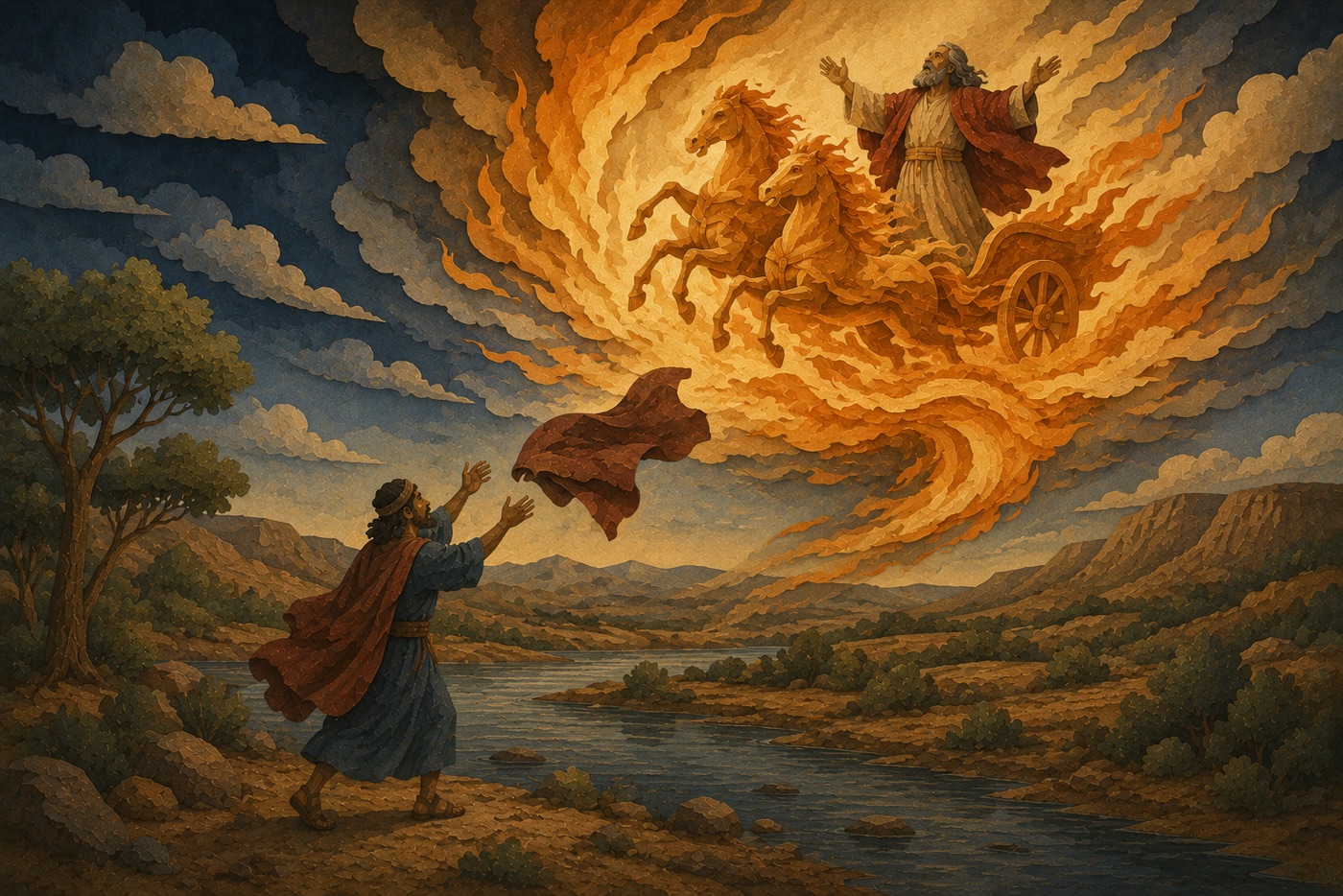
Elijah’s ministry ends not in death but in ascent. As he and Elisha walk together, “there appeared a chariot of fire, and horses of fire… and Elijah went up by a whirlwind into heaven” (2 Kings 2:11). Elisha, who had asked for “a double portion of thy spirit” (2:9), catches the falling mantle — and the prophetic office passes on. The North’s hope does not die with one man.
The Sons of the Prophets
Elijah and Elisha were not lone figures. Around them moved whole companies called the “sons of the prophets” — followers who lived, worked, and traveled together, based at towns like Bethel, Jericho, and Gilgal (2 Kings 2:3–7; 4:38; 6:1–2). The Hebrew phrase is worth a closer look. The word translated “sons,” ben (בֵּן), does not have to mean literal children; all across the ancient Near East it was also the ordinary word for an apprentice — a trainee bound to a master, much as we might say “a son of the guild.” The biblical scholar William Schniedewind reads the “sons of the prophets” as just that: a prophetic guild, a band of trainees learning the calling under a master, who passed both the craft and the traditions on to the next generation. The story even uses two such words for the same person: when Elisha sends “one of the children of the prophets” to anoint Jehu as king, that messenger is called “the young man (נַעַר) the prophet” (2 Kings 9:1, 4): ben (apprentice) and naʿar (attendant), both used for one junior member of the band.
Seen this way, the great prophets of the North were a community as much as they were individuals — which is how their words and deeds were kept, retold, and eventually written down. It is the same handing-down-by-apprenticeship that, generations later, stands behind the scribes who shaped the book of Kings itself (see The Deuteronomists’ Lens). (Reading “sons of the prophets” as apprentices is a scholarly interpretation of the Hebrew phrase, not something the story states directly.)
Elisha, a Foreshadow of Christ
Read Elisha’s miracles beside the Gospels and a pattern leaps out. Again and again, what Elisha does, Jesus does — larger, and for all.
- Elisha takes twenty loaves and feeds a hundred, with food left over (2 Kings 4:42–44) — Jesus takes five loaves and feeds five thousand, with baskets to spare.
- Elisha raises a dead boy to life (2 Kings 4:32–35) — Jesus raises the widow’s son at Nain and Jairus’s daughter.
- Elisha cleanses a leper (2 Kings 5) — Jesus cleanses lepers with a word.
- Elisha heals poisoned water and a poisoned pot (2 Kings 2:19–22; 4:38–41) — Jesus turns water to wine and stills a deadly sea.
- Even in death Elisha gives life: a corpse let down onto his bones revives (2 Kings 13:21) — a quiet foreshadow of a tomb that could not hold life in.
Interpretive layer. This is typology (reading an earlier figure as a foreshadow of a later one), not a claim the text makes outright — but the resonance is deliberate enough that the Gospel writers seem to have heard it. Elisha is drawn as a man of God whose works announce, centuries early, the kind of thing the Messiah will do.
The Prophets Who Blessed Outsiders
Here is the detail that will matter most. Twice, the North’s great prophets carry the covenant across the border, to people who were not Israel at all.
- Elijah is sent, in the famine, not to a daughter of Israel but to a widow in Zarephath, “which belongeth to Zidon” (1 Kings 17:9) — a Sidonian, a Phoenician, from the very homeland of Jezebel’s Baal. He multiplies her meal and oil and raises her son, and she confesses, “now by this I know that thou art a man of God” (17:24).
- Elisha heals Naaman the Syrian — an Aramean general, a leper, a commander of an enemy army — who dips seven times in the Jordan, comes up clean, and returns to say, “now I know that there is no God in all the earth, but in Israel” (2 Kings 5:14–15).
A Phoenician widow and a Syrian soldier receive what many in Israel did not. The covenant God is not fenced by a border.
The Prophets’ World
Trace it on the map. The calf‑shrines that defined the North (Dan, Bethel), the capitals the whole drama turned on (Samaria, Jerusalem), and — in green — the places Elijah and Elisha carried the covenant past Israel’s edge: north to a Sidonian widow at Zarephath, east to a Syrian general at Damascus, down to the Jordan where the mantle passed, and far south to Horeb, where the LORD spoke in a still small voice. Tap any marker (green markers link out to Holy Land Site).
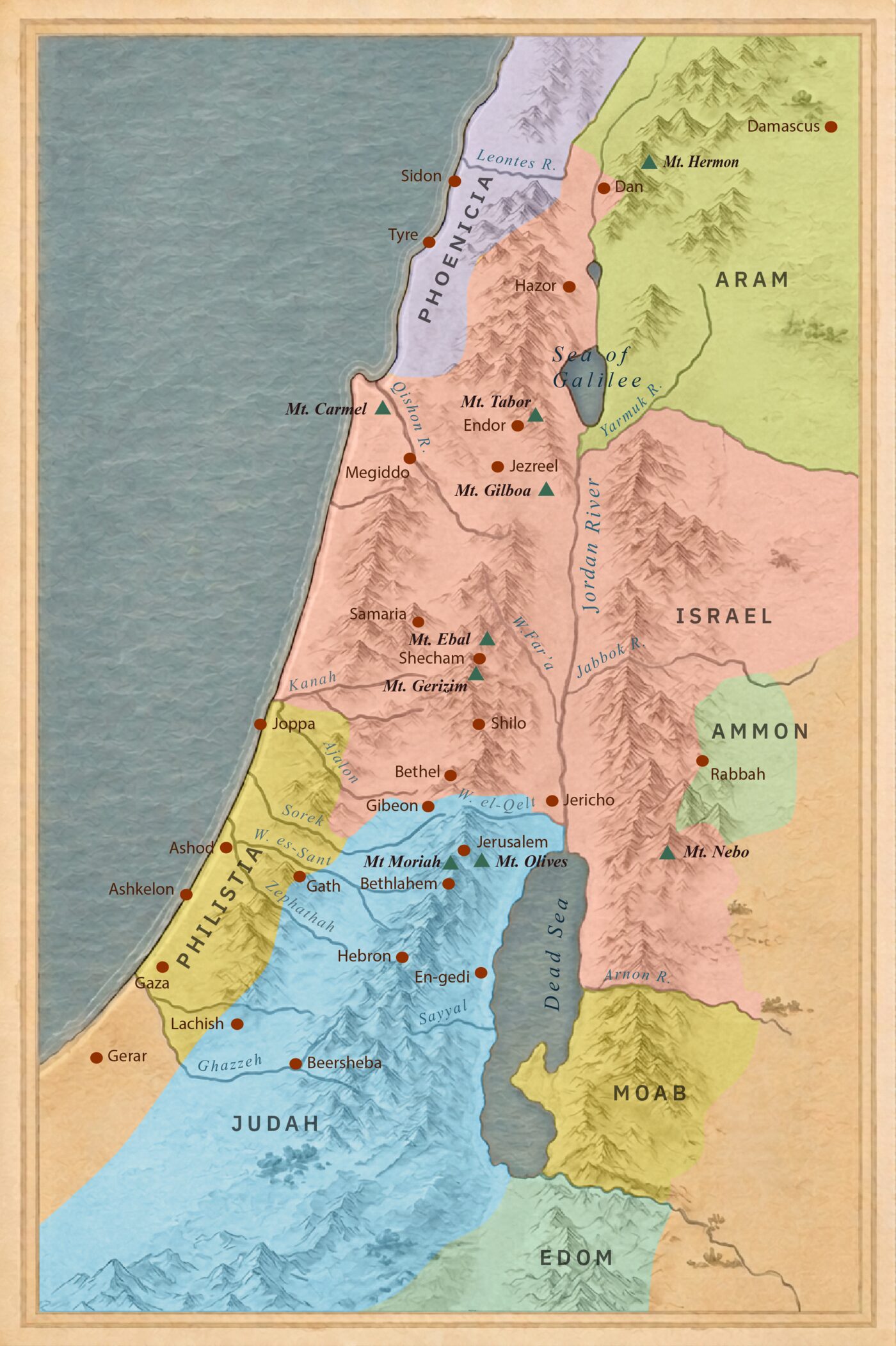
Tap a marker to see what happened there — the calf shrines, the capitals, and where Elijah & Elisha carried the covenant across the border.
The Sermon That Nearly Killed Him
Centuries later, in the synagogue at Nazareth, Jesus reaches for exactly these two stories. He has just read Isaiah’s promise of good news to the poor — and then, to a hometown crowd expecting a favorite son, he says, “No prophet is accepted in his own country” (Luke 4:24). And he proves it with Elijah and Elisha:
There were many widows in Israel in the days of Elias… but unto none of them was Elias sent, save unto Sarepta, a city of Sidon, unto a woman that was a widow. And many lepers were in Israel in the time of Eliseus the prophet; and none of them was cleansed, saving Naaman the Syrian. (Luke 4:25–27)
The point is unmistakable, and it is a blade: God’s own prophets crossed the border to bless outsiders — a Sidonian and a Syrian — while insiders went without. The reaction is instant. “All they in the synagogue, when they heard these things, were filled with wrath” (4:28), and they “thrust him out of the city, and led him unto the brow of the hill… that they might cast him down headlong” (4:29). His first recorded sermon nearly ends in his murder — because he held up outsider faith as a rebuke to hoarded privilege.
What the Fracture Broke — and Christ Reopened
Step back, and the whole guide converges here. The split did not only divide a kingdom; it severed the North from the Temple and its priesthood. Jeroboam’s golden calves and his “priests of the lowest of the people, which were not of the sons of Levi” (1 Kings 12:31) were engineered to keep northern Israel away from Jerusalem — away from the house where the covenant blessings were administered. Over the centuries that followed, the North became Samaria, and Samaria was shut out: no temple, no Levitical priesthood, no place at the table.
Read this way — offered as interpretation, a reading the guide finds moving rather than a claim the text spells out — Jesus’ ministry is the reversal of the fracture. To the Samaritan woman at the well he offers living water (John 4); a Samaritan is the hero of his parable (Luke 10:33) and the one leper who returns to give thanks (Luke 17:16); he answers the faith of a Syrophoenician mother, “a Greek” (Mark 7:26) — the same border Elijah once crossed. And at Nazareth he names Elijah and Elisha to say it aloud: the blessings were never meant to be fenced. What Jeroboam’s schism closed, the gospel reopens — access, for the outsider, to the full inheritance. Deepens, not debunks.
Elijah Returns
And the prophet of the North does not vanish from the story. Malachi seals the Old Testament with a promise: “I will send you Elijah the prophet before the coming of the great and dreadful day of the LORD” (Malachi 4:5). On the Mount of Transfiguration, Elijah stands with Moses beside the transfigured Christ (Matthew 17:3). And to Latter-day Saints the promise is kept in kind: at the Kirtland Temple, “Elijah the prophet, who was taken to heaven without tasting death, stood before us,” and restored the sealing keys — “to turn the hearts of the fathers to the children, and the children to the fathers” (Doctrine and Covenants 110:13–16).
Latter-day Saint layer. The prophet who once carried the covenant across the border to a Sidonian widow returns to gather all of scattered Israel home. The story that began with a fracture is, in the end, about a door reopened — and held open — to everyone.
Next: The Deuteronomists’ Lens → — the viewpoint that shaped how all these stories were told. (Back to The Sin of Jeroboam.)