Field Guide · The Divided Kingdom
Did They Have the Book of Kings?
If Kings reached its final form in the exile — after Lehi's family left Jerusalem with the brass plates — could the Book of Mormon writers have carried it? The timeline doesn't fight the record; it explains it.
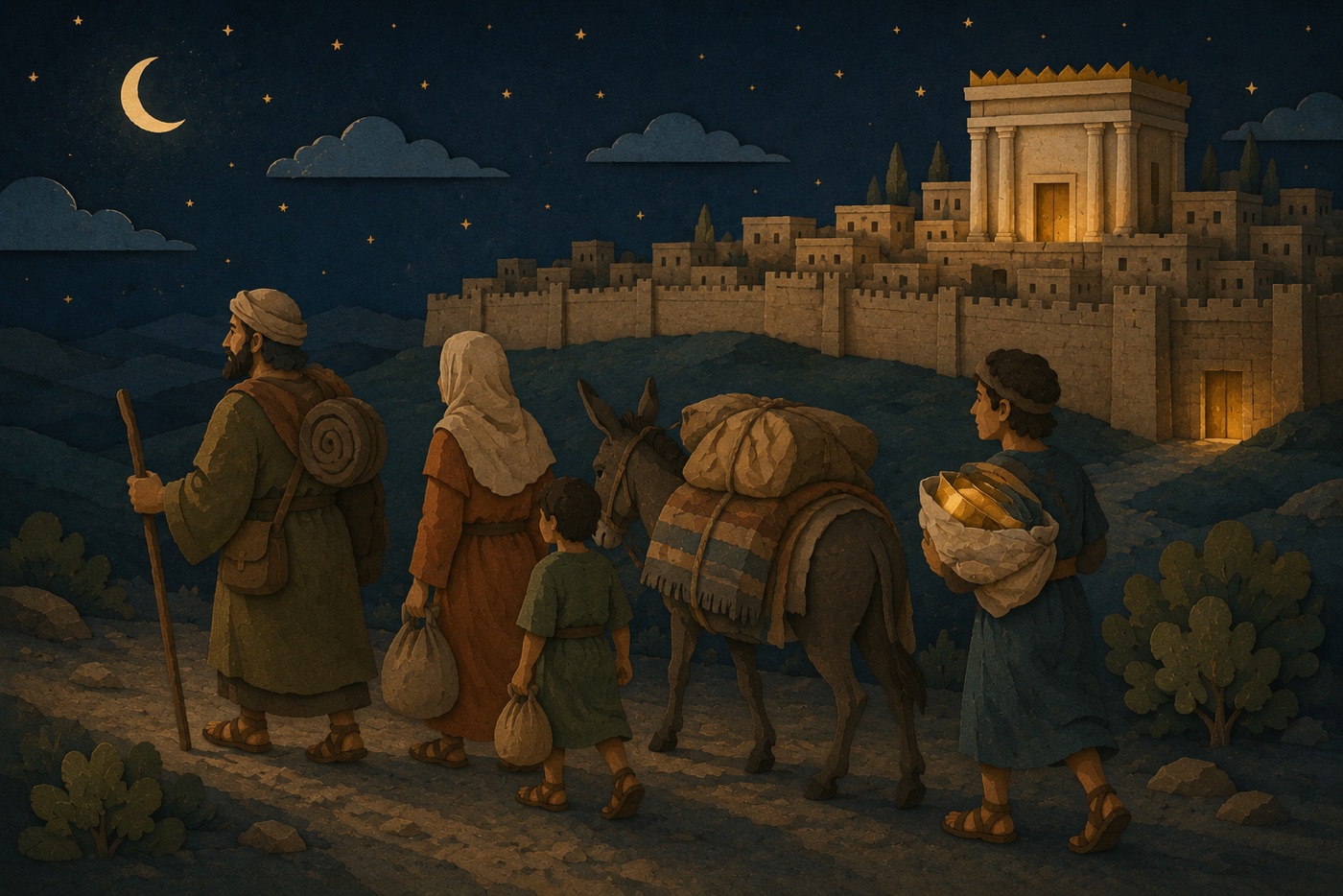
If 1 Kings reached its final form in the Babylonian exile — after Lehi’s family had already left Jerusalem with the brass plates — a fair question follows: could the Book of Mormon writers have carried the book of Kings at all? The honest answer deepens the picture rather than threatening it. The records that became Kings were pre-exilic and available; the compilation into the book we hold was exilic and later. Lehi left in between. The Book of Mormon’s own description of where its historical record ends fits that timeline rather than fighting it — and, as we’ll see, ancient Jewish tradition and modern critical scholarship converge on the same exilic moment.
The Brass Plates, Precisely
Nephi describes the brass plates by categories, not as a table of contents we could check against our Bible: the five books of Moses; “a record of the Jews from the beginning, even down to the commencement of the reign of Zedekiah, king of Judah”; and the prophecies of the holy prophets to that same point, “and also many prophecies which have been spoken by the mouth of Jeremiah” (1 Nephi 5:11–13).
Two things follow. First, the plates also carried material our biblical canon (the books that became our Old Testament) never kept — the writings of Zenos, Zenock, and Neum (1 Nephi 19:10), and the Joseph-in-Egypt prophecies (2 Nephi 3). So we cannot simply map the plates onto our own Old Testament. Second, and crucially: the historical record on the plates ends at “the commencement of the reign of Zedekiah” — which is exactly when Lehi departs.
The Timing Dissolves the Tension
Set the dates side by side:
- Lehi leaves Jerusalem “in the commencement of the first year of the reign of Zedekiah” (1 Nephi 1:4) — about 600 BC by the Book of Mormon’s own reckoning (historians date Zedekiah’s accession to 597 BC; the two are close, and “600 BC” is a round approximation).
- The brass-plates record ends at “the commencement of the reign of Zedekiah” (1 Nephi 5:12) — right as Lehi departs.
- Canonical Kings ends later, with the destruction of Jerusalem in 586 and the release of Jehoiachin from a Babylonian prison ~561 BC (2 Kings 25:27–30) — decades after Lehi is gone.
So the brass plates could not have carried the finished book of Kings — not because the underlying records didn’t exist, but because the compilation hadn’t happened yet. The sources were there; the book was not.
What This Actually Shows
- Sources: pre-exilic. The court records, prophetic collections, and “Acts of Solomon” that Kings draws on (1 Kings 11:41; 14:19, 29) were available in Lehi’s Jerusalem.
- Redaction: exilic. The shaping of those sources into Kings — read backward from the catastrophe of 586, with Jehoiachin’s release as its latest fixed point — belongs to the exile.
- Lehi: in between. He carried the sources, in their pre-exilic form, out of Jerusalem before the editors finished their work.
Ancient tradition (Jeremiah compiled Kings in the exile) and modern scholarship (the Deuteronomistic History reached final form in the exile) point at the same moment from opposite directions. Knowing how and when Kings was assembled doesn’t embarrass the Book of Mormon’s account — it explains why its record ends precisely where it does.
The Patterns Traveled, Too
If the Nephite writers grew up on those same pre-exilic sources — court chronicles and prophetic collections — we would expect their own history to move in the same world. It does. The record of the Nephite chief judges reads in the very key of Kings: a succession that splits a nation, a throne taken by the knife, murder for gain sworn in secret, a capital that falls when the covenant frays.
- A nation splits at the succession. When Pahoran dies, three of his sons — Pahoran, Paanchi, and Pacumeni — contend for the judgment-seat, and the people divide with them (Helaman 1:2–4) — the same fracture that tore Israel in two when the tribes rejected Rehoboam after Solomon: “To your tents, O Israel” (1 Kings 12:16).
- A throne taken by the knife. Kishkumen murders the chief judge Pahoran to seize the government (Helaman 1:9) — as Joash of Judah was slain by a palace conspiracy (2 Kings 12:20), and as Athaliah grasped the throne by killing off the royal seed (2 Kings 11:1).
- Murder for gain, sworn in secret. The band formed by Kishkumen and Gadianton were “murderers and plunderers,” stirred up amid “the riches of the world” (Helaman 6:17–18) — the same logic as Jezebel’s judicial murder of Naboth to seize the vineyard the crown coveted (1 Kings 21:13).
- The capital falls. Coriantumr storms the walls and takes Zarahemla, the Nephite capital (Helaman 1:19–20) — the shadow of Babylon breaking into Jerusalem and burning “the house of the LORD” (2 Kings 25:9).
None of this requires literary borrowing to explain it. It is what happens when a people carries the same histories and the same prophets out of Jerusalem — and then lives out the same temptations. The brass plates did not only preserve the law; they preserved a world, and the Nephite historians narrate their own kings and conspiracies in its idiom. (An interpretive parallel offered as illumination — the Book of Mormon nowhere cites Kings.)
A Further Proposal — “Some Scholars Propose”
A strand of Latter-day Saint scholarship presses the point further, and it should be flagged clearly as a proposal, not doctrine. Lehi was of the tribe of Manasseh — a lineage of Joseph, and so of the northern tribes rather than Judah (1 Nephi 5:14; Alma 10:3). The Deuteronomistic History is the Judahite, Jerusalem-centered, anti-Northern document. The brass plates carry prophets (Zenos, Zenock, Neum) the Judahite canon never preserved.
Drawing on Margaret Barker — a British biblical scholar whose work is widely discussed among Latter-day Saints — and her proposal that Josiah’s reform may have suppressed an older temple theology (itself a contested reconstruction), Latter-day Saint scholars such as Kevin Christensen read the brass plates as preserving a pre-Deuteronomic tradition — one older than, and untouched by, the Deuteronomists’ editing — that left Jerusalem just before the reforming and exilic editors fixed the canon.
Caution. This is provocative and contested, and the Church takes no position requiring it. Its value is that it turns the Deuteronomistic conversation from defensive to generative — but keep it explicitly in the “some scholars propose” register, distinct from the timeline argument above, which stands on its own without it.
The Payoff
This is the guide’s thesis in miniature: knowing the editors’ work deepens the text rather than debunking it. The Book of Mormon never claims the plates held our book of Kings; it tells us its record ends at Zedekiah’s accession — exactly what a pre-exilic departure would predict. The eighth Article of Faith — “we believe the Bible to be the word of God as far as it is translated correctly” — already invites us to think about transmission and compilation. The Deuteronomists are part of that story, not a threat to it.
Next: The Lady of the Temple → — the reform reached even into Solomon’s temple, and swept out the symbol of a goddess. (Back to How 1 Kings Was Written.)