LDS Connections
Promised land theology, divine justice, conversion, covenant renewal — and how the Book of Mormon reads the conquest of Canaan
The story of Israel entering Canaan raises some of the most difficult questions in scripture: Why did God command the destruction of entire peoples? How do we reconcile the violence of the conquest with the God of mercy revealed elsewhere? And what does it mean for a land to be “promised”?
Latter-day Saint scripture does not avoid these questions — it engages them directly. The Book of Mormon offers its own commentary on the Canaanite conquest, and the Restoration’s broader theological framework provides resources for grappling with the difficult elements of Joshua and Judges.
Promised Land Theology
The concept of a “promised land” is not unique to ancient Israel in Latter-day Saint scripture — it is a recurring pattern. The Jaredites were led to a promised land. Lehi’s family was led to a promised land. The Mulekites arrived at a promised land. And in each case, the same covenant logic applies:
“Behold, the Lord esteemeth all flesh in one; he that is righteous is favored of God. But behold, this people had rejected every word of God, and they were ripe in iniquity; and the fulness of the wrath of God was upon them; and the Lord did curse the land against them, and bless it unto our fathers; yea, he did curse it against them unto their destruction, and he did bless it unto our fathers unto their obtaining power over it.” — 1 Nephi 17:35
The promised land is never a blank gift. It comes with conditions — and those conditions apply equally to the new occupants. Nephi drives this point home: “Do ye suppose that our fathers would have been more choice than they if they had been righteous? I say unto you, Nay” (1 Nephi 17:34). God shows no ethnic favoritism. The same covenant that gave Israel the land would eventually exile them from it when they replicated the sins of the Canaanites.
This is the pattern: “He raiseth up a righteous nation, and destroyeth the nations of the wicked. And he leadeth away the righteous into precious lands, and the wicked he destroyeth, and curseth the land unto them for their sakes” (1 Nephi 17:37–38).
Cherem (חֵרֶם) and Divine Justice
The Hebrew word cherem (חֵרֶם) — often translated “utterly destroy” or “devote to destruction” — describes the most severe form of warfare in the Old Testament. Under the cherem, everything in a conquered city was dedicated to God: no plunder could be taken, no prisoners kept, no treaties made. When Achan violated the cherem at Jericho by taking forbidden spoil, the entire nation suffered defeat at Ai (Joshua 7).
This is the hardest aspect of the conquest narrative for modern readers. Several points from Latter-day Saint theology help frame the question without eliminating its difficulty:
1. God as the Lord of Life and Death
Latter-day Saint theology affirms that God, who gives life, has the sovereign right to end it — and that physical death is not the ultimate tragedy. The plan of salvation extends beyond mortality. This does not make the violence of the conquest comfortable, but it locates it within a larger framework where death is not annihilation.
Consider the analogy of a surgeon. A surgeon causes real pain — cuts into living tissue, removes what is diseased — not because the patient’s suffering is irrelevant, but because the surgeon can see what the patient cannot: that leaving the disease in place will destroy far more than the surgery itself. God’s perspective encompasses not only the present generation but the spiritual trajectory of nations across centuries. The Canaanite practices described in Section 04 — child sacrifice, ritual prostitution, the systematic corruption of worship — were not merely offensive to God; they were spiritually metastatic, spreading into every culture they contacted. Israel’s own history proved this: even with the divine warning, the incomplete conquest left precisely these influences in place, and they consumed Israel from within for generations. God, seeing the full scope of consequences that no mortal observer could, acted to prevent a greater harm — not with indifference to suffering, but with a knowledge of outcomes that transcends our own.
2. The “Ripeness” Principle
Both the Book of Mormon and the Old Testament describe the Canaanites as having reached a point of moral extremity. Nephi’s argument is explicit: “This people had rejected every word of God, and they were ripe in iniquity” (1 Nephi 17:35). The same language of “ripeness” applies to the Jaredites, the Nephites, and — the text implies — to any nation that occupies a promised land and then rejects God. The cherem was presented as judgment, not ethnic cleansing.
3. The Warning Applies to Israel Too
The prophets made clear that Israel was not exempt. Leviticus 18:28 warns directly: “That the land spue not you out also, when ye defile it, as it spued out the nations that were before you.” And this is precisely what happened — first to the northern kingdom (722 BC) and then to Judah (586 BC). The covenant cuts both ways.
4. The Difficulty Remains
Latter-day Saint readers need not pretend the cherem passages are easy. They can hold the tension between a God of mercy and a God who, in specific historical circumstances, commanded severe judgment — and recognize that prophetic understanding, even in scripture, may reflect human limitations in comprehending divine purposes.
Rahab: Faith, Conversion, and the Scarlet Thread
In the middle of the conquest narrative stands Rahab — a Canaanite, a woman, and what the English Bible calls “a harlot” — who is also a convert. Her story in Joshua 2 is one of the most remarkable in scripture.
Understanding “Harlot” — the Word Zonah
The Hebrew word applied to Rahab is zonah (זוֹנָה). English translations render it “harlot” or “prostitute,” but the ancient reality was more complicated. The consonants z-n-h can be vocalized as either zonah (prostitute) or zanah (a woman who provides food and lodging) — and in the ancient world, these roles often overlapped. The first-century historian Josephus describes Rahab as an innkeeper. The Jewish commentator Rashi and the Christian scholar Adam Clarke both interpreted the term the same way.
This matters because the modern word “prostitute” carries assumptions that do not map cleanly onto the ancient Near East. In Canaanite society, women had virtually no legal right to own property, inherit wealth, or engage in trade independently. A woman without a husband or father to provide for her — a widow, a divorced woman, an abandoned woman — had almost no legitimate economic options. Women in this position who became zonot were often running what amounted to roadside inns or boarding houses, providing food, drink, and lodging to travelers. Some were also sex workers — not because they chose it freely, but because the social structure left them no alternative. It was survival, not scandal. For women who were mothers, the choice was starker still: provide for your children by any means available, or watch them die.
Rahab’s house was built into the city wall of Jericho (Joshua 2:15) — the kind of location where an inn or lodging house would naturally operate, at the point where travelers entered the city. She had the space to hide men, access to the roof for drying flax (a commercial activity), and the social position to negotiate with both Canaanite authorities and foreign visitors. Whatever else she was, Rahab was a resourceful woman navigating a world that offered women like her almost nothing — and she did it with enough skill to keep her entire family alive.
Lynne Hilton Wilson’s Handmaidens, Harems, and Heroines series on Scripture Central explores Rahab’s story in this fuller context — examining how ancient women navigated systems that were often brutally hostile to their survival.
When the Israelite spies enter Jericho, Rahab hides them and makes a confession that goes beyond political calculation:
“I know that the LORD hath given you the land … for the LORD your God, he is God in heaven above, and in earth beneath.” — Joshua 2:9, 11
Rahab’s declaration is a confession of YHWH’s supremacy — from a Canaanite woman who had grown up surrounded by Baal worship. She recognized YHWH as the God who rules “in heaven above, and in earth beneath” — supreme over every power she had ever known. And she recognized this based on what she had heard about His acts: the Red Sea crossing, the defeat of Sihon and Og. Her faith was based on the testimony of others, acted upon in a moment of crisis.
The Scarlet Thread
The spies instruct Rahab to hang a scarlet cord from her window as a sign of protection (Joshua 2:18). When Jericho falls, everyone inside her house is saved. Latter-day Saint readers have often noted the parallel to the Passover — blood on the doorframe marking a household for deliverance. The symbolism of a scarlet sign of protection runs deep in the covenant narrative.
Rahab’s Legacy
Rahab’s story does not end at Jericho. The New Testament lists her in the genealogy of Christ (Matthew 1:5), making her one of only four women named in the lineage of the Messiah. She is also cited as an example of faith in both Hebrews 11:31 and James 2:25. A Canaanite woman, from the nation under the cherem, becomes an ancestor of the Savior.
For Latter-day Saint readers, Rahab embodies a core gospel principle: the covenant is not ethnic. Anyone — regardless of origin, background, or past — who exercises faith and acts on it can be gathered in. The conquest narrative is not about the destruction of a race; it is about the judgment of a culture. And even within that judgment, individual faith creates an exception.
Covenant Renewal at Shechem
Joshua’s farewell address and covenant renewal at Shechem (Joshua 24) resonates with several Latter-day Saint themes:
The Covenant Pattern
The Shechem ceremony follows a structure familiar to Latter-day Saints who study ancient covenant forms: a recitation of God’s saving acts (Joshua 24:2–13), a call to commitment (vv. 14–15), the people’s covenant response (vv. 16–18, 21, 24), and the establishment of witnesses and a memorial (vv. 22, 26–27). This pattern appears throughout scripture — from Sinai to King Benjamin’s speech (Mosiah 2–5).
“Choose You This Day”
Joshua’s famous challenge — “choose you this day whom ye will serve … but as for me and my house, we will serve the LORD” (Joshua 24:15) — is one of the most frequently quoted scriptures in General Conference. It captures the Restoration’s emphasis on moral agency: the covenant requires a conscious, deliberate choice. God will not compel worship, even in a promised land. The choice must be made — and remade — by each generation.
Joshua’s Warning
Notably, Joshua responds to the people’s enthusiastic commitment with a caution: “Ye cannot serve the LORD: for he is an holy God; he is a jealous God; he will not forgive your transgressions nor your sins” (Joshua 24:19). This is not a denial of grace — it is a warning against casual commitment. The covenant with YHWH is not one option among many; it demands total allegiance. Half-hearted devotion, limping between YHWH and the Baals, is worse than an honest rejection.
Book of Mormon Parallels
The Canaanite conquest narrative echoes through the Book of Mormon in several ways:
| Theme | Canaan | Book of Mormon |
|---|---|---|
| Promised land with conditions | Land given to Israel on condition of covenant faithfulness | “Inasmuch as ye shall keep my commandments, ye shall prosper in the land” (1 Nephi 2:20) |
| Displacement of the wicked | Canaanites “ripe in iniquity” displaced by Israel | Jaredites destroyed; Nephites inherit the land; Nephites destroyed; Lamanites remain |
| Syncretism as the core danger | Israel absorbs Canaanite worship; the Judges cycle | Nephite dissenters adopt Lamanite practices; Amlicites, Zoramites, Kingmen |
| The generational failure | “There arose another generation … which knew not the LORD” (Judges 2:10) | “There was a great contention among the people … the rising generation … did not believe” (Mosiah 26:1) |
| Covenant renewal assemblies | Joshua at Shechem | King Benjamin at the temple (Mosiah 2–5) |
| Individual conversion within judgment | Rahab saved from Jericho | Lamanite converts (Anti-Nephi-Lehies) spared amid broader conflict |
Nephi’s Argument (1 Nephi 17:32–38)
Nephi’s argument about the Canaanite conquest is the most direct Book of Mormon commentary on Joshua. Speaking to his brothers — who object to building a ship and essentially to the entire enterprise of following God into the unknown — Nephi invokes the conquest as precedent:
- The Canaanites were not innocent — they “had rejected every word of God” (v. 35)
- God shows no ethnic favoritism — “the Lord esteemeth all flesh in one; he that is righteous is favored of God” (v. 35)
- Israel was not inherently better — “do ye suppose that our fathers would have been more choice than they if they had been righteous? I say unto you, Nay” (v. 34)
- The principle is universal — God “raiseth up a righteous nation, and destroyeth the nations of the wicked” (v. 37)
For Nephi, the conquest of Canaan is not an embarrassment to be explained away — it is a theological principle to be understood. God grants lands to peoples conditionally, based on righteousness. The same covenant that gave Israel the land would — and did — remove them from it when they failed. And the same principle applies to every promised land, including the one Nephi’s family is sailing toward.
The Judges Cycle and Dispensational History
Latter-day Saint readers may recognize the Judges cycle — faithfulness, prosperity, complacency, apostasy, oppression, repentance, deliverance — as a pattern that extends far beyond ancient Israel. It maps onto the Latter-day Saint understanding of dispensational history:
- Each dispensation begins with a prophetic commission (Adam, Enoch, Noah, Abraham, Moses, Christ, Joseph Smith)
- Each is followed by a period of covenant faithfulness
- Each eventually succumbs to apostasy or fragmentation
- Each requires divine intervention to restart
The book of Judges is, in this reading, the most transparent example of a universal pattern — and it would be a mistake to assume that any dispensation, including our own, is immune to it. The Restoration provides priesthood continuity, living prophets, and temple covenants that bind across generations — but these are tools for navigating the cycle, not a guarantee of escaping it. We are all susceptible. The pattern recurs on a generational scale and on a deeply personal one: prosperity leads to comfort, comfort to complacency, complacency to forgetting God, and forgetting God to crisis — which, if we are wise, drives us back to Him.
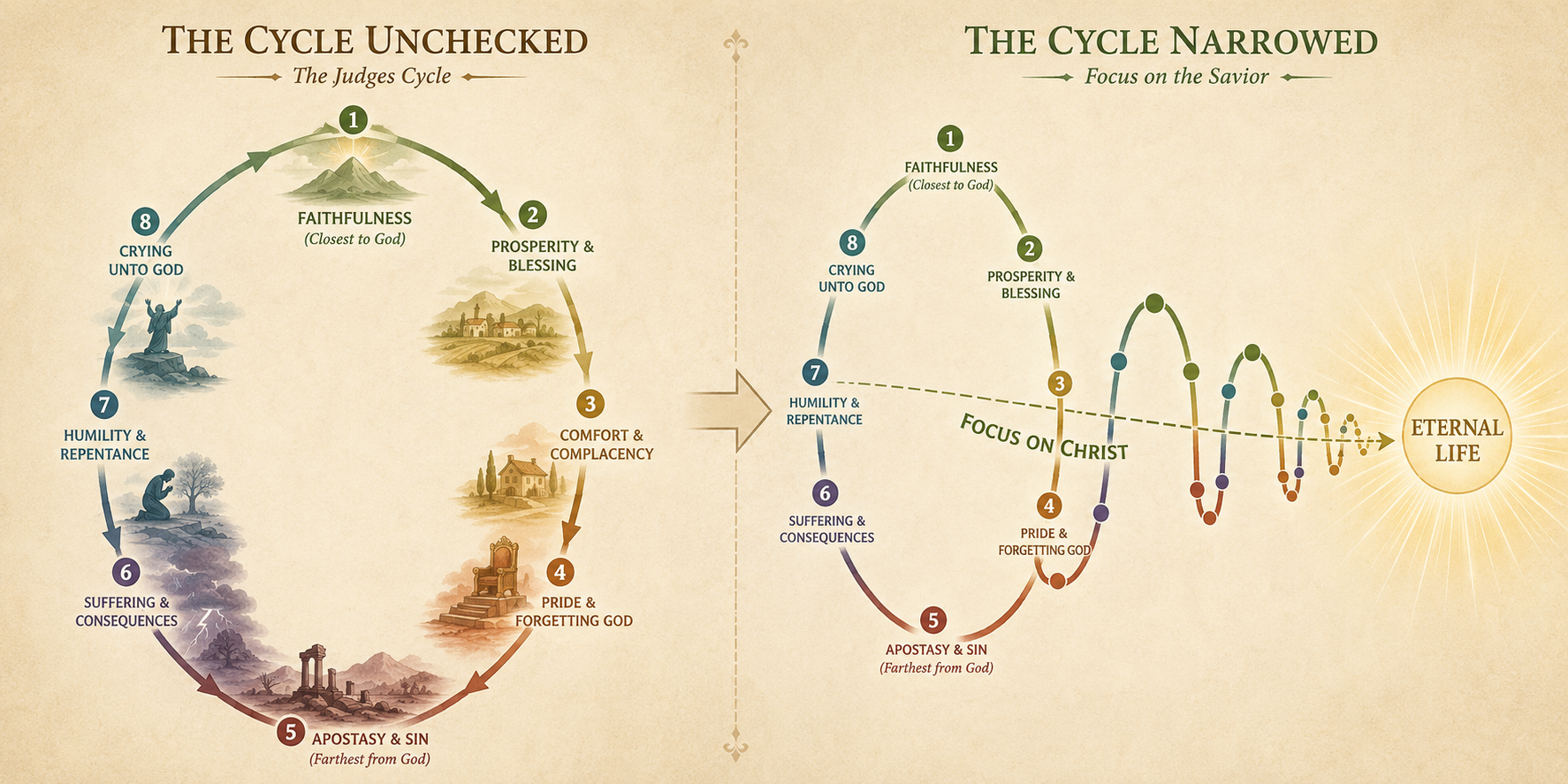
The goal is not to pretend the cycle does not exist. It is as constant as the seasons. The goal is to narrow it. Think of how light behaves: ordinary light scatters in every direction, its energy diffused. But when light is focused — trained, disciplined, aligned — it becomes a laser: coherent, precise, powerful enough to cut through anything. The wide pendulum swings of the Judges cycle — apostasy, suffering, repentance, deliverance, apostasy again — are scattered light. A life centered on the Savior does not eliminate the oscillation, but it hones it. The swings narrow. The recovery comes faster. The focus sharpens. Over time, what was a wild pendulum becomes something closer to a steady beam aimed at the target — eternal life and exaltation in the celestial kingdom. Jesus Christ is the guide to that destination. By focusing on Him — the “straight and narrow way” (2 Nephi 31:18) — the eye of the needle becomes possible.
The question for every generation — and every day: Joshua’s challenge at Shechem — “choose you this day whom ye will serve” — is not a historical relic. It is the question every covenant person must answer, in every generation, in every promised land, and on every ordinary morning. The Judges cycle shows what happens when the answer is delayed, diluted, or delegated to culture rather than conviction. The laser shows what happens when it is given daily, deliberately, and without reservation.
Key Scriptures
- 1 Nephi 17:32–38 — Nephi’s argument: the Canaanite conquest as theological principle
- 1 Nephi 2:20 — The conditional promised land covenant
- Joshua 24:15 — “Choose you this day whom ye will serve”
- Joshua 2:9–11 — Rahab’s confession of faith
- Deuteronomy 7:1–6 — The cherem command and the seven nations
- Leviticus 18:28 — The land spues out the wicked — including Israel
- Matthew 1:5 — Rahab in the genealogy of Christ
- Mosiah 2–5 — King Benjamin’s covenant renewal (parallel to Joshua 24)
Sources
Rahab and the Zonah Question:
- Josephus, Antiquities of the Jews 5.1.2 — Identifies Rahab as an innkeeper rather than a prostitute.
- Rashi (Rabbi Shlomo Yitzchaki), commentary on Joshua 2:1 — Interprets zonah as a woman who sells food (mazon), i.e. an innkeeper.
- Biblical Archaeology Society — “Rahab the Harlot?” — Scholarly discussion of the linguistic ambiguity of z-n-h (prostitute vs. provider of food/lodging) and the archaeological evidence for Rahab’s house in the casemate wall.
- Robert G. Boling, Joshua (Anchor Bible Commentary, Doubleday, 1982) — Notes that inns and brothels often occupied the same establishment in the ancient Near East; Rahab’s location was ideal for intelligence-gathering.
Women’s Social Status in the Ancient Near East:
- Carol Meyers, Rediscovering Eve: Ancient Israelite Women in Context (Oxford University Press, 2013) — Reassesses women’s economic and social roles in ancient Israel and Canaan beyond the legal restrictions of the text.
- Lynne Hilton Wilson, Handmaidens, Harems, and Heroines (Scripture Central, 2026) — Video series exploring women in the Old Testament, including Rahab’s story in its full ancient context.