The Amarna Age
What the diplomatic mail of a fading empire reveals about Canaan on the eve of Israel’s arrival
In 1887, a woman digging for fertilizer in the ruins of an ancient Egyptian city found a cache of clay tablets inscribed with wedge-shaped marks. She had stumbled onto the diplomatic archive of Pharaoh Akhenaten (reigned c. 1353–1336 BC) — 382 tablets that preserve the most detailed picture we have of Canaan in the century before Israel’s emergence.
The site was Tell el-Amarna, the ruins of Akhetaten, the short-lived capital Akhenaten had built for his new solar religion. The tablets — now known as the Amarna Letters — are correspondence between the Egyptian court and its network of vassal kings and allied great powers. Most are written in Akkadian cuneiform, the diplomatic lingua franca of the Late Bronze Age, though many of the Canaanite letters contain “Canaanisms” — local words and grammar showing through the Akkadian veneer.
These letters do not mention Israel, Moses, or the Exodus. But they illuminate the world that Israel entered — a world of petty rivalries, Egyptian exploitation, desperate vassal kings, and a mysterious group called the Habiru who have provoked one of the longest-running debates in biblical scholarship.
The International System
The Amarna Letters reveal two tiers of correspondence reflecting the power structure of the Late Bronze Age world:
Great Power Diplomacy
A small number of letters (about 40) are exchanges between Egypt and its peer states — the “Great Kings” who addressed each other as “brother.” These were the superpowers of the age:
- Hatti (the Hittite Empire, based in central Anatolia)
- Babylonia (Kassite dynasty in southern Mesopotamia)
- Mitanni (Hurrian kingdom in northern Mesopotamia and Syria)
- Assyria (rising power in northern Mesopotamia)
- Alashiya (Cyprus)
These letters discuss marriage alliances, gold shipments, trade disputes, and status negotiations. The tone is formal but frequently testy — Babylonian kings complain that Egypt sent too little gold; Hittite kings demand respect as equals.
Vassal Correspondence
The majority of the letters (over 300) are from Canaan — from the rulers of the city-states that constituted Egypt’s Levantine vassals. These letters are radically different in tone. Where the Great Kings address Pharaoh as “brother,” the Canaanite vassals prostrate themselves:
“To the king, my lord, my Sun, my god, the Sun from the sky: Message of Rib-Hadda, your servant, the dust at your feet. I fall at the feet of my lord, my Sun, my god, the Sun from the sky, seven times and seven times, on the stomach and on the back.”
— EA 108 (Rib-Hadda of Byblos to Pharaoh; Moran, Amarna Letters, 1992)
The formulaic groveling is extreme — but it reflects a real power relationship. Canaan’s city-state kings ruled at Egypt’s pleasure. They collected tribute, maintained order, and supplied corvée labor for Egyptian projects. In exchange, they received Egyptian military protection — theoretically.
Egyptian Control of Canaan
The Amarna Letters reveal how Egypt controlled Canaan without permanent colonization. The system had several components:
| Mechanism | How It Worked |
|---|---|
| Vassal kings | Local rulers kept their thrones but swore loyalty to Pharaoh. They were required to send tribute, supply labor, and obey Egyptian directives. Egypt confirmed (or installed) their succession. |
| Egyptian commissioners (rabisu) | Egyptian officials stationed in key cities monitored the vassal kings. The letters reference commissioners in Gaza, Sumur, and Kumidi. Vassal kings both feared and courted them. |
| Garrison troops | Small Egyptian garrisons were stationed at strategic locations. Vassal kings constantly begged for more troops — “send fifty men!” or even “send ten men!” — suggesting the garrisons were chronically undermanned. |
| Divide and rule | Egypt kept Canaanite city-states small and competitive. No vassal was allowed to grow strong enough to challenge Egyptian control. The constant inter-city rivalries documented in the letters served Egyptian interests. |
| Tribute and corvée | Vassal kings were required to send regular tribute (agricultural products, luxury goods) and supply forced labor for Egyptian building projects. This economic extraction was a constant drain on Canaanite cities. |
The system worked — until it didn’t. The letters reveal growing signs of strain: vassal kings who stop sending tribute, cities that switch allegiance to the Hittites, territories lost to the Habiru. Egypt’s grip on Canaan was loosening even as the letters were being written.
Voices from the Letters
The Amarna Letters are not dry bureaucratic records. They are the voices of real people in crisis — pleading, accusing, lying, and desperately trying to hold onto power. Two correspondents stand out.
Rib-Hadda of Byblos
Rib-Hadda, ruler of Byblos (see Section 05), is the most prolific correspondent in the archive — at least 68 letters, more than any other vassal. His letters are an escalating cry for help as his territory is swallowed by rivals and Habiru bands:
“Why have you sat and done nothing, so that the ‘Apiru dog takes your cities?… All my cities have been taken. I have no city left. Byblos alone remains, and now they are trying to take Byblos too.”
— EA 91 (Rib-Hadda of Byblos; Moran, Amarna Letters, 1992)
Rib-Hadda’s chief antagonist was Abdi-Ashirta (and later his son Aziru), rulers of the Amurru region in the northern Lebanese mountains, who systematically expanded at Byblos’s expense while professing loyalty to Egypt. Rib-Hadda accused them of allying with the Habiru, of murdering loyal vassals, and of secretly dealing with the Hittites — charges that were probably accurate. Egypt sent no meaningful help. Rib-Hadda was eventually overthrown by his own brother and likely killed. His letters are a firsthand document of imperial abandonment.
Abdi-Heba of Jerusalem
Six letters from Abdi-Heba, ruler of Jerusalem (Urusalim), provide a rare window into the pre-Israelite city that would become David’s capital.
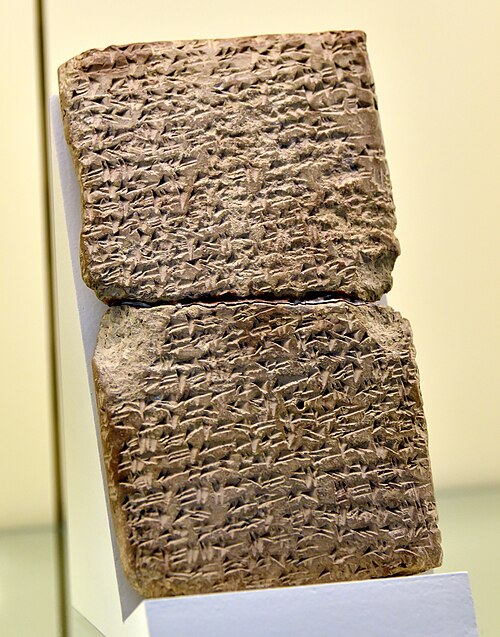
Abdi-Heba’s name is itself revealing: it combines a Semitic element (Abdi — “servant of”) with a Hurrian deity name (Heba — the Hurrian goddess Hepat). This mixed-language name reflects the cosmopolitan character of Canaanite cities — a Semitic ruler bearing a name honoring a non-Semitic goddess in a city that would later become the center of YHWH worship.
“Lost are the lands of the king. Do you not hear me? All the rulers are lost; the king, my lord, does not have a single ruler left. Let the king send troops. The king has no lands left. The ‘Apiru plunder all the lands of the king. If archers are here this year, the lands of the king, my lord, will remain. But if archers are not here, the lands of the king, my lord, are lost.”
— EA 286 (Abdi-Heba of Jerusalem; Moran, Amarna Letters, 1992)
Abdi-Heba also makes a striking claim about his own authority: “Neither my father nor my mother set me in this place. The strong arm of the king installed me” (EA 286). Unlike other vassal kings who inherited their thrones, Abdi-Heba claimed to rule solely by Pharaoh’s appointment — suggesting Jerusalem had a different political status within the Egyptian system.
Like Rib-Hadda, Abdi-Heba accuses his neighbors of treachery. He names specific cities that have defected to the Habiru: “the lands of Shechem and the lands up to the town of Gezer” (EA 290). He claims the central hill country is being lost while Egypt does nothing. The picture is one of Egyptian control disintegrating city by city.
The Habiru Question
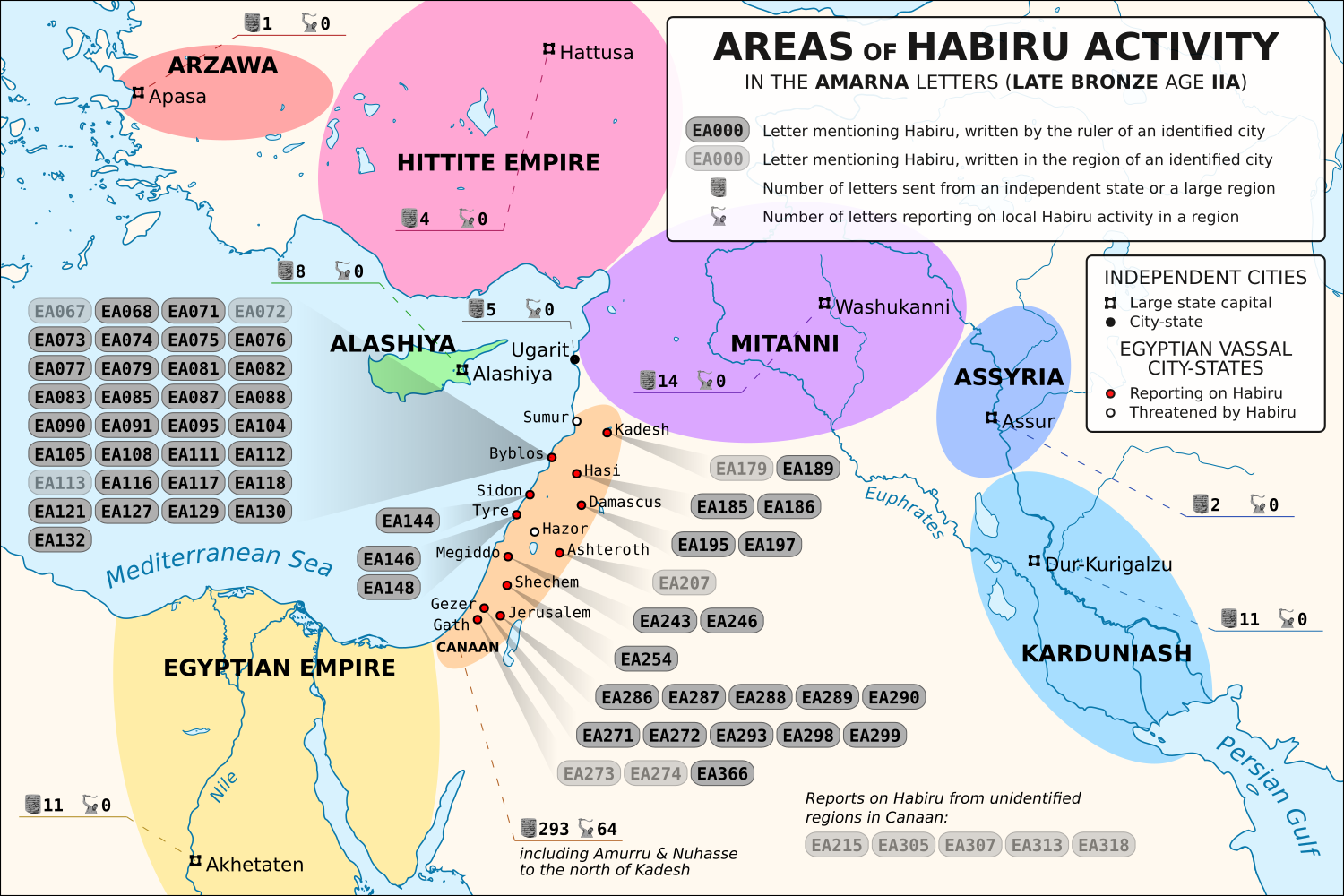
No topic in the Amarna Letters has generated more scholarly debate than the identity of the Habiru (also written ’Apiru in the letters).
The similarity to “Hebrew” (’Ivri / עִבְרִי) is immediately striking. Multiple Amarna Letters describe the Habiru as a disruptive force in Canaan — raiding, seizing cities, destabilizing the Egyptian vassal system. Abdi-Heba complains that the Habiru are taking over the highlands. The chronological overlap (14th century BC) with some proposed dates for the Israelite settlement adds to the apparent connection.
The temptation to equate Habiru with “Hebrews” — and to read the Amarna Letters as a Canaanite-eye view of the Israelite conquest — has been irresistible to some scholars and popular writers. But the evidence tells a more complicated story.
What the Evidence Shows
| Habiru = Hebrews? | The Evidence |
|---|---|
| For the connection | Phonetic similarity (Habiru / ’Ivri). Both terms describe outsiders/marginalized groups. The Habiru are active in precisely the areas where Israel later settled (central highlands). The timing is broadly compatible with some chronologies of the Israelite settlement. |
| Against the equation | The term Habiru/’Apiru appears in texts from across the ancient Near East — Mesopotamia, Egypt, Anatolia, Syria — spanning nearly a thousand years (c. 2000–1200 BC). It cannot refer to a single ethnic group. The Habiru in different texts include Semites, Hurrians, and others. The term appears to describe a social class — displaced people, refugees, mercenaries, bandits, people who have fallen outside the established social order — rather than an ethnic or national group. |
The scholarly consensus (to the extent one exists) is that the Habiru of the Amarna Letters are not the Israelites — but the terms may share a common origin. “Hebrew” in the Bible is used most often by foreigners to describe Israelites, or by Israelites when speaking to foreigners (e.g., Genesis 14:13, “Abram the Hebrew”; Exodus 2:6, “This is one of the Hebrews’ children”). Both terms may reflect an outsider’s label for people who do not fit the established social order. The early Israelites, settling in the highlands as newcomers without city-states, could easily have been classified as Habiru by the existing Canaanite power structure — without the Habiru as a whole being Israelite.
Put differently: all early Israelites may have been Habiru in the eyes of the Canaanite city-state system, but not all Habiru were Israelites.
What the Letters Reveal About the City-State System
Beyond the specific dramas of Rib-Hadda and Abdi-Heba, the Amarna Letters collectively paint a vivid picture of how Canaan functioned as a political landscape — the same landscape described from an archaeological perspective in Section 03.
Fragmentation
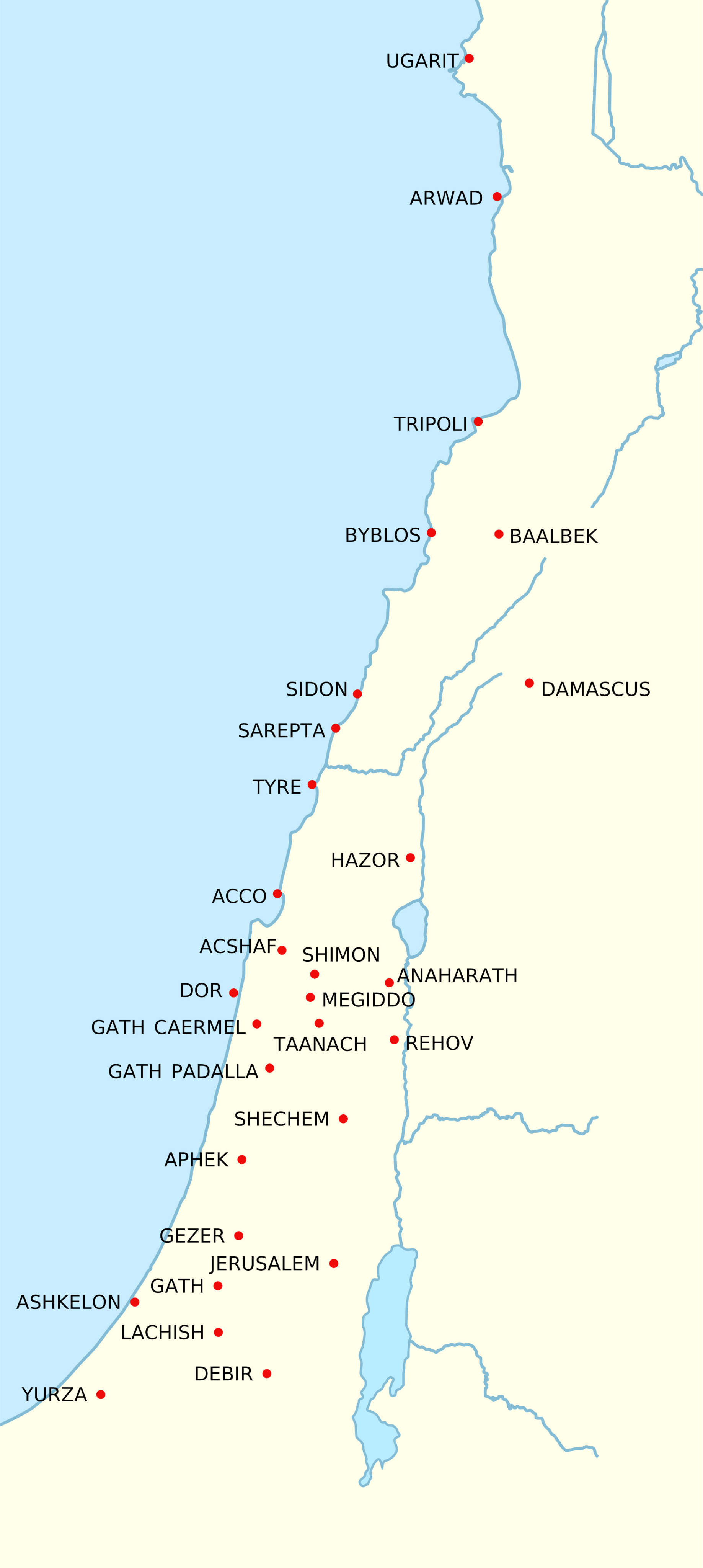
Canaan was not a country. The letters come from dozens of independent city-states, each controlling only a few square miles. The letters from the south alone include rulers from Jerusalem, Gezer, Lachish, Shechem, Megiddo, and others — each operating independently, each suspicious of the others.
Chronic Warfare
The vassal kings spent more energy fighting each other than confronting external threats. Lab’ayu of Shechem expanded aggressively into the central highlands; his neighbors accused him of allying with the Habiru and betraying Egypt. Milkilu of Gezer was accused of similar treachery. The letters are filled with accusations, denials, and counter-accusations — a world of shifting alliances and endemic conflict.
The Shechem Factor
Lab’ayu of Shechem is one of the most fascinating figures in the archive. His territory in the central hill country — the same region where Israel later concentrated — expanded dramatically. Other vassal kings accused him of giving land to the Habiru, of threatening Jerusalem and the coastal cities, and of effectively seceding from Egyptian control. Lab’ayu was eventually killed (possibly by Egypt’s order), but his sons continued the independent course.
That Shechem was the site where Joshua later renewed the covenant with all Israel (Joshua 24:1) and where the tribes gathered after Solomon’s death (1 Kings 12:1) may not be coincidental. The Amarna Letters suggest that Shechem already had a tradition of independence from outside control — a character that persisted into the Israelite period (see Section 07).
Egyptian Indifference
Perhaps the most revealing aspect of the letters is what Egypt did not do. The vassal kings begged for help — and Egypt largely ignored them. Akhenaten was consumed with his religious revolution and his new capital. The garrison troops that did exist were minimal. Egypt collected tribute but provided little in return.
This pattern matters for understanding what Israel entered. By the time of the Israelite settlement (whether one dates it to the 15th or 13th century BC), Egypt’s hold on Canaan had been weakening for generations. The power vacuum that allowed Israel to establish itself in the highlands was not a sudden event but a slow erosion — documented, letter by letter, in the Amarna archive.
The Amarna Letters and the Biblical Narrative
The Amarna Letters do not confirm the biblical conquest narrative — but they illuminate the world in which that narrative is set. Several points of contact deserve attention:
- The city-state system: The political fragmentation described in the letters matches the biblical picture of Canaan as a patchwork of independent cities, each with its own king. Joshua’s campaigns were not against a unified nation but against coalitions of city-state rulers — exactly the political landscape the letters describe.
- Jerusalem as a small highland city: Abdi-Heba’s letters show Jerusalem as a minor city with limited territory and few troops — consistent with the biblical picture of a city that remained independent (as Jebusite) until David captured it centuries later (2 Samuel 5:6–7).
- Highland instability: The letters describe the central highlands as the region most vulnerable to Habiru disruption and least controlled by Egypt — precisely the area where Israel settled.
- Shechem’s independence: Lab’ayu’s expansion around Shechem prefigures the city’s later importance in Israelite history.
- Egyptian withdrawal: The gradual erosion of Egyptian control documented in the letters created the conditions that made Israelite settlement possible — whether one understands that settlement as conquest, infiltration, or internal revolution.
A note on dating: The Amarna Letters date to approximately 1350–1330 BC. The date of the Israelite settlement is debated: a “late date” places the Exodus around 1250 BC and the settlement around 1200 BC; an “early date” places the Exodus around 1446 BC and the settlement around 1400 BC. Under the early chronology, the Amarna Letters would overlap with the period of Israelite entry into Canaan. Under the late chronology, they predate it by about a century. Either way, the letters describe the conditions — fragmented, Egyptian-dominated, chronically unstable — that characterized the land Israel entered.
Reading the Letters Today
The Amarna Letters are a reminder that the biblical narrative did not unfold in a vacuum. The land of Canaan was embedded in an international system of great powers, trade networks, and diplomatic protocol. The vassal kings whose desperate letters fill the archive were real people governing real cities — cities that Israel would later inhabit, conquer, or absorb.
When Abdi-Heba of Jerusalem cried out for help against the Habiru seizing his territory, he was documenting the slow collapse of a political order. Whether or not the Habiru he feared were Israelites, the instability he described was the world into which Israel arrived. The God who promised Abraham “all the land which thou seest” (Genesis 13:15) was not offering a pristine wilderness. He was offering a contested corridor — fought over by empires, fragmented by rivalries, and slowly slipping from the grasp of a distracted Pharaoh.
The promise was never that the land would be empty. It was that it would be given.
Sources
The Amarna Letters:
- William L. Moran, The Amarna Letters (Johns Hopkins University Press, 1992) — The standard English translation. All letter excerpts in this section are drawn from Moran’s translations (EA numbers follow the standard catalogue established by J.A. Knudtzon, Die El-Amarna-Tafeln, 1915).
- Anson F. Rainey, The El-Amarna Correspondence: A New Edition of the Cuneiform Letters from the Site of El-Amarna (Brill, 2015) — Updated philological analysis with revised translations of key letters.
The Habiru Question:
- Moshe Greenberg, The Hab/piru (American Oriental Society, 1955) — The foundational study collecting all known references to Habiru/’Apiru across the ancient Near East.
- Nadav Na’aman, “The Habiru and the Hebrews: The Transfer of a Social Term to the Literary Sphere,” Journal of Near Eastern Studies 45 (1986) — Nuanced treatment of the relationship between the social category and the biblical term.
Canaanite Politics & Egyptian Control:
- Nadav Na’aman, Canaan in the Second Millennium B.C.E. (Eisenbrauns, 2005) — Political history of Canaan under Egyptian suzerainty.
- Amihai Mazar, Archaeology of the Land of the Bible, 10,000–586 BCE (Doubleday, 1990) — Archaeological context for the Amarna period in Canaan.
- Anson F. Rainey & R. Steven Notley, The Sacred Bridge: Carta’s Atlas of the Biblical World (Carta, 2nd ed. 2014) — Geographic analysis of Amarna-era territories and city-state boundaries.
Online Resources:
- World History Encyclopedia — Amarna Letters (CC BY-NC-SA 4.0)
- World History Encyclopedia — Amarna (CC BY-NC-SA 4.0)
Scripture Citations:
- Genesis 13:15; 14:13 | Exodus 2:6 | Joshua 24:1 | 2 Samuel 5:6–7 | 1 Kings 12:1