Israel Among the Nations
The conquest, the coexistence, the cycle — and the long struggle to remain a covenant people in a land that worshipped other gods
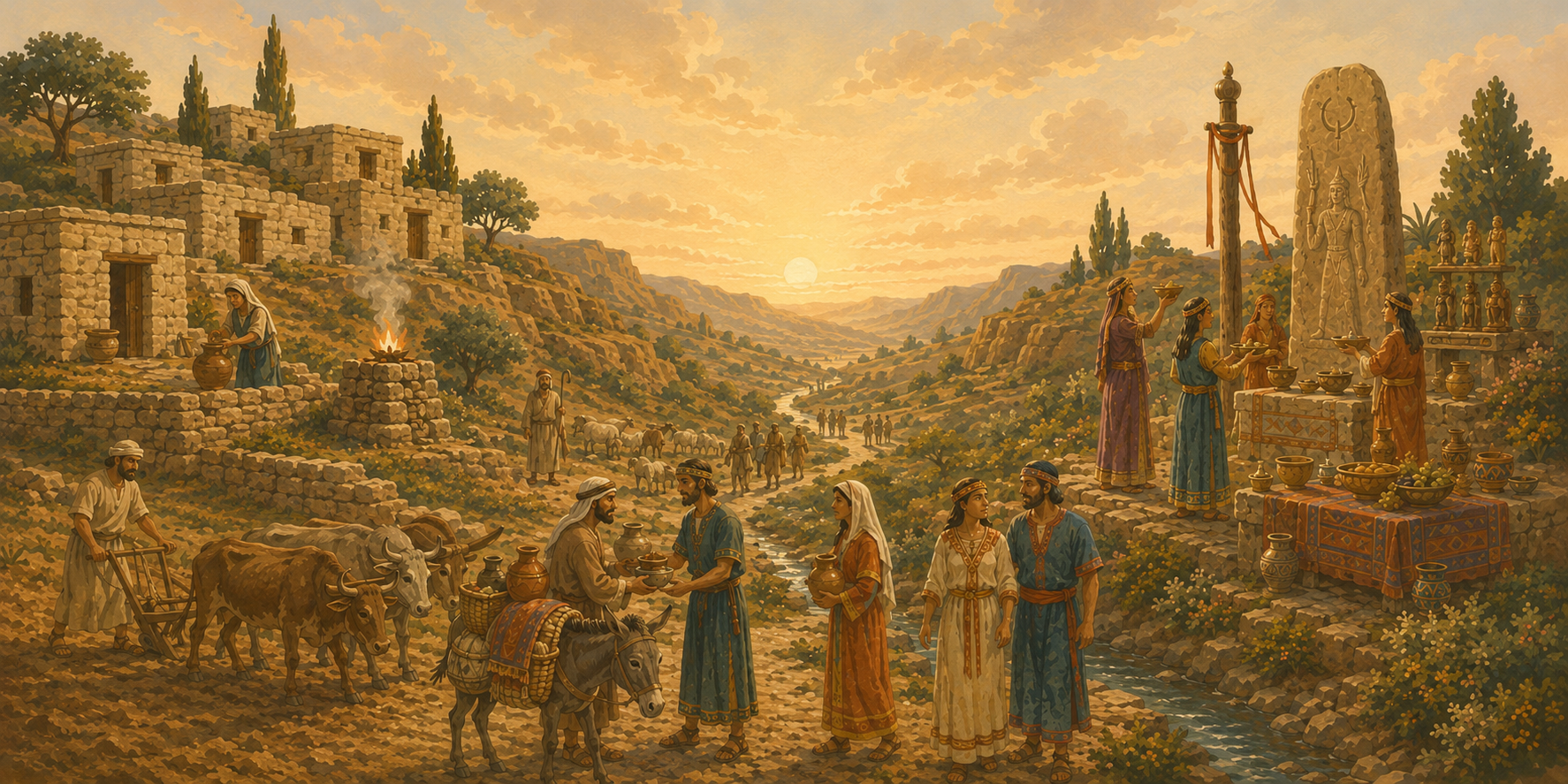
When Joshua led Israel across the Jordan, they were not entering empty land. Canaan was populated by city-states, each with its own king, its own walls, its own gods. The story that follows — spanning the books of Joshua and Judges — is not a simple tale of military victory. It is a story of partial conquest, uncomfortable coexistence, religious syncretism, and the repeated failure to become the people God had called them to be.
This section traces that story from the crossing of the Jordan through the end of the Judges period — approximately 1400–1050 BC by traditional chronology.
The Commission
Moses is gone — taken by the Lord (Moses 1:42; Deuteronomy 34:5–6). The generation that left Egypt has perished in the wilderness. And God speaks to Joshua the son of Nun with a charge that is both military and spiritual:
“Moses my servant is dead; now therefore arise, go over this Jordan, thou, and all this people, unto the land which I do give to them, even to the children of Israel. … Be strong and of a good courage: for unto this people shalt thou divide for an inheritance the land, which I sware unto their fathers to give them.” — Joshua 1:2, 6
The phrase “be strong and of a good courage” appears three times in Joshua 1 alone (vv. 6, 7, 9) — and each time the context shifts. The first is about military leadership. The second adds a condition: be courageous in keeping the law, “turn not from it to the right hand or to the left” (Joshua 1:7). The third is pure promise: “the LORD thy God is with thee whithersoever thou goest” (Joshua 1:9).
The book of Joshua, then, begins with a commission that is inseparable from covenant faithfulness. The land is given — but possessing it requires obedience.
The Conquest: What Joshua Accomplished
The early chapters of Joshua describe a series of dramatic military victories:
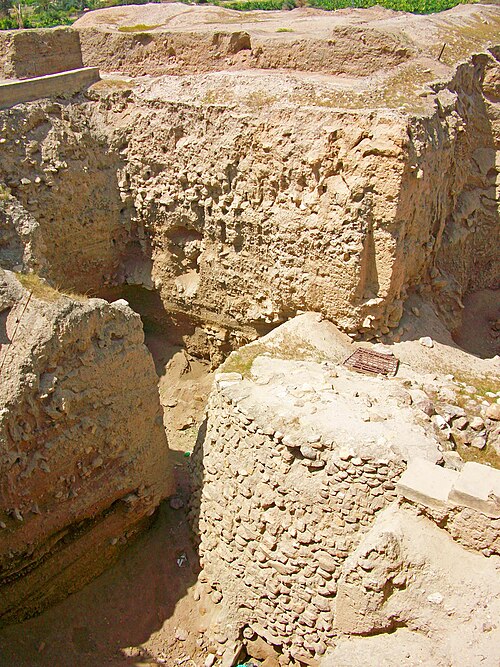
- Jericho (Joshua 6) — the walls fall after seven days of marching, with the ark of the covenant leading the procession. The victory is entirely God’s; Israel’s “weapon” is obedience.
- Ai (Joshua 7–8) — initial defeat because of Achan’s violation of the cherem (the ban), followed by victory after the sin is addressed. The lesson: covenant disobedience cancels divine protection.
- The southern campaign (Joshua 10) — a coalition of five kings defeated, with the famous episode of the sun standing still at Gibeon.
- The northern campaign (Joshua 11) — Hazor, the head of all those kingdoms, burned and conquered.
Joshua 11:23 summarizes: “So Joshua took the whole land, according to all that the LORD said unto Moses; and Joshua gave it for an inheritance unto Israel according to their divisions by their tribes. And the land rested from war.”
The Incomplete Possession
But the summary is more theological than geographical. Scattered throughout Joshua itself are admissions that the conquest was far from total:
| Passage | What Remained Unconquered |
|---|---|
| Joshua 13:1–6 | All the Philistine territories, Phoenician coast, Lebanese highlands |
| Joshua 15:63 | Jerusalem (Jebus) — “the children of Judah could not drive them out” |
| Joshua 16:10 | Gezer — Canaanites remained, put to forced labor |
| Joshua 17:12–13 | Beth-shean, Megiddo, Dor, and their villages — Manasseh could not drive them out |
| Judges 1:21–36 | A catalogue of failures — tribe after tribe unable or unwilling to complete the dispossession |
The result was not a clean boundary between “Israelite territory” and “Canaanite territory.” Instead, Israelites and Canaanites lived side by side — in the same valleys, sometimes in the same towns. Israel held the central hill country; the Canaanites retained the fortified lowland cities with their iron chariots (Judges 1:19). Jerusalem would not fall until David, centuries later.
Coexistence and Syncretism
Proximity made assimilation inevitable. Deuteronomy 7 had warned precisely against this:
“Neither shalt thou make marriages with them; thy daughter thou shalt not give unto his son, nor his daughter shalt thou take unto thy son. For they will turn away thy son from following me, that they may serve other gods.” — Deuteronomy 7:3–4
The fear was not ethnic but religious. Intermarriage would import the gods. And that is exactly what happened. Judges 3:5–6 states it bluntly: “And the children of Israel dwelt among the Canaanites, Hittites, and Amorites, and Perizzites, and Hivites, and Jebusites: and they took their daughters to be their wives, and gave their daughters to their sons, and served their gods.”
Syncretism in Canaan was not a dramatic apostasy — it was gradual absorption. Israelite farmers looked at their Canaanite neighbors' agricultural rituals and wondered: What if Baal really does control the rain? They didn’t necessarily abandon YHWH — they added Baal alongside Him. The prophets would later call this “limping between two opinions” (1 Kings 18:21).
Why Canaanite Religion Was Tempting
The practical appeal was real — Baal promised visible results for farmers who needed rain, and Canaanite worship offered the cultural normalcy of doing what everyone else did. But the deeper danger was that Canaanite religion was not foreign to Israel. It was disturbingly familiar.
The Canaanite pantheon was headed by a god named El — the same word Israel used for God. Canaanite worship featured sacrifice, temples, priesthoods, sacred festivals tied to the agricultural calendar, and covenant rituals. The vocabulary overlapped. The ritual forms echoed. For an Israelite farmer watching his Canaanite neighbor’s worship, the differences may have seemed like variations on a shared tradition rather than a fundamentally different religion.
From a Latter-day Saint perspective, this familiarity is not surprising. If the patriarchs — Abraham, Isaac, Jacob — worshipped the true God in Canaan for generations, then the religious traditions of the region would have carried fragments of that original worship. Over centuries without prophetic correction, those fragments corrupted into the Baal cult. This is the dispensational pattern: truth degrades without a prophetic anchor, producing traditions that are almost right — close enough to blend with covenant worship, close enough to make syncretism feel natural rather than apostate. It is the same pattern that required restoration through Abraham, through Moses, and ultimately through Joseph Smith. (For the full treatment of Canaanite religion and its relationship to YHWH worship, see Section 04: Ugarit & Canaanite Religion.)
The Cycle of the Judges
The book of Judges covers approximately 300 years of tribal confederation — before Israel had a king, before the Temple, before Jerusalem was the capital. The refrain says it all: “Every man did that which was right in his own eyes” (Judges 21:25).
The Pattern
The cycle repeats with mechanical precision (Judges 2:11–19):
| Step | What Happens |
|---|---|
| 1. Faithfulness | The shofet (שׁוֹפֵט) leads; Israel serves God |
| 2. The judge dies | Leadership vacuum; no dynasty, no succession |
| 3. Apostasy | “Did evil in the sight of the LORD, and served Baalim” |
| 4. Oppression | God “sold them” to surrounding enemies |
| 5. Crying out | Israel repents (at least outwardly) |
| 6. Deliverance | God raises up a shofet — a judge/deliverer |
| 7. Peace | “The land had rest” for a generation |
| 8. Repeat | …but worse each time |
The key verse: “And there arose another generation after them, which knew not the LORD, nor yet the works which he had done for Israel” (Judges 2:10). The failure was not just moral — it was generational. Each new generation had to be taught, and the teaching failed.
The Downward Spiral
The cycle doesn’t stay flat — it degenerates. Each judge is arguably worse than the last:
- Othniel (Judges 3:9–11) — a model judge, Caleb’s nephew, no recorded flaw
- Ehud (Judges 3:15–30) — clever but violent; assassinates the Moabite king with a hidden blade
- Deborah (Judges 4–5) — prophetess, judge, and commander; has to compensate for male failure when Barak refuses to go without her
- Gideon (Judges 6–8) — starts well (tears down Baal’s altar) but ends by making a golden ephod that becomes an idol
- Jephthah (Judges 11) — makes a rash vow with devastating consequences
- Samson (Judges 13–16) — maximum gifts, minimum character; violates every term of his Nazarite vow
By chapters 17–21, Israel is functionally indistinguishable from the Canaanites. The book ends with a Levite’s concubine dismembered, a civil war against Benjamin, and the kidnapping of women at Shiloh. The covenant people have become what they were sent to displace.
What Is a Shofet (שׁוֹפֵט)?
The English word “judge” is misleading. The Hebrew shofet (שׁוֹפֵט) in the book of Judges does not describe a courtroom official. These figures were charismatic military-political leaders raised up by God for specific crises. They resolved disputes (Deborah did this under her palm tree — Judges 4:5), but their primary function was deliverance: saving Israel from oppressors through God-empowered action.
Crucially, judges did not establish dynasties. Gideon explicitly refused kingship: “I will not rule over you … the LORD shall rule over you” (Judges 8:23). Their authority was personal and temporary — born from crisis, validated by victory, and gone when they died. This made every generational transition dangerous. Without a system for passing on both leadership and faith, the cycle was structurally inevitable.
Covenant Renewal at Shechem
Before the cycle began, Joshua made one last attempt to anchor the people. At Shechem — where Abraham had first received the promise (Genesis 12:6–7), where Jacob had buried foreign gods (Genesis 35:4) — Joshua gathered all the tribes for a covenant renewal ceremony:
“And if it seem evil unto you to serve the LORD, choose you this day whom ye will serve; whether the gods which your fathers served that were on the other side of the flood, or the gods of the Amorites, in whose land ye dwell: but as for me and my house, we will serve the LORD.” — Joshua 24:15
The covenant at Shechem followed a well-known ancient Near Eastern treaty pattern: a historical prologue recounting what the suzerain has done for the vassal (Joshua 24:2–13), stipulations (vv. 14–24), witnesses (v. 22 — “ye are witnesses against yourselves”), and a memorial stone (v. 27).
Joshua was pulling directly from Moses’ instruction at the end of Deuteronomy, where the terms and conditions of the Law are laid out in full. In Deuteronomy 27–30, Moses outlines the blessings that follow obedience and the consequences that follow rebellion — and then frames the entire covenant in language that deliberately echoes Eden: “I have set before thee this day life and good, and death and evil … therefore choose life, that both thou and thy seed may live” (Deuteronomy 30:15, 19). The vocabulary is identical to Genesis 2–3: good and evil (טוֹב וָרָע), life and death. The tree of the knowledge of good and evil presented Adam and Eve with the same fundamental choice — and the same consequences. Moses doesn’t name the tree, but he uses its language. Israel standing at the boundary of the promised land mirrors humanity standing before the tree: a choice placed before God’s people, with everything at stake. Joshua was not introducing something new at Shechem. He was calling Israel back to the choice Moses had already placed before them — the choice that has stood at the center of every covenant from Eden forward.
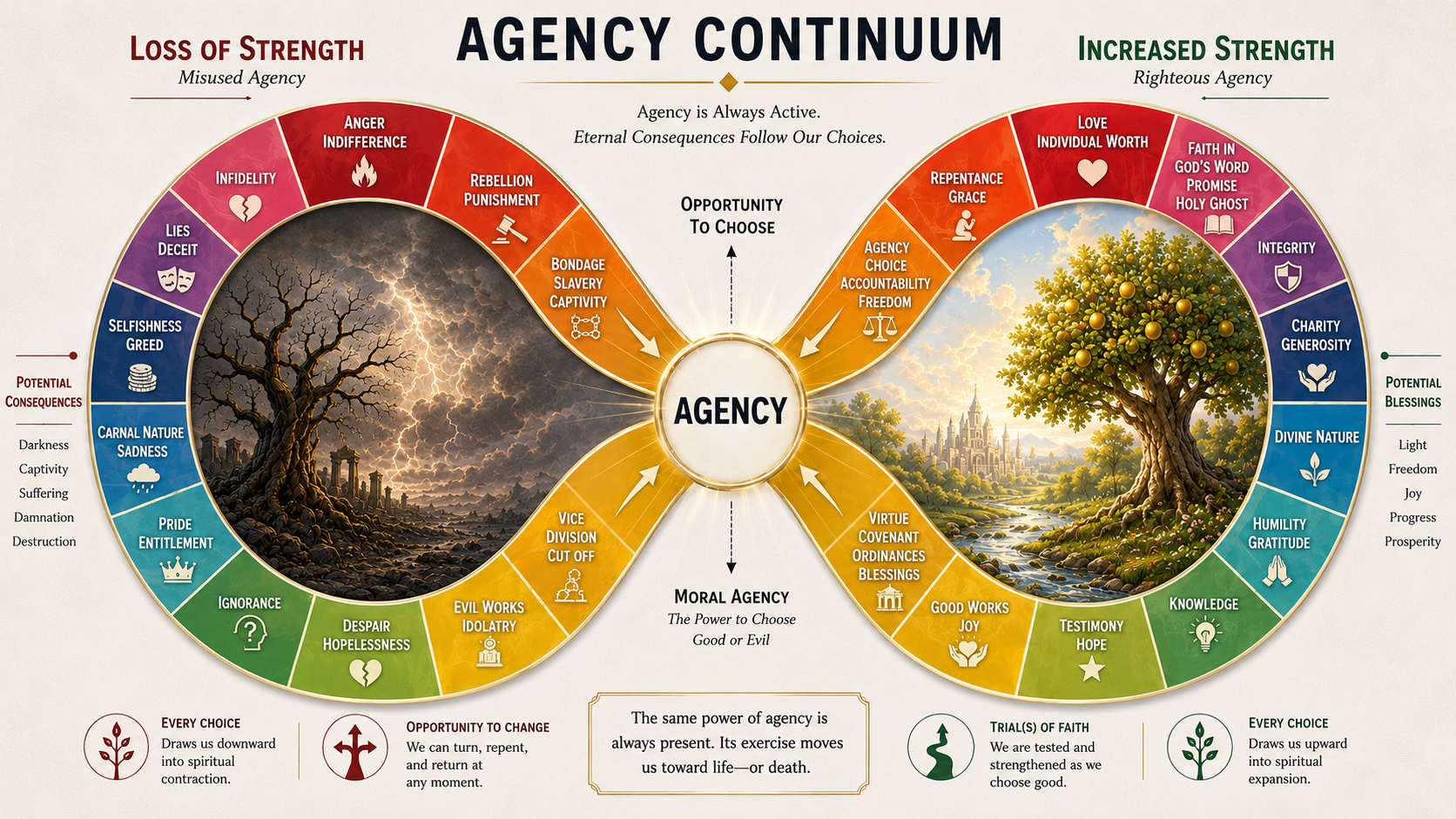
But Joshua’s most striking statement was his warning: “Ye cannot serve the LORD: for he is an holy God; he is a jealous God; he will not forgive your transgressions nor your sins” (Joshua 24:19). This was not pessimism — it was realism. Joshua knew what was coming. And the book of Judges proves him right.
The Theological Question
Why did God allow the incomplete conquest? Judges offers two answers, both operating simultaneously:
- As a test of faithfulness — “To prove Israel by them, whether they would keep the way of the LORD” (Judges 2:22)
- As military training — “That the generations of the children of Israel might know, to teach them war” (Judges 3:2)
The nations left in the land were not an accident — they were a curriculum. Israel was meant to learn faithfulness through opposition. Instead, they learned assimilation through convenience.
The pattern for every generation: The story of Joshua and Judges is not ancient history in the sense of being irrelevant. The same dynamic — covenant, prosperity, complacency, syncretism, loss, repentance, deliverance — repeats throughout scripture and is visible in every dispensation. The Judges cycle is the human condition, compressed into a narrative structure designed to make the pattern unmistakable.
Key Passages for Study
- Joshua 1:1–9 — The commission: “be strong and of a good courage”
- Deuteronomy 7:1–6 — The seven nations and the cherem command
- Joshua 13:1–6 — The land that remained unconquered
- Joshua 24:14–27 — Covenant renewal at Shechem
- Judges 2:10–19 — The apostasy cycle defined
- Judges 3:5–6 — Intermarriage and the adoption of foreign gods
- Judges 21:25 — “Every man did that which was right in his own eyes”