The Philistines
The Aegean warriors who settled on Canaan’s coast and became Israel’s defining rival
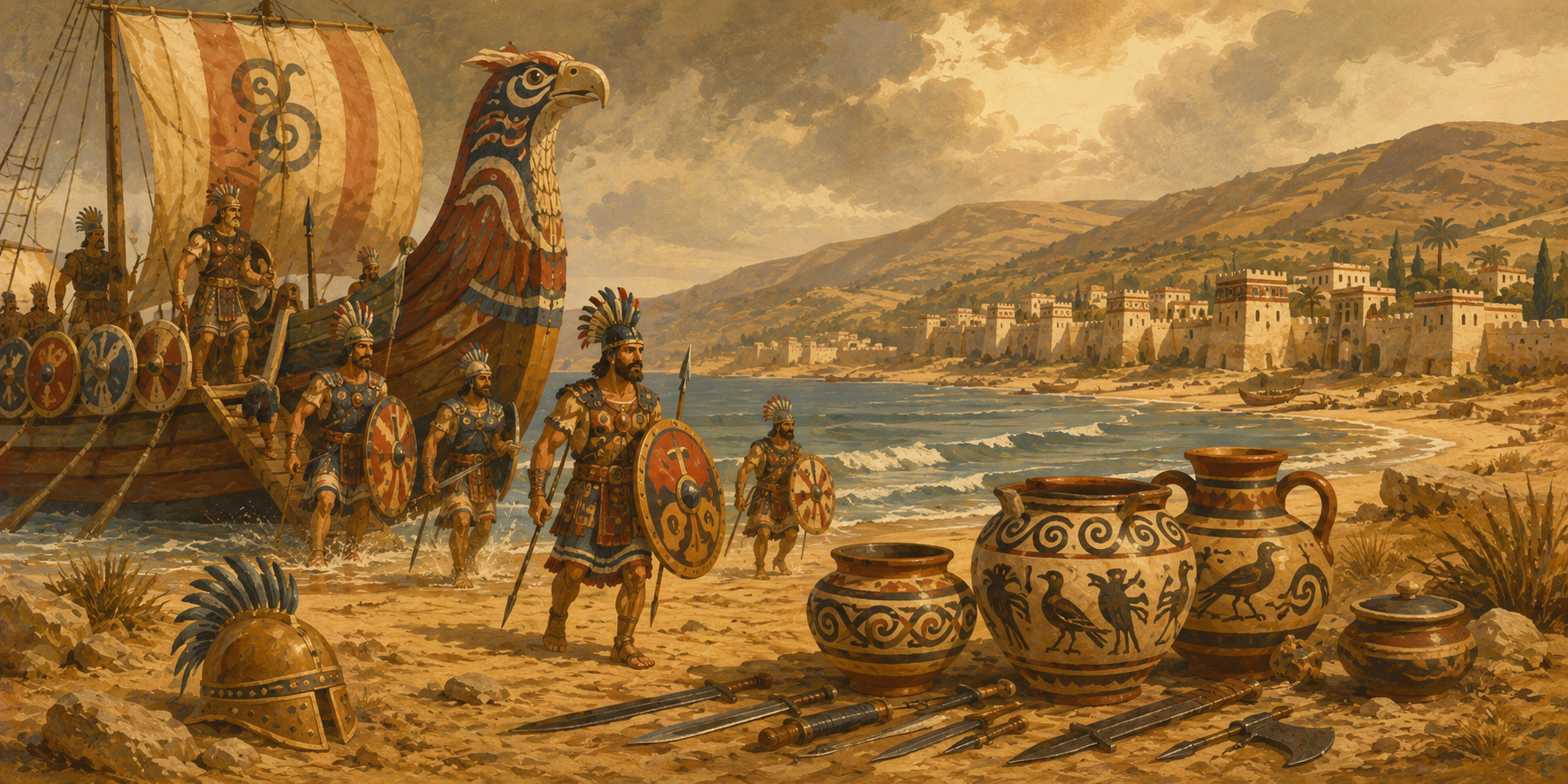
The Philistines were not Canaanites. They spoke a different language, worshipped different gods (at least initially), ate different food, built different pottery, and organized their cities differently. They arrived on the southern coast of Canaan around 1175 BC as part of the massive population upheaval known as the Sea Peoples migrations — and within a generation, they had established themselves as the most technologically advanced and militarily formidable power in the region.
For Israel, the Philistines were the enemy that forced a transformation. The tribal confederation that had survived the Judges period could not withstand Philistine military pressure. The demand for a king — “that we also may be like all the nations; and that our king may judge us, and go out before us, and fight our battles” (1 Samuel 8:20) — was driven in large part by the Philistine threat. The story of Israel from Samson through David is inseparable from the story of the Philistines.
The Sea Peoples
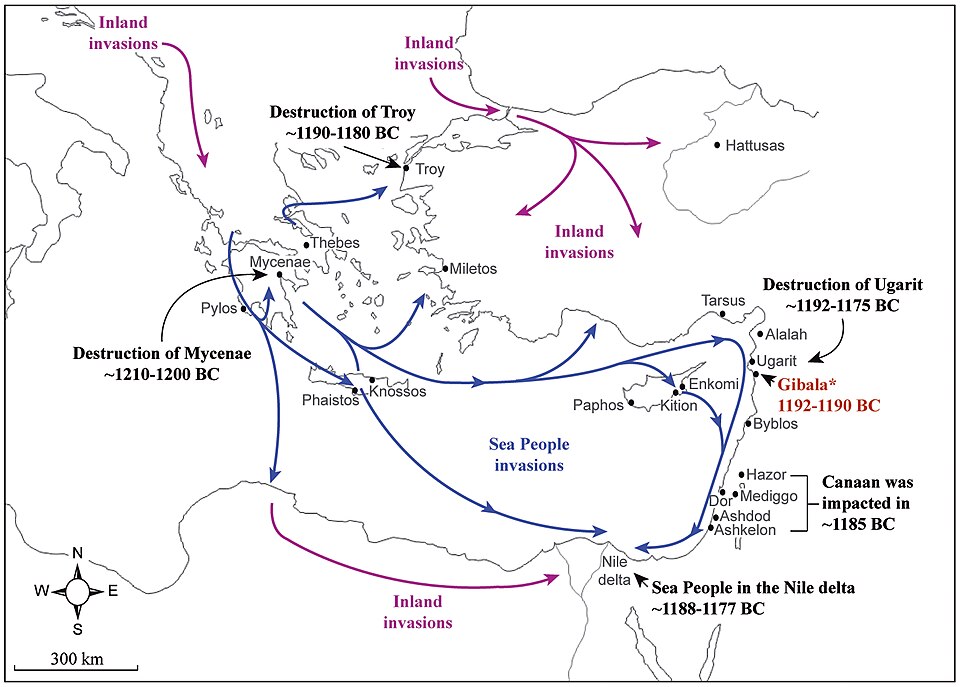
Around 1200 BC, the eastern Mediterranean world collapsed. The Hittite Empire fell. Ugarit was destroyed and never rebuilt (see Section 04). Mycenaean Greece fragmented. Egypt survived but was permanently weakened. The interconnected Bronze Age trade network that had linked these civilizations for centuries came apart in what Eric Cline has called “the worst disaster in ancient history, even more calamitous than the fall of the Roman Empire” (see Section 02 for the full Bronze Age Collapse narrative).
Into this vacuum came waves of migrating peoples whom the Egyptians called the “Sea Peoples.” The most detailed account comes from the mortuary temple of Pharaoh Ramesses III at Medinet Habu (c. 1178 BC), where wall reliefs and inscriptions describe a massive invasion by land and sea:
“The foreign countries made a conspiracy in their islands. All at once the lands were removed and scattered in the fray. No land could stand before their arms, from Hatti, Kode, Carchemish, Arzawa, and Alashiya on… They were coming forward toward Egypt, while the flame was prepared before them.”
— Medinet Habu inscription of Ramesses III
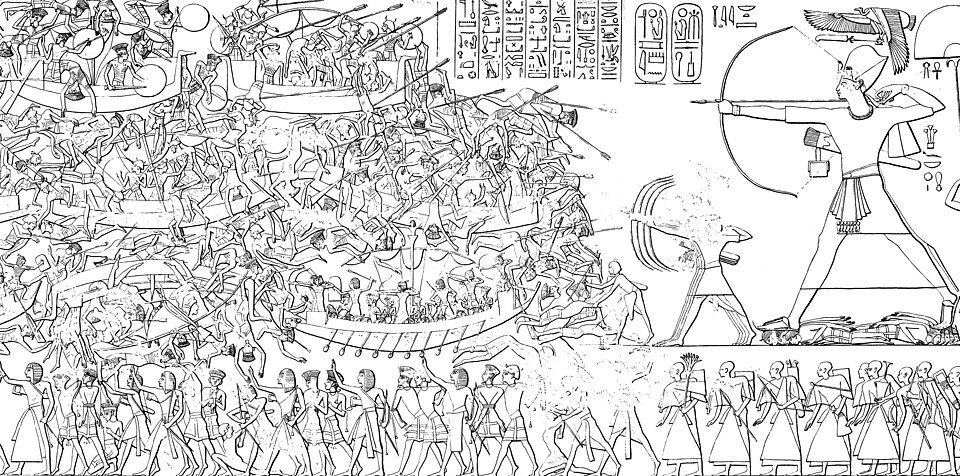
Ramesses III defeated the Sea Peoples in both a land battle in southern Canaan and a famous naval battle in the Nile Delta. But “defeated” is relative — Egypt could not push them back. Instead, the Peleset (Egyptian: P-r-s-t) were settled — whether by Egyptian policy or their own force — along the southern coastal plain of Canaan.
The Peleset are the Philistines.
Where Did They Come From?
The Bible itself preserves the answer: the Philistines came from Caphtor (כַּפְתּוֹר):
“Have not I brought up Israel out of the land of Egypt? and the Philistines from Caphtor, and the Syrians from Kir?”
— Amos 9:7
Caphtor is linguistically related to the Egyptian Keftiu — the same word used in Egyptian tomb paintings to describe Minoan/Aegean tribute bearers. Both names point to Crete and the Aegean world. Jeremiah similarly calls the Philistines “the remnant of the country of Caphtor” (Jeremiah 47:4).
Archaeology confirms the connection. Early Philistine pottery at Ekron, Ashkelon, and Ashdod is strikingly similar to Mycenaean IIIC:1b ware — a locally made version of Aegean pottery styles. Philistine dietary remains include pig bones in proportions unusual for Canaan but typical of the Aegean. Architectural features, including hearths and cultic installations, parallel Aegean models. DNA analysis from the Philistine cemetery at Ashkelon (published 2019) confirmed significant European-derived ancestry in the early Philistine population, with subsequent generations showing increasing local genetic admixture.
The Pentapolis
The Philistines organized themselves into a confederation of five cities — the Pentapolis — each ruled by a seren (סֶרֶן), a title with no Semitic etymology that may derive from the Greek tyrannos (τυραννος). The five seranim (lords) acted collectively on matters of war and policy — a form of governance fundamentally different from both the Canaanite city-state kingship and Israel’s tribal confederation.
| City | Location | Key Details |
|---|---|---|
| Gaza (עַזָּה) | Southernmost; on the Via Maris | The city where Samson was imprisoned and where he pulled down the temple of Dagon (Judges 16:21–30). Strategically vital as the gateway between Canaan and Egypt on the coastal trade route. |
| Ashkelon (אַשְׁקְלוֹן) | Coastal; major port | A major harbor city. Samson killed thirty men of Ashkelon to pay his wager (Judges 14:19). Excavations (Leon Levy Expedition, 1985–2016) revealed a Philistine cemetery with Aegean-style burial practices and the DNA evidence confirming European ancestry. |
| Ashdod (אַשְׁדּוֹד) | Inland from coast; between Ashkelon and Ekron | The city where the captured ark of the covenant was placed in the temple of Dagon — and Dagon fell on his face before it (1 Samuel 5:1–5). Excavations revealed distinctive Philistine pottery and a unique “Ashdoda” figurine — a female figure merged with a throne, reflecting Aegean artistic traditions. |
| Ekron (עֶקְרוֹן) | Inland; closest to Israelite territory | Identified with Tell Miqne, where excavations revealed the largest olive oil production facility in the ancient Near East (over 100 olive presses). A royal dedicatory inscription reading “the temple which he built, ’Ikausu [Achish] son of Padi, son of Ysd, son of Ada, son of Ya’ir, ruler of Ekron” confirmed the identification. The god Baal-zebub (“lord of the flies”) was associated with Ekron (2 Kings 1:2–3). |
| Gath (גַּת) | Inland; easternmost; at the edge of the Shephelah | Goliath’s city (1 Samuel 17:4). Identified with Tell es-Safi, where excavations by Aren Maeir have revealed the largest Philistine city yet discovered. David fled to Achish, king of Gath, when escaping Saul (1 Samuel 21:10; 27:2–4). Gath was destroyed by Hazael of Aram-Damascus (c. 830 BC) and never fully recovered. |
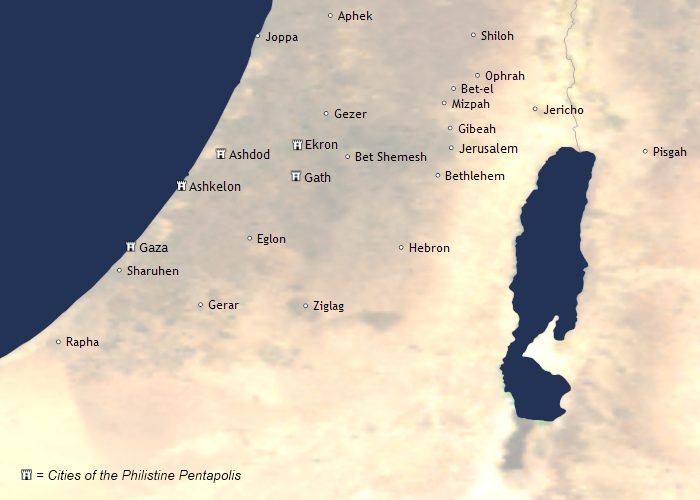
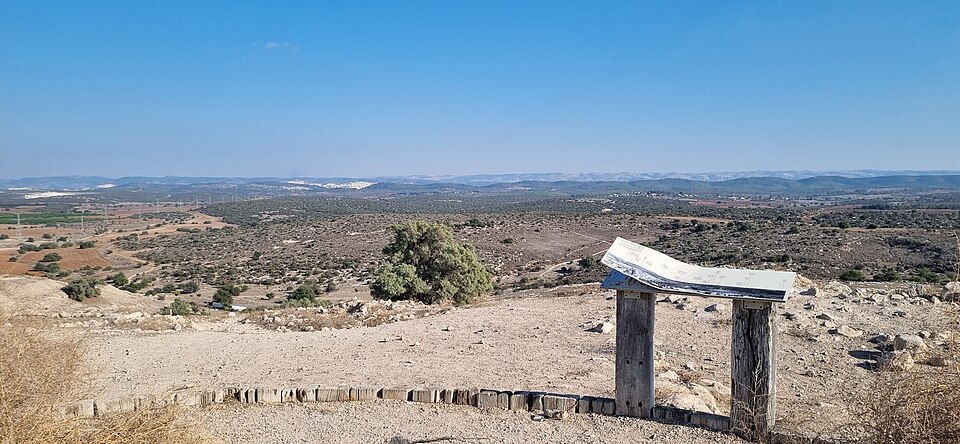
The Pentapolis controlled the southern coastal plain and the western Shephelah — precisely the lowland areas that Israel could not take during the incomplete conquest (see Section 03). The boundary between Philistine and Israelite territory ran through the Shephelah foothills — a contested frontier that produced many of the Bible’s most famous narratives.
Iron and Military Superiority
The Philistines possessed a critical technological advantage: iron-working.
The biblical text states this explicitly:
“Now there was no smith found throughout all the land of Israel: for the Philistines said, Lest the Hebrews make them swords or spears: But all the Israelites went down to the Philistines, to sharpen every man his share, and his coulter, and his axe, and his mattock.”
This was not merely a military advantage — it was economic control. By monopolizing iron-working, the Philistines made Israel dependent on them for agricultural tools as well as weapons. An Israelite farmer had to go to a Philistine smith to sharpen his plowshare.
Archaeological evidence from Philistine sites shows sophisticated metalworking from an early period. The Aegean world had begun experimenting with iron before the Bronze Age Collapse, and the Philistine settlers brought this knowledge with them. Iron ore was more widely available than the copper and tin required for bronze, but working it required higher temperatures and more advanced technique. The Philistines’ mastery of this technology gave them a decisive edge during the 12th–10th centuries BC.
Goliath’s equipment: The detailed description of Goliath’s armor in 1 Samuel 17:5–7 reads like a catalogue of Aegean military technology: a bronze helmet, a coat of scale armor (literally “a coat of mail of scales” — a type known from Mycenaean contexts), bronze greaves on his legs, and an iron spearhead weighing six hundred shekels. The description is archaeologically plausible for a heavily armed warrior of Aegean heritage — and entirely unlike anything an Israelite fighter would have carried.
Samson Through David: The Philistine Arc
The Philistine conflict defines the narrative arc from the late Judges period through the early monarchy. The escalation tells the story of Israel’s transformation:
Samson (Judges 13–16)
Samson operated in the border zone between Dan and Philistia — the contested Shephelah frontier. His story is one of individual, Spirit-empowered exploits against the Philistines: killing a lion, burning their fields, slaying a thousand with a jawbone. But Samson never led an army. His victories were personal and temporary.
Samson was a nazir (נָזִיר) — set apart from birth by divine vow (Judges 13:5). His uncut hair was not the source of his strength but the sign of his covenant — and when that sign was betrayed through Delilah, the Spirit departed (Judges 16:20). His final act — pulling down the temple of Dagon at Gaza — was both his greatest victory and his death. The Judges period ends as it began: with individual heroism that cannot solve the structural problem.
The Ark Crisis (1 Samuel 4–7)
The turning point. The Philistines defeated Israel at the battle of Aphek, capturing the ark of the covenant itself. Eli’s sons Hophni and Phinehas were killed; Eli collapsed and died upon hearing the news. The ark was taken to the temple of Dagon at Ashdod, where the idol fell before it — and plagues struck each Philistine city that housed it until the Philistines returned it on a new cart (1 Samuel 5–6).
The narrative makes a theological point: Israel’s God was not defeated even when Israel was. The ark did not need Israel’s army to demonstrate YHWH’s superiority over Dagon. But the military reality was devastating — the Philistines now controlled the central hill country approaches and had garrisons deep in Israelite territory.
Saul and Jonathan (1 Samuel 9–31)
The Philistine threat was the immediate catalyst for the monarchy. Samuel’s warning about kingship was given in the context of a people desperate for organized military leadership against Philistine pressure. Saul’s reign began with Philistine conflict (Jonathan’s attack on the Philistine garrison at Geba, 1 Samuel 13:3) and ended with it — Saul and Jonathan both died fighting the Philistines at Mount Gilboa (1 Samuel 31:1–6).
David (1 Samuel 17 — 2 Samuel 5)
David’s career is framed by the Philistines from beginning to end. His entry onto the national stage was the defeat of Goliath in the Valley of Elah (1 Samuel 17:49–50) — a contest between Aegean heavy infantry and an Israelite shepherd with a sling. His years as a fugitive included serving as a Philistine vassal under Achish of Gath (1 Samuel 27:2–7). His bodyguard included the Cherethites and Pelethites — almost certainly Philistine (Cretan) mercenaries (2 Samuel 8:18).
After becoming king, David defeated the Philistines decisively in two battles at the Valley of Rephaim (2 Samuel 5:17–25), breaking their power permanently. The Philistines never again threatened Israel’s existence — though they remained a regional presence for centuries.
David’s defeat of the Philistines also explains one of scripture’s most surprising alliances. The Phoenicians and the Philistines had been bitter commercial rivals — a conflict with roots stretching back to the Aegean trading wars between the Minoans and Mycenaeans. The Phoenicians had inherited the Minoan maritime tradition; the Philistines descended from the Mycenaean world that had displaced it. When David broke Philistine power on the southern coast, he eliminated the Phoenicians’ chief competitor. It is no coincidence that Hiram of Tyre immediately sent cedar, carpenters, and masons to build David a house (2 Samuel 5:11) — the enemy of his enemy had just become king of Israel.
Dagon and Philistine Religion
The Philistines arrived in Canaan with their own Aegean religious traditions, but they rapidly adopted Canaanite gods — most prominently Dagon (דָּגוֹן).
Dagon was not originally a Philistine deity. He was an ancient Semitic grain god worshipped across Mesopotamia and the Levant from at least the third millennium BC. At Ugarit, Baal is called “son of Dagan” (see Section 04). The Philistines adopted Dagon as their chief deity — an early example of the cultural assimilation that would eventually dissolve the Philistines as a distinct people.
Dagon temples are attested at Gaza (Judges 16:23–30) and Ashdod (1 Samuel 5:2–5). The popular identification of Dagon as a “fish god” (from Hebrew dag / דָּג — “fish”) is almost certainly a folk etymology. The name more likely derives from dagan (דָּגָן — “grain”), reflecting his agricultural character.
Other deities worshipped by the Philistines included:
- Ashtoreth (עַשְׁתָּרוֹת) — Saul’s armor was placed in “the house of Ashtaroth” after his death at Gilboa (1 Samuel 31:10)
- Baal-zebub (בַּעַל זְבוּב — “lord of the flies”) — the god of Ekron, consulted by King Ahaziah of Israel (2 Kings 1:2). The name is likely a deliberate Israelite distortion of Baal-zebul (“lord of the exalted dwelling”)
The pattern is clear: the Philistines arrived as Aegean foreigners but progressively adopted the Canaanite religious landscape. This cultural absorption worked in both directions — Philistine material culture influenced Israelite pottery and architecture in the border regions, while Canaanite language and religion gradually replaced Philistine originals.
Aegean Material Culture
Archaeology has vividly illustrated the Philistines’ Aegean origins through their material culture, especially in the earliest layers of settlement (12th–11th centuries BC):
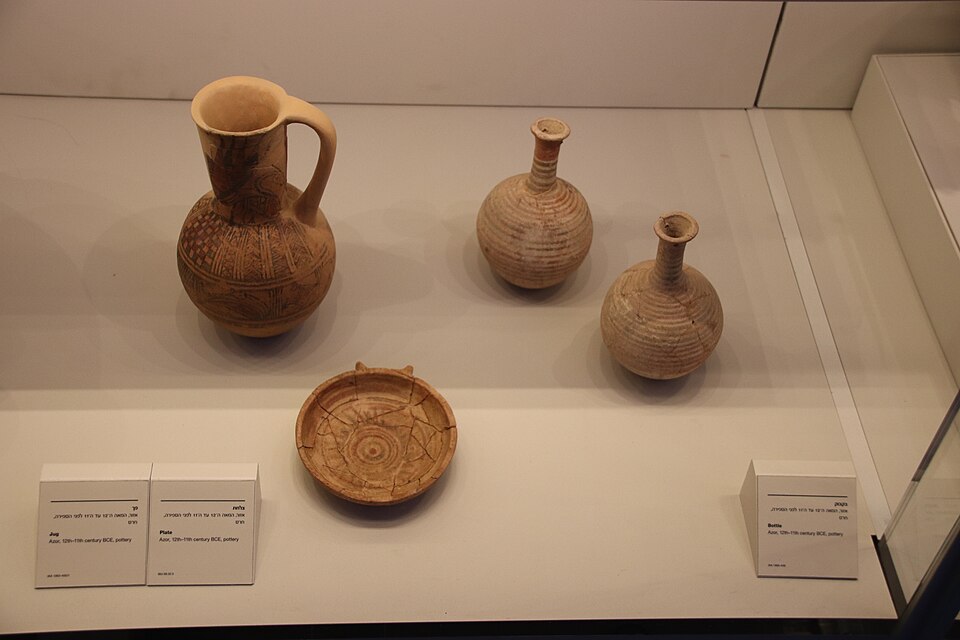
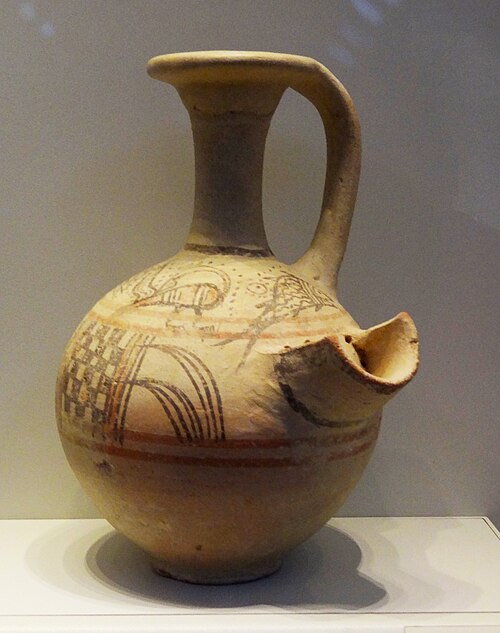
- Pottery: Early Philistine pottery (called “Philistine Bichrome Ware”) features distinctive red and black geometric decoration on white slip — spirals, birds, and fish motifs that derive from Mycenaean artistic traditions. This ware is found exclusively at Philistine sites and is the clearest archaeological marker of Philistine settlement.
- Dietary evidence: Pig bones constitute a significantly higher percentage of animal remains at Philistine sites than at contemporary Israelite or Canaanite sites. This difference aligns with Aegean dietary practices and contrasts sharply with the later Israelite prohibition on pork.
- Architecture: Early Philistine buildings include Aegean-style hearths (circular, plastered) that are unknown in Canaanite architecture. Temple architecture at Tell Qasile (near modern Tel Aviv) shows a distinctive plan with parallels in the Aegean.
- Loom weights: Philistine sites yield cylindrical loom weights typical of the Aegean, unlike the conical weights standard in Canaan — indicating that Philistine women brought their weaving traditions with them.
Over the 11th–10th centuries BC, these distinctive Aegean features gradually disappear. Philistine pottery becomes indistinguishable from local styles. Pig consumption declines. Architecture shifts to Levantine norms. The Philistines were being absorbed into the Canaanite cultural landscape — a process that was largely complete by the 9th century BC.
Assimilation and Legacy
The Philistines did not vanish in a single moment. After David broke their military power, they continued as a distinct group for centuries — mentioned in Assyrian records, referenced by later prophets, and maintaining their city identities. But culturally, they were increasingly indistinguishable from their Semitic neighbors.
By the 7th century BC, the Philistine cities were Assyrian vassals. Ekron’s royal inscription from this period is written in a Semitic language — the Philistines had adopted the language of Canaan. When Nebuchadnezzar destroyed the Philistine cities in 604 BC, the Philistine identity effectively ended.
Their most lasting legacy is, ironically, a name. The Romans, after crushing the Bar Kokhba revolt in 135 AD, renamed the province of Judaea as Syria Palaestina — derived from “Philistine” — deliberately erasing the Jewish connection to the land. The modern name “Palestine” preserves the name of a people who had ceased to exist more than seven hundred years before the Romans applied it.
Sources
Philistine Archaeology & History:
- Trude Dothan, The Philistines and Their Material Culture (Yale University Press, 1982) — The foundational archaeological study of Philistine material culture.
- Trude Dothan & Moshe Dothan, People of the Sea: The Search for the Philistines (Macmillan, 1992) — Accessible overview combining archaeological and textual evidence.
- Aren M. Maeir, ed., Tell es-Safi/Gath I: The 1996–2005 Seasons (Ägypten und Altes Testament 69, 2012) — Excavation reports from Gath.
- Assaf Yasur-Landau, The Philistines and Aegean Migration at the End of the Late Bronze Age (Cambridge University Press, 2010) — The most comprehensive treatment of Philistine origins and the Sea Peoples migration.
Sea Peoples & Bronze Age Collapse:
- Eric H. Cline, 1177 B.C.: The Year Civilization Collapsed (Princeton University Press, rev. ed. 2021) — The systems-collapse model for the end of the Bronze Age.
- Amihai Mazar, Archaeology of the Land of the Bible, 10,000–586 BCE (Doubleday, 1990) — Archaeological context for the Philistine settlement.
DNA & Bioarchaeology:
- Michal Feldman et al., “Ancient DNA sheds light on the genetic origins of early Iron Age Philistines,” Science Advances 5:7 (2019) — Genetic evidence for European ancestry in the founding Philistine population at Ashkelon.
Online Resources:
- World History Encyclopedia — Philistines (CC BY-NC-SA 4.0)
- World History Encyclopedia — Sea Peoples (CC BY-NC-SA 4.0)
Scripture Citations:
- Judges 13:5; 14:19; 16:20–30 | 1 Samuel 5–6; 8:20; 13:3, 19–21; 17:4–7, 49–50; 21:10; 27:2–7; 31:1–6, 10 | 2 Samuel 5:11, 17–25; 8:18 | 2 Kings 1:2–3 | Amos 9:7 | Jeremiah 47:4