The Phoenicians
The sea traders who spread the alphabet across the ancient world — and gave Israel both its Temple timber and its deadliest queen
The Phoenicians were never an empire. They built no palaces to rival Thebes, raised no armies to match Assyria, carved no monuments boasting of conquest. What they did was more lasting: they sailed farther than any people before them, built a commercial network that connected the entire ancient world, and carried alphabetic writing to every shore they touched.
They were Canaanites — culturally, linguistically, and religiously indistinguishable from the inland peoples described in Section 03. They never called themselves “Phoenician” — that was a Greek nickname (Phoinikes, Φοινικες, meaning “purple people”), a reference to the famous dye that was their most lucrative export. They called themselves Kena’ani (כְּנַעֲנִי) — Canaanites — or, more commonly, identified themselves by their home city: Tyrian, Sidonian, Gebalite (from Byblos/Gebal), much as a person from Europe identifies as French or German rather than “European.”
For Israel, the Phoenicians were both essential partners and dangerous influences. Hiram of Tyre supplied the cedar and craftsmen for Solomon’s Temple. Jezebel of Sidon imported the Baal cult that nearly destroyed YHWH worship in the northern kingdom. The same cities provided partners for both alliance and apostasy.
The Three Great Cities
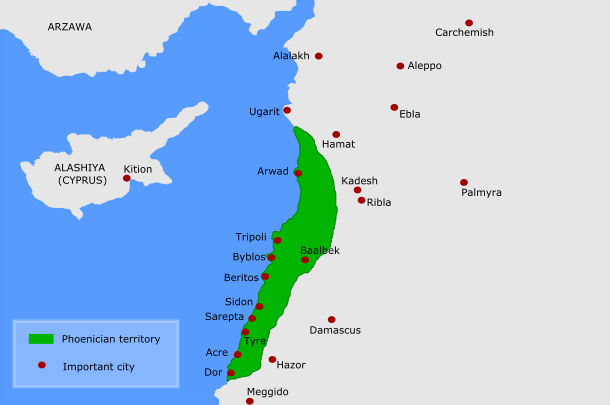
Phoenicia was not a nation but a string of independent city-states along a narrow coastal strip — roughly modern Lebanon, from Arwad in the north to Acco in the south. The geography dictated everything: a thin fertile plain, backed by the Lebanon mountains, facing the open sea. With limited farmland and timber-rich mountains behind them, the Phoenicians looked westward — and in doing so, became the bridge that connected the ancient East to the broader Mediterranean, merging cultures, languages, and economies across a world that had never been linked before.
Three cities dominated at different periods:
| City | Peak Period | Key Role |
|---|---|---|
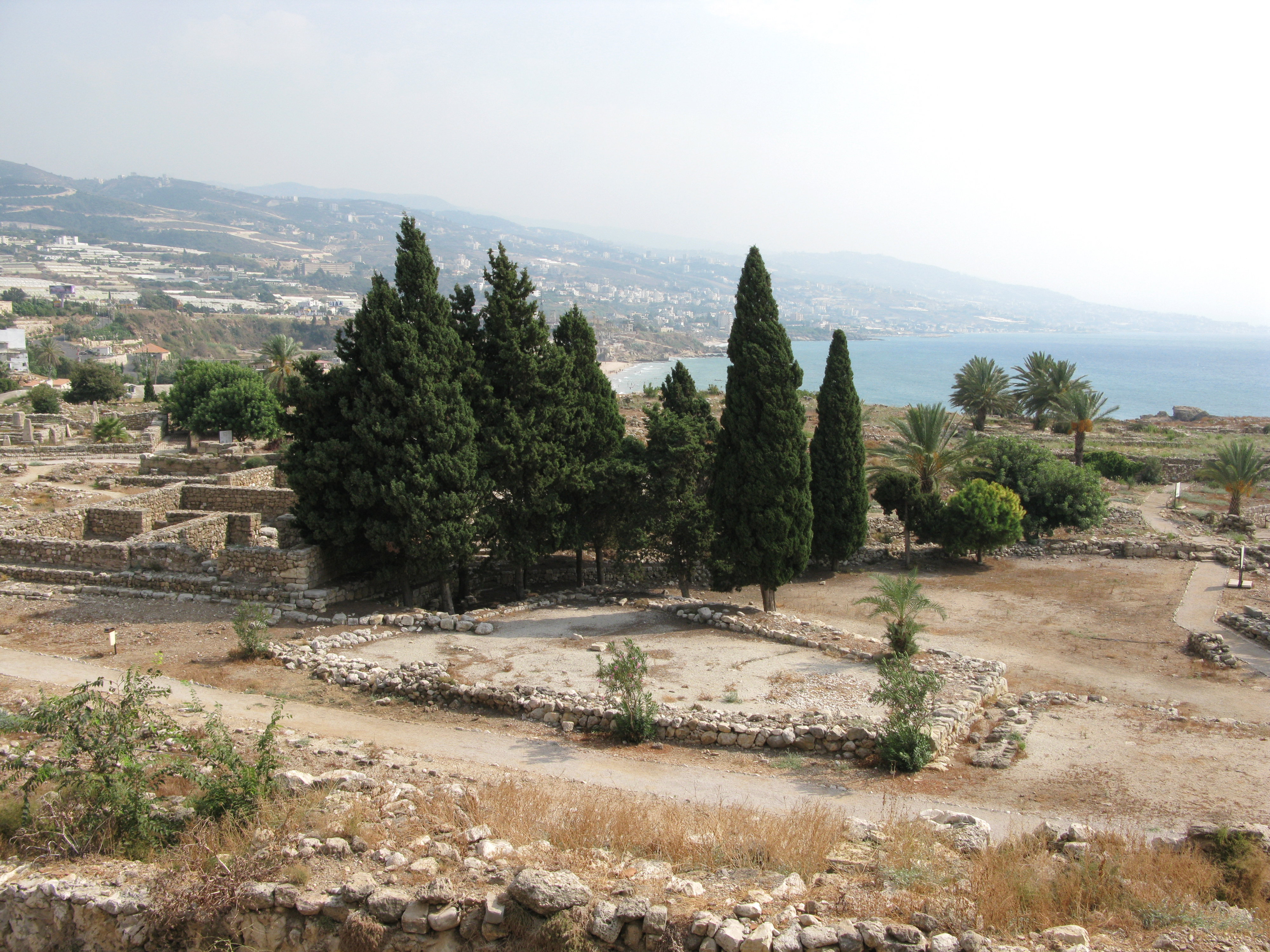
| Byblos (Gebal / גְּבַל) | 4th–2nd millennium BC | The oldest of the three, with occupation dating to at least 3200 BC and Egyptian trade connections reaching back to the Old Kingdom. Byblos supplied the famous cedars of Lebanon to Egypt — timber essential for construction projects including the ancient pyramids, because Egypt’s own climate and Nile flooding patterns could not produce the large-scale lumber needed. Byblos also exported resin and oil; Egyptian artifacts dominate its archaeological record. The Greek word biblos (βιβλος — “book,” source of “Bible”) derives from this city’s name, because Byblos was the primary source of Egyptian papyrus shipped to Greece. |
| Sidon (צִידוֹן) | Late 2nd millennium BC | Dominant during the Late Bronze Age. So prominent that “Sidonian” became a generic term for all Phoenicians in some biblical and Homeric texts. Jezebel was a Sidonian princess — daughter of Ethbaal, king of the Sidonians (1 Kings 16:31). |
| Tyre (צוֹר — “Rock”) | 10th–6th century BC | Built partly on an offshore island, making it nearly impregnable. Tyre became the dominant Phoenician city during the Iron Age and was the commercial capital of the Mediterranean. Hiram I of Tyre was Solomon’s ally; Tyre founded its sister city Carthage (c. 814 BC) on the coast of modern Tunisia. Ezekiel’s lament over Tyre (Ezekiel 27) preserves the most detailed ancient description of a Phoenician trading network. |
These cities were rivals as often as allies. Like the inland Canaanite city-states (see Section 03), each had its own king, its own patron deity, and its own foreign policy. What united them was the sea.
The Spread of the Alphabet
The Phoenicians’ most consequential gift to civilization was not purple dye or cedar wood — it was the spread of alphabetic writing across the Mediterranean world.
The Phoenicians did not invent the alphabet. Alphabetic writing emerged centuries earlier in the Proto-Sinaitic script (c. 1800 BC) — a Semitic adaptation of Egyptian hieroglyphic signs, used and spread by Canaanite-speaking workers in the turquoise mines of the Sinai Peninsula. This Proto-Sinaitic script was the common ancestor of both the Phoenician alphabet and the early Proto-Hebraic script that would eventually evolve into the square Hebrew characters used today. Before these alphabetic innovations, writing systems were enormously complex: Egyptian hieroglyphics used hundreds of signs, and Mesopotamian cuneiform required years of scribal training. Even the Ugaritic cuneiform alphabet (see Section 04) had simplified this to about 30 signs, but it was still wedge-shaped marks pressed into clay.
What the Phoenicians contributed was standardization and transmission. They refined the inherited Proto-Canaanite script into a linear alphabet of 22 phonetic consonant signs — simple enough to be written with pen and ink on papyrus, portable enough to travel with merchants, and learnable in days rather than years. And then they carried it everywhere they sailed. By the 11th century BC, this script was in widespread use along the Phoenician coast, and Phoenician traders were spreading it to every port in the Mediterranean.
From Phoenician to you: The Greeks adopted the Phoenician alphabet around the 9th–8th century BC, adding vowel signs (the Phoenician script, like Hebrew, wrote only consonants). The Greek alphabet became the basis for Etruscan, which became the basis for Latin, which became the script you are reading now. The Hebrew alphabet also derives from the same Proto-Canaanite ancestor. The letter names tell the story: aleph (אָלֶף — “ox”) became Greek alpha, then Latin A. Bet (בֵּית — “house”) became beta, then B. The sequence has been preserved for three thousand years.
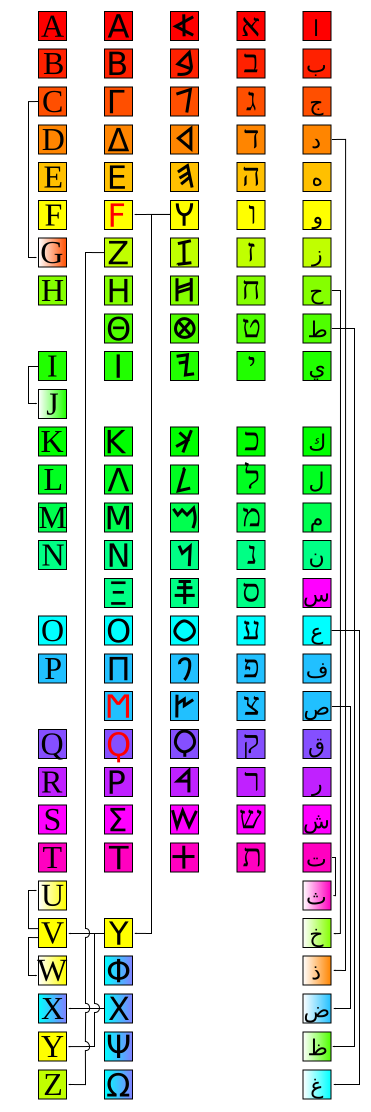
Phoenician echoes in English: The Greeks called their borrowed letters Phoinikeia grammata (Φοινικεια γραμματα) — “Phoenician letters” (Herodotus, Histories 5.58). The word alphabet itself preserves the Phoenician letter names (aleph + bet). And the word Bible derives from Greek biblos (βιβλος) — “book” — which comes from the city of Byblos, because it was the primary source of papyrus shipped to Greece.
An intriguing question: the Greek word phonē (φωνη — “voice, sound”) — the root of phonetic, phonics, and telephone — is conventionally traced to a Proto-Indo-European root meaning “to speak.” But the Phoenicians taught the Greeks a writing system built entirely on the principle that letters represent sounds — and the near-homophony between “Phoenician” (Φοινικες) and “sound” (φωνη) is striking. Whether the cultural reality influenced the word, or the similarity is coincidence that reinforced the association, remains an open question — but the Phoenicians undeniably gave the Greeks their phonetic alphabet, whatever we make of the etymology.
The alphabet democratized literacy. In Egypt and Mesopotamia, reading and writing were the province of professional scribes. The Phoenician alphabet made it possible for merchants, sailors, and ordinary people to keep records, write contracts, and send letters. This was not an abstract achievement — it was a commercial tool that became a civilizational revolution.
Tyrian Purple
The Phoenicians’ signature product was a dye so rare, so labor-intensive, and so stunningly colorfast that it became synonymous with royalty throughout the ancient world.
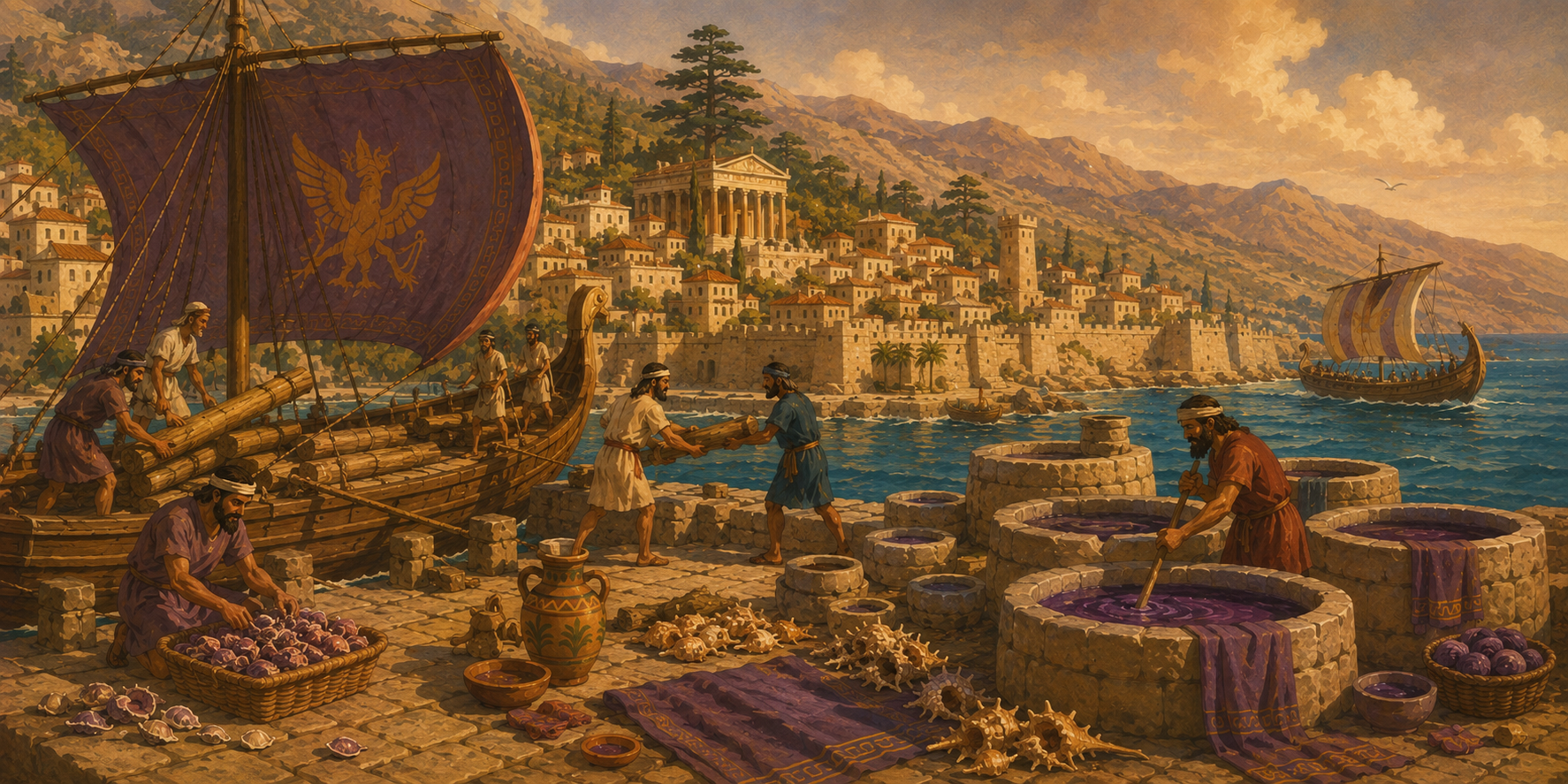
Argaman (אַרְגָּמָן) in Hebrew, the dye was extracted from the hypobranchial gland of Murex sea snails — primarily Bolinus brandaris and Hexaplex trunculus. The process was extraordinary:
- Thousands of snails were harvested from the sea floor
- The glands were extracted and crushed
- The secretion was mixed with salt, left to soak for three days, then slowly heated (but never boiled) in stone vats for ten days
- The resulting liquid ranged from reddish-purple to violet, depending on the species and exposure to sunlight
- A single gram of dye required approximately 10,000 snails

The Phoenicians may not have originated these techniques. Archaeological evidence of earlier purple dye production has been found on Minoan Crete, suggesting that the Phoenicians likely adopted and refined the process from their Aegean trading partners before scaling it into the industry that made them famous.
Archaeological evidence confirms the scale of the Phoenician industry: massive deposits of crushed Murex shells have been found at Sidon and Tyre, some mounds meters deep. The stench of the processing vats was reportedly unbearable — Sidon’s dye works were located downwind from the city.
The cost was staggering. In the Roman period, a pound of Tyrian purple dye was worth more than its weight in silver. This is the background to the biblical use of purple as a marker of royalty and wealth: the tabernacle curtains included “blue, and purple, and scarlet” (Exodus 26:1); the virtuous woman of Proverbs “is clothed in purple” (Proverbs 31:22); and the Roman soldiers who mocked Jesus dressed him in a purple robe (Mark 15:17).
Tekhelet and the tabernacle: The blue dye (tekhelet / תְּכֵלֶת) specified for the tabernacle and priestly garments is now believed to have been produced from the same Hexaplex trunculus snail, with exposure to ultraviolet light shifting the color from purple to blue. Phoenician dyers likely supplied this sacred material to Israel. The connection is striking: the very dye that adorned YHWH’s tabernacle came from the workshops of Canaan’s coastal cities.
These were the techniques that the great artificers of Israel’s sacred spaces were skilled in. Bezalel (בְּצַלְאֵל), whom God filled “with wisdom, and with understanding, and with knowledge, and in all manner of workmanship” (Exodus 31:3), worked with blue, purple, and scarlet to construct the tabernacle. Centuries later, Hiram the master craftsman — half-Phoenician, “a worker in brass” from Tyre (1 Kings 7:14) — brought these same Phoenician arts to Solomon’s Temple. The sacred spaces of Israel were built with Canaanite craftsmanship, consecrated to YHWH.
Hiram of Tyre and Solomon’s Temple
The most consequential relationship between Israel and Phoenicia was the alliance between King Hiram I of Tyre and Kings David and Solomon. This was not merely diplomatic friendship — it was an economic partnership that made the Temple possible.
The arrangement began under David:
“And Hiram king of Tyre sent messengers to David, and cedar trees, and carpenters, and masons: and they built David an house.”
Hiram’s eagerness to ally with David was not mere diplomacy — it was strategic. The Phoenicians and the Philistines were bitter commercial rivals. The roots of this rivalry likely stretched back generations to the conflict between the Minoans and Mycenaeans — the Phoenicians had inherited the Minoan maritime trading tradition, while the Philistines descended from the Mycenaean/Aegean world that had displaced it. When David broke Philistine power at the Valley of Rephaim (2 Samuel 5:17–25), he eliminated the Phoenicians’ chief competitor on the southern coast. Hiram had every reason to invest in that relationship.
Under Solomon, the partnership expanded dramatically. Hiram provided the materials and skilled labor that Israel lacked:
- Cedar and cypress timber from the Lebanon mountains — the finest building material in the ancient Near East, prized for its fragrance, durability, and resistance to insects. Solomon’s Temple, the royal palace, and the “House of the Forest of Lebanon” all used Phoenician cedar.
- Skilled craftsmen — Phoenician builders, stonecutters, and metalworkers who brought expertise Israel did not possess. The master artisan sent to cast the Temple’s bronze work was himself half-Phoenician: “a widow’s son of the tribe of Naphtali, and his father was a man of Tyre, a worker in brass” (1 Kings 7:14).
- Maritime expertise — Hiram provided ships and sailors for Solomon’s fleet at Ezion-geber on the Red Sea, enabling trade with Ophir (1 Kings 9:26–28).
In exchange, Solomon sent Hiram wheat and olive oil annually (1 Kings 5:11) — agricultural products that the narrow Phoenician coast could not produce in sufficient quantity. He also ceded twenty Galilean cities to Tyre (1 Kings 9:11–13), though Hiram was reportedly dissatisfied with them.
Temple architecture and Phoenician design: The tripartite plan of Solomon’s Temple — porch (ulam), main hall (hekal), and inner sanctuary (devir) — closely matches Phoenician and Syrian temple designs known from archaeology, including temples at Tell Tayinat and ‘Ain Dara in Syria. The word hekal (הֵיכָל) itself is borrowed from the Sumerian E.GAL (“great house”) via Canaanite/Phoenician transmission. The Temple was built to YHWH’s specifications, but in Phoenician idiom — using the architectural vocabulary of the region.
Jezebel and the Baal Crisis
If Hiram represented the best of the Israelite-Phoenician relationship, Jezebel represented its most dangerous dimension.
Jezebel (Izevel / אִיזֶבֶל) was a princess of Sidon — daughter of Ethbaal (or Ittobaal), who was both king and priest of Astarte (1 Kings 16:31). Her marriage to King Ahab of Israel (c. 874–853 BC) was a political alliance, following the same pattern as Solomon’s foreign marriages. But Jezebel did not simply bring her personal devotion — she brought an institutional cult.
What Jezebel imported was not folk religion but state-sponsored Baal worship:
- She maintained 450 prophets of Baal and 400 prophets of Asherah “which eat at Jezebel’s table” (1 Kings 18:19)
- She actively persecuted YHWH’s prophets, killing them systematically (1 Kings 18:4)
- She established Baal worship as a royal institution with its own temple in Samaria (1 Kings 16:32)
This was not the gradual syncretism that had always plagued Israel (see Section 07). It was a deliberate attempt to replace YHWH worship with the Phoenician Baal cult as the official religion of the northern kingdom. The confrontation on Mount Carmel (1 Kings 18:20–40) was not Elijah challenging a marginal cult — it was a prophet of YHWH confronting the full apparatus of royal religious power.
The theological stakes were those described in Section 04: Baal offered rain and fertility through ritual; YHWH offered rain and fertility through covenant obedience. On Carmel, Elijah forced the question into the open: “How long halt ye between two opinions? if the LORD be God, follow him: but if Baal, then follow him” (1 Kings 18:21).
Seafaring and Colonization
The Phoenicians were the greatest sailors of the ancient world. While other peoples hugged coastlines, Phoenician mariners crossed the open Mediterranean, navigated by the stars (the Greeks called the North Star “the Phoenician star”), and established trading colonies from Cyprus to Spain.
The Trading Network
Phoenician commercial reach was extraordinary. Ezekiel’s detailed lament over Tyre (Ezekiel 27) provides a catalogue of Tyre’s trading partners and goods that reads like an ancient bill of lading:
- Tarshish (probably southern Spain) — silver, iron, tin, lead
- Greece and Anatolia — slaves and bronze vessels
- Damascus — wine and white wool
- Arabia — lambs, rams, goats, spices, precious stones, gold
- Egypt — linen and embroidered cloth
In return, Tyre exported cedar, purple dye, glass (the Phoenicians were early pioneers of glassmaking), metalwork, and finished textiles. They traded in everything — including, regrettably, human beings (Joel 3:6).
The Colonies
As Phoenician trade expanded, merchants established permanent settlements across the Mediterranean:
- Cyprus (Kition) — the nearest and earliest colony, exploiting the island’s copper deposits
- North Africa (Utica, Carthage) — Carthage, founded from Tyre c. 814 BC according to tradition, became the greatest Phoenician colony, eventually building its own empire
- Sicily, Sardinia, Malta — strategic positions along Mediterranean sea lanes
- Spain (Gadir / modern Cádiz) — access to Iberian silver and tin from beyond the Strait of Gibraltar
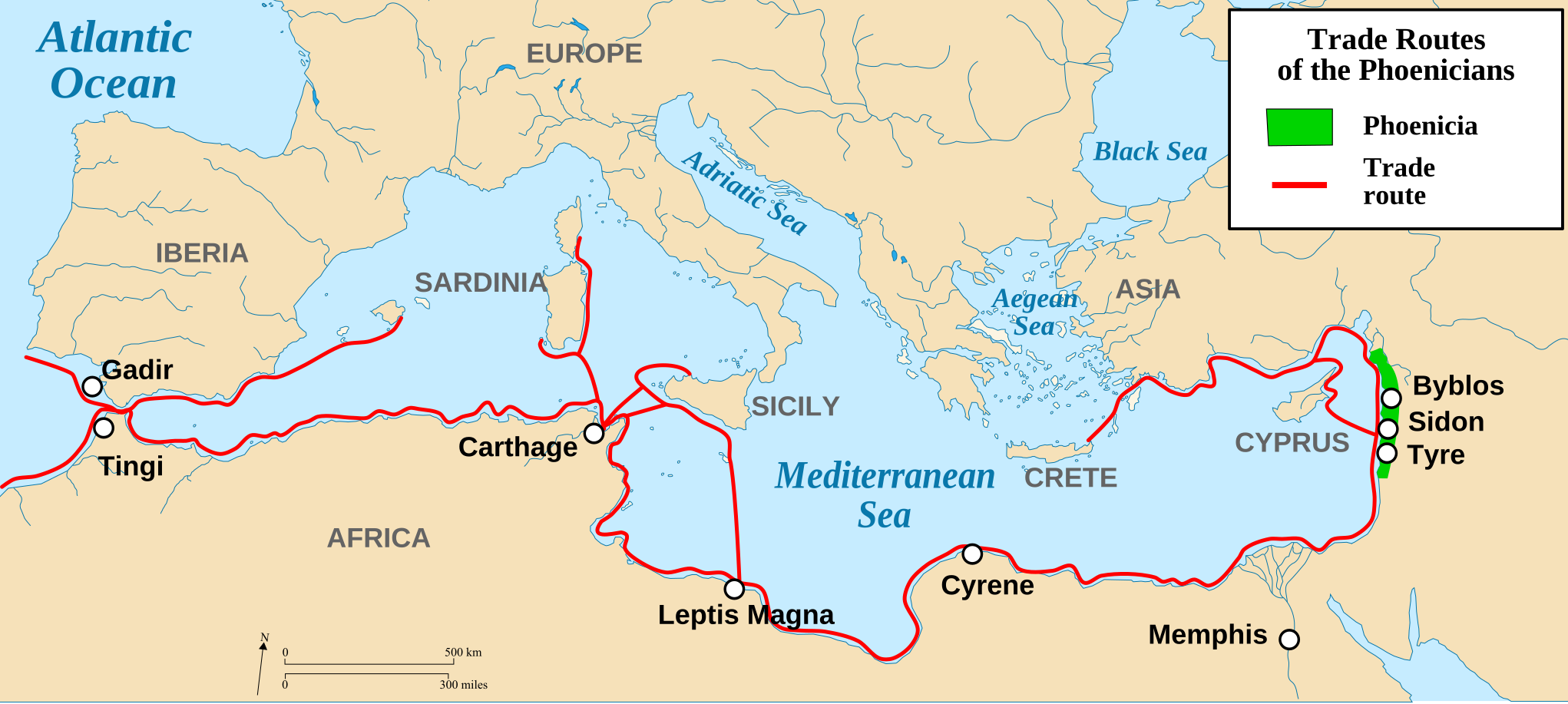
Herodotus reports that the Egyptian Pharaoh Necho II (c. 600 BC) commissioned Phoenician sailors to circumnavigate Africa — and that they succeeded, a voyage of approximately three years. Herodotus himself doubted the story because the sailors reported that the sun was on their right as they sailed westward around the southern tip — which is, of course, exactly what would happen south of the equator, lending the account unexpected credibility.
Evidence also suggests that Phoenician traders ventured beyond the Mediterranean entirely. The tin trade drew them north through the Strait of Gibraltar to the Cassiterides — the “Tin Islands,” almost certainly the Cornwall coast and the Scilly Isles of modern Britain. Tin was essential for producing bronze, and Cornwall was one of the richest tin sources in the ancient world. The Phoenicians guarded these Atlantic trade routes jealously; Strabo records that a Phoenician captain deliberately ran his ship aground rather than allow a Roman vessel to follow him to his tin source.
A Latter-day Saint connection: The Phoenicians’ demonstrated ability to navigate the open Atlantic — around Africa, to Britain, and possibly beyond — has led several Latter-day Saint scholars to propose that Mulek, the surviving son of King Zedekiah (Helaman 6:10; Mosiah 25:2), may have been transported to the Americas by Phoenician sailors. The timing aligns: Jerusalem fell to Babylon in 586 BC, precisely when Phoenician maritime capability was at its peak.
Intriguingly, when the Mulekites settled in the land they called Zarahemla, the major river nearby was named Sidon (Alma 2:15) — the name of the great Phoenician port city. And the name Zarahemla itself can be read as Hebrew: zera ha-melekh (זֶרַע הַמֶּלֶךְ) — “seed of the king” — an apt designation for a colony founded by a surviving prince of the royal house of Judah. These connections remain proposals rather than proof, but they illustrate how Phoenician maritime history intersects with Book of Mormon geography in ways that reward careful attention.
Carthage and the Phoenician Legacy
Carthage (“New City” — from Phoenician Qart-Hadasht) became the most powerful Phoenician settlement, eventually dominating the western Mediterranean. Carthaginian religion preserved Phoenician worship patterns, including veneration of Baal Hammon and Tanit. The tophet at Carthage — a sacred precinct containing thousands of urns with the cremated remains of children — remains one of the most debated archaeological sites in the Mediterranean (see the discussion of child sacrifice in Section 04).
Rome destroyed Carthage in 146 BC, but the Phoenician legacy endured: their alphabet, their maritime routes, their glassmaking techniques, and their purple dye industry all outlived the civilization that created and transmitted them.
Phoenician Religion
Phoenician religion was Canaanite religion carried to sea. The pantheon described in Section 04 was the same pantheon worshipped in Tyre, Sidon, and Byblos, with local variations:
| City | Patron Deity | Notes |
|---|---|---|
| Byblos | Baalat Gebal (“Lady of Byblos”) | A goddess equated with Egyptian Hathor; the temple at Byblos was one of the oldest in the Levant |
| Sidon | Astarte (עַשְׁתָּרוֹת / Ashtoreth) | Goddess of love, war, and fertility. Ethbaal, Jezebel’s father, was a priest of Astarte before becoming king. |
| Tyre | Melqart (“King of the City”) | A form of Baal specific to Tyre. Melqart had a death-and-resurrection cycle celebrated annually (the egersis). This is likely the specific “Baal” that Jezebel promoted in Israel. |
The Phoenicians carried their gods wherever they sailed. Temples to Melqart, Astarte, and Eshmun (a healing god) have been found across the Mediterranean, from Cyprus to Spain. When Jezebel established Baal worship in Samaria, she was not introducing a generic fertility cult — she was installing the specific institutional religion of the Tyrian-Sidonian royal house, complete with its priesthood, its prophets, and its royal patronage.
The Phoenicians in Scripture
The Bible’s treatment of the Phoenicians reflects the complexity of the relationship:
- Positive: Hiram’s alliance is presented without criticism. The Phoenician craftsmen who built the Temple are honored. Psalm 45:12 mentions “the daughter of Tyre” bringing gifts. Jesus himself traveled to “the coasts of Tyre and Sidon” (Matthew 15:21) and healed the Syro-Phoenician woman’s daughter.
- Negative: Jezebel’s importation of Baal worship is condemned absolutely. Solomon’s foreign wives led him to worship “Ashtoreth the goddess of the Zidonians” (1 Kings 11:5).
- Prophetic: Ezekiel 26–28 and Isaiah 23 pronounce judgment on Tyre, portraying its wealth and pride as leading to destruction. Ezekiel’s image of Tyre’s king as a fallen cherub (“Thou hast been in Eden the garden of God,” Ezekiel 28:13) has a long history of interpretation in both Jewish and Christian tradition.
The pattern is consistent: commerce and craft were welcome; worship was not. Israel could receive cedar from Tyre but not gods from Sidon. The line was not ethnic but theological — the same principle that runs through the entire Canaan narrative (see Section 10).
Sources
Phoenician History & Culture:
- Glenn E. Markoe, Phoenicians (University of California Press, 2000) — The standard English-language overview of Phoenician civilization.
- Maria Eugenia Aubet, The Phoenicians and the West: Politics, Colonies, and Trade (Cambridge University Press, 2nd ed. 2001) — Definitive study of Phoenician colonization and trade networks.
- Sabatino Moscati, ed., The Phoenicians (Rizzoli, 1999) — Comprehensive catalogue from the major exhibition; covers art, religion, and material culture.
The Alphabet:
- Joseph Naveh, Early History of the Alphabet: An Introduction to West Semitic Epigraphy and Palaeography (Magnes Press, 2nd ed. 1987) — The development from Proto-Sinaitic through Phoenician to Greek.
Purple Dye:
- Inge Boesken Kanold, “The Purple Fermentation Vat,” in Purpurae Vestes: Textiles y tintes del Mediterráneo en época romana (2004) — Technical reconstruction of the ancient dyeing process.
Solomon’s Temple & Phoenician Architecture:
- William G. Dever, Who Were the Early Israelites and Where Did They Come From? (Eerdmans, 2003) — Temple parallels in Phoenician/Syrian architecture.
- Amihai Mazar, Archaeology of the Land of the Bible, 10,000–586 BCE (Doubleday, 1990) — Archaeological context for the Solomonic period.
Online Resources:
- World History Encyclopedia — Phoenicia (CC BY-NC-SA 4.0)
- World History Encyclopedia — Tyrian Purple (CC BY-NC-SA 4.0)
Scripture Citations:
- Exodus 26:1 | Proverbs 31:22 | Mark 15:17 | 2 Samuel 5:11 | 1 Kings 5:11; 7:14; 9:11–13, 26–28; 11:5; 16:31–32; 18:4, 19, 20–40 | Ezekiel 26–28 | Isaiah 23 | Joel 3:6 | Amos 9:7 | Matthew 15:21 | Psalm 45:12