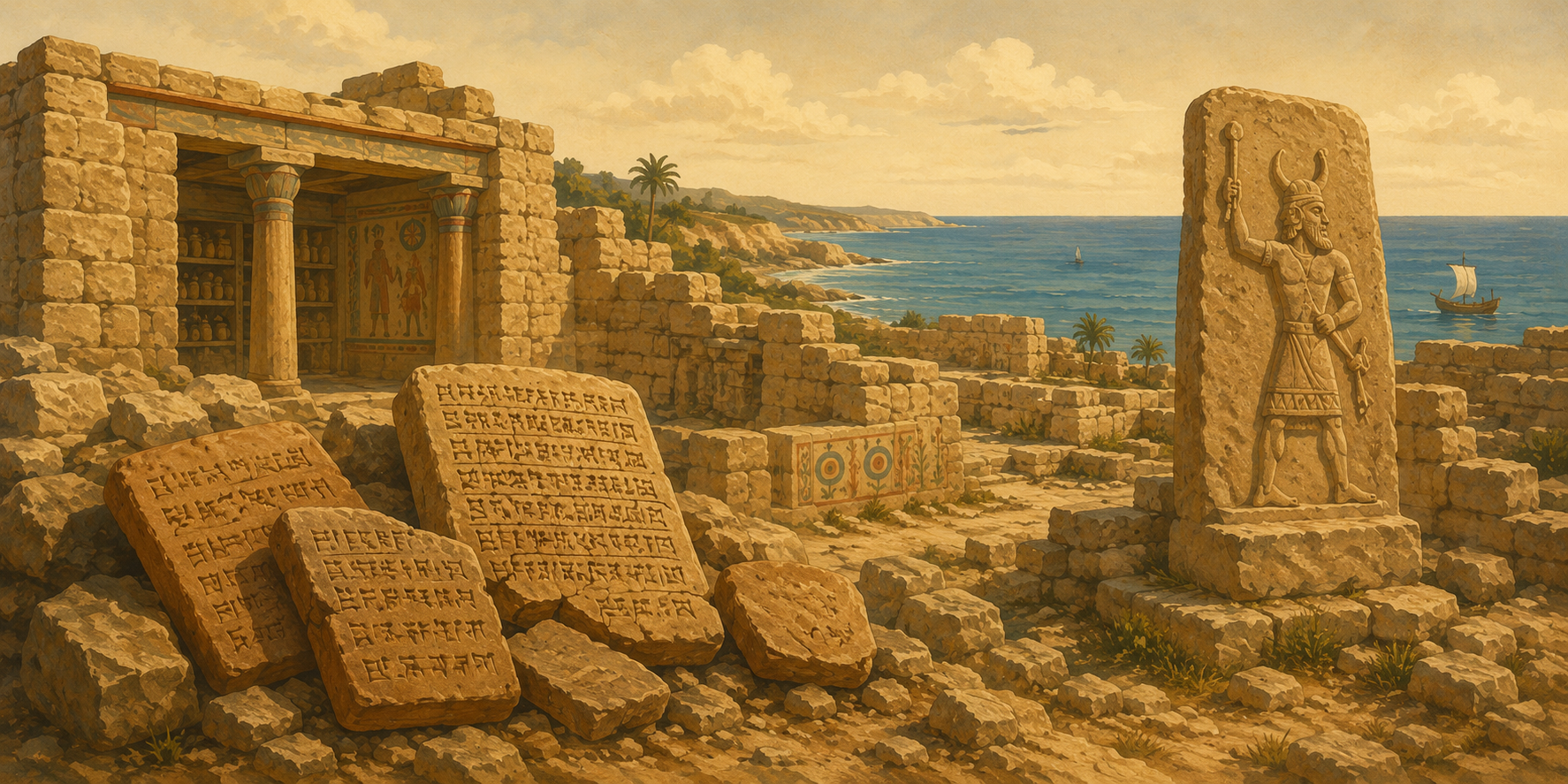
Ugarit & Canaanite Religion
The gods Israel was commanded to reject — and the archaeological discovery that revealed them
For centuries, nearly everything we knew about Canaanite religion came from the Bible’s condemnation of it. The prophets denounced Baal worship, but they did not explain it. They demanded the destruction of Asherah poles, but they did not describe the theology behind them. The denunciation was clear; the content was a blank.
Then, in 1929, a farmer’s plow struck the roof of an ancient tomb at a site called Ras Shamra on the coast of modern Syria. The excavation that followed uncovered the ruins of Ugarit — a thriving Bronze Age city destroyed around 1185 BC — and with it, thousands of clay tablets written in a previously unknown cuneiform script. When deciphered, these texts revealed the mythology, ritual practices, and theology of the Canaanite world in stunning detail.
For the first time, scholars could read the stories the Canaanites told about their own gods — and understand exactly what Israel’s prophets were fighting against.
The Discovery of Ugarit
Ugarit (modern Ras Shamra, Syria) was a major port city on the Mediterranean coast, about 10 kilometers north of the modern city of Latakia. At its height in the 14th–13th centuries BC, it was a cosmopolitan trading center with connections to Egypt, the Hittite Empire, Cyprus, and Mesopotamia.
The city was destroyed in the wave of upheaval associated with the Sea Peoples around 1185 BC and was never rebuilt. This was, paradoxically, its preservation — the tablets were buried intact, sealed under destruction debris for over three thousand years.
The Tablets
The Ugaritic texts, written in a cuneiform alphabetic script (one of the earliest alphabets known), include:
- Mythological epics — the Baal Cycle, the Legend of Keret, the Tale of Aqhat
- Ritual texts — instructions for sacrifices, festivals, and priestly duties
- God lists — catalogues of the deities worshipped at Ugarit
- Administrative records — trade documents, diplomatic correspondence, legal texts
The Ugaritic language is closely related to Hebrew — both are Northwest Semitic languages. Many words, phrases, and poetic structures in the Ugaritic texts have direct parallels in the Hebrew Bible, illuminating difficult passages and providing the cultural context that the biblical authors assumed their readers already knew.
The Canaanite Pantheon
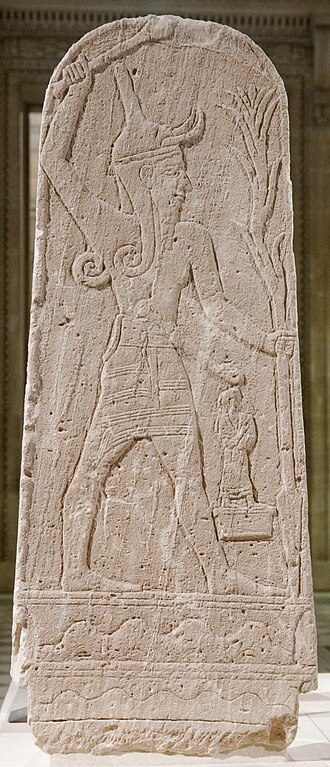
The Ugaritic texts reveal a complex, hierarchical pantheon. These are the gods that Israel encountered in Canaan — the gods behind the “high places,” the sacred poles, and the rituals that the prophets condemned.
| Deity | Domain | Significance |
|---|---|---|
| El (אֵל) | Father of the gods; creator; wisdom | The supreme god of the Canaanite pantheon, depicted as an aged, bearded patriarch dwelling at the source of the two rivers. His consort was Athirat (Asherah). The Hebrew word el (אֵל) for “god” is the same word. |
| Baal (בַּעַל — “Lord/Master”) | Storm, rain, fertility, agriculture | Son of El (or in some traditions, Dagan). The active, warrior god who defeats Sea (Yam) and Death (Mot). His worship was the primary rival to YHWH worship throughout Israel’s history. |
| Asherah (אֲשֵׁרָה) | Mother goddess; fertility; the sea | Consort of El at Ugarit, called “Lady Athirat of the Sea.” In Canaan, her cultic symbol was a sacred pole or tree planted near altars. The KJV translates asherah (אֲשֵׁרָה) as “grove” — obscuring that it refers to a goddess and her cultic object. |
| Anat (עֲנָת) | War, love, hunting | Baal’s sister and fierce ally. In the Baal Cycle, she wades through the blood of her enemies and retrieves Baal’s body from the underworld. The city of Beth-anath in Naphtali (Judges 1:33) was named for her. |
| Mot (מוֹת — “Death”) | Death, the underworld | Baal’s great adversary. In the Baal Cycle, Mot swallows Baal (representing the dry season’s death of vegetation), and Baal’s eventual triumph over Mot represents the return of rain and fertility. The Hebrew word for “death” (mavet / מָוֶת) is the same root. |
| Dagon (דָּגוֹן) | Grain, agriculture | An ancient grain deity, worshipped widely in Mesopotamia and Canaan. In the Ugaritic texts, Baal is sometimes called “son of Dagan.” The Philistines adopted Dagon as a chief deity; it was in Dagon’s temple at Gaza that Samson pulled down the pillars (Judges 16:23). |
| Yam (יָם — “Sea”) | Sea, chaos, cosmic waters | The chaotic sea god whom Baal defeats to establish his kingship. The Hebrew word for “sea” (yam / יָם) is the same. Some scholars see echoes of this cosmic battle in biblical passages like Psalm 74:13–14 and Isaiah 27:1, where YHWH defeats the sea monster. |
The Baal Cycle
The most important mythological text from Ugarit is the Baal Cycle — a series of epic poems found on clay tablets in the library of the high priest. The narrative covers Baal’s rise to kingship among the gods and provides the theological framework for Canaanite religion.
The Story
- Baal vs. Yam (Sea) — Baal defeats the chaotic sea god Yam with the help of divine weapons crafted by the craftsman god Kothar-wa-Khasis. This establishes Baal as king of the gods.
- Baal’s Palace — Having proved his kingship, Baal petitions El for permission to build a palace. This narrative is rich with descriptions of divine craftsmanship, cedar and precious metals — a temple-building story that parallels Solomon’s later construction of the Temple in Jerusalem.
- Baal vs. Mot (Death) — Death challenges Baal’s rule. Baal descends to the underworld and is swallowed by Mot. The earth dries up; fertility ceases. Anat kills Mot (cutting, winnowing, and grinding him like grain). Baal returns to life and the rains resume.
What It Meant for Worshippers
The Baal Cycle was not entertainment — it was liturgical. The death and resurrection of Baal was tied to the agricultural year: the dry summer was Baal’s defeat by Mot; the autumn rains were his return to life. Canaanite worship ritually re-enacted this cycle through festivals, sacrifices, and — according to both biblical and extra-biblical evidence — sexual rites intended to stimulate the gods’ fertility.
For Israelite farmers who depended on the same rains, the Baal cult offered a direct, practical appeal: worship the god who controls the weather, and your crops will grow. This was the temptation that defined Israelite religious history from the conquest through the exile.
Baal and Asherah in the Bible
The biblical text mentions Baal and Asherah repeatedly — almost always in the context of condemnation:
Baal (בַּעַל — “Lord/Master”)
Baal was the god of storms, rain, fertility, and agricultural abundance. For a farming society, his promises were directly practical: worship me and your crops grow. The Ugaritic texts reveal Baal mythology in detail: he dies and rises annually with the seasons, his worship includes ritual drama, and his cult sites were on hilltops (“high places”).
The biblical writers use the plural “Baalim” (בְּעָלִים) because Baal worship was localized — each city or region had its own Baal: Baal-Peor, Baal-Hermon, Baal-Zebub of Ekron (see Section 06), and others.
Asherah / Ashtoreth (אֲשֵׁרָה / עַשְׁתָּרוֹת)
The female counterpart — goddess of fertility, sexuality, and (in her Ashtoreth form) warfare. At Ugarit, Athirat/Asherah was the consort of El and mother of the gods. In Canaan, her cultic symbol was a sacred pole or tree planted near an altar. The KJV translates the Hebrew asherah as “grove” — obscuring that the text refers to a goddess and her cultic representation.
Worship of Asherah included sexual rituals. Deuteronomy’s repeated commands to “cut down their groves” (Deuteronomy 7:5) are instructions to destroy the Asherah poles — the visible presence of the goddess at Canaanite worship sites.
These cultic sites frequently exploited women and girls. Across the ancient Near East, temple-associated women — the qedeshot of the biblical text, the qadishtu of Mesopotamian records — were often not willing participants. Mesopotamian legal texts document families selling daughters into temple service or pledging them as debt surety; if the debt went unpaid, the girl became temple property. Young women were drugged, coerced, and in some cases killed. The Deuteronomic prohibition against bringing “the hire of a whore, or the price of a dog” into YHWH’s house (Deuteronomy 23:17–18) implies an established commercial system that treated human beings as commodities for cultic profit. Whatever scholarly debates exist about the precise nature of “sacred prostitution” (see the discussion below), the exploitation of vulnerable women and girls at these sites is well documented — and it is this reality that the biblical prophets condemned with such ferocity.
YHWH vs. the Canaanite Gods: The Fundamental Contrast
The Ugaritic texts make the contrast between YHWH worship and Canaanite religion far clearer than the Bible alone could:
| Canaanite Religion | YHWH Worship |
|---|---|
| Many gods in a complex hierarchy; gods competing, scheming, and fighting among themselves | YHWH as supreme — “Hear, O Israel: the LORD our God is one LORD” (Deuteronomy 6:4). The Hebrew echad (אֶחָד) carries the sense of “unified” or “alone” rather than a strict numeric count. Early Israel did not deny the existence of other gods — the command “thou shalt have no other gods before me” (Exodus 20:3) itself implies their reality. The claim was that YHWH was supreme, stronger than all others, and demanded exclusive loyalty. Strict monotheism — the idea that other gods simply do not exist — developed later in Israel’s history, articulated most clearly by the prophets of the Exile. |
| Gods represented by images — idols in human and animal form, visible and tangible | No image permitted — YHWH forbids representation: “thou shalt not make unto thee any graven image” (Exodus 20:4) |
| Fertility rituals including sacred prostitution — worship designed to arouse the gods’ reproductive power | Sexual ethics rooted in covenant fidelity — sexuality as sacred but bounded by moral law |
| Nature gods embedded in and dependent on the natural cycle — Baal dies and rises with the seasons | God as Creator — YHWH is above nature, not within it; He controls the rain without needing to be annually resurrected |
| Moral relativism — the gods themselves are violent, sexually promiscuous, and deceitful | Moral holiness — YHWH is righteous and demands righteousness: “Be ye holy; for I am holy” (Leviticus 11:44) |
| Ritual manipulation — correct performance of rites compels the gods to act | Covenant relationship — worship is response to grace, not a technique for controlling deity |
A note on the scholarly debate: The table above presents the contrast as the prophets eventually articulated it. But many scholars — including Daniel McClellan, Mark S. Smith, and others — argue that the relationship between Israelite and Canaanite religion was far more entangled than a simple “monotheism vs. polytheism” divide. The evidence suggests that early Israelite religion was not uniformly monotheistic. Archaeological finds (such as the Kuntillet Ajrud inscriptions referencing “YHWH and his Asherah”), the biblical text’s own accounts of widespread Israelite worship of other gods, and the divine council imagery in passages like Psalm 82:1 and Deuteronomy 32:8–9 all point to a more complex picture.
What scholars generally agree on is that Israelite religion evolved over time — from an early stage where YHWH was worshipped as the supreme god among others (sometimes called monolatry — exclusive worship of one god without denying that others exist), toward the explicit monotheism articulated by the later prophets, especially during and after the Babylonian Exile (Isaiah 44–45). The Shema’s declaration that YHWH is echad (אֶחָד) may be better understood as a demand for undivided loyalty — “YHWH alone” — rather than a philosophical claim about the number of gods in existence. For Latter-day Saint readers, this trajectory is consistent with a restoration framework: original truths about God can be lost or diluted through apostasy and then restored through prophetic revelation.
Why Israel Was Tempted
The practical appeal of Canaanite religion was real — visible gods, agricultural guarantees, cultural normalcy (see Section 07 for the full picture of how this played out in the Judges period). But the deeper reason Israel was so vulnerable to Canaanite worship was not that it was foreign. It was that it was familiar.
Consider what the Ugaritic texts reveal: the Canaanite pantheon was headed by a god named El — the same word Israel used for God. El presided over a divine council — a concept that appears in Israelite scripture (Psalm 82:1; 1 Kings 22:19). Canaanite religion featured covenant rituals, sacrifice, temples, priesthoods, and sacred festivals tied to the agricultural calendar. The vocabulary was shared. The ritual forms overlapped. The names echoed.
This was not coincidence. From a Latter-day Saint perspective, the pattern is recognizable: Canaanite religion likely did not arise in a vacuum. If the patriarchs — Abraham, Isaac, Jacob — worshipped the true God in Canaan for generations, then the religious traditions of the region would have carried fragments of that original worship. Over centuries without prophetic correction, those fragments would have been corrupted, syncretized with local practice, and eventually hardened into the Baal cult that the prophets condemned. The fertility and sacrifice rituals, the high places, the sacred poles — these may represent what happens when covenant worship is maintained superficially in outward form but loses its prophetic anchor and intended meaning.
This is the same pattern that repeats throughout scripture:
- Before Abraham: The people of Ur had religious traditions that included fragments of earlier truth — but corrupted by idolatry. Abraham was called out to restore covenant worship.
- Before Moses: Israel in Egypt had absorbed the religious practices of their surroundings. The covenant at Sinai was a restoration — restoring the law, the priesthood, and the exclusive worship of YHWH.
- In Canaan: The surrounding nations had traditions that almost resembled what Israel believed — close enough to blend, close enough to confuse. The prophets’ job was to draw the line between corrupted tradition and restored truth.
- The Restoration: Joseph Smith encountered a Christianity that preserved fragments of original truth within centuries of accumulated, confused, and lost tradition. The pattern is the same: familiar enough to be confusing, different enough to require prophetic clarification.
The temptation of Baal worship was not that it was obviously wrong. It was that it was almost right — close enough to covenant worship that the boundaries blurred. The shared vocabulary, the overlapping ritual forms, the familiar divine names — these made syncretism feel less like apostasy and more like a natural blending. That is precisely what made it so dangerous, and precisely why the prophets responded with such intensity.
The prophetic confrontation: Elijah’s contest on Mount Carmel (1 Kings 18:21–39) is the climax of this centuries-long conflict. His challenge — “How long halt ye between two opinions? if the LORD be God, follow him: but if Baal, then follow him” — is not a question about whether Baal exists. It is a demand to stop blending, stop hedging, and choose. The fire that falls from heaven is YHWH’s definitive answer: the traditions may look similar, but the source of power is not the same.
Shared Vocabulary, Different Theology
One of the most important insights from the Ugaritic texts is that Israelite and Canaanite religion shared a common vocabulary while meaning fundamentally different things by it. Some examples:
- El (אֵל) — at Ugarit, the name of a specific god at the head of the pantheon. In the Bible, used as a generic word for “god” and as an element in divine names (Elohim, El Shaddai, El Elyon). The same word, applied to radically different theology.
- Baal (בַּעַל — “lord/master”) — the title of the storm god, but also a common Hebrew word for “lord,” “husband,” or “owner.” Hosea 2:16 plays on this: “Thou shalt call me Ishi [my husband]; and shalt call me no more Baali [my master/my Baal]” (Hosea 2:16).
- Mot (מוֹת / מָוֶת) — at Ugarit, the god of death personified. In Hebrew, the ordinary word for “death.” Isaiah’s prophecy that God “will swallow up death in victory” (Isaiah 25:8) uses language that echoes the Baal Cycle’s defeat of Mot — but attributes the victory to YHWH alone.
- Yam (יָם) — at Ugarit, the sea god whom Baal defeats. In Hebrew, simply “sea.” When the Psalmist declares that YHWH “didst divide the sea by thy strength” (Psalm 74:13), the language resonates with Baal’s battle against Yam — but the point is clear: YHWH, not Baal, is the one who conquers chaos.
The biblical writers were not borrowing Canaanite theology. They were using a shared linguistic and cultural framework to make a polemical point: everything Baal claims to do, YHWH actually does — and YHWH does it as Creator, not as one god among many.
The High Places
Throughout Judges and Kings, the “high places” (bamot / בָּמוֹת) are the persistent symbol of Canaanite religious influence. These were hilltop worship sites — often featuring an altar, a standing stone (massebah / מַצֵּבָה), and an Asherah pole — where both Canaanite and syncretistic Israelite worship took place.
The command to destroy these sites was explicit: “Ye shall destroy their altars, and break down their images, and cut down their groves, and burn their graven images with fire” (Deuteronomy 7:5). The failure to do so is one of the defining failures of the Judges and early monarchy period. Even kings described as faithful are sometimes qualified with the note: “but the high places were not taken away” (e.g., 1 Kings 22:43).
Molech and Child Sacrifice
The most horrifying aspect of Canaanite religion — and the one the biblical text condemns with the greatest intensity — was the practice of child sacrifice. The Torah addresses it with unusual directness:
“And thou shalt not let any of thy seed pass through the fire to Molech, neither shalt thou profane the name of thy God: I am the LORD.”
Who or What Was Molech?
The identity of Molech (מֹלֶךְ) has been debated for over a century. The word may be related to the Hebrew melekh (מֶלֶךְ — “king”), possibly with the vowels of boshet (בֹּשֶׁת — “shame”) substituted as a deliberate insult — a practice the biblical writers also applied to Baal-names. Some scholars, following Otto Eissfeldt’s influential 1935 study, have argued that molk (or mulk) was not a deity’s name at all but a type of sacrifice — similar to what Phoenician and Punic inscriptions call molk. Others maintain that Molech was a distinct deity associated with the underworld.
The biblical text condemns the practice in Leviticus 18:21 and 20:2–5, Deuteronomy 12:31 and 18:10, and in the prophetic denunciations of Jeremiah 7:31–32 and 32:35. The site associated with it was the Valley of Hinnom (Gei Ben-Hinnom / גֵּיא בֶן־הִנֹּם) south of Jerusalem — a name that eventually gave rise to Gehenna (גֵּיהִנָּם), the New Testament’s image of hell.
A note on the counter-argument: Some scholars have argued that child sacrifice in the Canaanite world never actually occurred — that the biblical accounts are political and theological propaganda crafted to justify the conquest and demonize the peoples Israel displaced. In this reading, the accusations served the same function as wartime rhetoric in any era: dehumanize the enemy to make their destruction seem not only acceptable but righteous. This is a serious argument that deserves honest engagement. Conquering peoples throughout history have fabricated or exaggerated the practices of those they conquered to justify violence after the fact.
However, the evidence is not limited to Israelite sources. Greek and Roman writers independently reported child sacrifice at Carthage. The archaeological record at the Carthage tophet (see below) includes thousands of cremated infant remains with dedicatory inscriptions. And the biblical text itself preserves an uncomfortable honesty that undermines a simple propaganda reading: it acknowledges that Israelites themselves practiced child sacrifice (2 Kings 16:3; 2 Kings 21:6), which is not what propaganda designed to demonize an enemy typically does. The most honest assessment is that the practice was real, that its precise scope and nature are debated, and that readers should weigh the cumulative evidence — biblical, classical, and archaeological — rather than accepting any single source uncritically.
The Tophet at Carthage
The most extensive archaeological evidence for child sacrifice in the broader Canaanite cultural world comes from Carthage — the Phoenician colony in North Africa. Excavations of the tophet (a sacred precinct named after the biblical Topheth in the Valley of Hinnom — 2 Kings 23:10) uncovered thousands of urns containing the cremated remains of infants and young children, accompanied by dedicatory inscriptions. The inscriptions use the term molk in what appears to be a sacrificial context.
Scholars remain divided. Some (Patricia Smith, Lawrence Stager, Joseph Greene) argue that the evidence confirms widespread ritual child sacrifice. Others (M’hamed Hassine Fantar, some Tunisian scholars) suggest that at least some of the remains represent children who died naturally and were given a special burial. The debate is ongoing, but the convergence of biblical condemnation, classical Greek and Roman reports, and the archaeological evidence from Carthage makes a strong cumulative case that child sacrifice was a real practice in the Canaanite-Phoenician cultural sphere.
The prophetic response: Jeremiah’s condemnation is among the most visceral in Scripture: “They have built also the high places of Baal, to burn their sons with fire for burnt offerings unto Baal, which I commanded not, nor spake it, neither came it into my mind” (Jeremiah 19:5). The phrase “neither came it into my mind” is extraordinary — God distancing Himself not just from a practice but from the very thought of it. That this needed to be said suggests that some Israelites had convinced themselves that child sacrifice was compatible with YHWH worship — a syncretistic horror that the prophets fought with everything they had.
Sacred Prostitution: The Scholarly Reassessment
For much of the twentieth century, it was widely accepted that Canaanite temples employed “sacred prostitutes” — men and women who engaged in ritual sex as part of fertility worship. This understanding was based on biblical references to the qedeshah (קְדֵשָׁה — “consecrated/holy woman”) and qadesh (קָדֵשׁ — “consecrated/holy man”), often translated “temple prostitute” in English Bibles, along with passages like Deuteronomy 23:17 (“There shall be no whore of the daughters of Israel, nor a sodomite of the sons of Israel”) and the accounts in Kings of cultic functionaries expelled during religious reforms.
The Challenge
Recent scholarship has significantly complicated this picture. Stephanie Budin (The Myth of Sacred Prostitution in Antiquity, Cambridge University Press, 2008) and Julia Assante, among others, have argued that the evidence for institutionalized sacred prostitution in the ancient Near East is far weaker than previously assumed:
- The Ugaritic texts — despite providing extensive detail about temples, priests, rituals, and festivals — contain no clear description of ritual sex as a temple function.
- The qedeshah / qadesh titles may refer to a class of cultic personnel whose duties did not necessarily include sexual activity. The root q-d-sh (ק-ד-שׁ) means “holy, set apart” — the same root as qadosh (קָדוֹשׁ, “holy”). The sexual interpretation may reflect the biblical writers’ polemical framing rather than a neutral description of the office.
- Classical sources (Herodotus’s account of Babylonian temple prostitution, for instance) are increasingly viewed as outsider accounts that may have misunderstood or sensationalized foreign practices.
What We Can Say
The scholarly reassessment does not mean that Canaanite religion was sexually innocuous. The biblical text’s condemnation of the qedeshah and qadesh reflects a real concern about sexual practices associated with non-YHWH worship. The fertility cult’s theological logic — that human sexual activity could stimulate divine reproductive power and thus ensure agricultural abundance — created a context where sexual ritual was theologically coherent, even if the institutional form was less organized than earlier scholars assumed.
The honest position is that the evidence is mixed and the debate is active. The biblical text unambiguously condemns the association of sexual activity with worship. Whether Canaanite temples employed dedicated sexual functionaries as a formal institution, or whether the sexual dimension of fertility worship took less institutionalized forms, the prophetic objection was the same: the worship of YHWH demanded sexual ethics rooted in covenant fidelity, not ritual performance.
Ugaritic Parallels to the Psalms
One of the most productive areas of Ugaritic scholarship has been the discovery of striking parallels between the Ugaritic poetic texts and the Hebrew Psalms. These parallels illuminate the Psalms’ original cultural context and reveal how Israel’s poets used shared Canaanite literary traditions to make distinctly Israelite theological claims.
Psalm 29 — The Storm Theophany
Psalm 29 describes YHWH’s voice in the thunderstorm with language so close to Ugaritic descriptions of Baal that many scholars consider it an Israelite adaptation of a Canaanite hymn to the storm god:
“The voice of the LORD is upon the waters: the God of glory thundereth… The voice of the LORD breaketh the cedars; yea, the LORD breaketh the cedars of Lebanon. He maketh them also to skip like a calf; Lebanon and Sirion like a young unicorn.”
The geographic references (Lebanon, Sirion — the Phoenician name for Mount Hermon) point north toward Ugaritic territory. The sevenfold “voice of the LORD” (qol YHWH / קוֹל יְהוָה) parallels the Baal Cycle’s descriptions of Baal’s thunder-voice. The cedar-breaking imagery mirrors Baal’s association with the storms that batter the Lebanese mountains. But the Psalm attributes all of this to YHWH — the same polemic we see throughout: everything Baal claims to do, YHWH actually does.
Psalm 74 — The Cosmic Battle
Psalm 74:13–14 celebrates YHWH’s victory over the sea and the many-headed sea monster:
“Thou didst divide the sea by thy strength: thou brakest the heads of the dragons in the waters. Thou brakest the heads of leviathan in pieces, and gavest him to be meat to the people inhabiting the wilderness.”
The Baal Cycle describes Baal’s defeat of Yam (Sea) and Lotan (the twisting serpent with seven heads) in nearly identical terms. The Hebrew Livyatan (לִוְיָתָן / Leviathan) is cognate with the Ugaritic Ltn (Lotan). But the Psalmist attributes the cosmic victory to YHWH, not to Baal. The shared imagery is the vehicle; the theological reassignment is the point.
Psalm 82 — The Divine Council
Psalm 82 opens with a scene drawn directly from the divine council tradition known from Ugarit:
“God standeth in the congregation of the mighty; he judgeth among the gods.”
At Ugarit, El presided over the divine assembly (puhru ilima) where the gods met to deliberate. Psalm 82 uses this framework but subverts it: YHWH judges the other “gods” for injustice and declares that they “shall die like men” (Psalm 82:7). The Canaanite concept of a divine council is acknowledged — but YHWH is not one among equals. He is the judge who holds all other powers accountable.
For Latter-day Saint readers, the divine council in Psalm 82 resonates with the council in heaven described in Abraham 3:22–28 and Moses 4:1–4. The shared ancient Near Eastern framework suggests that the concept of a heavenly council was not an Israelite invention or a Canaanite borrowing, but a widespread tradition rooted in genuine knowledge of heavenly realities — preserved more faithfully in some traditions than others.
Psalm 104 — Creation and Kingship
Psalm 104 celebrates YHWH as Creator with imagery that parallels both the Baal Cycle and Egyptian hymnic literature (especially the Hymn to the Aten). The storm imagery (104:3–4), the taming of waters (104:6–9), and the provision of rain for agriculture (104:10–18) all find close parallels in Ugaritic descriptions of Baal’s functions. But Psalm 104 attributes everything to YHWH as Creator — not as a storm god who battles other deities, but as the sovereign Lord who commands all of nature without opposition.
The pattern across all these parallels is consistent: Israel’s poets did not reject the literary and mythic vocabulary of their world. They claimed it. Every power attributed to Baal, every cosmic victory claimed for the storm god, every fertility blessing credited to the Canaanite pantheon — the Psalms systematically reassigned to YHWH. The shared language was not evidence of theological confusion; it was the medium of theological polemic. Israel used the words of Canaan to declare that the gods of Canaan were powerless.
Sources
Primary Text Collections:
- Nicolas Wyatt, Religious Texts from Ugarit (Sheffield Academic Press, 2nd ed. 2002) — English translations of the major mythological and ritual texts from Ras Shamra.
- Simon B. Parker, ed., Ugaritic Narrative Poetry (Society of Biblical Literature, Writings from the Ancient World 9, 1997) — Scholarly translations of the Baal Cycle, Keret, and Aqhat.
Canaanite Religion & Biblical Context:
- Mark S. Smith, The Early History of God: Yahweh and the Other Deities in Ancient Israel (Eerdmans, 2nd ed. 2002) — The standard scholarly treatment of Israelite-Canaanite religious connections.
- John Day, Yahweh and the Gods and Goddesses of Canaan (Sheffield Academic Press, 2000) — Detailed study including extensive treatment of Psalm parallels.
- Michael D. Coogan, Stories from Ancient Canaan (Westminster Press, 2nd ed. 2012) — Accessible English translations of Ugaritic myths with introduction.
Molech & Child Sacrifice:
- John Day, Molech: A God of Human Sacrifice in the Old Testament (Cambridge University Press, 1989) — The standard scholarly treatment of the Molech question.
- Lawrence E. Stager & Joseph A. Greene, “An Odyssey Debate: Were Living Children Sacrificed to the Gods?” Archaeology Odyssey 3.6 (2000) — Archaeological evidence from the Carthage tophet.
- Daniel O. McClellan, “The Gods-Complaint: Psalm 82 as a Psalm of Imprecation” and related work on Israelite religion, child sacrifice, and the rhetoric of Canaanite condemnation — McClellan’s research explores how biblical authors framed Canaanite practices within their theological polemic, including the question of whether some accusations served ideological purposes rather than strictly historical ones. His work is widely accessible through his YouTube channel and academic publications.
Sacred Prostitution Debate:
- Stephanie Lynn Budin, The Myth of Sacred Prostitution in Antiquity (Cambridge University Press, 2008) — The major revisionist treatment challenging the traditional understanding.
- Julia Assante, “The kar.kid/šarimtu: Prostitute or Single Woman?” Ugarit-Forschungen 30 (1998) — Reassessment of Mesopotamian cultic personnel.
Ugaritic Parallels to the Psalms:
- Peter C. Craigie, Psalms 1–50 (Word Biblical Commentary, 1983) — Extensive treatment of Ugaritic parallels, especially for Psalm 29.
- Frank Moore Cross, Canaanite Myth and Hebrew Epic (Harvard University Press, 1973) — Foundational study of the relationship between Canaanite mythology and Israelite literature.
Online Resources:
- World History Encyclopedia — Ugarit (CC BY-NC-SA 4.0)
- Bible Odyssey — Scholarly articles on Canaanite religion and Ugaritic parallels.