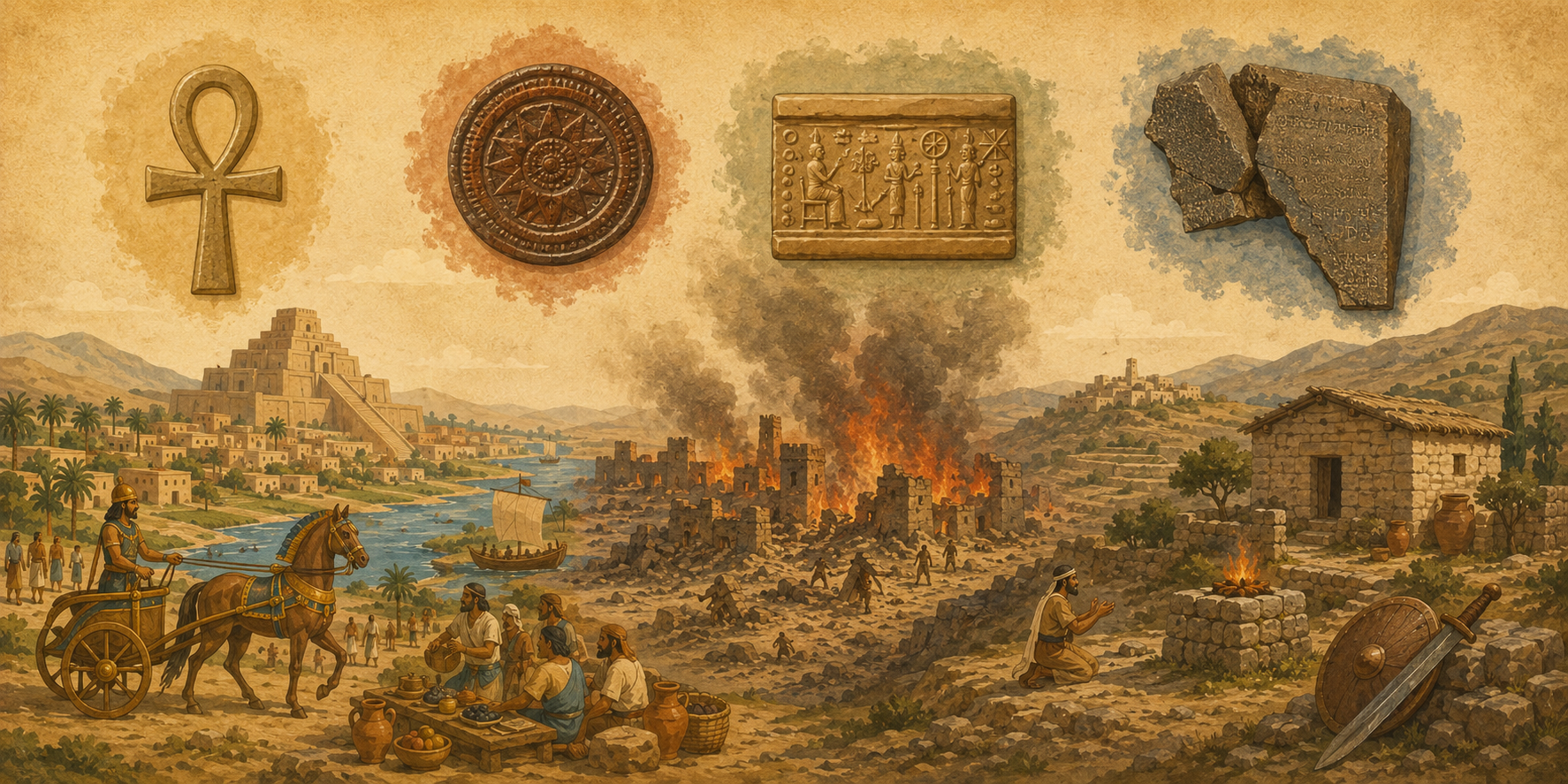
Timeline & Empires
The empires that ruled Canaan, the trade networks that enriched it, and the catastrophe that opened it
Canaan was never free. Wedged between Egypt to the south and Mesopotamia to the northeast, squeezed between the Mediterranean and the desert, this narrow strip of land was controlled, contested, or coveted by every major power in the ancient world. Understanding who ruled Canaan — and when — is essential for understanding why Israel entered when it did, and what it found there.
This timeline begins with Abraham's world and runs through the end of the Judges period, covering roughly 1,000 years (c. 2000–1050 BC) across the most transformative era in ancient Near Eastern history.
Periods at a Glance
| Period | Approximate Dates | Biblical Connection |
|---|---|---|
| Middle Bronze Age I–II | c. 2000–1550 BC | Abraham, Isaac, Jacob, Joseph — the patriarchal era |
| Late Bronze Age | c. 1550–1200 BC | Egyptian vassalage, Amarna period, Exodus — Canaan under Pharaoh's control |
| Bronze Age Collapse | c. 1200–1150 BC | The power vacuum — Egypt withdraws, Hittites vanish, Sea Peoples arrive |
| Iron Age I | c. 1200–1000 BC | Joshua, Judges, Samuel — Israel settles in the highlands |
Visual Timeline: Canaan from Abraham to the Judges
The Middle Bronze Age: Abraham's World (c. 2000–1550 BC)
The early second millennium BC was a period of movement and migration across the Fertile Crescent. The Amorite migrations were bringing Semitic-speaking peoples from the Syrian steppe into Mesopotamia and Canaan. Known as Martu in Sumerian and Amurru in Akkadian — both meaning “westerners” — the Amorites had been pressing into settled territory for centuries. By Abraham’s era they had established dynasties across the region, most famously Hammurabi’s Babylon. The Mari archives (over 15,000 clay tablets from the Euphrates city destroyed by Hammurabi in 1761 BC) document Amorite tribal life in vivid detail — semi-nomadic clans moving between the steppe and settled areas in patterns strikingly similar to the patriarchal narratives of Genesis. The region had no unified empire — Canaan consisted of independent city-states, Egypt was in its Middle Kingdom period, and Mesopotamia was divided among competing kingdoms. It was a world shaped by a civilization that was, by Abraham’s time, already ancient: the Sumerians.
Where Was Abraham’s Ur?
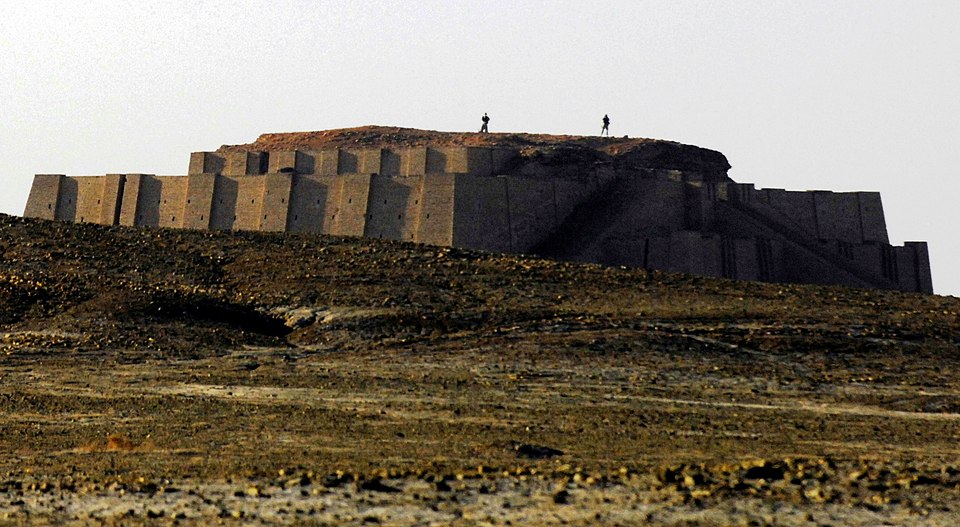
The traditional identification of “Ur of the Chaldees” (Genesis 11:31; Abraham 2:4) places Abraham’s homeland at Tell el-Muqayyar in southern Iraq — the great Sumerian city excavated by Leonard Woolley in the 1920s–30s. This identification has dominated popular understanding since Woolley’s spectacular discoveries of the Royal Tombs and the massive ziggurat of the moon god Nanna/Sin.
However, a growing number of scholars have argued that Abraham’s Ur was more likely located in the Haran region of northern Mesopotamia (modern southeastern Turkey). The arguments include:
- Geographic logic: A journey from southern Iraq to Haran (1,000+ km northwest) only to turn south again to Canaan makes little geographic sense. A northern Ur, near Haran, produces a much more natural migration route southward into Canaan.
- The “Chaldees” problem: The Chaldeans (Kasdim / כַּשְׂדִּים) did not arrive in southern Mesopotamia until the first millennium BC — centuries after Abraham. The designation “Ur of the Chaldees” applied to the southern Sumerian city is anachronistic for Abraham’s era. Some scholars suggest it better fits a location in the region where Chaldean-related peoples were present earlier.
- Family connections: Abraham’s family appears deeply rooted in the Haran region. His brother is named Haran (Genesis 11:26). His father Terah settled and died there. Abraham later sent his servant back to “my country and my kindred” near Haran to find a wife for Isaac (Genesis 24:4). Jacob fled to relatives in the same region. These connections suggest the family’s roots were in the north, not in distant southern Iraq.
- Moon worship in both locations: Haran was, like the southern Ur, a major center of moon-god worship (Sin/Nanna). Abraham’s father Terah — whose name may derive from yereach (יָרֵחַ, “moon”) — could have been connected to lunar worship in either location.
- Book of Abraham context: Abraham 1 describes a setting with significant Egyptian religious influence, including a “priest of Pharaoh” offering human sacrifices in the land of the Chaldeans. Egyptian cultural influence reaching into northern Mesopotamia along trade routes is well documented; direct Egyptian presence in the far south of Sumer is much harder to establish for this period.
The scholarly pioneer of this northern identification was Cyrus Gordon (1958), and it has been supported by scholars including H.W.F. Saggs and, among Latter-day Saint scholars, by researchers who note the Book of Abraham’s geographic details. The question is not settled — both identifications have serious proponents — but the northern Ur hypothesis has gained significant ground and deserves consideration alongside the traditional view.
What both identifications agree on: Whether Abraham’s Ur was in the north or the south, his world was shaped by Sumerian civilization — the culture that had invented writing, built the first cities, codified the first laws, and created a literary and religious tradition that influenced every society in the ancient Near East for millennia. Abraham left a Sumerian-influenced world and entered a Canaan that was already deeply marked by that same cultural inheritance.
The Sumerian Legacy in Canaan
By Abraham’s time, Sumerian civilization as a political entity was already gone — the Third Dynasty of Ur had collapsed around 2004 BC. But Sumerian cultural influence had been radiating outward across the Fertile Crescent for over a millennium, and its imprint on Canaan was deep and lasting:
Writing and Language
The Sumerians invented cuneiform — the wedge-shaped writing system pressed into clay tablets — around 3400 BC. It became the standard writing technology of the entire ancient Near East. When the Akkadians, Babylonians, Hittites, and Assyrians built their empires, they all wrote in cuneiform. The Amarna Letters — diplomatic correspondence between Egyptian pharaohs and Canaanite vassal kings from the 14th century BC — were written in Akkadian cuneiform, not in Egyptian hieroglyphs. This is remarkable: Canaanite kings writing to an Egyptian pharaoh used a Mesopotamian script adapted from Sumerian, because cuneiform had become the international lingua franca of diplomacy and trade. Even Ugarit, the great Canaanite port city, developed its own alphabetic cuneiform for local use while maintaining Akkadian cuneiform for international correspondence.
Legal Traditions
Sumerian legal codes — including the Code of Ur-Nammu (c. 2100–2050 BC), the oldest surviving law code — established precedents for contract law, property rights, marriage and divorce regulations, and debt resolution. These legal traditions spread throughout the Fertile Crescent via Akkadian and Babylonian channels. The Nuzi tablets (15th century BC, from modern northern Iraq) preserve legal customs — adoption of heirs, surrogate motherhood, inheritance contracts — that directly parallel practices described in the patriarchal narratives of Genesis. When Abraham negotiated the purchase of the cave of Machpelah from Ephron the Hittite (Genesis 23), the transaction followed legal conventions rooted in this Sumerian-derived tradition.
Religion and Mythology
Sumerian mythological themes permeated the entire region. The concept of a divine council presided over by a chief deity, the idea of a great flood sent by the gods, the underworld as a shadowy realm of the dead, temple worship centered on a ziggurat or high place — all of these entered Canaanite and broader Semitic religious thought through Sumerian channels. The Canaanite god El, who presides over a divine assembly in the Ugaritic texts, follows a pattern established in Sumerian theology with the god Enlil. When the biblical prophets described YHWH presiding over a heavenly council (Psalm 82:1; 1 Kings 22:19), they were engaging with a concept that had Sumerian roots stretching back two millennia.
Astronomy, Mathematics, and the Ordering of Time
The Sumerians were not primitive stargazers — they were systematic astronomers whose calculations were so precise that we still use their systems today. Their base-60 (sexagesimal) number system divided the circle into 360 degrees, the hour into 60 minutes, the minute into 60 seconds. Sixty was chosen because it is divisible by 2, 3, 4, 5, 6, 10, 12, 15, 20, and 30 — making calculations elegant rather than cumbersome. This was the foundation for geometry, trigonometry, and angular astronomy: every celestial body could be tracked by angular position with precision.
The mathematical sophistication went further than counting. Mesopotamian tablets preserve calculations involving geometric series, quadratic equations, and methods for computing areas and volumes that anticipate concepts later formalized in Greek and modern mathematics. They could predict eclipses, calculate planetary conjunctions, and reconcile three different astronomical cycles — daily rotation, lunar months, and solar years — into one coherent system.
Their ordering of time was equally precise. The Ur III calendar (standardized under King Shulgi, c. 2094–2047 BC) organized time into a nested hierarchy: seven-day weeks — called shabattum (שַׁבָּתוֹן), the origin of “Sabbath” — nested within twelve lunar months of 29 or 30 days, with seven intercalary months added every nineteen years to keep the calendar synchronized with the solar year. This nineteen-year cycle (later called the Metonic cycle, after the Greek astronomer who “discovered” it in 432 BC) is mathematically elegant: 19 solar years equal almost exactly 235 lunar months. The Mesopotamians had been using it for over a thousand years before Meton was born.
The seven-day week itself emerged from astronomical observation: the ancients tracked seven “wandering” bodies (Moon, Mercury, Venus, Sun, Mars, Jupiter, Saturn) whose movements differed from the fixed stars. Each day was assigned to a planetary body — a system preserved in the names of our weekdays to this day (Sunday/Sun, Monday/Moon, Saturday/Saturn). The twelve-month year reflected the approximately twelve lunations per solar year. These were not arbitrary religious inventions but observational conclusions embedded in mathematical structure.
The astronomical tablets themselves are staggering in scope. The MUL.APIN compendium catalogued dozens of stars and their rising and setting times throughout the year, organized by constellation and calibrated to the latitude of Mesopotamia (36°N). The Venus Tablet of Ammisaduqa preserves twenty-one years of systematic Venus observations. Thousands of Astronomical Diaries recorded daily planetary positions, lunar phases, and weather conditions — a continuous observational program spanning centuries.

Abraham’s inheritance: This was the intellectual world Abraham was born into. The scholar-priests of Ur’s temple schools were not mystics chanting at the moon — they were astronomers, mathematicians, and record-keepers. Abraham learned base-60 mathematics, calendar computation, and observational astronomy as a young man in Ur. When the Lord later showed him the stars and told him to “tell” them (Genesis 15:5) — the Hebrew saphar (סָפַר) meaning not merely to count but to recount, record, systematize — Abraham already had the training to do exactly that. The Book of Abraham’s astronomical discourse (Abraham 3) — with its reckoning of times, governing bodies, and ordered cosmos — speaks in the language of a man who had been educated in Chaldean astronomy and was now receiving divine correction and expansion of what he already understood.
Remarkably, this same tradition was still functioning over a thousand years later when Daniel was trained “in the learning and the tongue of the Chaldeans” (Daniel 1:4) in Babylon — the same base-60 mathematics, the same observational techniques, the same calendar systems. It was living institutional knowledge, continuously refined, not static mythology.
Trade and Economy
Sumerian innovations in accounting, weights and measures, and commercial contracts shaped how business was conducted across the Fertile Crescent. The shekel (Hebrew: sheqel / שֶׁקֶל) — the weight standard Abraham used to purchase Sarah’s burial cave (Genesis 23:16) — was originally a Sumerian unit of weight. The commercial infrastructure of Canaan’s trade routes was built on Sumerian-derived economic conventions.
The invisible foundation: Sumerian civilization is the invisible foundation beneath the entire biblical world. When we read about Canaanite city-states, cuneiform tablets, divine councils, shekels of silver, and legal customs governing marriage and inheritance, we are reading about a world that the Sumerians helped build — even though Sumer itself had fallen centuries before Abraham walked the land.
Canaan in the Patriarchal Age
The Canaan that Abraham entered was not a wilderness — it was a landscape already ancient, already urbanized in the lowlands, and already deeply connected to the wider world. Major cities like Hazor, Shechem, Megiddo, and Gezer were fortified urban centers with massive earthwork ramparts, temples, and palace complexes. Hazor in the north covered nearly 200 acres and may have had a population of 20,000 — one of the largest cities in the ancient Near East. These were the city-states of the peoples later listed in Deuteronomy 7:1 — the “seven nations greater and mightier than thou.” (For more on who these peoples were, see Section 03: The Canaanite Peoples.)
Between and around these cities, semi-nomadic herding communities like Abraham’s household moved with their flocks, following seasonal pasture patterns. Abraham’s dealings with various kings — the Pharaoh of Egypt, the kings of Sodom, Gomorrah, and Salem — reflect the political fragmentation of the time. His household was large enough to muster 318 trained servants for battle (Genesis 14:14), indicating substantial wealth and a household of perhaps 1,000+ people.
Religiously, Canaan was already home to the worship of El (the high god), Baal (the storm god), and various fertility deities. The “terebinth of Moreh” at Shechem (Genesis 12:6) was likely a sacred tree associated with Canaanite worship. By building an altar to YHWH at these locations, Abraham was establishing the worship of the true God in a land already thick with other gods. (For the full picture of Canaanite religion as revealed by the Ugaritic texts, see Section 04: Ugarit & Canaanite Religion.)
Archaeological Confirmation
Several major archaeological discoveries have confirmed details of this era:
| Discovery | Date Found | Significance |
|---|---|---|
| Ur excavations (southern) | 1922–1934 | Woolley’s excavations at Tell el-Muqayyar revealed a sophisticated Sumerian city with the ziggurat of Nanna/Sin (moon god), Royal Tombs, and advanced urban culture — the traditional identification of Abraham’s Ur |
| Haran / northern Ur sites | Various | The city of Harran (modern Turkey) was also a major center of Sin worship; nearby sites in the Haran region are candidates for the alternative northern identification of Abraham’s Ur |
| Nuzi tablets | 1925–1931 | Legal customs parallel Abraham’s story: adoption of heirs, surrogate motherhood, covenant rituals — rooted in Sumerian-derived legal tradition |
| Mari tablets | 1933–present | Amorite culture contemporary with Abraham; semi-nomadic lifestyles matching the patriarchal narratives; written in Akkadian cuneiform |
| Ebla archives | 1974–1976 | Ancient Semitic names and possible geographic references, including a possible connection to “Olishem” (Abraham 1:10); located in northern Syria near the Haran region |
The Mediterranean Trading World (c. 2000–1200 BC)
Abraham’s Canaan was not a backwater. It sat at the center of a vast trading network that connected three continents. To understand why this narrow corridor mattered so much — and why empires fought over it for millennia — you need to see the network.
The Four Great Land Routes
| Route | Path | Biblical Reference |
|---|---|---|
| Via Maris (“Way of the Sea”) | Egypt → Gaza → Joppa → Megiddo → Hazor → Damascus | Isaiah 9:1 |
| King’s Highway | Gulf of Aqaba → Edom → Moab → Ammon → Damascus | Numbers 20:17 |
| Ridge Route (“Way of the Patriarchs”) | Beersheba → Hebron → Jerusalem → Bethel → Shechem → Jezreel Valley | Genesis 12:6–9 |
| Incense Route | Southern Arabia (Sheba) → Petra → Gaza → Mediterranean | Queen of Sheba’s visit to Solomon |
These routes were already ancient when Abraham walked them — the Via Maris dates to the Early Bronze Age (3000+ BC). Every army that marched between Egypt and Mesopotamia passed through Canaan. Every trade caravan between Arabia and the Mediterranean crossed it. The covenant people were placed at the crossroads of the ancient world.
The Minoan Sea Network
While the overland routes connected Canaan to Egypt and Mesopotamia, the maritime routes connected it to the Aegean world. The Minoans of Crete — called Keftiu by the Egyptians — dominated Mediterranean maritime trade from roughly 2000 to 1450 BC. Their powerful navy controlled the sea routes that connected Egypt, the Levant, and the Aegean.
This was not distant commerce. Minoan trade goods appear at Canaanite and Egyptian sites. Egyptian objects appear on Crete. The tomb paintings at Thebes show Keftiu tribute bearers carrying distinctive bull-headed vessels (rhyta) in Minoan clothing and hairstyles. The Levantine port cities — Byblos, Ugarit, Sidon — were nodes in this network, shipping cedar, textiles, and metals west to Crete and receiving Aegean pottery, metalwork, and luxury goods in return.
The result was a deeply interconnected Bronze Age world. The patriarchs did not live in isolation. Abraham’s Canaan was embedded in a trading system that stretched from Mesopotamia to Crete, from Egypt to Anatolia. Goods, languages, religious ideas, and peoples moved along these routes constantly.
The Collapse of Minoan Power
Sometime between 1650 and 1550 BC, the volcanic eruption of Thera (modern Santorini) — one of the most catastrophic natural disasters in recorded history — devastated the island and generated massive tsunamis that struck the northern coast of Crete. The eruption did not destroy Minoan civilization outright, but research by Knappett, Rivers, and Evans (Antiquity, 2011) has shown that the loss of Thera as a critical maritime hub gradually increased transport costs across the Aegean, weakening the economic network that sustained Minoan power.
Approximately a century later (c. 1450 BC), the mainland Mycenaeans exploited this weakness. They seized control of Knossos, replaced Linear A with their own script (Linear B), and took over the trade routes. The Minoans — who had been the major merchant hub for much of the ancient world — were absorbed under Mycenaean domination.
Why this matters for the biblical story: The Minoan-Mycenaean transition reshaped the entire eastern Mediterranean. The Levantine port cities that had traded with the Minoans now dealt with Mycenaean merchants. The goods, styles, and cultural influences flowing through Canaan shifted. And the long-term destabilization of Aegean trade networks was one of several converging forces — alongside Egyptian imperial overreach, Hittite-Egyptian rivalry, climate-driven famine, and internal social upheaval — that would eventually produce the catastrophic Bronze Age Collapse. No single event opened the promised land; it was the convergence of all of them that shattered the power structures holding Canaan in place.
The Late Bronze Age: Canaan Under Egypt (c. 1550–1200 BC)
During Egypt’s New Kingdom, Canaan was an Egyptian vassal territory. Egyptian governors, garrisons, and administrative centers dotted the landscape. Canaanite kings ruled their city-states, but they ruled under Pharaoh’s authority — paying tribute, providing corvée labor, and begging for military assistance when rivals threatened.
Egypt’s ability to project this kind of power into Canaan rested, in large part, on a technology that had transformed warfare across the ancient world: the horse-drawn chariot.
The Chariot Revolution
The chariot was not a Canaanite or Egyptian invention. Its origins lie thousands of miles to the north, on the Pontic-Caspian steppes of what is now Ukraine and southern Russia. As David W. Anthony documents in The Horse, the Wheel, and Language (Princeton, 2007), the domestication of the horse (c. 4200–3500 BC) and the development of the spoked wheel and lightweight chariot (c. 2100–2000 BC) originated among the Proto-Indo-European peoples of the steppe. These innovations spread southward through Central Asia and the Caucasus into Anatolia, Mesopotamia, and eventually the Levant — carried by migrating peoples and transmitted through trade networks.
The chariot reached the ancient Near East by approximately 1800 BC. But it was the Hyksos — Semitic peoples from the Levant who migrated into Egypt and ruled the Nile Delta as the 15th Dynasty (c. 1650–1550 BC) — who introduced chariot warfare to Egypt. The Hyksos brought with them the light, horse-drawn war chariot, the composite bow (which could be fired effectively from a moving platform), and new bronze weaponry. These technologies gave them a decisive military advantage over the native Egyptian forces, who had never faced them.
When the native Egyptian 18th Dynasty expelled the Hyksos and founded the New Kingdom (c. 1550 BC), they did not discard the technology that had defeated them — they mastered and perfected it. Egyptian chariotry became the most formidable military force in the ancient world. The New Kingdom’s ability to control Canaan as a vassal territory, to project power across the Levant, and to contest the Hittites at Kadesh was built on the chariot corps that the Hyksos had originally introduced.
The chariot in Canaan: By the Late Bronze Age, the chariot was the defining weapon of the Canaanite city-states. Maintaining a chariot force required enormous resources — trained horses, skilled craftsmen, bronze fittings, and an elite warrior class. Only wealthy, established city-states could afford them. This is why the Canaanite lowland cities with their chariots remained unconquerable by Israel’s tribal infantry: “the LORD was with Judah; and he drave out the inhabitants of the mountain; but could not drive out the inhabitants of the valley, because they had chariots of iron” (Judges 1:19).
The technological journey is remarkable: a steppe innovation from the grasslands north of the Black Sea traveled through Anatolia and the Levant, was introduced to Egypt by Semitic migrants, was perfected by native Egyptian pharaohs, and then was used by Canaanite vassal kings to hold their territory against Israelite tribes who fought on foot. The chariot is a thread that connects the Indo-European steppe to the promised land.
The Amarna Letters
The most vivid evidence of this period comes from the Amarna Letters — approximately 382 clay tablets discovered at Akhenaten’s capital, dating to roughly 1350–1330 BC. Written in Akkadian cuneiform (the diplomatic language of the era), these are letters between Pharaoh and rulers throughout the Near East. The Canaanite letters reveal a fractured, constantly contested landscape:
- City-state kings accusing each other of treachery and begging Egypt for troops
- Reports of the disruptive Habiru (Apiru) — a social class of outsiders and displaced people whose name is linguistically similar to “Hebrew,” though the connection remains debated
- A world where loyalty was fluid, alliances shifted constantly, and no Canaanite ruler could survive without Egyptian backing
This is the Canaan that existed before Israel — not a unified nation but a patchwork of petty kingdoms, all under the umbrella of Egyptian imperial control. (See Section 09: The Amarna Age for the full treatment.)
The Hittite Rivalry
Egypt did not control the northern Levant unchallenged. The Hittite Empire of Anatolia (modern Turkey) competed for control of Syria and the territory above Canaan. The climax was the Battle of Kadesh (c. 1274 BC) between Ramesses II and the Hittite king Muwatalli II — the best-documented battle of the ancient world. Both sides claimed victory. The conflict eventually produced the Treaty of Kadesh (c. 1258 BC) — the oldest known peace treaty between sovereign nations.
This Egyptian-Hittite rivalry meant that Canaan was caught between two superpowers. The northern Levant (including Ugarit) fell within the Hittite sphere; the southern Levant (including the territory Israel would later claim) was Egyptian. The boundary between them ran through what is now Syria and Lebanon.
The Merneptah Stele
The earliest mention of “Israel” outside the Bible appears on the Merneptah Stele (c. 1208 BC), carved to commemorate an Egyptian military campaign into Canaan. The relevant line reads: “Israel is laid waste; his seed is not.” The determinative used for “Israel” in the hieroglyphic text indicates a people, not a place — suggesting that by this date, Israel existed as an identifiable group in Canaan, but not yet as a settled territorial state.
The Bronze Age Collapse (c. 1200–1150 BC)
Around 1200 BC, the interconnected world of the Late Bronze Age came apart. Within a single generation, the Hittite Empire vanished. Mycenaean Greece collapsed. Ugarit was destroyed and never rebuilt. Egypt survived but withdrew from Canaan permanently. The sophisticated international trade network that had sustained these civilizations for centuries disintegrated.
The “Perfect Storm”
Eric Cline’s influential study 1177 B.C.: The Year Civilization Collapsed (Princeton, 2014/2021) identifies a convergence of five cascading catastrophes:
- Climate change and prolonged drought — reducing harvests across the eastern Mediterranean
- Famine — documented in letters from Ugarit and Hatti begging Egypt for grain shipments
- Devastating earthquakes — a sequence of seismic events across the region
- Internal rebellions — populations revolting against palace economies already strained by crisis
- Migrations of displaced peoples — the “Sea Peoples”
The deeply interconnected Bronze Age trade network — the same system that had made these civilizations wealthy — became the mechanism of their collapse. The failure of each node stressed others in a cascading domino effect. Notably, inland empires untouched by seafaring raiders (Kassite Babylonia, Elam, Assyria) also declined during this period, confirming that the Sea Peoples alone cannot explain the collapse.
The Sea Peoples
Egyptian records describe attacks by groups they called the “Sea Peoples”. Ramesses III repelled their invasion of Egypt (c. 1178 BC, depicted in reliefs at Medinet Habu). These were not a single people but displaced populations from across the Mediterranean — a symptom of the collapse, not its cause:
| Egyptian Name | Proposed Identification | Probable Origin |
|---|---|---|
| Peleset | Philistines | Crete / Aegean |
| Tjeker | Possibly Trojan-related | Anatolia |
| Denyen | Danaans (Homeric Greeks) | Greece |
| Sherden | Sardinians | Sardinia |
| Shekelesh | Siculi | Sicily |
| Lukka | Lycians | Southwest Anatolia |
The Philistines (Peleset) — Israel’s persistent adversaries in Judges and Samuel — were among these displaced groups. After being repelled from Egypt, they settled on the southern Canaanite coast. Archaeological evidence from Ashkelon, Ekron, and Gath shows Mycenaean-style pottery, Aegean temple designs, and Mycenaean loom weights in their earliest levels. The Bible itself preserves this connection: Amos 9:7 and Jeremiah 47:4 associate the Philistines with Caphtor — a name linguistically related to the Egyptian Keftiu, both pointing to Crete and the Aegean world. (See Section 06: The Philistines.)
For Latter-day Saint readers: The Bronze Age Collapse is not merely ancient geopolitics — it is the event that opened the promised land. For centuries, Canaan had been under the firm control of Egypt and its network of vassal kings. The Hittites dominated the north. The Mycenaean-Minoan trade network linked the coasts. As long as these great powers held, no tribal confederation could have taken and held the land.
But when the system collapsed — when Egypt withdrew its garrisons, the Hittite Empire vanished, the coastal cities burned, and the established power structures disintegrated — a power vacuum opened across the very territory God had promised to Abraham’s descendants. The Israelites entered Canaan not into a thriving empire but into a fractured landscape of weakened city-states, exactly the conditions in which a covenant people led by Joshua could take possession of the land (Joshua 1:2–4). The timing was not coincidental — it was providential.
Iron Age I: Israel Settles the Highlands (c. 1200–1000 BC)
The collapse opened a window. With no imperial overlord controlling the region, the central hill country of Canaan — less desirable, harder to farm, largely ignored by the great powers — became available for new settlement.
Archaeological surveys have documented a dramatic increase in small, unwalled villages in the central highlands during Iron Age I. These settlements share distinctive features: four-room houses, collared-rim storage jars, terraced hillside agriculture, and a notable absence of pig bones (in contrast to Philistine coastal sites). Whether these settlers arrived from outside Canaan (the biblical conquest model) or emerged from within Canaanite society (the social-revolution model), or some combination, remains one of the most debated questions in biblical archaeology.
What the archaeological record confirms is this: by 1200 BC, a distinct population was establishing itself in the central highlands of Canaan. By 1208 BC (the Merneptah Stele), this population was identifiable enough for Egypt to name it: Israel.
The Iron Age Transition
The transition from bronze to iron had military and economic consequences that directly affected Israel’s story:
- Iron chariots: The chariot technology that had originated on the Eurasian steppes, been introduced to Egypt by the Hyksos, and dominated Late Bronze Age warfare now evolved further. Canaanite city-states upgraded from bronze to iron fittings, making their chariots even more formidable. Israel, fighting on foot from the highlands, had no answer for them in the lowlands — “the LORD was with Judah; and he drave out the inhabitants of the mountain; but could not drive out the inhabitants of the valley, because they had chariots of iron” (Judges 1:19)
- Philistine iron monopoly: The Philistines initially controlled iron smelting technology in the region — “there was no smith found throughout all the land of Israel: for the Philistines said, Lest the Hebrews make them swords or spears” (1 Samuel 13:19)
- Agricultural expansion: Iron tools enabled terracing and clearing of the rocky highland terrain, making previously marginal land productive — precisely the kind of land Israel was settling
The Big Picture: Why This Timeline Matters
The story of Canaan’s timeline is a story of strategic position, imperial control, catastrophic collapse, and the narrow window that opened between the fall of one world order and the rise of the next.
| Era | Who Controlled Canaan | Israel’s Status |
|---|---|---|
| Middle Bronze Age | No single power; city-states + Egyptian influence | Patriarchs sojourn as guests and migrants |
| Late Bronze Age | Egypt (with Hittite rivalry in the north) | Israel in Egypt — slavery, Exodus, wilderness |
| Bronze Age Collapse | Nobody — the power vacuum | Joshua’s conquest; the window opens |
| Iron Age I | Contested: Canaanite city-states, Philistines, Israelite tribes | Judges period; tribal confederation; struggle for survival |
Israel entered the land not through diplomatic negotiation or military conquest of a great empire, but through a crack in history — a moment when every power that had held Canaan for centuries simultaneously lost its grip. That crack was wide enough for a covenant people to walk through. The book of Joshua is, in part, the story of what they did with that opening. The book of Judges is the story of what happened when they failed to hold it.
Sources and Further Reading
- Eric H. Cline, 1177 B.C.: The Year Civilization Collapsed (Princeton, rev. 2021) — Definitive treatment of the Bronze Age Collapse as a systems failure
- Eric H. Cline, After 1177 B.C.: The Survival of Civilizations (Princeton, 2024) — What survived and how the Iron Age emerged
- Amihai Mazar, Archaeology of the Land of the Bible: 10,000–586 BCE (Doubleday, 1990) — Standard archaeological survey
- David W. Anthony, The Horse, the Wheel, and Language: How Bronze-Age Riders from the Eurasian Steppes Shaped the Modern World (Princeton, 2007) — Definitive treatment of horse domestication, chariot development, and the spread of Indo-European peoples and technologies from the Pontic-Caspian steppe
- Cyrus H. Gordon, “Abraham and the Merchants of Ura,” Journal of Near Eastern Studies 17 (1958): 28–31 — The seminal argument for a northern identification of Abraham’s Ur
- Israel Finkelstein, The Archaeology of the Israelite Settlement (Israel Exploration Society, 1988) — The original highland survey data documenting the dramatic increase in Iron Age I settlements; foundational for all subsequent debate about Israelite origins
- Lawrence E. Stager, “The Archaeology of the Family in Ancient Israel,” Bulletin of the American Schools of Oriental Research 260 (1985): 1–35 — Identified the four-room house and collared-rim storage jar as distinctive markers of early Israelite settlement
- Brian Hesse & Paula Wapnish, “Can Pig Remains Be Used for Ethnic Diagnosis in the Ancient Near East?” in Neil Asher Silberman & David Small, eds., The Archaeology of Israel: Constructing the Past, Interpreting the Present (Sheffield Academic Press, 1997) — Analysis of pig bone absence at highland sites vs. presence at Philistine coastal sites as a cultural/dietary marker
- Giorgio Buccellati, The Amorites of the Ur III Period (Istituto Orientale di Napoli, 1966) — Foundational study documenting Amorite peoples in Mesopotamian records; traces their migration from the Syrian steppe into Ur III territory and their eventual establishment of dynasties across the region
- Kenneth Kitchen, On the Reliability of the Old Testament (Eerdmans, 2003) — Extensive treatment of patriarchal and conquest-era evidence
- Knappett, Rivers & Evans, “The Theran eruption and Minoan palatial collapse: new interpretations gained from modelling the maritime network,” Antiquity 85 (2011): 1008–1023 — Network modeling of Thera’s impact on Minoan trade
- WHE — Minoan Civilization
- WHE — Mycenaean Civilization
- WHE — Bronze Age Collapse
- WHE — Sea Peoples
- WHE — Amarna Letters
- WHE — Amorites
- WHE — Mari
- WHE — Hammurabi