LDS-Specific Connections
The Book of Mormon begins in Babylon’s shadow — and the Restoration still speaks Babylon’s name
For Latter-day Saints, the Babylonian crisis is not background reading — it is the opening scene of the Book of Mormon. Two families of refugees from Nebuchadnezzar’s Judah, Lehi’s and Mulek’s, carry the book’s entire premise across the ocean. And at the other end of the dispensations, the Doctrine and Covenants adopts Babylon as its standing name for the world the Saints are called out of. This page draws those threads together.
Lehi’s Jerusalem: The Book of Mormon’s First Page Is a Babylon Page
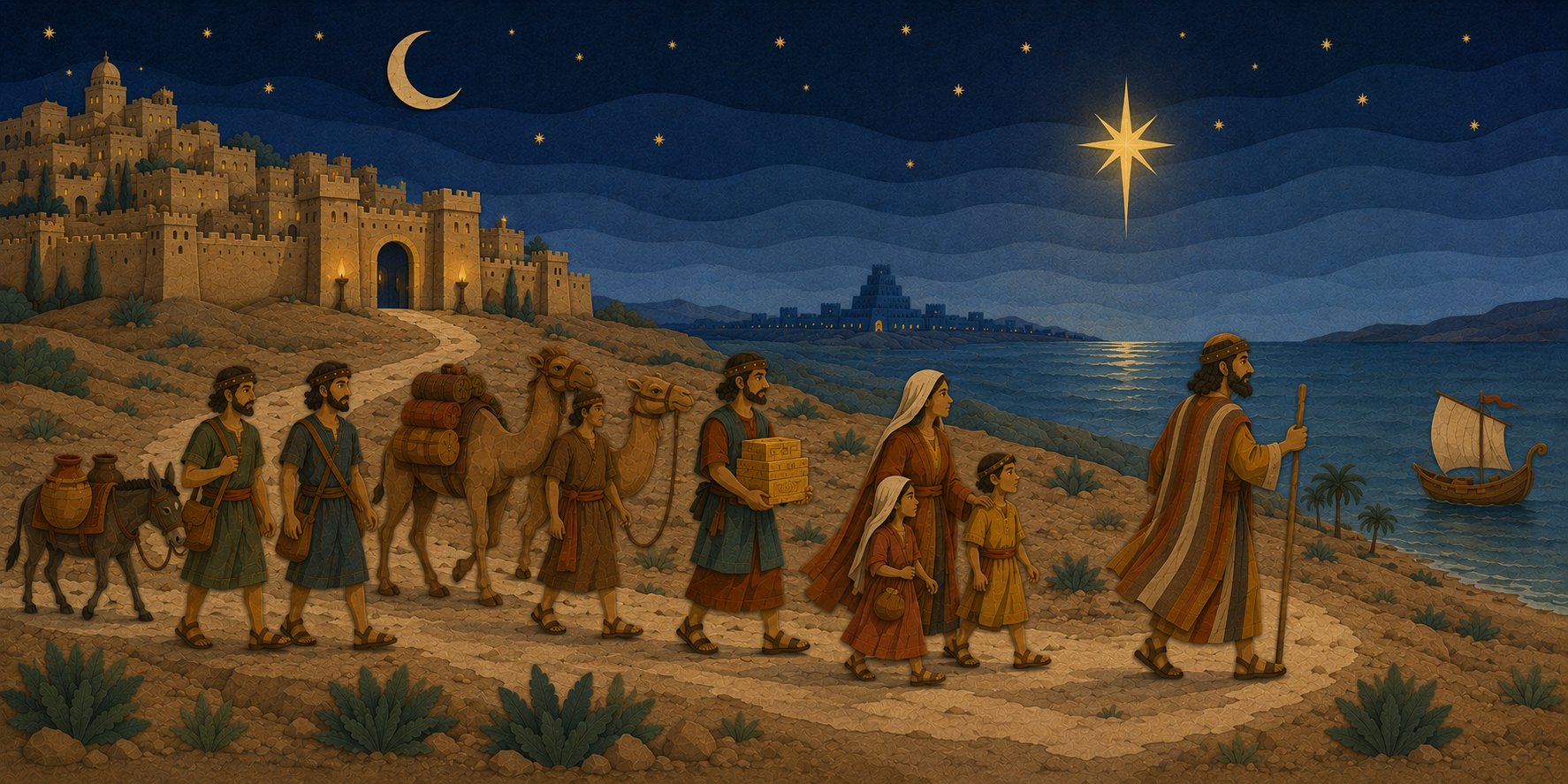
The Book of Mormon dates itself, in its first sentence of history, to this guide’s events: “in the commencement of the first year of the reign of Zedekiah, king of Judah… there came many prophets, prophesying unto the people that they must repent, or the great city Jerusalem must be destroyed” (1 Nephi 1:4). Zedekiah’s first year is a date the Babylonian Chronicle lets us fix precisely: 597 BC. That is the aftershock of the first deportation, when Nebuchadnezzar had just carried off Jehoiachin and “appointed a king of his own choice” (see Section 08). And the “many prophets” of that verse are not a literary flourish. Jeremiah’s ministry ran unbroken from Josiah to the city’s fall (Jeremiah 1:2–3), and within a few years of Zedekiah’s accession he was wearing the yoke in the temple court (Jeremiah 27:12; 28:1). Habakkuk’s cry over the Chaldean rise belongs to these same years, though his book carries no date. Ezekiel, deported in 597 BC, would be called by the Chebar within five years (Ezekiel 1:2). And a generation of prophets had already learned the price: Urijah son of Shemaiah had been extradited from Egypt and executed under Jehoiakim for preaching exactly what Lehi preached (Jeremiah 26:20–23). That last case matters. It shows the death threats against Lehi (1 Nephi 1:20) were standard operating procedure, not storybook peril.
Read against this guide, 1 Nephi’s opening chapters sit snugly inside their decade. The city is boiling with pro-Egypt optimism after 597 (Zedekiah’s court faction, Jeremiah 37:5–9). Prophets are condemned as traitors for saying Babylon would win. Records are kept on brass plates in an age when Judah’s scribal culture was at its peak (see the excavated bullae of Jeremiah’s circle, Section 08). And a wealthy family with a “land of inheritance” liquidates gold and silver (1 Nephi 3:22) to escape a doomed city. The Latter-day Saint scholarly literature on this setting is rich: the essays collected in Glimpses of Lehi’s Jerusalem (Welch, Seely & Seely, eds., 2004) reconstruct the politics, economy, and prophetic ferment of exactly these years. Lehi’s vision of Jerusalem’s coming destruction (1 Nephi 1:13) was vindicated a little over a decade later. His son Nephi later recorded a vision Lehi had in the New World, of the city’s destruction: “I have seen a vision, in which I know that Jerusalem is destroyed; and had we remained in Jerusalem we should also have perished” (2 Nephi 1:4).
One story, two arks: it is worth pausing on what the Book of Mormon is, structurally: exile literature. Like Ezekiel’s community on the Chebar, Lehi’s family is a covenant remnant carried out of Jerusalem in the Babylonian crisis, sustained by records, prophets, and promises of gathering. The book’s founding anxieties (keeping the record, keeping the covenant, remembering Jerusalem) are the exile’s anxieties (see Section 07). The difference is the direction of travel. Judah’s exiles were carried east, into the empire. Lehi’s family was led west, out of it — to make the same experiment, covenant life without the old temple mount, on a new continent, complete with a temple “after the manner of… Solomon” (2 Nephi 5:16).
Mulek: The Other Escape
The Book of Mormon preserves a second, stranger footnote to 586 BC. The people of Zarahemla, discovered by Mosiah’s Nephites, “came out from Jerusalem at the time that Zedekiah, king of Judah, was carried away captive into Babylon” (Omni 1:15). Their leader was Mulek, identified as a son of Zedekiah (Helaman 6:10; Mosiah 25:2). That is a bold claim. 2 Kings records Nebuchadnezzar slaughtering “the sons of Zedekiah” at Riblah before their father’s eyes (2 Kings 25:7) — and the Book of Mormon makes the exception explicit: “Will ye say that the sons of Zedekiah were not slain, all except it were Mulek?” (Helaman 8:21). Picture what that would look like. An infant or young son, unlisted among the executed adult heirs, smuggled out in the chaos of the city’s fall, through the very escape gap the text describes between the walls (2 Kings 25:4). That is precisely the kind of detail official history would not record.
How would a Judahite refugee party cross an ocean? Here Latter-day Saint scholarship has long pointed to Phoenician seafaring: the one Mediterranean people with the ships and the range (see the Phoenicians page of the Canaan guide). John L. Sorenson developed the case in his study of the Mulekites (BYU Studies, 1990). Hugh Nibley noted long before that Egyptian-financed ships of the era were “manned… by Syrian and Phoenician crews” (An Approach to the Book of Mormon). And Scripture Central has gathered the evidence in its “Mulek’s Transoceanic Voyage” entry. It remains a reconstruction, offered as such; the Book of Mormon itself says nothing about the route. But it is a coherent one. Tyre’s navy was the ally of Zedekiah’s anti-Babylon coalition (Jeremiah 27:3), and Phoenician hulls were the era’s only plausible blue-water transport. (A caution for teachers: the popular etymology “Zarahemla means seed of the king” is not the preferred scholarly reading. The Book of Mormon Onomasticon (a scholarly dictionary of the book’s names) derives the name from zeraʿ-ḥemlah, “seed of compassion,” a lovely name in its own right for a refugee people preserved by mercy.)
Daniel: The Manual for Living in Babylon
If Lehi’s family shows the Lord leading a remnant out of Babylon’s reach, Daniel shows the other calling: covenant faithfulness inside the empire. Which is, after all, where most of God’s people have to live. The book’s episodes form a practical curriculum that Latter-day Saint teaching has drawn on for generations. The young exiles show quiet dietary resolve, “purposed in his heart” before the test arrived (Daniel 1:8). They excel in Babylon’s own learning without adopting Babylon’s gods (Daniel 1:17–20; see Section 05). The three friends answer at the furnace with faith without a guaranteed outcome — “but if not…” (Daniel 3:17–18). And Daniel keeps his prayer, windows open, at known cost (Daniel 6:10).
The Restoration gave Daniel’s grandest image an address: the “stone… cut out of the mountain without hands” that breaks the image of empires and fills the whole earth (Daniel 2:44–45). Modern revelation applies it directly to the latter-day kingdom of God rolling forth (D&C 65:2), and Joseph Smith taught the Saints to see their own work inside that prophecy. Babylon, in Daniel’s vision, is only the statue’s golden head — the first and most splendid of a procession of kingdoms. Their common fate is to become “like the chaff of the summer threshingfloors” (Daniel 2:35).
“Go Ye Out From Babylon”: The Symbol in the Restoration
The Doctrine and Covenants opens with Babylon and nearly closes with it. In the Lord’s preface, the world’s condition is diagnosed with the old city’s name: every man walks “in his own way, and after the image of his own god… whose substance is that of an idol, which waxeth old and shall perish in Babylon, even Babylon the great, which shall fall” (D&C 1:16). That is idolatry redefined for a modern age (self-made gods), with Isaiah’s watchman-cry (“is fallen, is fallen,” see Section 08) embedded in the verdict. And in the great gathering revelation, the exile’s summons is reissued to the whole church: “Go ye out from Babylon. Be ye clean that bear the vessels of the Lord” (D&C 133:5; also vv. 7, 14). The language is lifted from Isaiah’s and Jeremiah’s departure-oracles (Isaiah 52:11; Jeremiah 51:6). And the temple vessels of 586 BC (Ezra 1:7) are transfigured into the covenants the Saints carry. The pioneers sang the symbol across the plains: “O Babylon, O Babylon, we bid thee farewell” (Ye Elders of Israel, Hymns no. 319). The Church’s teaching since has turned the symbol fully inward: leaving Babylon today is not a wagon journey but a daily choice. It is Jeremiah’s balance for the exiles, exactly: in the world, not of it. Build, plant, and bless the city you live in (Jeremiah 29:5–7), and help it become Zion. The pioneers gathered to a Zion in the mountains, but scripture defines Zion by its people, not its place: “this is Zion—THE PURE IN HEART” (D&C 97:21), a people “of one heart and one mind” who “dwelt in righteousness” (Moses 7:18). Today the stakes of Zion reach around the world, and Zion is wherever covenant people live that law.
Scattering and gathering: the exile is the Old Testament’s master pattern of a principle the Restoration places at the center of the latter days. Israel is scattered for covenant breach, preserved in scattering, and gathered again with interest: “after they have been scattered, and the Lord God hath scourged them by other nations” (2 Nephi 25:16), until the day he will “remember the covenants which he made to their fathers” (1 Nephi 19:15). Babylon scattered Judah in three known directions: Babylonia, Egypt, and (by the Book of Mormon’s witness) across the sea. Israel’s scattering reached farther still. Nephi wrote that “the more part of all the tribes” were “scattered to and fro upon the isles of the sea; and whither they are none of us knoweth” (1 Nephi 22:4), and the risen Savior spoke of “other sheep, which are not of this land, neither of the land of Jerusalem” (3 Nephi 16:1; John 10:16). Every stream was remembered. Latter-day Saints read their own missionary and temple work as the far end of that same arc. It is the gathering that the return from Babylon rehearsed in miniature (Jeremiah 29:14), now conducted “out of every nation,” one covenant at a time, on both sides of the veil.
A War Before Creation — and Why It Isn’t Babylon’s
The sharpest connection of all reaches back before the world itself. Genesis 1 has no war before creation (see Section 04) — but the Restoration does. In the premortal council, John’s “war in heaven” broke out: Michael against the dragon (Revelation 12:7–9). And it was fought over agency itself. Two came forward, and in Abraham’s account both answer alike, “Here am I, send me,” and the Lord says, “I will send the first.” Moses supplies what set the second apart: he demanded the Father’s own honor and “sought to destroy the agency of man” to guarantee that not one soul would be lost (Moses 4:1–4; Abraham 3:27–28). The Father chose the first; the second “was angry, and kept not his first estate.”
Set that against Babylon, and the difference is total. Babylon also had a war before creation — but there the war was the creation: the cosmos hacked from the carcass of the slain Tiamat, humanity kneaded from a murdered god’s blood. The Restoration keeps the pre-creation war and refuses the pre-creation slaughter. There was a conflict before the world — but the world is not its trophy. Creation still comes exactly as Genesis says it does: by a word, freely spoken, to make room for children who could choose. Babylon’s cosmos is what is left when gods fight for power; the Restoration’s is what a Father builds in order to give it away.
Teaching With This Guide: Three Threads Worth Pulling
- Trust, the theme of the Come, Follow Me lesson on 2 Kings 16–25, has a geography. Hezekiah “trusted in the LORD God of Israel” (2 Kings 18:5) with Assyria at the wall; a century later Zedekiah trusted Egypt with Babylon at the wall. Same map, same pressure, opposite anchors, opposite endings — and the Babylonian evidence (the 601 BC border battle that emboldened Jehoiakim; Egypt’s token relief force of 588 that Jeremiah saw through, Jeremiah 37:7–8) makes the politics of misplaced trust concrete for a class.
- The exile did not interrupt the covenant — it advanced it. Jehoiachin at the king’s table (the book of Kings’ deliberate last word, 2 Kings 25:27–30), Judah-town’s households building and planting per Jeremiah’s letter, Daniel in the court: God’s work continued in Babylon, through people who thought their story was over. Few chapters in scripture speak more directly to a student, or a family, living through their own version of 586.
- The Book of Mormon is this story’s sequel. When class members next read 1 Nephi, they will be standing in Zedekiah’s Jerusalem — this exact decade, these exact prophets, this exact empire at the door. Planting that connection now (“the Book of Mormon is what the Lord was doing with one more family while all this happened”) is the cheapest cross-reference in the curriculum and one of the most powerful.
Sources and Further Reading
Lehi’s Jerusalem & the Mulekites:
- John W. Welch, David Rolph Seely & Jo Ann H. Seely, eds., Glimpses of Lehi’s Jerusalem (FARMS/BYU, 2004) — The essential essay collection on Jerusalem c. 600 BC as the Book of Mormon’s opening setting.
- John L. Sorenson, “The Mulekites,” BYU Studies 30, no. 3 (1990) — The standard study of the Mulekite migration and its plausibility.
- Hugh Nibley, An Approach to the Book of Mormon (Deseret Book/FARMS, 3rd ed. 1988) — Includes the discussion of Phoenician-crewed shipping in Lehi’s era.
- Scripture Central, “Evidence: Mulek’s Transoceanic Voyage” — gathered evidence and sources for the escape-by-sea reconstruction.
- Book of Mormon Onomasticon (BYU) — s.v. “Zarahemla” and “Mulek,” for the careful state of the name questions.
Exile & Restoration Themes:
- Rainer Albertz, Israel in Exile (SBL, 2003) — The scholarly frame for the exile as covenant crucible (see Section 07).
- Come, Follow Me — Old Testament, the lesson “He Trusted in the Lord God of Israel” (2 Kings 16–25) — and the companion Divided Kingdom Field Guide on this site, which covers how the books of Kings were written.
- Doctrine and Covenants 1; 65; 133 — the Restoration’s Babylon texts read on this page.