Major Sites & Discoveries
Where Babylon’s story surfaced — the mounds, the digs, and the museum halls
For seventeen centuries, Babylon was a rumor under the mounds of Iraq: a name in scripture and Herodotus, its location half-remembered, its script unreadable. Then the nineteenth and twentieth centuries reversed all of that in a rush. The wedge-script was deciphered. The mounds were opened. And the libraries of the Bible’s great adversary began, tablet by tablet, to corroborate the Bible’s account of it. This page maps the principal sites and the landmark finds, and tells you where each one sits today.
Babylon Itself (Tell Babil, Iraq)
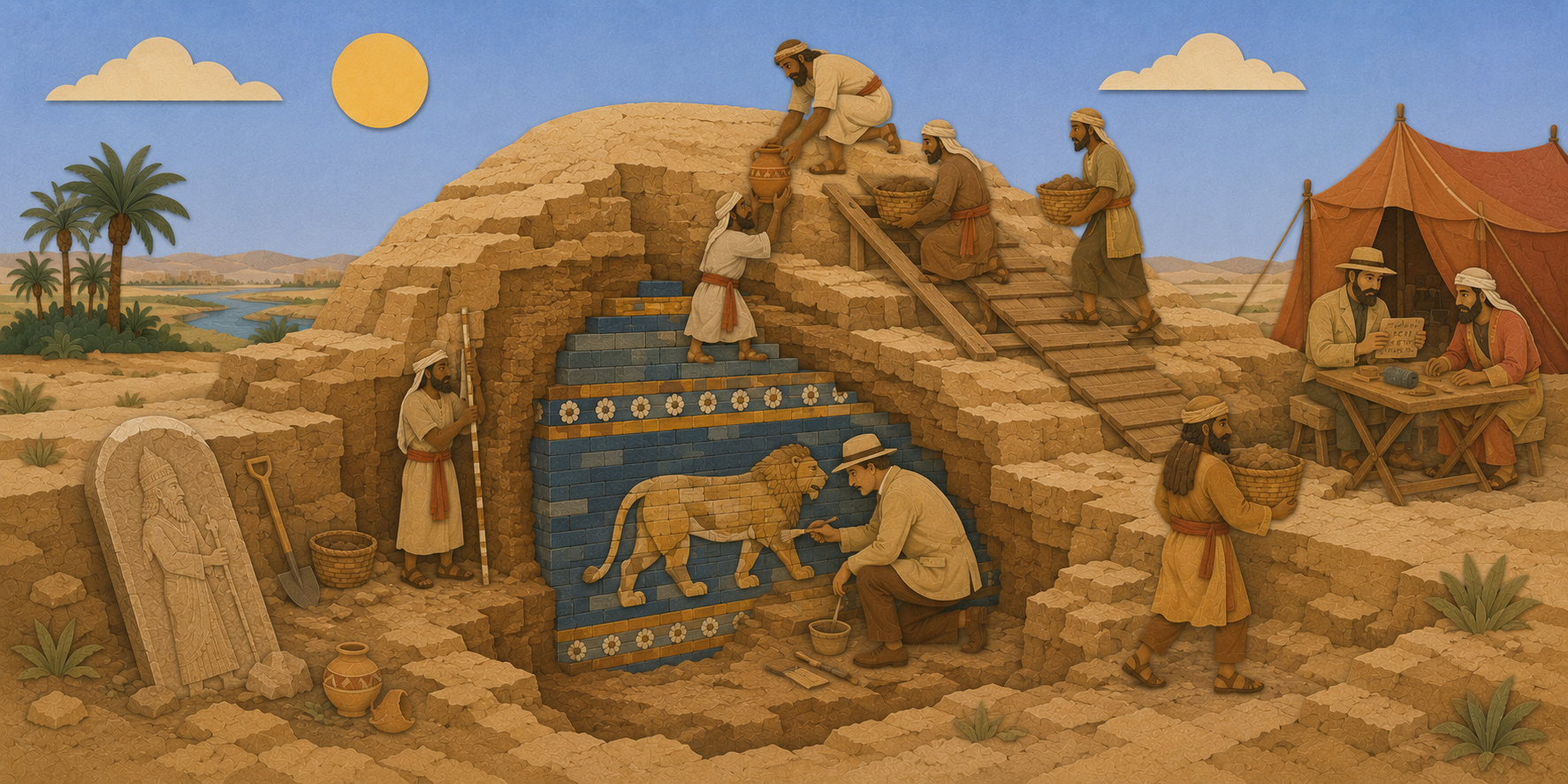
The ruin field lies on the Euphrates about 85 km south of Baghdad, near modern Hillah. The early explorers found it baffling. Claudius Rich, the East India Company’s Baghdad resident, surveyed the mounds in 1811 and 1817. Austen Henry Layard, the excavator of Nineveh, made test digs (soundings) here. But the mudbrick defeated them both, and they turned to the more photogenic Assyrian capitals instead. Babylon’s real excavation was Robert Koldewey’s German expedition of 1899–1917: eighteen continuous years, digging through Ottoman rule into a world war. It recovered the city of Nebuchadnezzar in plan: the double walls, the Processional Way, and the Southern Palace, with the Jehoiachin ration tablets in its storerooms (see Section 07). It uncovered the foundations of Etemenanki and the glazed-brick masses of the Ishtar Gate, shipped to Berlin and reassembled there by 1930 (see Section 06). And Koldewey’s methods (the patient tracing of mudbrick architecture that earlier diggers had shoveled through unseen) helped found modern Near Eastern archaeology.
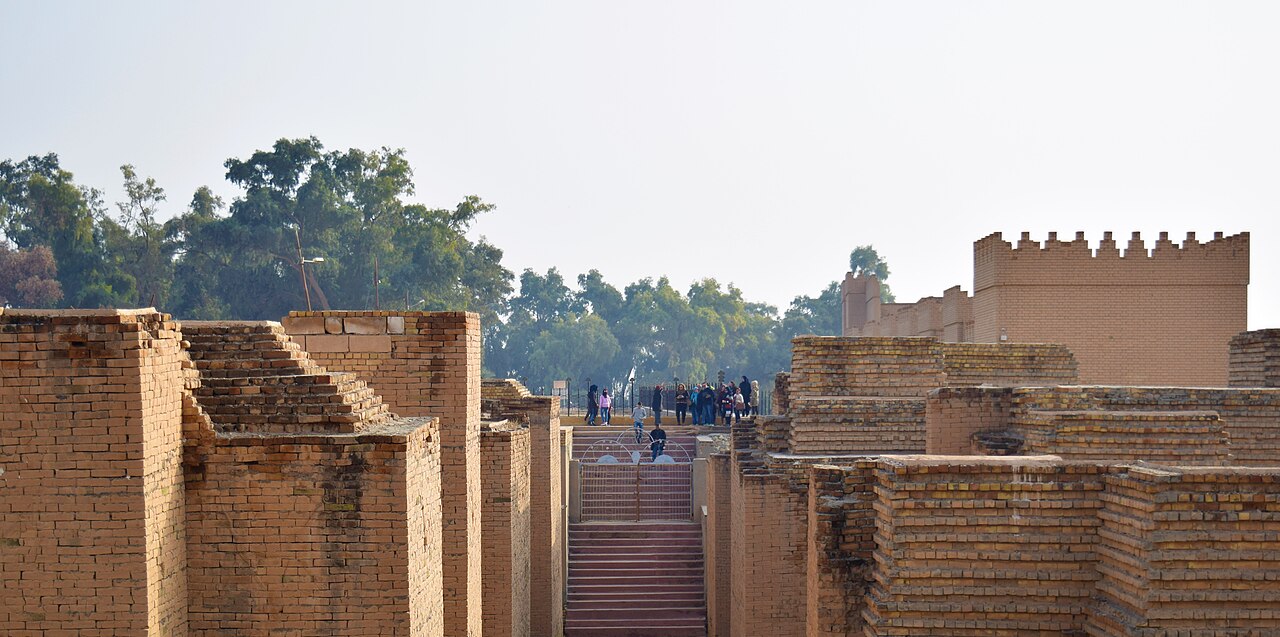
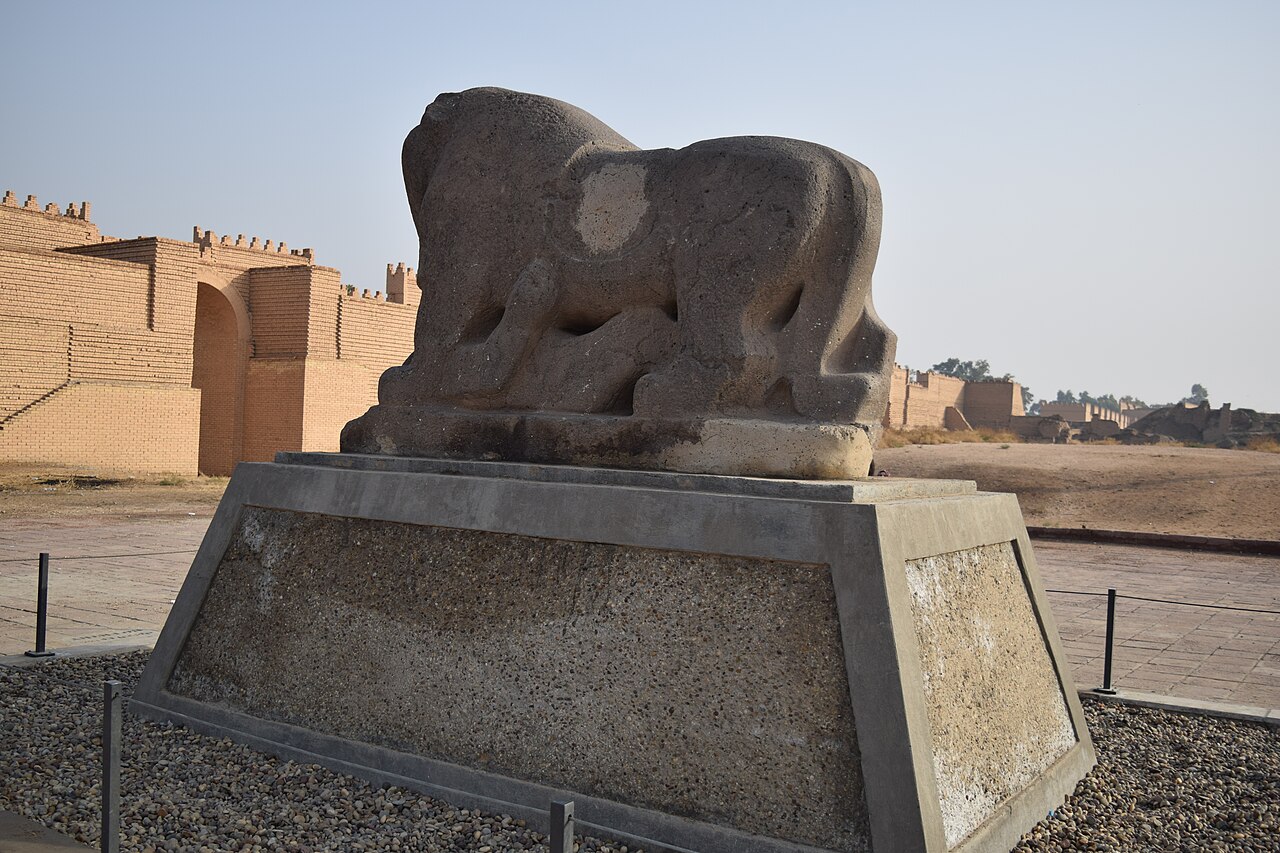
The site’s modern history is its own cautionary tale. In the 1980s, Saddam Hussein rebuilt walls and palace rooms directly on the ancient foundations, and crowned a neighboring mound with a presidential palace. In conscious imitation of Nebuchadnezzar, Saddam’s bricks were stamped with his own name as the city’s restorer. Then in 2003–2004, coalition forces made the ruins a military base (“Camp Alpha”). The documented damage to the Processional Way and Ishtar Gate area drew international protest. Conservation has since resumed under Iraqi and international programs, and in 2019 Babylon was inscribed as a UNESCO World Heritage Site. Visitors today walk Processional-Way paving at the level of Nebuchadnezzar’s street, pass a replica Ishtar Gate, and meet the basalt Lion of Babylon — the site’s ancient mascot, still trampling its enemy after 2,600 years.
The Sister Cities
The Cities of Babylonia
Tap a city to see what it was — and why it matters to this story.
| Site | What it was | Why it matters here |
|---|---|---|
| Ur (Tell el-Muqayyar) | Great Sumerian city of the moon god; traditional “Ur of the Chaldees” | Leonard Woolley’s excavations (1922–34) — the Royal Tombs, the best-preserved ziggurat in Iraq (restored by Nabonidus, whose cylinder naming Belshazzar was found here), and the world Abraham left (Genesis 11:31; on the northern-Ur question, see the Canaan guide) |
| Uruk (Warka; biblical Erech) | The world’s first true city; Gilgamesh’s city | Birthplace of writing (c. 3400–3300 BC) and of monumental urban life; named in Nimrod’s kingdom (Genesis 10:10) |
| Nippur | Holy city of Enlil; never a political capital, always a religious one | Hub of the countryside where Judah’s exiles were settled — the Chebar canal, the Āl-Yāhūdu district, and the Murašû archive all belong to its region (see Section 07) |
| Borsippa (Birs Nimrud) | Babylon’s twin city, seat of Nabu | Its vitrified (fire-glassed) ziggurat ruin towers so dramatically that centuries of travelers mistook it for the Tower of Babel; Nabu’s statue traveled from here to Babylon each New Year (see Section 04) |
| Sippar (Tell Abu Habbah) | City of the sun god Shamash | Its Ebabbar temple yielded tens of thousands of Neo-Babylonian tablets — the day-to-day economy of Nebuchadnezzar’s empire — plus a genuine temple library found in place, jar-filed on its shelves |
| Nineveh (Mosul) | The Assyrian capital | Included here for one reason: Ashurbanipal’s library, where Babylon’s classics (the flood tablet, the Enūma Eliš) were found (see Section 05) |
The Shelf of Great Discoveries
A short list of the finds that carry this guide’s story, with their present addresses:
- The Flood Tablet (Gilgamesh XI, from Nineveh) — the tablet George Smith deciphered in 1872, electrifying the Victorian public with a Babylonian deluge; British Museum. (See Section 04.)
- The Code of Hammurabi stele — carried off to Susa by Elamite raiders c. 1155 BC and excavated there by French archaeologists in 1901–02; Louvre, Paris. (See Section 02.)
- The Ishtar Gate and Processional Way — excavated 1899–1917, rebuilt from original glazed bricks; Pergamon Museum (Vorderasiatisches Museum), Berlin, with panels dispersed to museums worldwide, including the Metropolitan Museum in New York and the Oriental Institute (now ISAC) in Chicago.
- The Babylonian Chronicles, including the Jerusalem Chronicle (BM 21946) dating Jerusalem’s capture to March 16, 597 BC; British Museum. (See Section 08.)
- The Jehoiachin ration tablets — from Nebuchadnezzar’s Southern Palace; Vorderasiatisches Museum, Berlin. (See Section 07.)
- The Nabonidus Cylinder of Ur — the prayer naming “Belshazzar, the eldest son, my offspring”; British Museum. (See Section 03.)
- The Cyrus Cylinder — found in Babylon’s foundations by Hormuzd Rassam in 1879; Cyrus’s own account of taking the city and returning captive peoples and their gods: the Persian policy behind Ezra 1; British Museum. (It belongs to the next guide in this series: the Achaemenid Empire.)
- The Babylonian Map of the World — the 6th-century BC disk-map with Babylon at the center; British Museum. (See Section 05.)
- The Āl-Yāhūdu (“Judah-town”) tablets — the Judean exile community’s documents, published 2014; unprovenanced (acquired on the antiquities market), now largely in private collections, with groups exhibited at the Bible Lands Museum, Jerusalem. (See Section 07, including why the provenance caveat matters.)
- The Lachish Letters — Judah’s final war correspondence, excavated 1935; principal group in the British Museum, others in the Rockefeller Museum, Jerusalem. (See Section 08.)
A note on reading discoveries responsibly: the same century that gave us these finds also taught two hard lessons. First, provenance matters. Tablets that surface on the market rather than in documented excavation (like the Āl-Yāhūdu group) carry real questions about looting and, occasionally, forgery, which is why scholars flag them, and why this guide does too. Second, sensations need patience. From the Victorian “Babel-und-Bibel” debates over how much the Bible owed to Babylon, down to modern headlines, first claims about Bible-related finds are routinely revised. The discoveries that endure (the chronicles, the ration tablets, the excavated bullae) endured precisely because careful people checked. That is a good model for faith-and-scholarship questions generally: neither credulity nor cynicism, but verification and time.
Planning a Museum Visit
You do not need a visa for Iraq to stand in front of Babylon. The essential rooms:
- Pergamon Museum, Berlin — the Ishtar Gate and Processional Way, plus the throne-room façade. (Check current status: the museum is undergoing a long phased renovation.)
- British Museum, London — the deepest Babylon shelf anywhere: flood tablet, chronicles, Nabonidus and Cyrus cylinders, the Map of the World, Lachish letters, and the Ashurbanipal library galleries.
- Louvre, Paris — the Code of Hammurabi, and the Mesopotamian galleries that frame it.
- Metropolitan Museum of Art, New York — Processional Way lion panels and a superb ancient Near East collection.
- Institute for the Study of Ancient Cultures (ISAC, formerly the Oriental Institute), Chicago — excavation-based collections from Nippur and beyond, and America’s strongest teaching gallery for this material.
- Iraq Museum, Baghdad — the homeland collection, recovering and rebuilding after the 2003 looting; and the Bible Lands Museum, Jerusalem, for exile-era exhibitions.
Sources and Further Reading
- Robert Koldewey, The Excavations at Babylon (Macmillan, 1914) — The excavator’s own report, still readable and still cited.
- C. Leonard Woolley, Ur of the Chaldees (rev. ed. by P. R. S. Moorey as Ur ‘of the Chaldees’, Cornell University Press, 1982) — The classic account of the Ur excavations, updated by a careful successor.
- Irving Finkel & Michael Seymour, eds., Babylon: Myth and Reality (British Museum Press, 2008) — The best single guide to the objects and their afterlives.
- David Damrosch, The Buried Book: The Loss and Rediscovery of the Great Epic of Gilgamesh (Henry Holt, 2007) — George Smith, the flood tablet, and the drama of decipherment.
- Paul-Alain Beaulieu, A History of Babylon, 2200 BC–AD 75 (Wiley-Blackwell, 2018) — Ties the discoveries into a continuous history.
- Lawrence Rothfield, The Rape of Mesopotamia: Behind the Looting of the Iraq Museum (University of Chicago Press, 2009) — The 2003 catastrophe and the provenance problem.
Online Resources:
- UNESCO — Babylon — the World Heritage listing with site documentation.
- British Museum Collection Online — nearly every BM object on this page, with photographs.
- ISAC, University of Chicago — publications free to download, including excavation reports.
- Penn Museum — co-excavator of Ur and Nippur; excellent online resources.