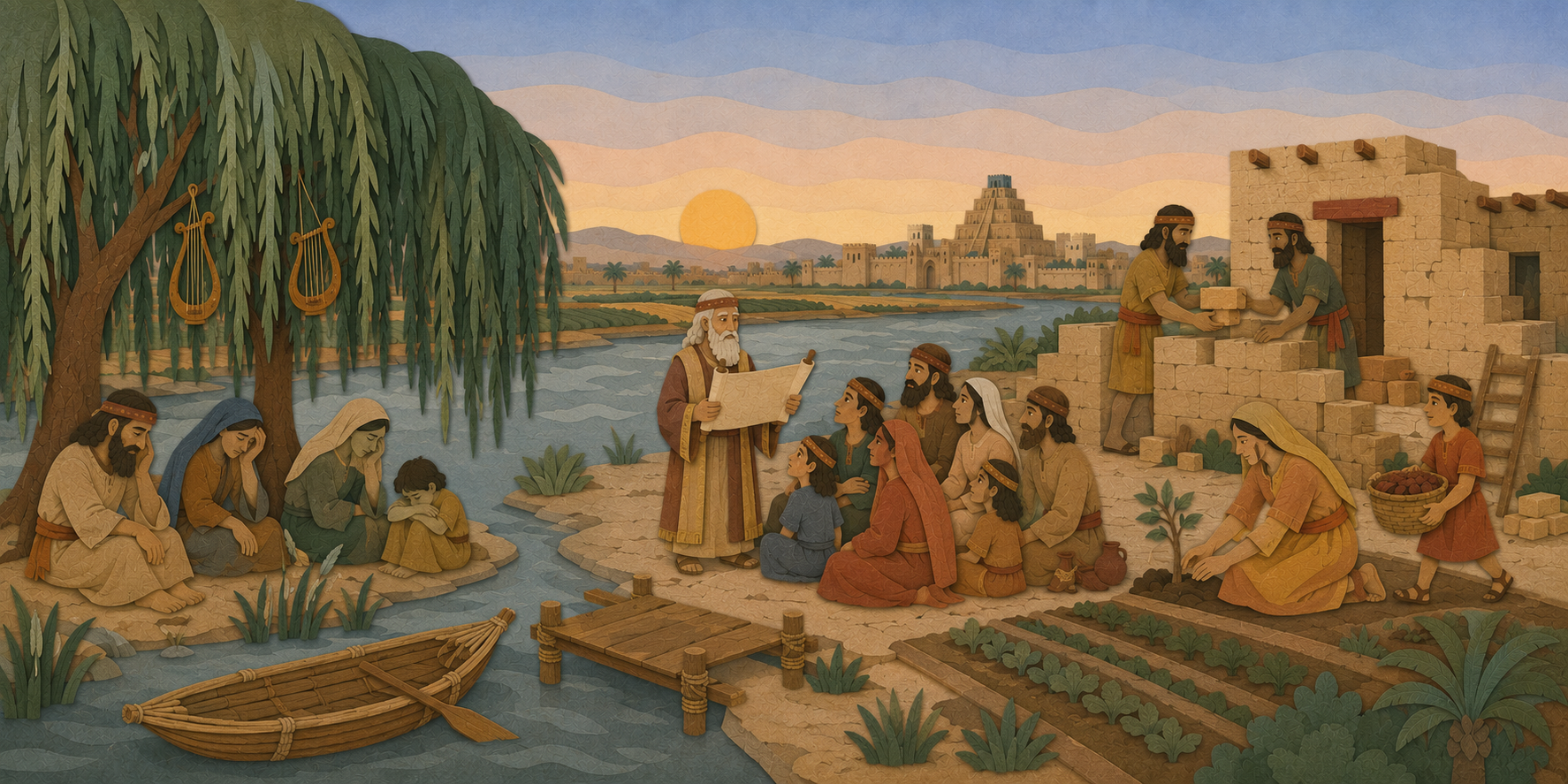
The Exile Experience
“By the rivers of Babylon, there we sat down” — and then, remarkably, stood back up
The exile is the hinge of the Old Testament: the catastrophe every prophet warned of and the furnace in which Israel’s faith was refined into the form that survived. For centuries, readers could see it only from the inside, through Psalm 137’s grief, Ezekiel’s visions, and Jeremiah’s letters. In the last hundred years, and dramatically in the last few decades, Babylonian clay has begun to show us the exile from the outside: ration lists naming Judah’s captive king, and whole archives of ordinary contracts from a canal-side settlement the scribes called, simply, Judah-town.

The Deportations: Who Went, Who Stayed
Babylon emptied Jerusalem in stages, not all at once:
| Wave | Date | Who was taken |
|---|---|---|
| The hostages | 605 BC | Select youth of the royal house and nobility (Daniel and his companions among them, Daniel 1:3–6), plus temple vessels |
| The great deportation | 597 BC | King Jehoiachin, the queen mother, officials, warriors, and all the craftsmen and smiths — “none remained, save the poorest sort of the people of the land” (2 Kings 24:14–16). Ezekiel was in this wave (Ezekiel 1:1–3) |
| The destruction | 586 BC | The city’s survivors after the temple’s burning (2 Kings 25:11); vinedressers and farmers left behind (25:12) |
| The aftershock | 582 BC | A final group after Gedaliah’s assassination (Jeremiah 52:30) |
How many people? The Bible itself preserves two kinds of figures: round totals (“ten thousand captives” in 597, 2 Kings 24:14) and an oddly exact accounting in Jeremiah 52:28–30: 3,023 + 832 + 745 = 4,600 persons, perhaps counting only adult men of standing. Either way, the deportation was selective, not total: Babylon took the king, the leadership, the fighting men, and, with an empire-builder’s eye, the craftsmen, leaving a peasant remnant to keep the land producing tribute. Judah’s story thus split into three streams: the exiles in Babylonia, the remnant in the land, and the group that fled to Egypt dragging Jeremiah with them (Jeremiah 43:5–7). It was the Babylonian stream, the one that seemed most defeated, that the prophets identified as the “good figs,” the carriers of the future (Jeremiah 24:5–7).
The journey itself (the long road north through Riblah and around the desert; see Section 01) took months on foot. Assyrian reliefs of earlier deportations show the standard imperial procedure: families with carts and bundles, herded in columns, a policy designed not to annihilate peoples but to transplant and use them.
The Road to Babylon
Every deportation took the same long road — north through Riblah, then down the Euphrates to the canal-country by the Chebar. Step through the waves.
Judah-Town: The Exile in Cuneiform
Where did they go? Ezekiel gives the view from the ground: a settlement called Tel-abib “by the river of Chebar” (Ezekiel 3:15). Both names turn out to be genuine Babylonian: the “river” is the Kabaru canal, a major irrigation channel in the Nippur countryside attested in Babylonian archives, and Tel-abib is Akkadian til abūbi, “flood mound” — the scribes’ term for an ancient abandoned settlement mound. The picture is precise: deported communities were planted on crown land in the underdeveloped countryside, often on derelict mound-sites beside canals, as agricultural colonists of the king.
Then, beginning in the 1990s, that picture acquired paperwork. A group of some two hundred cuneiform tablets (the Āl-Yāhūdu archive) was published by Laurie Pearce and Cornelia Wunsch in 2014. The tablets document a village in the Nippur region whose Babylonian name means “Judah-town” (the scribes at first even wrote “city of the Judeans”). The records run from 572 BC, just fourteen years after the temple burned, down into the Persian era. (The tablets surfaced on the antiquities market rather than in controlled excavation, a provenance problem scholars are careful to flag; their contents, extensively studied, are considered authentic.) In them, people with unmistakably Judean names (names built on the divine name YHWH, like Yahû-azāri, “YHWH is my help”) do utterly ordinary things: lease fields, pay the king’s taxes, take loans of barley and silver, marry, inherit, and go to court. Fathers with Yahwistic names give sons Babylonian names and vice versa; a man might use both. They farm “bow-land” (plots held in exchange for tax and service obligations) along canals, exactly as Ezekiel’s geography implies.
Jeremiah’s letter, confirmed by tax receipts: to the exiles of 597, Jeremiah wrote the most counterintuitive pastoral letter in scripture: “Build ye houses, and dwell in them; and plant gardens… and seek the peace of the city whither I have caused you to be carried away captives, and pray unto the LORD for it” (Jeremiah 29:5–7): settle in, for the stay has a fixed term and a promised end (29:10–14). The Āl-Yāhūdu tablets read like the receipts of a community that did exactly that: houses built, fields leased, families raised, taxes paid — and identity kept. It is one of the quiet marvels of archaeology that the practical shape of Judah’s survival in Babylon matches, document by document, the counsel of the prophet who told them how to survive it.
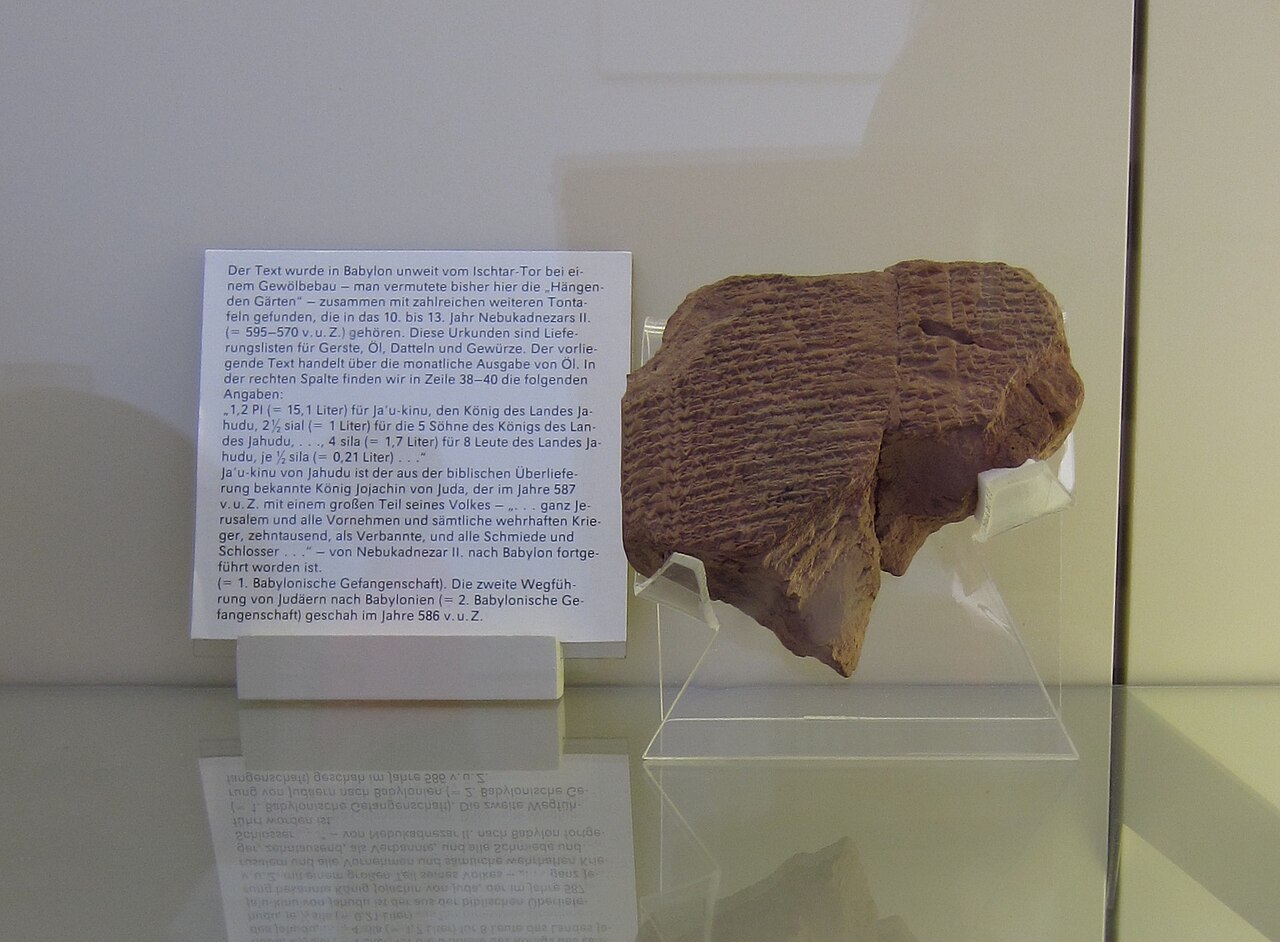
Higher up the social ladder, the palace itself kept records of Judah’s royalty: the Jehoiachin ration tablets, found in a storeroom of Nebuchadnezzar’s Southern Palace and published in 1939, list monthly oil allotments for “Ya’u-kīnu, king of the land of Yahudu,” his five sons, and other Judean notables: the captive king of 2 Kings 24:15, alive on Babylon’s books. Decades later, the book of Kings closes with his release to a seat at the royal table with “a continual allowance… all the days of his life” (2 Kings 25:27–30; see Section 03). Still later, in the Persian era, the Murashu business archive from Nippur (about 700 tablets from the 5th century BC) shows dozens of Judean families still farming, lending, and prospering in the same countryside, the community from which Ezra’s and Nehemiah’s returnees, and centuries of Babylonian Jewish life after them, would be drawn.
The Grief and the Question
None of this normalcy should soften the wound. The exiles had watched their city starve and burn; the poetry they left is scripture’s rawest: “By the rivers of Babylon, there we sat down, yea, we wept, when we remembered Zion” (Psalm 137:1), the canals of their new farmland doubling as the waters of mourning, while their captors called for entertainment: “Sing us one of the songs of Zion” (137:3). The whole book of Lamentations sits by the ruins on the other end of the road. And beneath the grief lay a theological emergency. In the ancient Near East’s standard logic, a destroyed temple meant a defeated god. Was the LORD weaker than Marduk? Or — the covenant’s own answer, harder but infinitely more hopeful — had the LORD himself done this, as long warned, for covenant breach (Deuteronomy 28:36; 2 Kings 24:3)? Ezekiel’s inaugural vision answered by geography: the divine throne-chariot appears in Babylonia, “among the captives by the river of Chebar” (Ezekiel 1:1): wheels within wheels, a throne that moves. The God of Israel had not been left behind in the rubble; He was not a territorial god at all. He could be with His people in the land of their captors — “as a little sanctuary” to them there (Ezekiel 11:16).
The Quiet Revolution
Between the grief and the tax receipts, something extraordinary happened: a nation learned how to be a covenant people without land, temple, or king. The exile-era innovations became the permanent architecture of Jewish life — and much of the vocabulary of ours:
- Portable holiness. With sacrifice impossible, the covenant’s portable signs moved to the center: Sabbath, the sign “between me and you throughout your generations” (Exodus 31:13; pressed hard by Ezekiel, Ezekiel 20:12), circumcision, food laws, and prayer toward Jerusalem (Daniel 6:10; anticipated in Solomon’s dedication, 1 Kings 8:48). These boundary-markers are exactly what a minority needs to remain itself inside an empire — and exactly where the exile’s famous tests fall (the king’s food, the king’s image, the king’s prayer ban: Daniel 1, 3, 6).
- The gathered assembly. Ezekiel repeatedly shows “the elders of Judah” sitting before him in his house, seeking a word from the LORD (Ezekiel 8:1; 33:31): worship as word, prayer, and study rather than altar. Jewish tradition and many scholars trace the roots of the synagogue to these exile gatherings; the institution is fully visible only later, but something like it had to be born here, and with it the pattern (congregation, scripture reading, exposition) that shapes Jewish and Christian (and Latter-day Saint) worship to this day.
- The people of the book. Exile turned Judah’s scribes into its lifeline. Cut off from the temple, the community’s treasure became its texts — the law, the histories, the prophets’ words, now gathered, copied, and studied with Babylonian-grade scribal seriousness (see Section 05). The figure who steps out of the exile’s far end is emblematic: Ezra, “a ready scribe in the law of Moses” (Ezra 7:6), reading the book to the assembled people. Judah went into Babylon a temple-people and came out, additionally and permanently, a scripture-people.
- A new language and calendar. Aramaic speech, the square script, and Babylonian month names (see The Calendar and the Names of Time) — the everyday furniture of post-exilic Jewish life, carried home from the rivers of Babylon.
The furnace that refined: Isaiah’s exile-facing chapters give the era its own metaphor: “I have chosen thee in the furnace of affliction” (Isaiah 48:10). What went into the furnace was a kingdom like its neighbors: throne, borders, temple, and a chronic weakness for its neighbors’ gods. What came out was something history had not seen before: a people defined by covenant, scripture, and Sabbath, capable of keeping faith anywhere on earth — which is to say, a people finally shaped for the mission given to Abraham at the start: that in his seed “shall all families of the earth be blessed” (Genesis 12:3). The exile is the Old Testament’s sternest chapter and its most fruitful — the pattern of every scattering and gathering since (see Section 10).
Sources and Further Reading
- Laurie E. Pearce & Cornelia Wunsch, Documents of Judean Exiles and West Semites in Babylonia in the Collection of David Sofer (CUSAS 28; CDL Press, 2014) — The publication of the Āl-Yāhūdu (“Judah-town”) tablets.
- Rainer Albertz, Israel in Exile: The History and Literature of the Sixth Century B.C.E. (Society of Biblical Literature, 2003) — The standard scholarly synthesis of the period.
- Peter R. Ackroyd, Exile and Restoration: A Study of Hebrew Thought of the Sixth Century B.C. (Westminster, 1968) — The classic theological study of how exile reshaped Israel’s faith.
- Daniel L. Smith-Christopher, A Biblical Theology of Exile (Fortress, 2002) — The exile’s trauma and creativity, read with modern displacement studies.
- Oded Lipschits, The Fall and Rise of Jerusalem: Judah under Babylonian Rule (Eisenbrauns, 2005) — What happened to those who stayed, from survey archaeology and texts.
- Ernst F. Weidner, “Jojachin, König von Juda, in babylonischen Keilschrifttexten,” in Mélanges syriens offerts à Monsieur René Dussaud (Geuthner, 1939) — The Jehoiachin ration tablets.
- Matthew W. Stolper, Entrepreneurs and Empire: The Murašû Archive, the Murašû Firm, and Persian Rule in Babylonia (Nederlands Instituut voor het Nabije Oosten, 1985) — The later Nippur archive with its Judean families.
Online Resources:
- Bible Odyssey — SBL articles on the exile, Ezekiel, and the Judean diaspora.