The City Itself
“Is not this great Babylon, that I have built?”
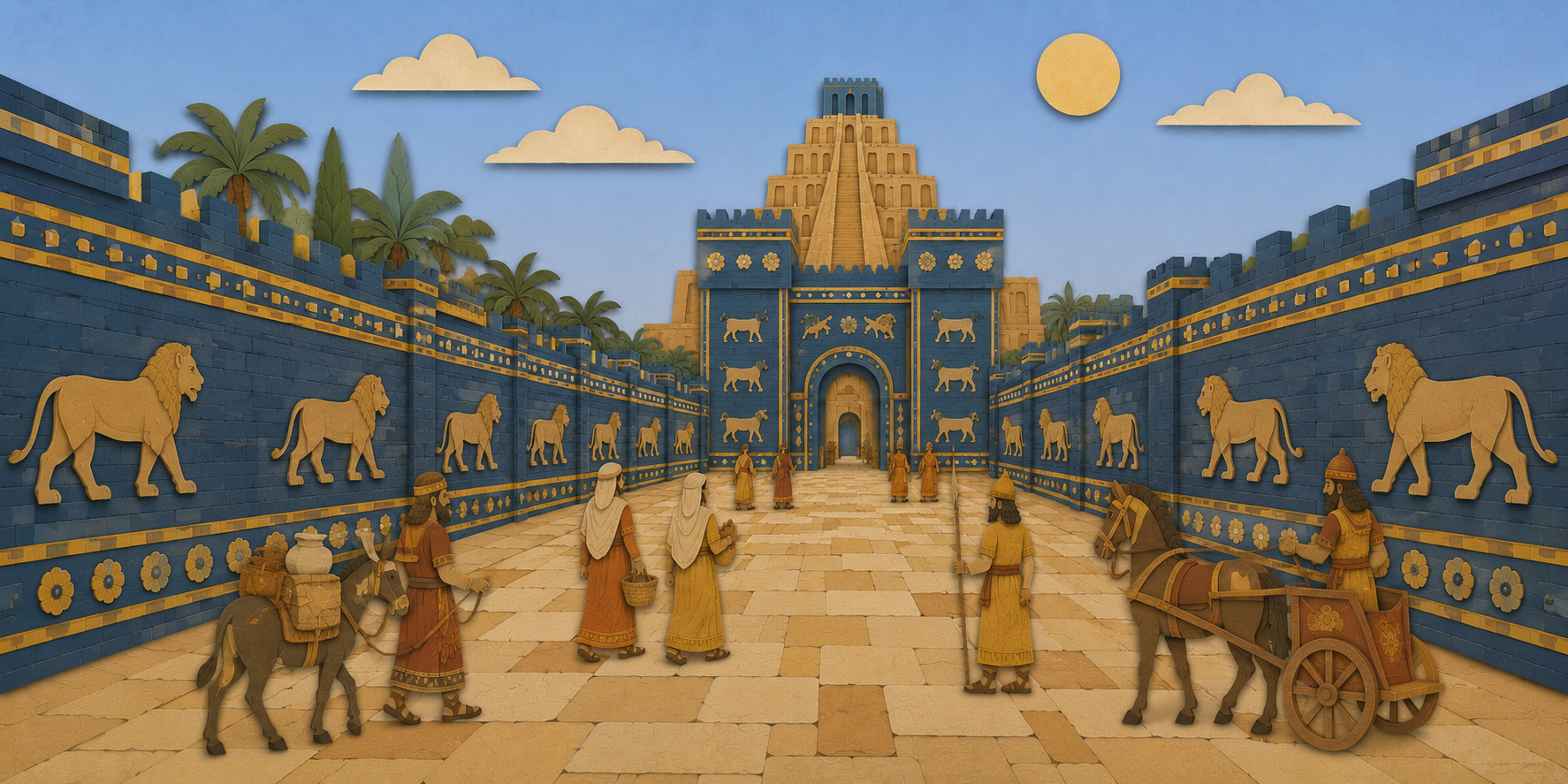
Picture the city the exiles saw. Babylon was the largest city on earth, by several estimates the largest the world had ever built. Nothing in Judah could have prepared a captive for it. Jerusalem, in 597 BC, covered perhaps a twentieth of it; a whole village of Judah would have fit inside a single temple courtyard. Even the Greeks, a century later, ran out of measured words: Herodotus said Babylon “surpasses in splendour any city in the known world,” and Aristotle grumbled that it had “the circuit of a nation rather than a city.” This page walks that city: the one Nebuchadnezzar built, the one his own bricks still describe, and the one archaeologists have dug back into daylight in astonishing detail.
The Walls: A Fortress the Size of a County
Babylon’s walls were its signature — and its boast. The inner city, split by the Euphrates, sat inside a double wall whose ancient names the builders lovingly recorded: Imgur-Enlil (“Enlil approved”) and, just outside it, Nimitti-Enlil. A broad moat, fed from the river, ran in front. Then Nebuchadnezzar went further, throwing a vast outer wall around the palaces and suburbs east of the river, until the whole fortified circuit stretched some 18 kilometers. The walls were mudbrick at the core, fired brick on the face, set in bitumen, studded with towers every few dozen meters, and so thick that ancient writers swore a chariot could turn around on top. Herodotus put their height at 90 meters, which is cheerful nonsense; but the truth needed no help. Perhaps 25 meters of wall, above a moat full of water, running kilometer after kilometer: no army of that age could take it by storm. That is why every conqueror of Babylon, Cyrus included, walked in through the gates rather than climbing over the walls. And it is why Jeremiah’s promise that Babylon’s “broad walls” would be “utterly broken” (Jeremiah 51:58) sounded, to anyone standing beneath them, like the least believable sentence in all of prophecy.
The Ishtar Gate and the Processional Way
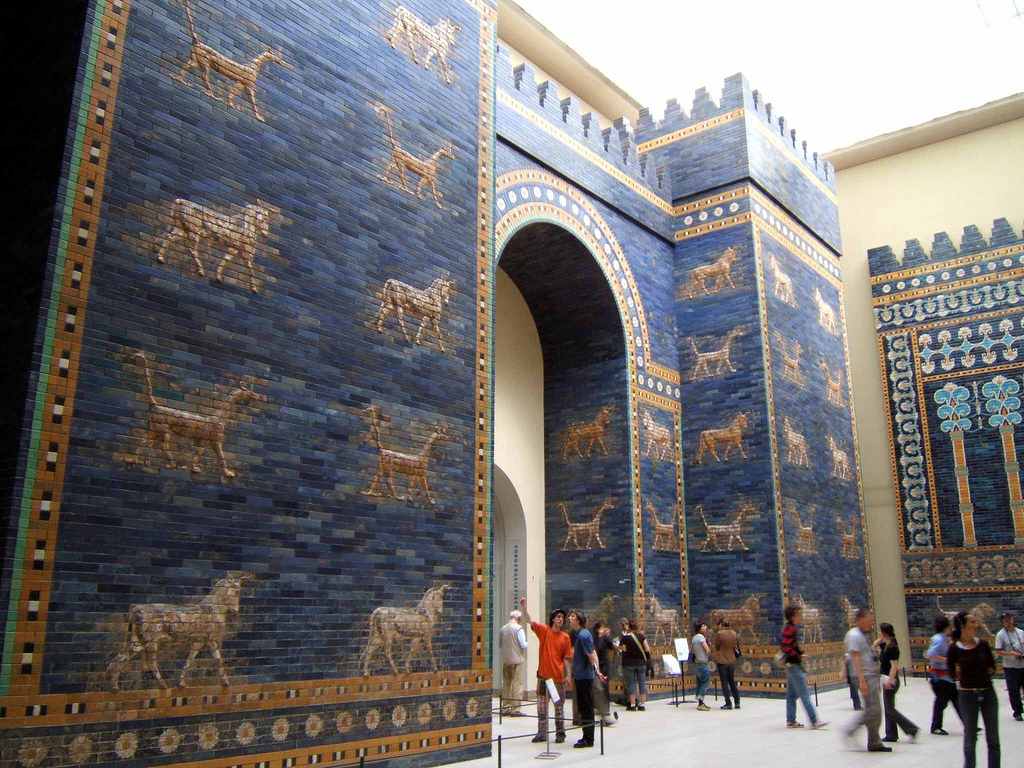
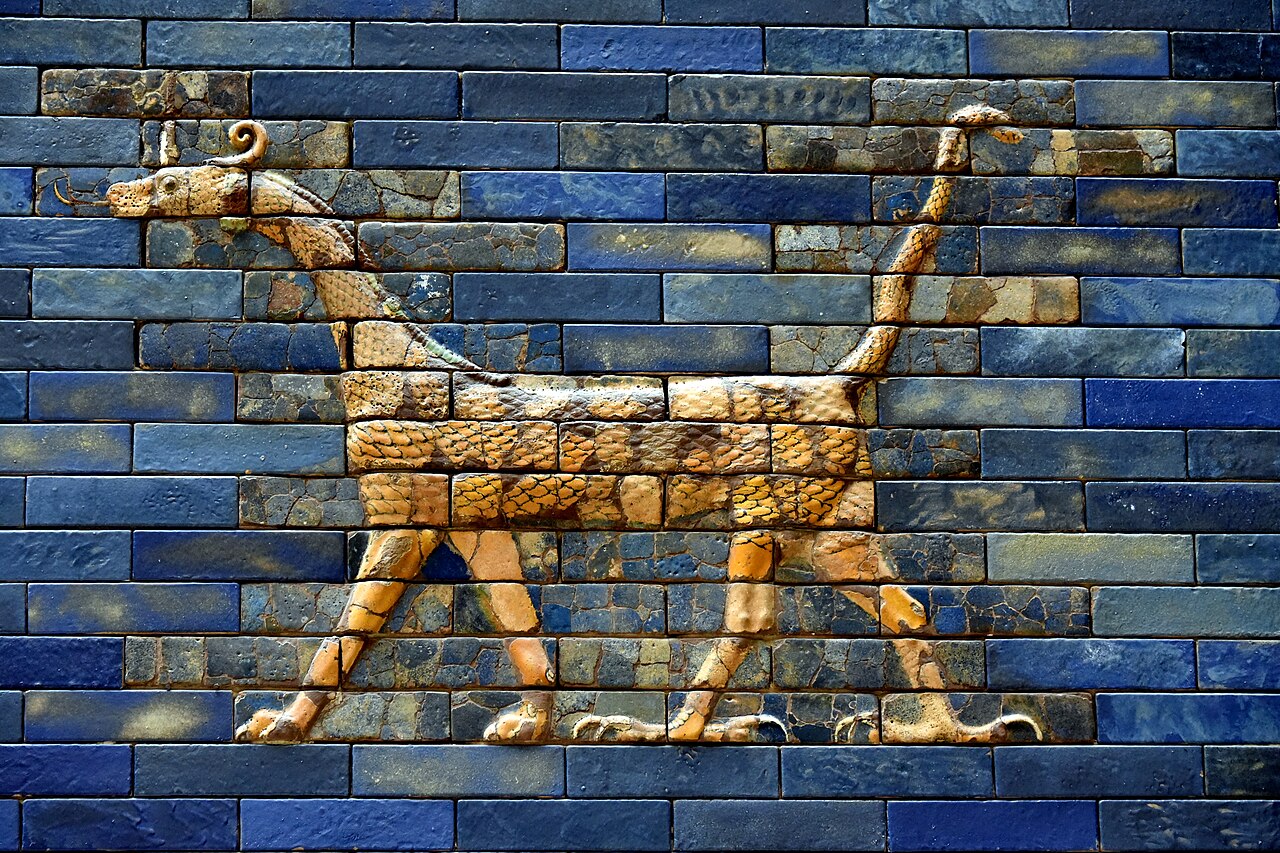
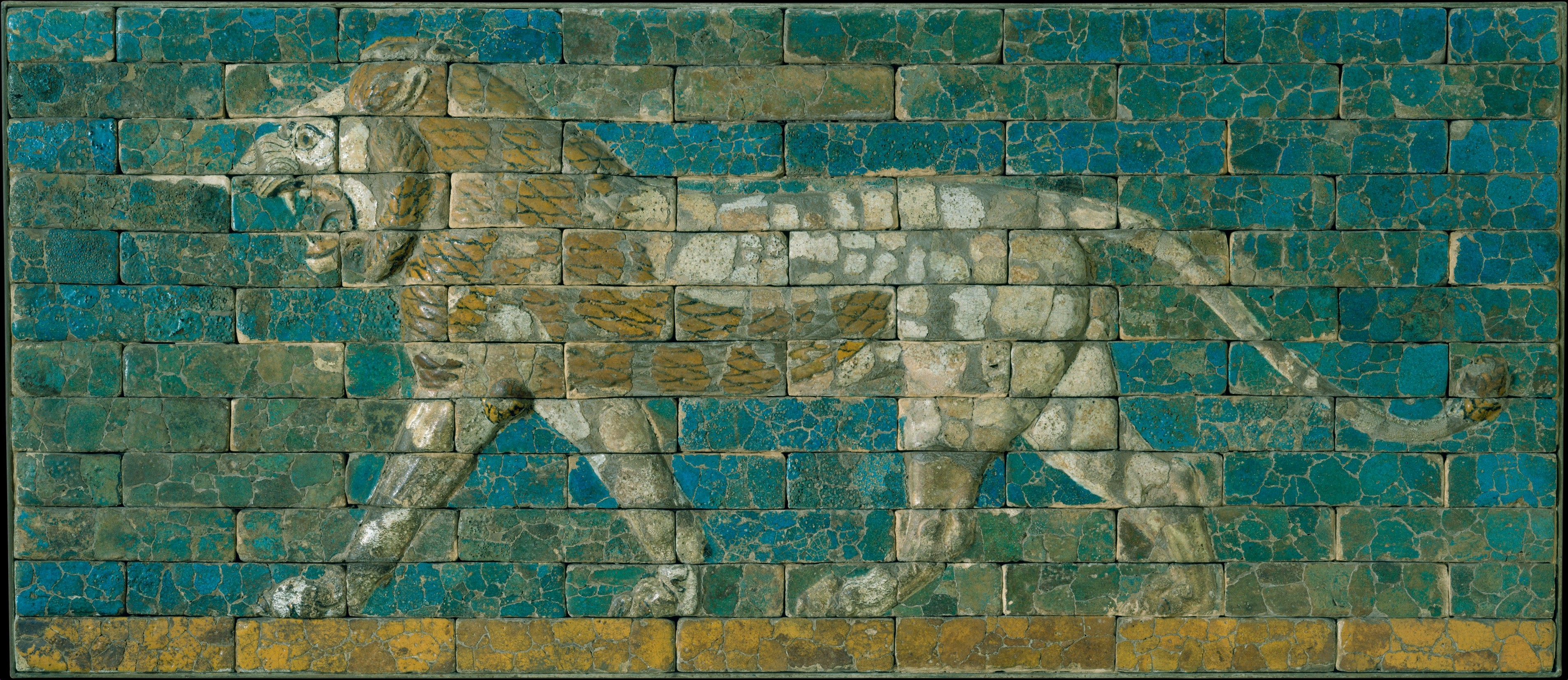
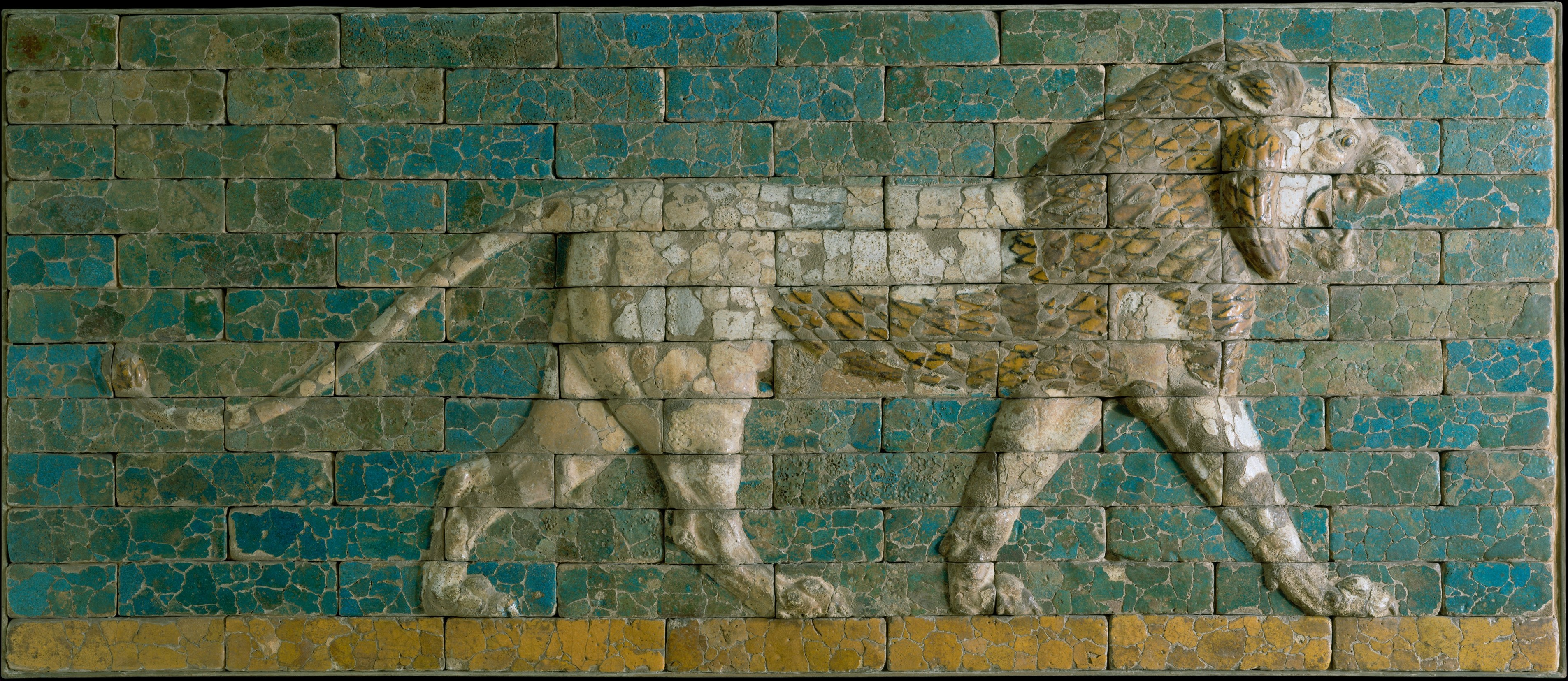
Eight great gates pierced the inner wall, each named for a god. The grandest, because it carried the New Year procession (see Section 04), was the Ishtar Gate, on the north side. Picture a double gatehouse rising more than 14 meters, every surface faced in glazed brick of deep lapis blue. Across that blue marched hundreds of animals in molded relief: rows of white-and-gold wild bulls (aurochs) for the storm-god Adad, and the strange dragon of Marduk, the mušḫuššu: a creature with a scaled body, a lion’s front legs, an eagle’s talons behind, and the horned head of a serpent. Through the gate ran the Processional Way, a paved avenue up to 20 meters wide. Its walls were glazed too, lined with striding lions (the beast of Ishtar), sixty to a side, white-maned and gold-maned against the blue. Nebuchadnezzar’s own dedication boasts that he made the gate’s splendor “a wonder for all peoples to behold.”
And he was right, in a way he could never have pictured. Robert Koldewey’s German expedition (1899–1917) dug the gate out one glazed brick at a time, shipped it to Berlin, and rebuilt it — and today it fills a museum hall two stories high, still the single most overwhelming survival of the biblical world anywhere on earth (see Section 09). The same blue that awed the exiles still floods that room. So when Ezekiel, himself a deportee of 597, reaches for words for the throne of God and lands on “the appearance of a sapphire stone” (Ezekiel 1:26), and when he describes idols “pourtrayed upon the wall” in bright vermilion, “after the manner of the Babylonians of Chaldea” (Ezekiel 23:14–15), he is writing as a man who had walked past exactly this kind of glazed magnificence.
Etemenanki: The Tower Behind the Tower
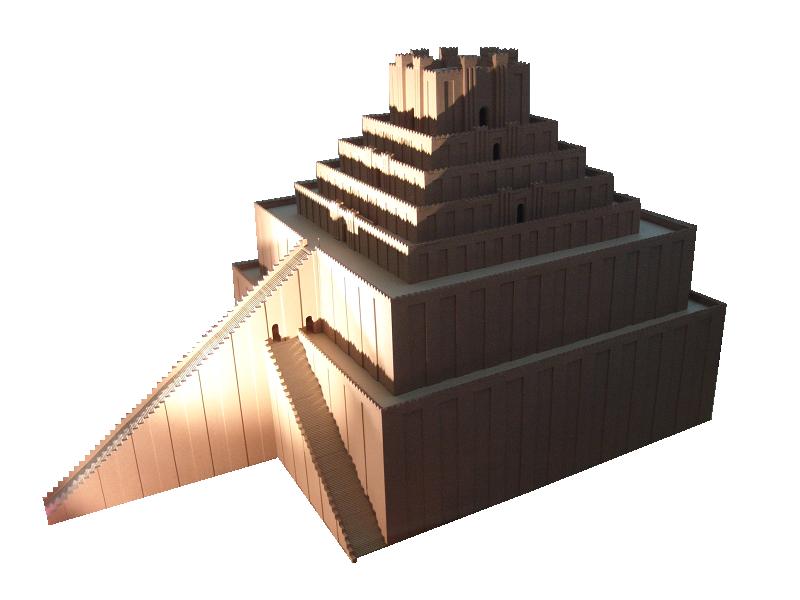
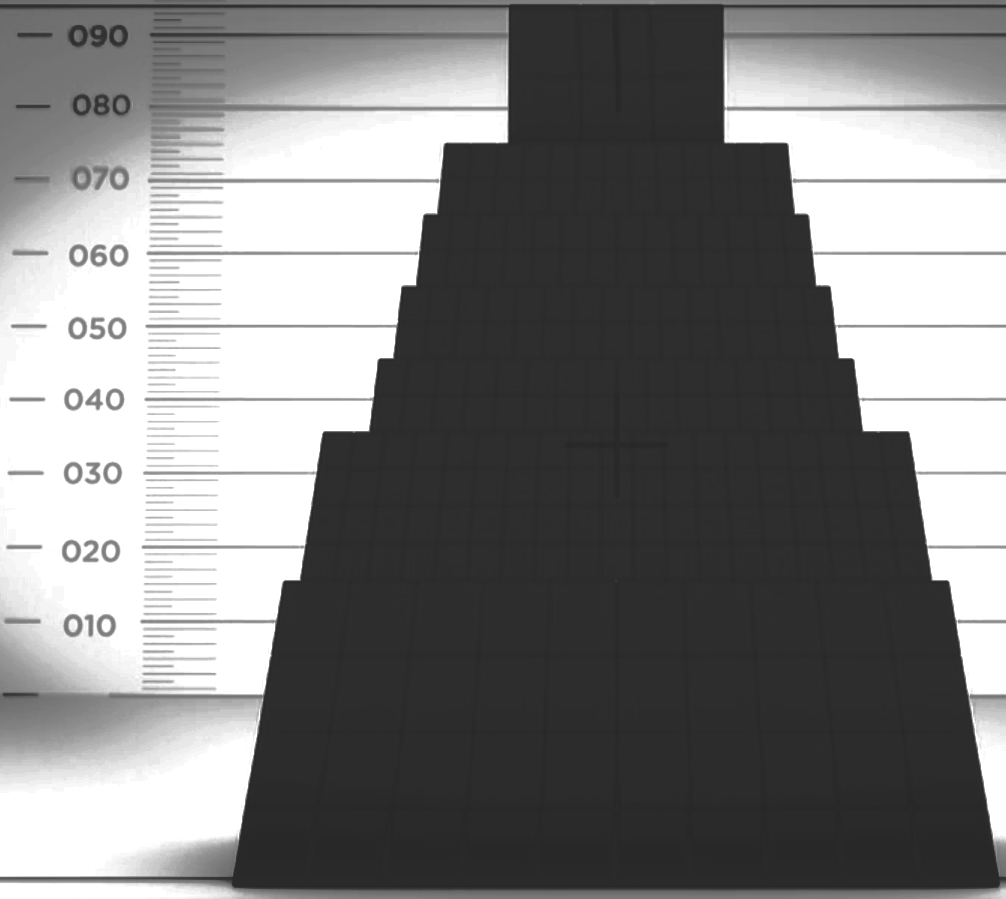
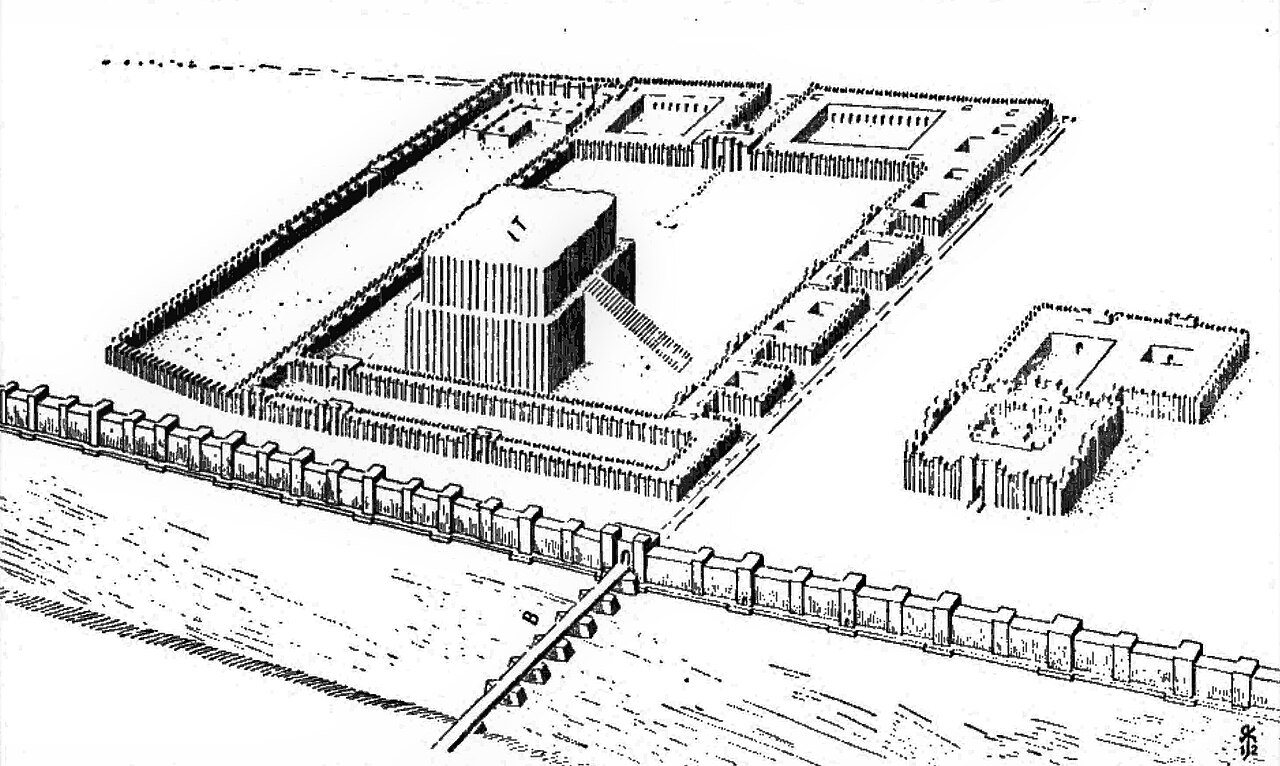
South of the Ishtar Gate, inside its own walled precinct, stood the building that ruled both the skyline and the imagination of the ancient world: Etemenanki, “House of the Foundation-Platform of Heaven and Earth,” the great ziggurat of Marduk. A cuneiform document (the “Esagila tablet”) and the excavated foundations agree on its size: a square base about 91 meters on a side, and a height in the same range. It was a stepped mountain of mudbrick, cased in fired brick, climbed by a monumental triple stairway and crowned with a high temple whose bricks were glazed blue — so that its summit seemed to melt into the sky. The Assyrian century left it battered; Nabopolassar and Nebuchadnezzar rebuilt it with imperial thoroughness. Nebuchadnezzar boasted that he raised its head to “rival the heavens.”
That phrase should ring a bell. Genesis 11 describes a tower on the plain of Shinar “whose top may reach unto heaven” (Genesis 11:4), built of burned brick with bitumen for mortar (Genesis 11:3) — the same materials, the same plain, the same boast. Scholars, led by Andrew George (the leading authority on the tower’s written record), broadly agree that the Tower of Babel story has Etemenanki and its tradition in view: a real, datable, excavated building whose whole theology (a man-made mountain “with its head in heaven,” raised to make a name) Genesis answers with quiet devastation. To inspect the tower that supposedly scraped heaven, the LORD has to “come down” (Genesis 11:5). Scholars still debate which way the influence runs: was Genesis 11 an ancient memory from the age when such towers were first built, or an answer to the rebuilt tower the exiles themselves saw? Either way, the target is not in doubt: the tower of the Babel story is Babylon’s tower, and its name-pun (Babel/“confusion,” Genesis 11:9) is aimed at the city’s own proud name, “Gate of the Gods” (see Section 01).
At the ziggurat’s foot sprawled Esagila, “House whose Head is Raised,” Marduk’s own temple, the Vatican of Mesopotamia, its inner shrine said to be lavished with tons of gold. This is where conquerors deposited captured temple treasures, by ancient custom (2 Chronicles 36:7). Here the sacred vessels of the LORD’s house sat in “the house of his god” — until the night a Babylonian regent poured wine from them at a feast (Daniel 5:2–3), and until Cyrus finally sent them home (Ezra 1:7).
Palaces, the Bridge, and the Museum of Empires
Nebuchadnezzar’s Southern Palace filled the corner between the Processional Way and the river — five courtyards deep, with a throne room 52 meters long. Its façade was glazed a brilliant blue and patterned with palm-leaves and stylized trees; like the Ishtar Gate, it has been rebuilt in Berlin.
This one building sits at the heart of the exile story. Somewhere inside it, the young Judean nobles of Daniel 1 were trained for the king’s service. In its storerooms, archaeologists uncovered the ration tablets that name Jehoiachin, king of Judah, among the captives fed from the royal supply (see Section 07). And it was very likely here, in the throne room, that a horrified court watched a hand appear and write on the wall (Daniel 5:5). The account even catches the lamplight — the hand wrote “upon the plaister of the wall of the king’s palace, over against the candlestick.” Centuries later, in 323 BC, Alexander the Great died in this same palace.
Babylon’s kings also kept what can only be called a museum. In and around the palace, excavators found treasures of long-vanished empires — old statues, inscribed monuments of the Akkadian kings, trophies dedicated across the previous fifteen centuries. These rulers knew exactly how ancient their city’s claim to glory was, and they collected the proof.
Babylon’s engineering ran right through the river. A permanent bridge, set on stone-and-timber piers (among the earliest known over a great river anywhere), joined the two halves of the city, its piers shaped like boat-hulls to cut the current, found by Koldewey exactly where the texts said they’d be. The streets ran on a rough grid; houses turned blank walls to the street and opened instead onto cool inner courtyards. And in Nebuchadnezzar’s own telling, the whole city was one long act of devotion: his inscriptions list the temples he restored across Babylon and its sister cities the way the book of Kings lists the works of Solomon.
The Hanging Gardens: A Wonder in the Wrong City?
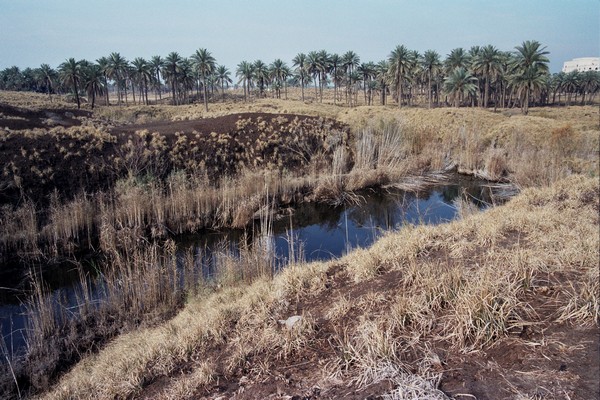
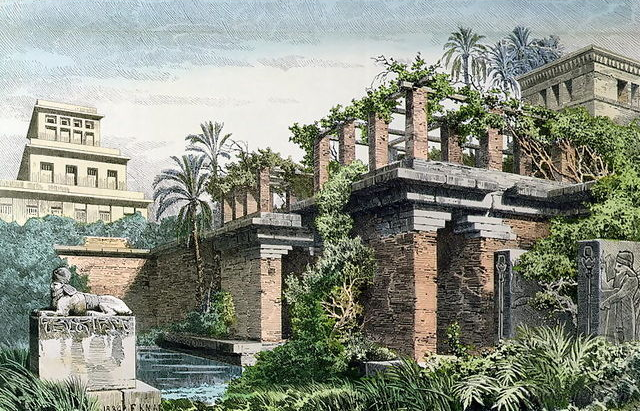
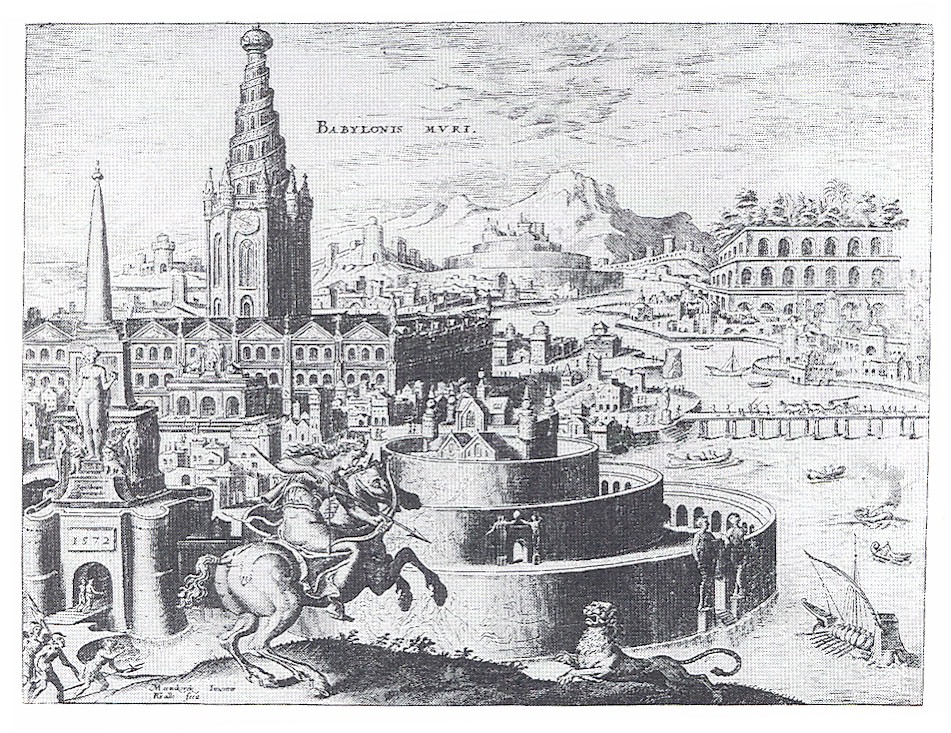
And the famous gardens? Classical writers ranked the Hanging Gardens of Babylon among the Seven Wonders of the World: terraces of trees raised on vaulted galleries, watered by hidden machinery, built (so the story went) by a king to comfort a queen homesick for her mountains. Here’s the puzzle: Nebuchadnezzar, a king who itemized everything he built, never mentions them. Neither does Herodotus. And the spade has turned up no agreed trace of them anywhere in Babylon. The Assyriologist Stephanie Dalley has made a detailed case that the wonder belongs to a different king in a different city altogether: Sennacherib’s palace garden at Nineveh, which that king describes in his own words as a “wonder for all peoples,” raised on vaults and watered by bronze screws, and that later storytellers simply moved the marvel to the more famous name of Babylon. Others still defend the traditional spot, on an unexcavated stretch of riverbank. It stays an honest open question — and a good reminder, for readers of scripture and history alike, that “everyone knows” is not the same as evidence, and that the next tablet out of the ground always keeps the right to surprise us.
The view from the wall: stand a Judean exile on the Processional Way in 570 BC: blue-glazed lions to the horizon, the ziggurat “rivaling heaven,” the walls that could not fall, the temple treasuries of a dozen conquered nations. Every visible fact argued that Marduk had won and the LORD of a burned hilltop temple had lost. The prophets’ astonishing wager was to read the skyline backwards: this — all of it — is the thing that passes. “And Babylon, the glory of kingdoms, the beauty of the Chaldees’ excellency, shall be as when God overthrew Sodom and Gomorrah” (Isaiah 13:19). Within a lifetime the gates stood open to a Persian; within centuries the city was mounds. The exiles who believed the prophets over their own eyes are the reason there was a people left to come home.
Sources and Further Reading
- Robert Koldewey, The Excavations at Babylon (Macmillan, 1914) — The excavator’s own account: walls, gates, palaces, bridge, and the ziggurat foundations.
- Joan Oates, Babylon (Thames & Hudson, rev. ed. 1986) — Accessible synthesis of the archaeology with excellent plans and reconstructions.
- Paul-Alain Beaulieu, A History of Babylon, 2200 BC–AD 75 (Wiley-Blackwell, 2018) — Current scholarly framing of the Neo-Babylonian building program.
- D. J. Wiseman, Nebuchadrezzar and Babylon (Oxford University Press, 1985) — The king’s constructions from his own inscriptions.
- Andrew George, “The Tower of Babel: Archaeology, History and Cuneiform Texts,” Archiv für Orientforschung 51 (2005/2006): 75–95 — The authoritative study of Etemenanki’s textual and archaeological record.
- Stephanie Dalley, The Mystery of the Hanging Garden of Babylon (Oxford University Press, 2013) — The full argument for Nineveh as the wonder’s true home.
- Irving Finkel & Michael Seymour, eds., Babylon: Myth and Reality (British Museum Press, 2008) — Catalogue of the landmark exhibition; the city’s reality and its afterlife in Western imagination.
- Herodotus, Histories 1.178–191 — The classic (and classically embellished) Greek description of the city and its capture.
Online Resources:
- WHE — Ishtar Gate (CC BY-NC-SA 4.0)
- Pergamon Museum, Berlin — home of the reconstructed Ishtar Gate and Processional Way.
- UNESCO — Babylon World Heritage listing (inscribed 2019).