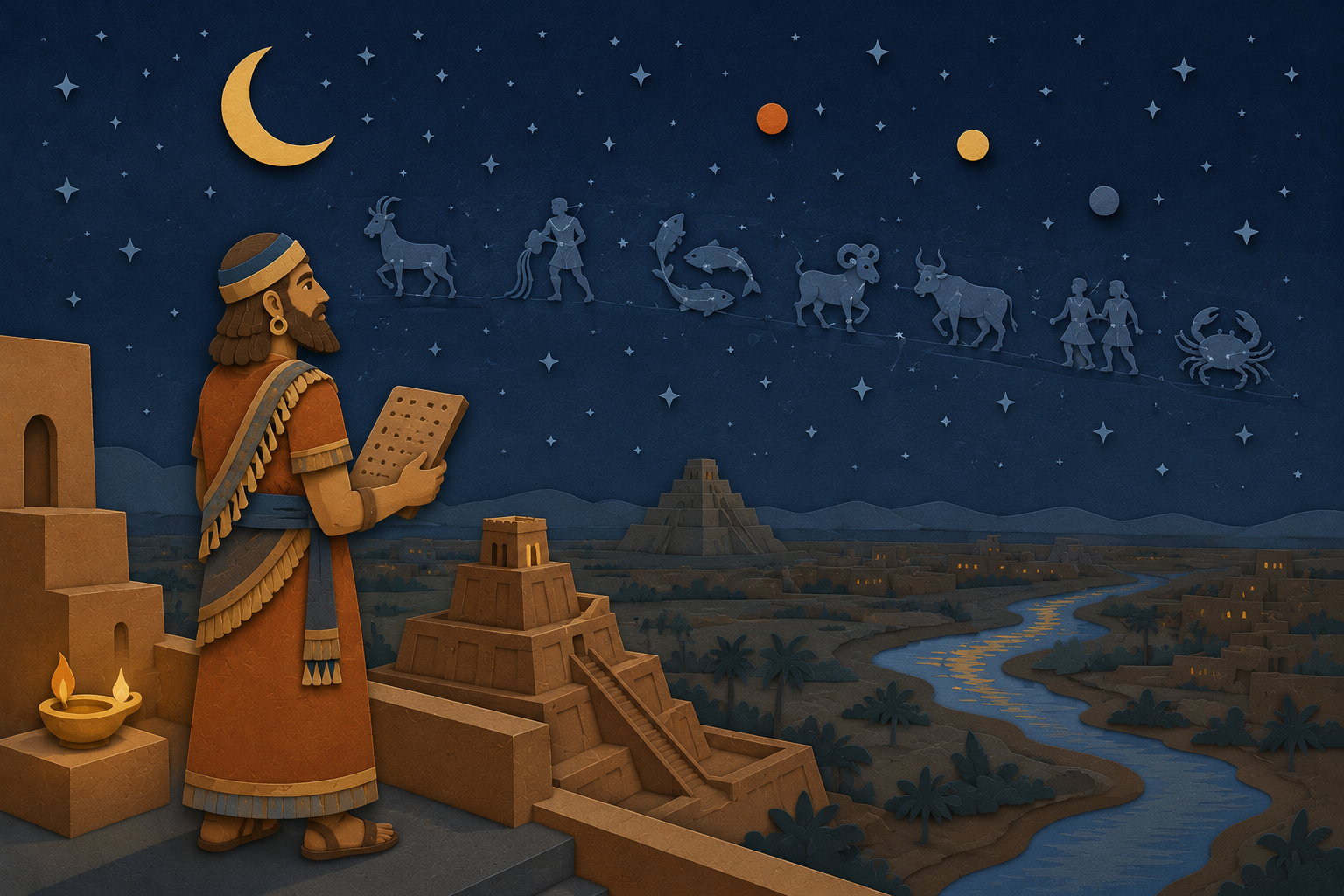
The Calendar & the Names of Time
How Babylon taught the world to count time — and named it after gods
Every time you glance at a clock and read sixty minutes, or a compass and read three hundred sixty degrees, you are using a system Babylon gave the world. Its astronomers kept the longest watch in the ancient world, and their base-60 arithmetic still runs quietly beneath every hour we count.
But Israel did not arrive in Babylon without a calendar. Long before the exile it kept its own reckoning of time — and kept it, pointedly, without the names of gods. The nations named their days and months for the sun, the moon, and the planets they worshipped. Israel mostly counted: “the second month,” “the seventh month, on the first day.” So what the exiles met on the Processional Way (see Section 06) was not a blank to be filled. It was a science to be adapted: the calendar-craft of the world’s greatest astronomers. They took it up without taking up its star-worship.
It is a story of discernment as much as adoption. Only one seam shows the strain — a single borrowed month-name, Tammuz, carrying the name of a god Ezekiel had once seen mourned. And before anyone shakes a head at it, this page holds up a mirror. Our own week is named, almost entirely, for gods we no longer even notice.
The Long Watch: Babylonian Time-Science
Babylon kept a lunisolar calendar, the hardest kind to run well. The month began with the first sighting of the new crescent moon, giving twelve months of roughly 29 or 30 days. But twelve lunar months fall about eleven days short of a solar year. A purely lunar calendar drifts backward through the seasons, and a barley festival slides into winter within a decade. The Babylonians solved the drift by intercalation: periodically inserting a thirteenth “leap month” to snap the calendar back into step with the sun. For centuries the decision to add a month was made ad hoc by royal decree. But by the Persian period the astronomers had reduced it to a rule. They fixed the pattern on a 19-year cycle (seven leap-months every nineteen years) so precise that the lunar and solar calendars realign almost perfectly. That same 19-year cycle still governs the Jewish calendar today, fixing the date of Passover each spring. And because the first Easter fell at Passover, a parallel reckoning still sets the Christian date of Easter as well. The old cycle runs quietly underneath the modern world.
The engine beneath all of this was a way of counting. Babylonian arithmetic ran on a sexagesimal (base-60) place-value system (see Section 05). Sixty turned out to be a magnificent choice: it divides evenly by 2, 3, 4, 5, 6, 10, 12, 15, 20, and 30, which makes fractions and angles behave. We never let it go. The 360-degree circle, the 60 minutes in an hour, the 60 seconds in a minute, the sixtieths of a degree we still call minutes and seconds of arc — all of it is Babylon, preserved for four thousand years because base-60 was simply too good at dividing the sky to abandon.
And the sky is what they watched. Because the heavens were read as a running message from the gods (see Section 04), they were observed with a discipline no ancient culture matched. From the mid-eighth century BC, Babylonian scholars kept the Astronomical Diaries — nightly records of the moon, the planets, eclipses, weather, river levels, and grain prices. They maintained them for something like seven centuries, one of the longest continuous observational records in human history. Out of that mountain of data came real predictive power. They mastered the roughly 18-year eclipse cycle (later called the Saros) that lets you forecast eclipses, and they built mathematical models of lunar and planetary motion. When Isaiah taunts “the astrologers, the stargazers, the monthly prognosticators” of Babylon (see Section 05), the taunt only bites because these were, in cold fact, the best astronomers alive.
That long watch left two inheritances, and they reach us roughly in the order they were made. First the constellations. The star-figures came earliest of all. The Bull of Heaven, the Lion, and the Scorpion were already fixed in the Mesopotamian sky before Abraham’s day. They passed to the Greeks, who kept the pictures and handed them on under the Latin names we still use: Taurus, Leo, Scorpius.
Onto that ancient band, Babylonian astronomers then laid a mathematics. By around the fifth century BC they had divided the ecliptic (the sun’s yearly path through the stars) into twelve equal thirty-degree signs. That is the coordinate zodiac the Greeks inherited and we still carry.
Then the calendar. The same moon whose phases they tracked gave the month both its name and its length. The oldest calendars are purely lunar, a run of new-moon months. Babylon bound those months to the solar year to make the lunisolar calendar described above, which the Jewish year still keeps. And the calendar most of the modern West lives by finally cut the months loose from the moon into a purely solar year — that last step Roman, not Babylonian. Lunar, then lunisolar, then solar: three calendars in a line. We still live inside the family Babylon did the most to shape.
The Mathematics — Carefully
The reputation is deserved. Babylonian mathematics was genuinely advanced. It had true place-value notation two thousand years before the decimal system reached Europe. Its scribes systematically solved what we would call quadratic equations and computed square roots to several decimal places. Vast reference tables of reciprocals, squares, and cubes let a scribe multiply and divide by lookup. This was working mathematics (for surveying fields, splitting inheritances, digging canals, and provisioning armies), and it was very good.
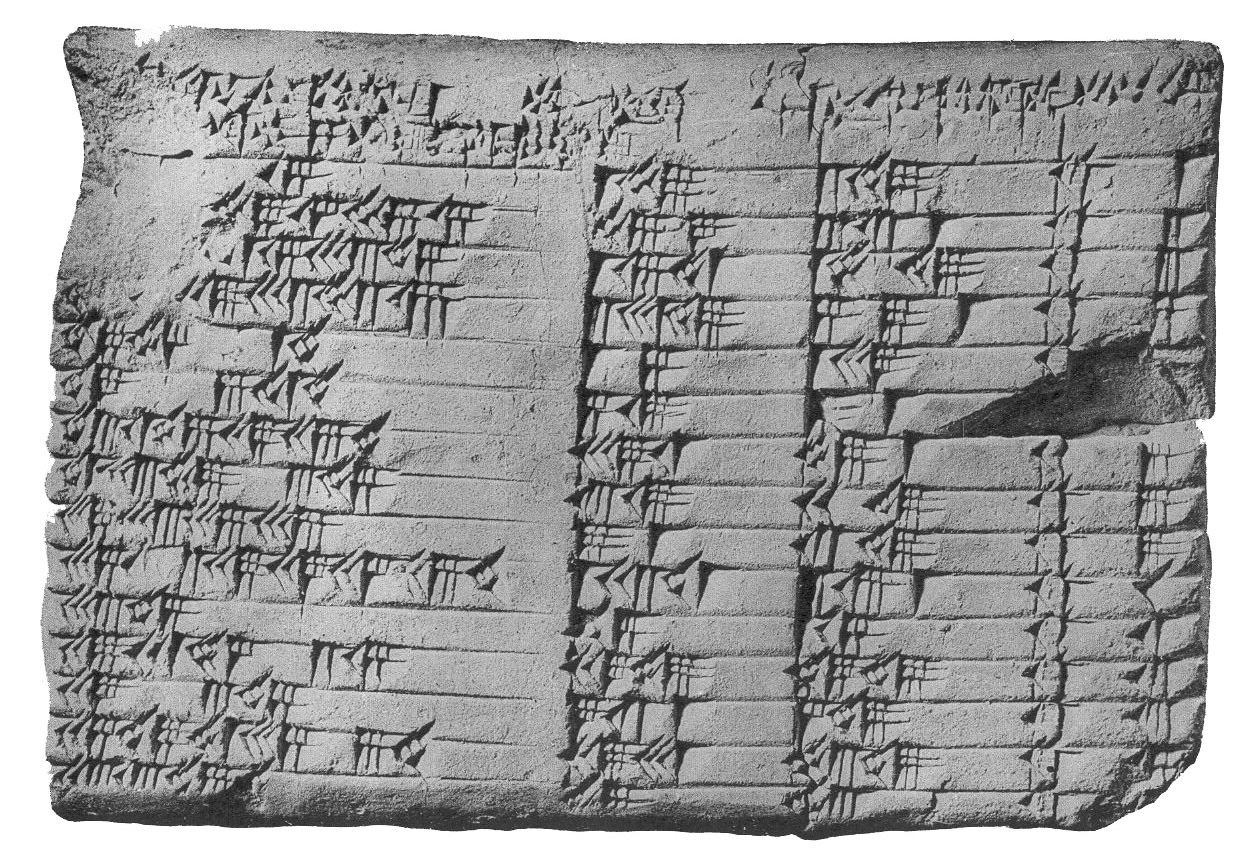
It is tempting to go one step further and credit Babylon with trigonometry, and here we should slow down. The famous tablet Plimpton 322 is real and remarkable: an Old Babylonian table of Pythagorean-style number triples, written a thousand years before Pythagoras. In 2017 two mathematicians, Daniel Mansfield and Norman Wildberger, argued that it is more than a list of triples. They argued that it is, in effect, the world’s oldest trigonometric table, a ratio-based tool for solving triangles that predates Greek trigonometry by over a millennium. It is a striking claim, and it may well be right — but it is contested. Many Assyriologists read the same tablet as a teacher’s exercise in generating number pairs, part of the scribal-school curriculum, with no trigonometric intent at all. So it belongs in this guide honestly labeled: a live scholarly debate, not a settled fact.
What is not in doubt is the lineage that runs forward from Babylon into the exact sciences of the West. Greek astronomers did not build in a vacuum. Hipparchus in the second century BC inherited Babylonian eclipse records, Babylonian planetary parameters, and the Babylonian sexagesimal degree. On that foundation of measured Babylonian data organized by Greek geometry, Greek trigonometry and Ptolemy’s astronomy were raised. The solid, uncontested story is not “Babylon invented trigonometry” but something almost as impressive: Babylon supplied the centuries of observation and the base-60 arithmetic on which Greek exact science was built. The line runs Babylon → Greece → us, and it runs right through your wristwatch.
Abraham the Astronomer — and the Star-Gods He Left
The instinct to take the sky’s mathematics without its gods did not begin in exile. The tradition traces it to Abraham himself. Abraham came out of Ur of the Chaldees, the heartland of Babylonian star-science. So when God takes him out to “tell the stars, if thou be able to number them” (Genesis 15:5), He addresses a man already fluent in the heavens. The Hebrew for “tell” is סָפַר (saphar): “to count,” but also “to recount, to record,” the same root behind סֵפֶר (sepher, “book”). To number the stars was, in the same breath, to keep the record of them.
Later tradition remembered exactly this. The first-century historian Josephus credits Abraham with carrying astronomy “from the Chaldeans into Egypt, and from thence to the Greeks also” (Antiquities 1.8.2), the same Chaldea-to-Greece road this page has been tracing, now with a patriarch walking it. And the Book of Jubilees remembers the decisive turn. Abraham watches the night sky for omens until “a word came into his heart”: “All the signs of the stars … are all in the hand of the Lord” (Jubilees 12:16–17). He breaks from the star-worship of his Chaldean kin and takes up instead “the books of his fathers” (Jubilees 12:27). (Jubilees and Josephus are later Jewish tradition, not scripture, offered here as the tradition’s memory of Abraham, not as established history.)
That is the seed of a standard Israel would not always keep. The next section watches it both held and, in one telling instance, let go. When the returning exiles took up Babylon’s calendar, most of what they adopted was harmless arithmetic and agricultural month-names. But one adopted name, Tammuz, carried a god Ezekiel had condemned (Ezekiel 8:14). The calendar that came home from Babylon was a compromise of the older instinct, not its fulfillment.
The Calendar That Changed in Exile
Now the quieter story — the one that touches scripture directly. Before the exile, Israel mostly numbered its months. The Bible’s default is ordinal. Things happen “in the second month” (Genesis 7:11), or “in the seventh month, in the first day of the month” (Leviticus 23:24), the day we now call Rosh Hashanah, described purely by number.
Only a small handful of named months survive from the older period, and their names are Canaanite rather than Babylonian. One caveat, though: that Canaanite calendar had itself grown out of the same Mesopotamian tradition. The difference here is one of names, not of whole systems. There is Abib, the spring month of the Exodus (“this day came ye out in the month Abib,” Exodus 13:4). There is Zif, when Solomon began the temple (“the month Zif, which is the second month,” 1 Kings 6:1), and Ethanim, when he dedicated it (“the month Ethanim, which is the seventh month,” 1 Kings 8:2). And there is Bul, when it was finished (“the month Bul, which is the eighth month,” 1 Kings 6:38). Notice how the narrator gently glosses even these (“which is the second month”), as if the number, not the name, is the thing the reader is sure to know.
After Babylon, everything changed. The Jews adopted the Babylonian month-names still in use today: Nisan, Iyar, Sivan, Tammuz, Av, Elul, Tishrei, Marcheshvan, Kislev, Tevet, Shevat, and Adar. And you can watch the shift happen in the text itself, because the post-exilic books suddenly start using these very names. Nehemiah dates his cupbearing to “the month Nisan” (Nehemiah 2:1). Esther explains for her readers that “the first month” is now “the month Nisan” and “the twelfth month” is “the month Adar” (Esther 3:7): the very gloss reversed, name explaining number. Nehemiah also dates events to “the month Chisleu” (Nehemiah 1:1), the Kislev of Hanukkah, as does Zechariah (Zechariah 7:1). Zechariah elsewhere dates a vision to “the eleventh month, which is the month Sebat” (Zechariah 1:7), that is, Shevat. The Jewish tradition itself is completely candid about where these names came from. The Jerusalem Talmud (Rosh Hashanah 1:2) states it plainly: the names of the months came up with them from Babylon.
The name in the list: look again at that roster of adopted months and one entry should stop you — Tammuz. Tammuz was not a neutral label. He was a Babylonian god, the dying-and-rising deity of the seasons. His mourning rites were among the abominations Ezekiel was shown at the very temple gate: “there sat women weeping for Tammuz” (Ezekiel 8:14). Within a generation of that vision, the returning exiles were dating their own summers by a month named for him. The Jewish calendar has carried the name of Ezekiel’s pagan grief, unremarked, ever since.
Laid out in full, the contrast is easy to see — and it does not fall where you might expect. Switch between the two tables below.
The Irony, and the Honest Caution
There is a small, careful Book of Mormon note to make here, and it is worth making precisely. Lehi’s family left Jerusalem around 600 BC, before the Babylonian month-names were adopted into Jewish use. And the Nephite record, cut off from that later development, never picks up the Babylonian names. It keeps counting time the older way: by regnal years, by the years since Lehi left Jerusalem, and by event-anchored reckoning rather than by Nisan and Tammuz and Adar. It is a modest point, not a proof of anything grand. But it is a quiet, internally consistent witness that the record’s roots really do lie in the pre-exilic Israelite way of keeping time, on the far side of the Babylonian shift.
Why did pre-exilic Israel prefer bare numbers in the first place? One reading (and it deserves to be flagged as a reasonable interpretation rather than an established fact) connects the habit to a command: “make no mention of the name of other gods, neither let it be heard out of thy mouth” (Exodus 23:13). If the names of pagan deities were not to cross your lips, then a month called simply “the seventh” is safer ground than a month called Tammuz. On this view the numbering was a deliberate theology of time, a small daily act of not naming the gods. It is an attractive idea and it may be true — but we cannot prove it was the motive. The plainer numbering may simply be older and more prosaic. Either way, the contrast with the post-exilic calendar is real.
And here is where honesty cuts toward us rather than away. It would be easy to shake a head at the exiles for keeping “Tammuz” — until you look at your own week. The seven-day planetary week is not, strictly, Babylonian at all; it is Greco-Roman. It was assembled in the Hellenistic world from the seven classical “planets,” each carrying a god’s name that had itself been handed down Babylon → Greece → Rome. Rome named the days for its gods. When the Germanic peoples borrowed the scheme, they simply swapped in their own: Tuesday for Tiw, Wednesday for Woden, Thursday for Thor, Friday for Frigg, with Saturday still openly wearing Saturn’s name. The months are no better: January for two-faced Janus, March for Mars the war-god, and July and August for the deified emperors Julius and Augustus, whose names we speak as easily as breathing.
Put it side by side and the contrast is quietly striking. The post-exilic Jewish calendar carries essentially one god’s name, Tammuz, an inheritance the tradition never hid and openly credited to Babylon. Our own everyday calendar is saturated with gods and god-kings: a pagan deity in most days of the week and several months of the year. We invoke them without a flicker of thought. This is no summons to stop saying “Thursday”: the names are worn smooth, long emptied of worship, harmless on the tongue. If anything the exiles who kept “Tammuz” deserve less of our scrutiny than we who say “Thursday” and never once hear Thor. But there is something worth hearing in the pattern itself.
Near the end of his life, Moses was told that Israel would not keep faith — that they would “go a whoring after the gods of the strangers of the land” and “break my covenant” (Deuteronomy 31:16). So God gave him a song and had him teach it to the people, “that this song may be a witness for me against the children of Israel” (Deuteronomy 31:19). It was a testimony meant to be standing still “in the latter days,” after they had “utterly corrupt[ed]” themselves (Deuteronomy 31:29). And the Song itself names the drift with startling precision: they would sacrifice “to gods whom they knew not, to new gods that came newly up, whom your fathers feared not” (Deuteronomy 32:17).
Read in that light, the god-saturated calendar becomes an unlikely witness — not a crime to be prosecuted, but a testimony no one meant to leave. “New gods that came newly up” did exactly that, and spread, until the whole world, the covenant people scattered among the nations included, kept their names in the ordinary counting of its days. That the names are now emptied of belief does not unsay the history. If anything it sharpens the point. The Song foresaw not a people who chose other gods in open defiance, but a people who would carry them without a thought, having forgotten there was ever a covenant to break. Babylon taught the world to count time with a brilliance we still rely on every hour. It also taught the world to name time after gods. And on that second lesson, the calendar we all speak stands quietly where Moses said his song would stand — one more witness, in the latter days, that the word spoken over Israel was kept to the letter.
Sources and Further Reading
Babylonian Astronomy & Mathematics:
- Francesca Rochberg, The Heavenly Writing: Divination, Horoscopy, and Astronomy in Mesopotamian Culture (Cambridge University Press, 2004) — How the long watch of the diaries became mathematical astronomy, and how the zodiac and horoscope were born.
- Otto Neugebauer, The Exact Sciences in Antiquity (Dover, 2nd ed. 1969) — The classic account of sexagesimal arithmetic and the transmission of Babylonian astronomy into the Greek world.
- Mathieu Ossendrijver, Babylonian Mathematical Astronomy: Procedure Texts (Springer, 2012) — The technical modern edition of the computational astronomy behind the ephemerides.
- Eleanor Robson, Mathematics in Ancient Iraq: A Social History (Princeton University Press, 2008) — The standard treatment; her earlier articles are also the sober counterweight to over-reading Plimpton 322.
- Daniel F. Mansfield & N. J. Wildberger, “Plimpton 322 is Babylonian exact sexagesimal trigonometry,” Historia Mathematica 44 (2017): 395–419 — The contested trigonometry argument, presented here as debate, not consensus.
Calendar & the Exile:
- Sacha Stern, Calendar and Community: A History of the Jewish Calendar, 2nd Century BCE–10th Century CE (Oxford University Press, 2001) — The authoritative history of how the Jewish calendar developed, including its Babylonian month-names and lunisolar mechanics.
- Jack Finegan, Handbook of Biblical Chronology (Hendrickson, rev. ed. 1998) — A thorough reference on the pre-exilic Canaanite month-names (Abib, Ziv, Ethanim, Bul) and their Babylonian replacements.
- Jerusalem Talmud, Rosh Hashanah 1:2 — “The names of the months came up with them from Babylon” — the tradition’s own account of the borrowing.
Abraham & the Star-Science (later tradition):
- Book of Jubilees 12 (2nd century BCE; preserved complete in Ethiopic and in fragments among the Dead Sea Scrolls) — Abraham’s all-night astronomical vigil and his turn from astral divination to the God whose hand holds “the signs of the stars.” Critical edition: James C. VanderKam, The Book of Jubilees (CSCO 511; Peeters, 1989). Text: Sefaria, Jubilees 12. Extra-biblical; cited as the tradition’s memory, not as scripture.
- Josephus, Antiquities of the Jews 1.8.2 — Abraham “communicated to them arithmetic, and delivered to them the science of astronomy… that science came from the Chaldeans into Egypt, and from thence to the Greeks also.” Text: Perseus Digital Library. First-century historian; cited as tradition, not as scripture.
Online Resources:
- ORACC — the Open Richly Annotated Cuneiform Corpus, including astronomical and calendrical texts in transliteration and translation.
- British Museum — Babylonian astronomical tablets and the diaries tradition.