Writing & Learning
“The learning and the tongue of the Chaldeans” — what Daniel actually studied
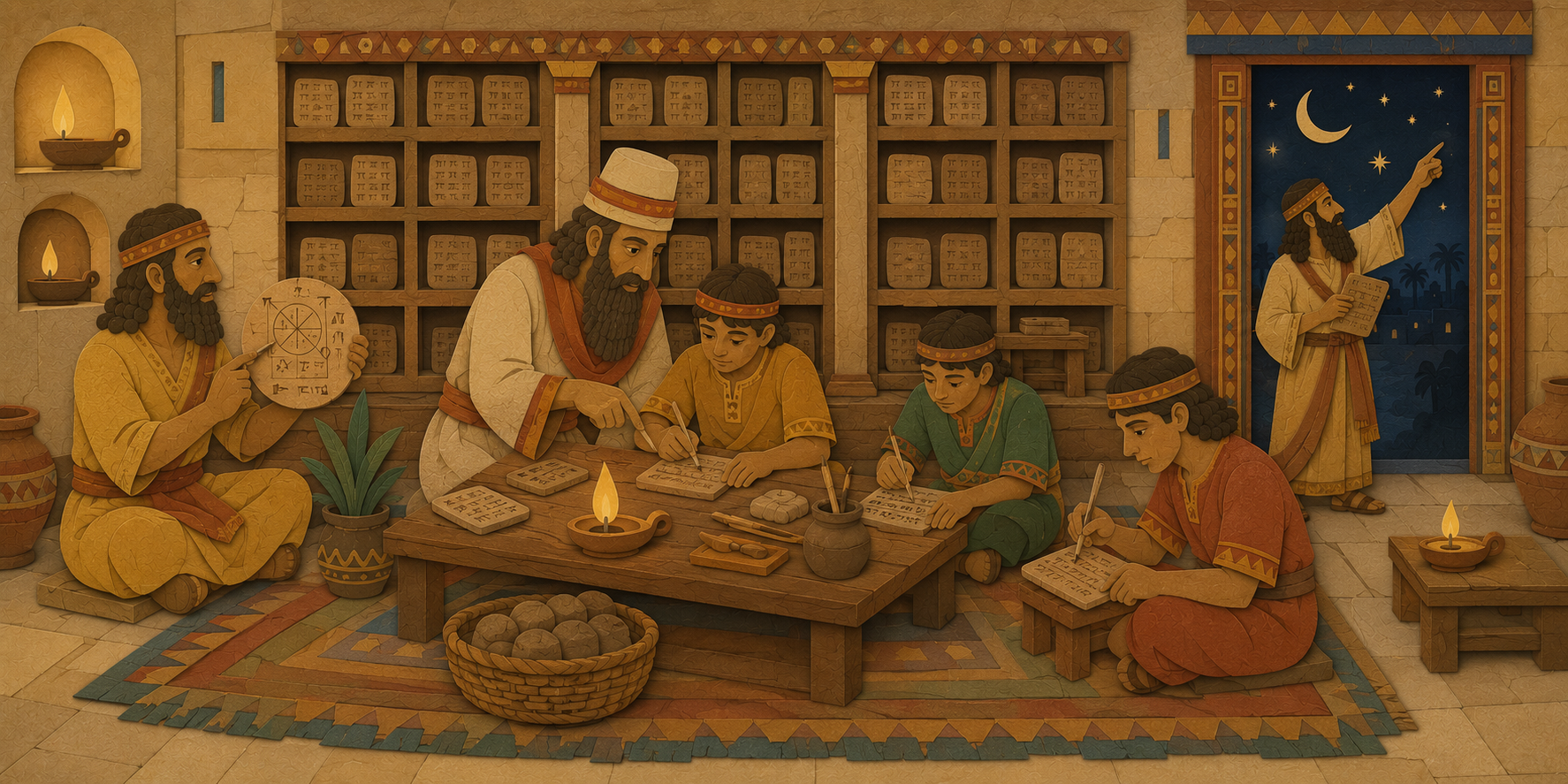
When Nebuchadnezzar ordered that select young exiles be taught “the learning and the tongue of the Chaldeans” (Daniel 1:4), he was enrolling Daniel and his friends in the longest-running intellectual tradition on earth. Babylonian scholarship in the 6th century BC stood on two thousand years of accumulated writing, more preserved text than any other ancient civilization would leave behind. Why did so much survive? Clay, it turns out, was the great accident of history. Papyrus rots and parchment burns, but a clay tablet in a burning archive is fired, not destroyed. Hundreds of thousands of tablets survive. From them we can reconstruct Babylonian learning in extraordinary detail: its schoolrooms, its libraries, its mathematics, its star charts.
Cuneiform: Three Thousand Years of Wedges
Cuneiform means “wedge-shaped,” named for the marks a cut reed stylus presses into damp clay. It began in the city of Uruk around 3400–3300 BC, and it was the world’s first writing. It was born not for poetry but for accounting: temple bureaucrats tracking sheep, grain, and beer rations. Over centuries the pictures became abstract wedge-clusters. And the system grew to write not just Sumerian but Akkadian (the Semitic language whose two great dialects, Babylonian and Assyrian, dominated the Near East for two millennia), plus a dozen other languages from Hittite to Elamite.
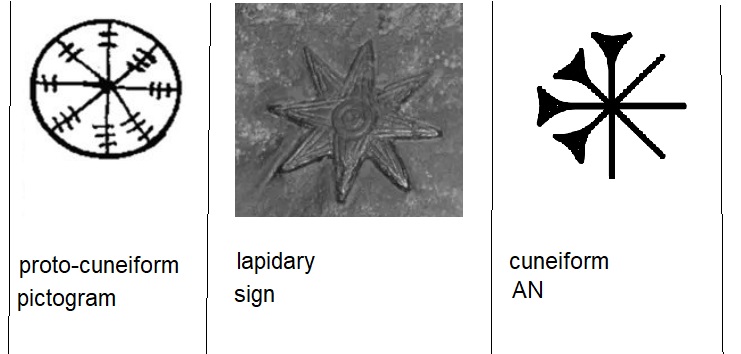

It was a difficult art. Cuneiform used several hundred signs, and each sign could carry multiple sound values and multiple word meanings depending on context. Mastering it took years. That is exactly why scribes formed a professional class, and why kings boasted when they could read (Ashurbanipal claimed he could decipher tablets “from before the flood”). It is also why Babylonian learning had such staying power: the difficulty of the script made the school, and the school carried the culture.
Two scripts side by side: by the Neo-Babylonian era, everyday life was increasingly conducted in Aramaic, a related Semitic language written with a mere 22 alphabetic letters, in ink, on perishable materials. Reliefs show pairs of scribes side by side: one pressing cuneiform into clay, one writing Aramaic with pen and scroll. Aramaic became the empire’s connective tissue. That is why Judah’s officials could already speak it in Hezekiah’s day (2 Kings 18:26). It is why the exiles came home speaking it, and why chapters of Daniel and Ezra are written in it. It is even why Jews to this day write Hebrew in what is technically the Aramaic square script — a quiet, permanent souvenir of Babylon. The writing on Belshazzar’s wall is Aramaic too: MENE, MENE, TEKEL, UPHARSIN (Daniel 5:25) is a string of weight-and-measure words (a mina, a shekel, halves) that the court’s cuneiform experts could not read as a sentence until Daniel supplied the interpretation.
The Scribal School
The Babylonians called the school the edubba, the “tablet house.” Surviving exercise tablets let us watch the curriculum in progress: on one side a teacher’s elegant model line, on the other a student’s wobbly copy, sometimes with the teacher’s corrections still visible. Students began with single wedges and sign lists. They graduated to long bilingual dictionaries: Sumerian–Akkadian word lists, the world’s first reference works. Then they copied proverbs, contracts, letters, and finally the classics: Gilgamesh, hymns, omen series. And the language of learning was Sumerian, dead as a spoken tongue since roughly the patriarchal age, yet memorized and copied for another 1,500 years, the way Latin lived on in medieval Europe.
School texts describe the schoolboy’s day with timeless realism. He is up at dawn with his lunch from mother. He is caned for tardiness, caned for sloppy signs, caned for talking. One famous composition ends with the student’s father inviting the teacher to dinner and plying him with gifts — after which the boy’s prospects miraculously improve. Literacy remained a minority skill, but a broader one than once thought. Merchants’ letters, private contracts, and even soldiers’ correspondence (like the Hebrew Lachish letters of 586 BC; see Section 08) show practical literacy well beyond the temple.
Daniel’s three-year royal course (Daniel 1:5) fits this world precisely: language and script, the literary classics, and the professional corpus of the “wise men”: omen series, dream manuals, astronomy, mathematics. The book is careful about what that meant spiritually. Daniel mastered the curriculum (Daniel 1:17, “learning and wisdom” given by God) — yet he declined the court’s food and never practiced its divination. When the king demanded the future, Daniel prayed (Daniel 2:17–19). Educated in Babylon, never by it — the exile’s whole dilemma in one biography.
Libraries and Literature
Mesopotamia invented the library along with the book. Temple and palace collections existed from early times, but the greatest was assembled at Nineveh by the Assyrian king Ashurbanipal (r. 668–c. 631 BC). He sent agents through Babylonia with shopping lists, demanding tablets by title. Over 30,000 tablets and fragments from his collection now sit in the British Museum, and they are the single richest source for Babylonian literature. The irony is complete. When Nineveh burned in 612 BC, the fire baked the library into permanence. And when the pioneering excavators Layard and Rassam dug it out in the 1840s–50s, Babylon’s classics (the Enūma Eliš, the flood tablet of Gilgamesh) came back to the world out of the ruins of Babylon’s destroyer.
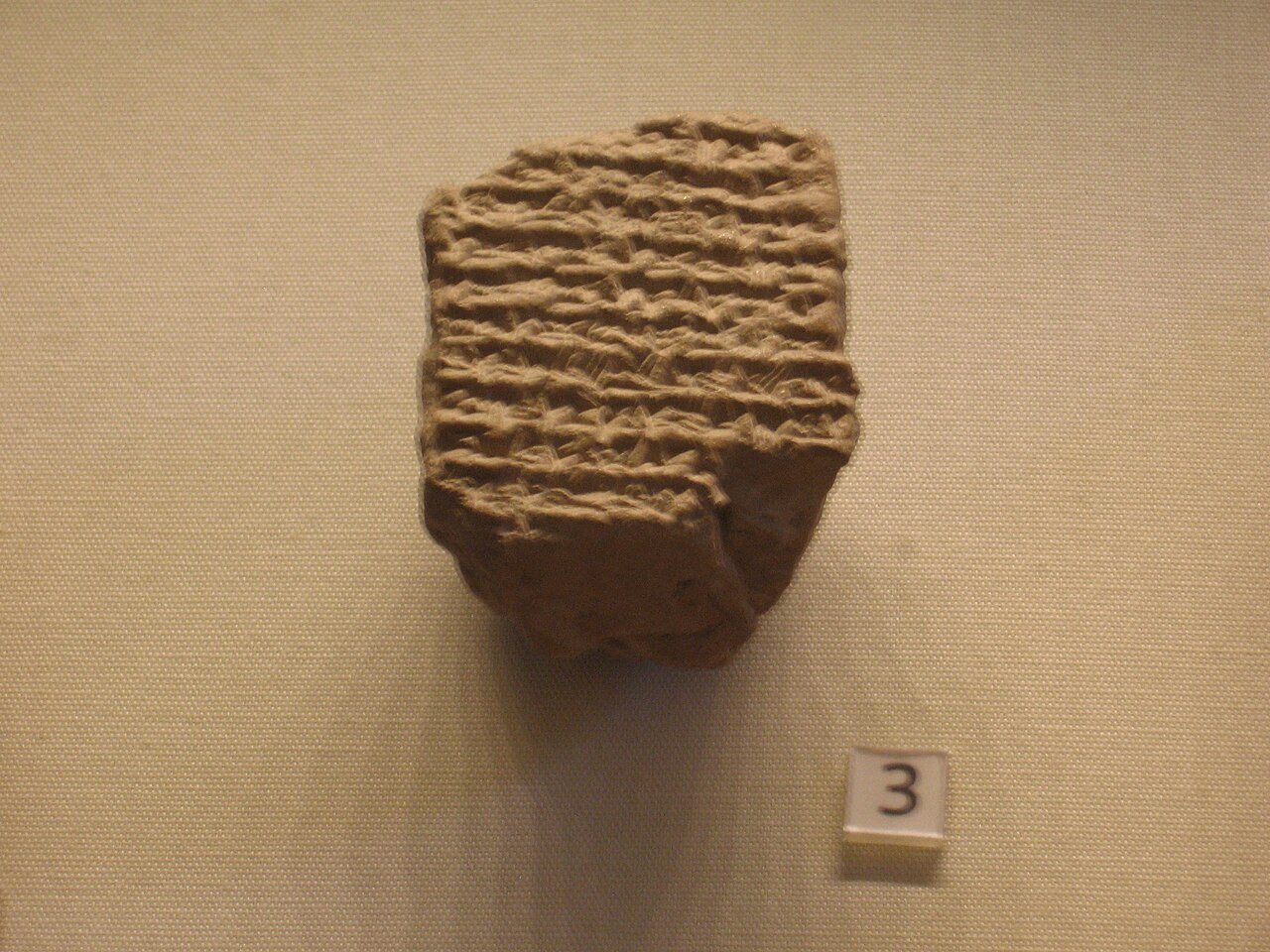
What did the tradition preserve? Epic — Gilgamesh, the king who sought immortality and came home with wisdom instead. Creation and flood narratives (see Section 04). Royal chronicles kept with dry, dateline precision (see Section 08). Hymns and laments. Proverbs. And a striking shelf of wisdom literature wrestling with the same questions as Job and Ecclesiastes:
- Ludlul bēl nēmeqi — the “Babylonian Job,” whose righteous sufferer loses health and honor despite perfect piety.
- The Babylonian Theodicy — an acrostic debate between a sufferer and his orthodox friend.
- The sardonic Dialogue of Pessimism — a master proposes each course of life and its opposite, and his servant supplies equally good reasons for both.
Israel’s sages knew this international wisdom conversation and joined it — with the decisive difference that their answer began with “the fear of the LORD” (Proverbs 1:7).
Mathematics: The World in Base 60
Babylonian mathematics ran on a sexagesimal (base-60) place-value system — the first positional notation in history, some two thousand years before the decimal system reached the West. Why sixty? Sixty divides evenly by 2, 3, 4, 5, 6, 10, 12, 15, 20, and 30, which makes fractions tame. And the choice still governs your wristwatch (60 minutes, 60 seconds) and every circle you measure (360 degrees).
Old Babylonian problem tablets (mostly c. 1800–1600 BC, the mathematical golden age) show scribes solving what we would call quadratic equations. They computed square roots to remarkable precision: one famous tablet gives √2 accurately to about six decimal places. They calculated compound interest. They worked with the ratios of right triangles: the tablet known as Plimpton 322 is a systematic table of Pythagorean-style number triples a millennium before Pythagoras. This was mathematics as professional craft: surveying fields, dividing inheritances, engineering canals and siege ramps, managing the granaries that fed the empire that marched on Jerusalem.
Astronomy: The Long Watch
Babylon’s most celebrated science grew out of its religion. Because the sky was believed to carry divine messages (see Section 04), the sky was watched — systematically, nightly, for centuries. The compendium MUL.APIN catalogued the stars and their calendar of risings. The Venus Tablet of Ammisaduqa preserves twenty-one years of Venus observations from the Old Babylonian period. And from the mid-8th century BC, the Astronomical Diaries record planetary positions, eclipses, weather, river levels, and market prices night after night for some seven hundred years, the longest continuous scientific observation program ever conducted.
Patience became prediction. From the accumulated data, Babylonian astronomers learned the eclipse-repeating cycle of about 18 years (the “Saros”), enabling them to warn of lunar eclipses in advance. By the Persian era they had gone further and built full mathematical models of lunar and planetary motion. These are the ephemerides: tables predicting where the moon and planets would be. Their methods pass directly into Greek astronomy: Hipparchus and Ptolemy cite Babylonian eclipse records and use Babylonian parameters and the sexagesimal degrees we still use. The twelve-sign zodiac itself is a Babylonian invention of roughly the 5th century BC. When Isaiah taunts Babylon (“Let now the astrologers, the stargazers, the monthly prognosticators, stand up, and save thee,” Isaiah 47:13), the barb lands precisely because these were the finest astronomers alive. The critique is not that they were frauds at observing heaven. It is that they worshipped what they observed. In Genesis the sun, moon, and stars are things God made and set in the sky “for signs, and for seasons, and for days, and years” (Genesis 1:14). They are there to mark time and to teach, not to be consulted as gods. Babylon read the sky better than anyone, but it read the sky as the embodiment of its fickle gods, and no star or planet had the power to save a city, let alone a soul.
Babylon in the Jewish calendar: the exiles also came home carrying Babylon’s calendar — its month-names and its leap cycle. That story has its own chapter: The Calendar and the Names of Time.
Medicine, Maps, and the Practical Arts
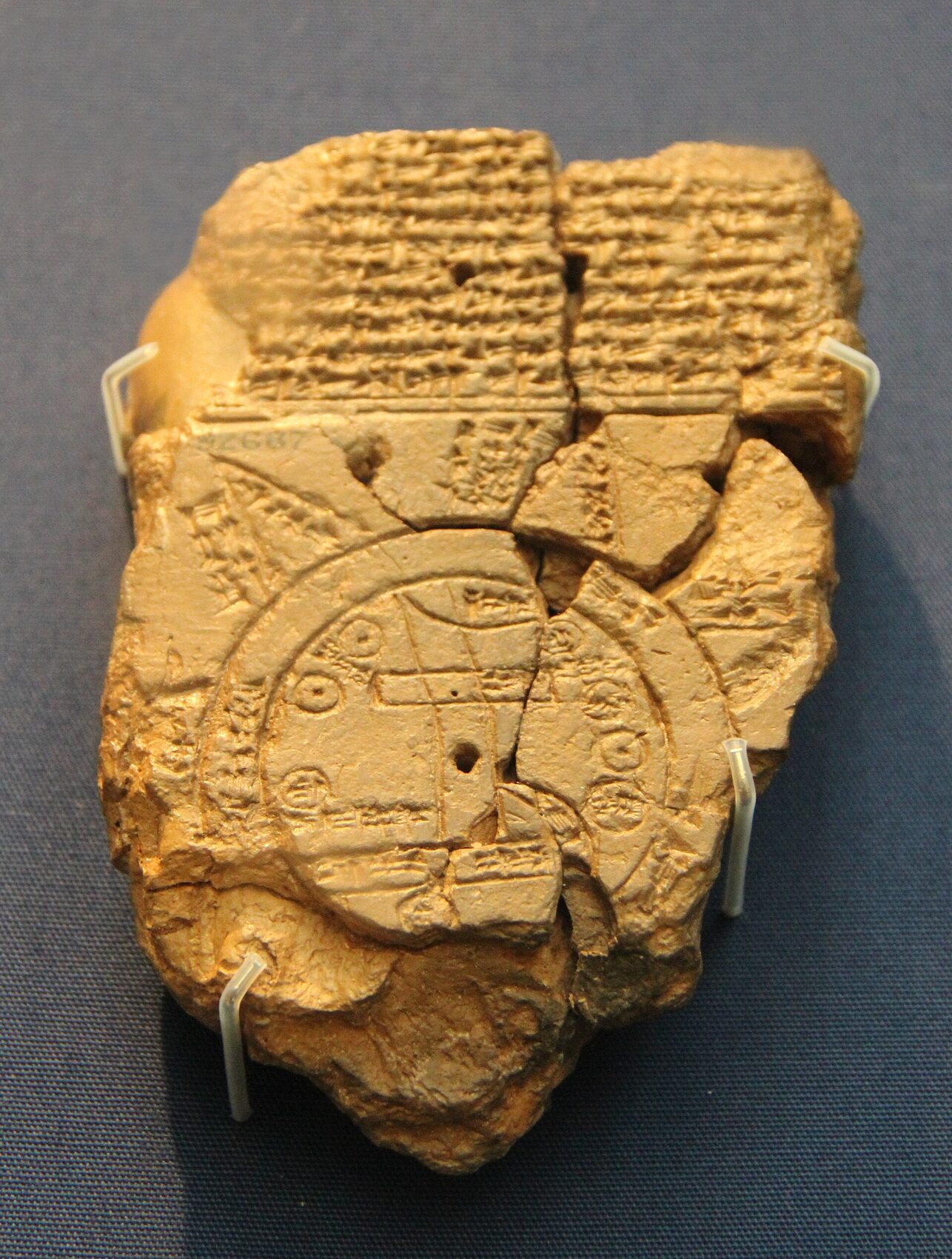
The same list-making genius organized everything else too. Medicine: the Diagnostic Handbook catalogued symptoms and prognoses, and healers divided into the asû, the empirical physician of salves and potions, and the āšipu, the ritual specialist. Ancient Babylon saw no contradiction in employing both. Law: see Hammurabi in Section 02. Lexicography. And even geography: the Babylonian Map of the World (a 6th-century BC tablet in the British Museum) draws the earth as a disk ringed by a “Bitter River” of ocean, with Babylon, naturally, at the center. It is both a real map and a theological statement. And it is precisely the mental map the exiles had to live inside: a world whose official center was Babylon — while their prophets kept insisting the true center was a ruined city on a ridge in Judah, to which they would return (Jeremiah 29:10).

Sources and Further Reading
Writing & Scribal Culture:
- Irving Finkel & Jonathan Taylor, Cuneiform (British Museum Press, 2015) — Compact, authoritative, and delightful introduction to the script and its world.
- Dominique Charpin, Reading and Writing in Babylon (Harvard University Press, 2010) — How literacy actually worked, arguing it reached further than the scribal elite.
- A. Leo Oppenheim, Ancient Mesopotamia: Portrait of a Dead Civilization (University of Chicago Press, rev. ed. 1977) — Foundational on the “stream of tradition” and the scribal schools.
Literature:
- Andrew George, The Epic of Gilgamesh (Penguin Classics, 1999) — The standard translation by the leading Gilgamesh scholar.
- Benjamin R. Foster, Before the Muses: An Anthology of Akkadian Literature (CDL Press, 3rd ed. 2005) — The wisdom texts, hymns, and laments discussed on this page.
- Irving Finkel, The Ark Before Noah: Decoding the Story of the Flood (Hodder & Stoughton, 2014) — A cuneiform curator’s engaging account of the flood-story tablets, occasioned by a newly identified “round ark” tablet.
Mathematics & Astronomy:
- Eleanor Robson, Mathematics in Ancient Iraq: A Social History (Princeton University Press, 2008) — The standard modern treatment, from token-counting to Plimpton 322.
- Francesca Rochberg, The Heavenly Writing: Divination, Horoscopy, and Astronomy in Mesopotamian Culture (Cambridge University Press, 2004) — How omen-watching became mathematical astronomy.
- Hermann Hunger & David Pingree, Astral Sciences in Mesopotamia (Brill, 1999) — Technical survey of MUL.APIN, the diaries, and the ephemerides.
Online Resources:
- WHE — Cuneiform (CC BY-NC-SA 4.0)
- British Museum — the Babylonian Map of the World
- ORACC — the Open Richly Annotated Cuneiform Corpus: real Babylonian texts, transliterated and translated, free to explore.