Religion & Mythology
The gods of the land where Judah spent seventy years
When the exiles of Judah arrived in Babylonia, they stepped into the most religiously saturated landscape on earth. This was a civilization that had been worshipping, cataloguing, feeding, clothing, and consulting its gods for over two thousand years. And that world matters for reading the Bible’s exile-era books. The prophets’ attacks on idols, Daniel’s contests with the “wise men,” Israel’s own hard-won clarity about the God who is not a statue — all of it was forged against this backdrop.
The Pantheon: A Bureaucracy of Heaven
Mesopotamian religion imagined the cosmos as a divine state. Each great god held an office. Each major city was a god’s estate — the temple was the manor house, and the people were the staff. The head offices were ancient and, in theory, fixed:
| Deity | Domain | Chief City | In the Bible |
|---|---|---|---|
| Anu | Sky; remote father of the gods | Uruk | — |
| Enlil | Kingship, storm, decree | Nippur | — |
| Ea (Enki) | Wisdom, fresh water, crafts; humanity’s friend | Eridu | — |
| Sin (Nanna) | Moon; calendars and omens | Ur and Harran | The god of Abraham’s two hometowns (Joshua 24:2) |
| Shamash | Sun; justice and oaths | Sippar and Larsa | Hands Hammurabi the emblems of justice on the law stele |
| Ishtar | Love and war; the planet Venus | Uruk (and everywhere) | Cognate of Canaanite Astarte / “Ashtaroth” (Judges 2:13) |
| Marduk (“Bel”) | King of the gods (by promotion) | Babylon | “Bel boweth down” (Isaiah 46:1); “Merodach is broken” (Jeremiah 50:2) |
| Nabu | Writing, scribes, destiny; Marduk’s son | Borsippa | “Nebo stoopeth” (Isaiah 46:1); the “Nebu-” in Nebuchadnezzar |
A Babylonian name was not just a label. It was a tiny sentence (a god’s name wrapped around a request), which made royal names miniature prayers to this pantheon. Nabu-kudurri-usur (Nebuchadnezzar) means “O Nabu, protect my heir”; Bel-shar-usur (Belshazzar) means “O Bel, protect the king.” The exiles’ captors renamed Daniel and his friends into this same theology: Belteshazzar, Shadrach, Meshach, Abed-nego (Daniel 1:7). These were names invoking Babylon’s gods, pressed onto young men who pointedly declined to invoke them.
Marduk’s Rise and the Enūma Eliš
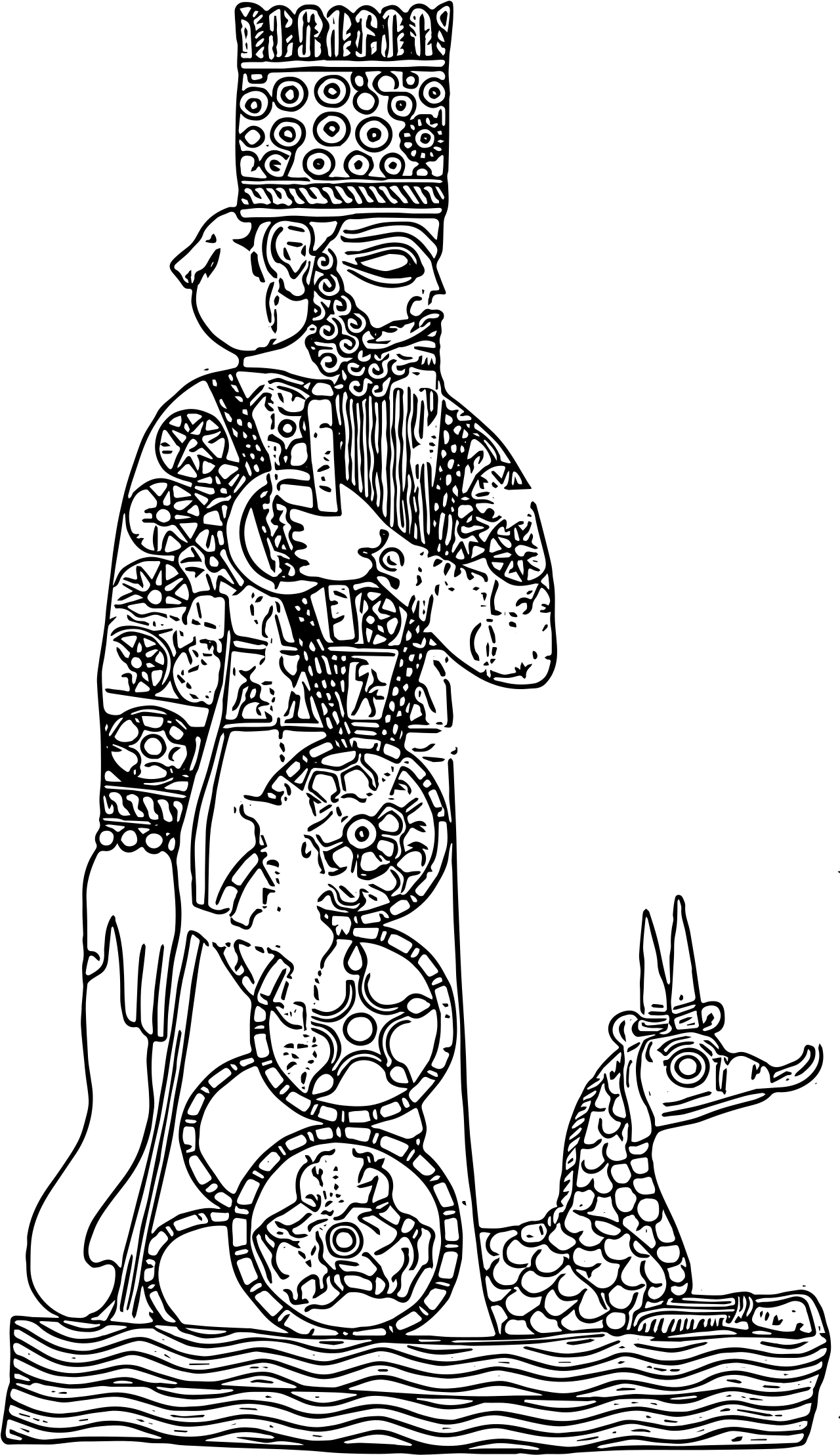
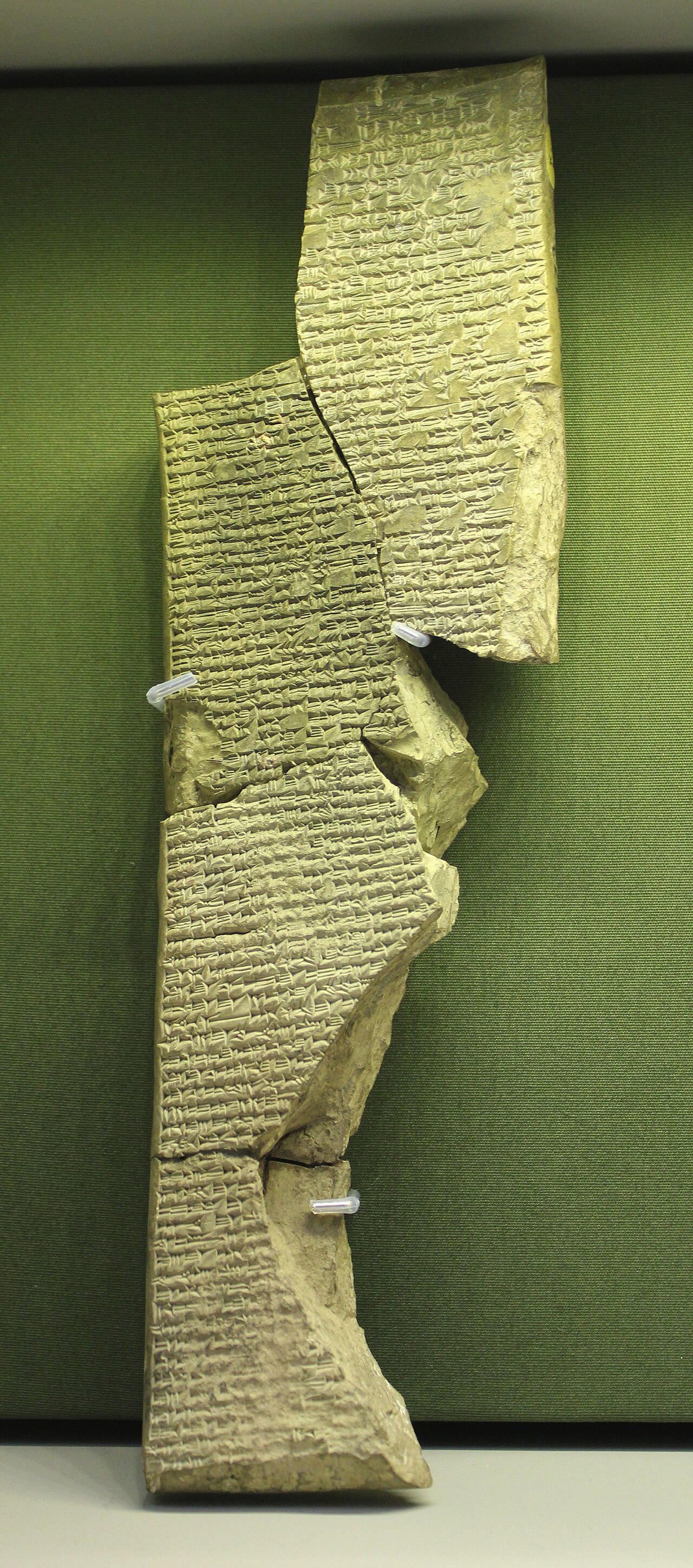
Marduk began as the modest patron of a modest town. As Babylon rose, so did he. He absorbed the offices and epithets of older gods until, by the later second millennium BC, Babylonian theology crowned him king of the entire pantheon. The classic statement of that kingship is the epic modern scholars call the Enūma Eliš (“When on high…”, from its opening words). It is often labeled the “Babylonian creation epic” — but it is really an enthronement text, a story told to prove Marduk deserves his throne. The creation of the world is the evidence; Marduk’s kingship is the verdict.
The story runs across seven tablets. In the beginning, the primeval waters (fresh-water Apsu and salt-water Tiamat) mingle and beget the gods. The younger gods’ noise provokes a war. When Tiamat, the ocean-mother turned monster, marshals an army of dragons, only young Marduk dares face her — and he names his price: supreme kingship. He kills Tiamat with wind and arrow. Then he splits her carcass in two and builds the cosmos from it: half her body arched as the sky, holding back the upper waters; the Tigris and Euphrates set flowing from her eyes. He organizes the stars and the calendar. Then, from the blood of the rebel god Kingu, he has humanity created, explicitly as a labor force, “that the gods may rest.” The epic closes with the gods building Marduk his city, Babylon, and reciting his fifty names of honor.
Enūma Eliš and Genesis 1
The epic was discovered in the ruins of Nineveh’s royal library and published by George Smith in 1876. Ever since, readers have noticed both the echoes and the gulf between this text and Genesis 1. The echoes are real. Both stories begin in watery formlessness. The Hebrew word for the “deep” over which God’s spirit moves, tᵊhôm (תְּהוֹם, Genesis 1:2), is the linguistic cousin of Tiamat. Both have a firmament dividing waters above from waters below. And both unfold in a seven-part literary structure ending in rest.
So did Genesis borrow from Babylon? Early scholars thought so; Hermann Gunkel argued it in a famous 1895 study, and many followed him. But the leading modern authority on the epic, W. G. Lambert, pushed back hard. He showed that the Enūma Eliš is itself late and idiosyncratic (a one-off, not “the” standard Near Eastern creation story), and that direct literary borrowing is unlikely. So most scholars today put it differently. Genesis and Babylon both drew on a shared ancient cosmological vocabulary: a common stock of images for talking about how the world began: the deep, the divided waters, the ordered sky. And Genesis uses that vocabulary polemically. A polemic is an argument built to tear down a rival view. In other words, Genesis speaks Babylon’s language in order to answer it.
The differences are the sermon. Read against Babylon’s epic, Genesis 1 is quietly devastating. Creation is no war-prize. There is no cosmos wrenched from a slain god, no rival God must conquer to build it. God speaks, and it is so. The sea is not a slain goddess; it is a creature, gathered and bounded on command. The sun and moon, mighty gods in Babylon, are not even named in Genesis. They are “the greater light” and “the lesser light,” lamps hung by their Maker (Genesis 1:16). And humanity is no afterthought brewed from rebel blood to relieve the gods of chores. Humanity is the summit of creation, made in God’s own image and blessed (Genesis 1:27). For Latter-day Saints, who read creation as the founding act of a plan centered on human beings as God’s children (Moses 1:39), the contrast could hardly be sharper.
The Flood Before the Flood Story
Babylon also told of a great deluge — and told it long before any part of the Bible was written down. In the Atrahasis epic (Old Babylonian, c. 17th century BC), the gods send a flood to silence noisy humanity, but Ea warns one man to build a boat. Then there is Tablet XI of the Epic of Gilgamesh, the tablet whose 1872 decipherment by George Smith famously stunned Victorian London. On it, the flood hero Utnapishtim tells his story, and the details are startlingly familiar. Precise boat-building instructions. The animals loaded aboard. A storm so terrible the gods themselves cower. The boat grounding on a mountain. And the birds (a dove, a swallow, a raven) sent out to find land, before the survivor offers sacrifice and the gods crowd round it.
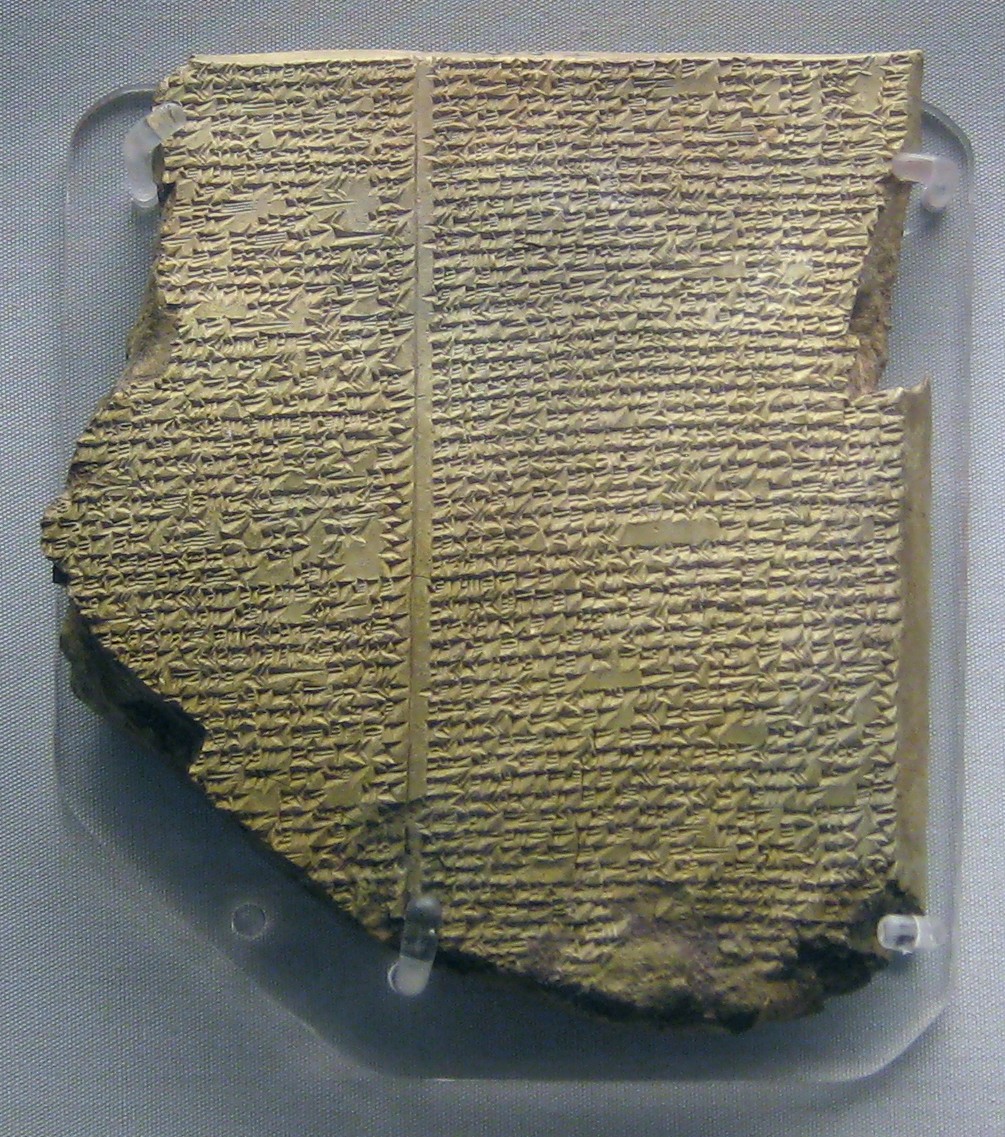

The parallels with Genesis 6–9 are unmistakable — and unsurprising. Both traditions remember the same event-shaped story in the same landscape: a flood plain civilization that kept flood layers in its very soil and a “mound of the flood” in its place names. What differs, again, is the theology. Babylon’s gods send the flood out of irritation. They lie about it to each other. They panic when it comes. And they swarm “like flies” to the post-flood sacrifice because they are hungry: no one has fed them in a week. Genesis tells it differently at every point. The flood is grounded in moral judgment (Genesis 6:5). One sovereign God both judges and remembers (Genesis 8:1). And the story ends not with divine snacking but with covenant: a bow set in the cloud (Genesis 9:13). Latter-day Saint readers, who accept revealed knowledge of these events reaching back to the patriarchs, need not be troubled that Mesopotamia remembered a flood too. A real event leaves many memories. Read in faith, the differences show which tradition kept its meaning.
Feeding the Gods: Temples, Statues, and the Akitu Festival
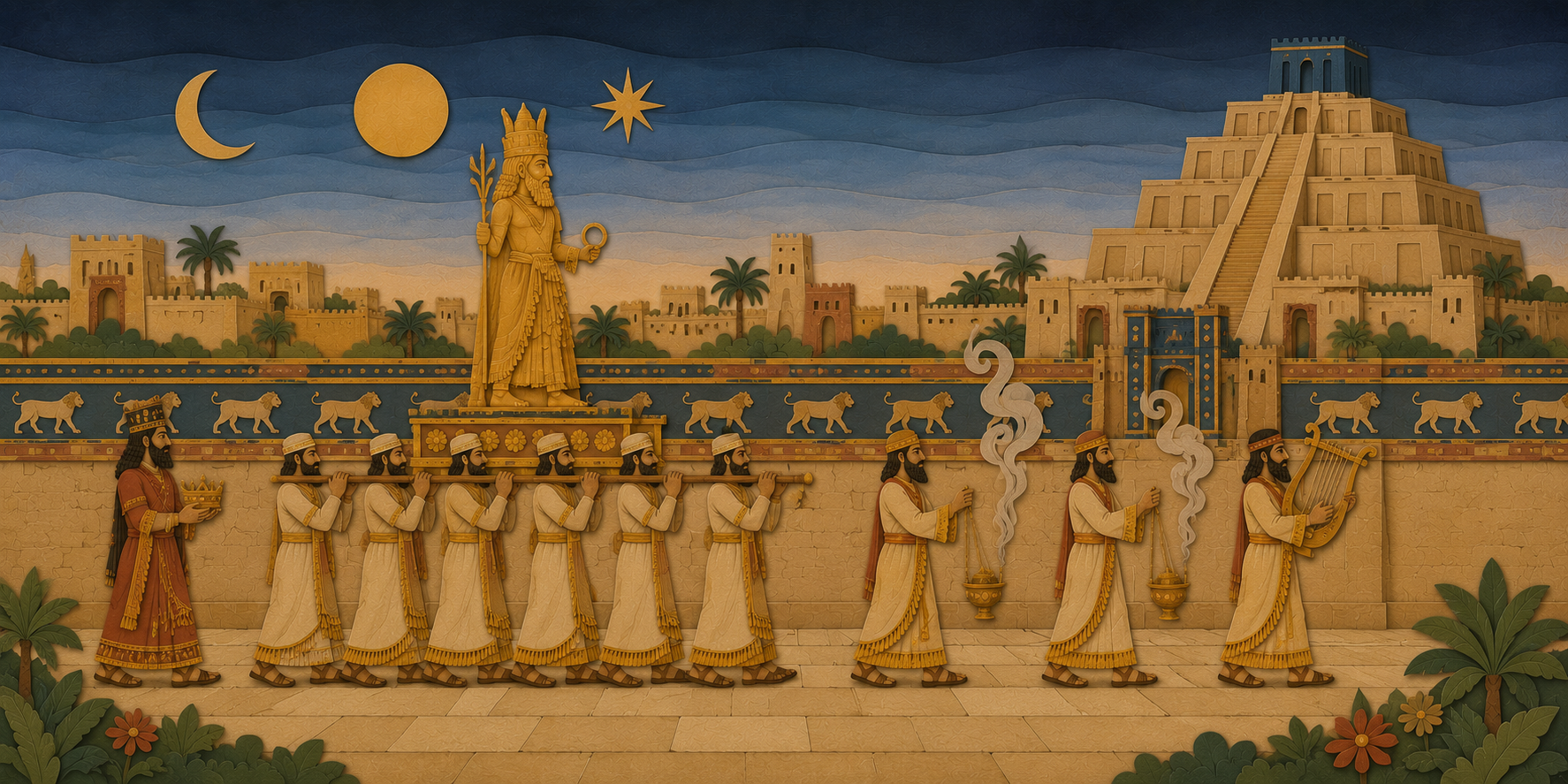
Babylonian worship was, at its core, statue care. The god was understood to be really (if mysteriously) present in the cult image: a wooden core plated with gold, dressed in garments, crowned, and enthroned in a dark inner shrine. Twice a day, the statue was served full meals behind a curtain. It was washed, clothed, perfumed, and entertained with music. On festival days it was carried in procession so the public could see its face. A newly made statue underwent the mīs pî (“washing of the mouth”), a ritual held to transform the artifact into a living vessel of the god. Revealingly, the incantations themselves protest that the statue was made “not by human hands.”
The temples that housed the gods were economic institutions on a national scale: landowners, granaries, workshops, banks, and archives all at once. Esagila, Marduk’s temple in Babylon, commanded estates and prebends (shares in temple income) that made its priesthood a political force. Kings crossed that priesthood at their peril — as Nabonidus learned (see Section 03). Beside each great temple rose the ziggurat. It was not a temple for congregations but a stairway-mountain, a pedestal connecting heaven and earth, with a small high shrine at its summit. Babylon’s ziggurat, Etemenanki (“House of the Foundation-Platform of Heaven and Earth”), stood some ninety meters square at the base. It figures directly in the background of Genesis 11 (see Section 06).
The high point of the religious year was the Akitu, the New Year festival: twelve days at the spring equinox in the month Nisannu, the very month name Judah’s calendar borrowed as Nisan. The Enūma Eliš was recited before Marduk’s statue. The gods of other cities (Nabu foremost) came to Babylon by barge and chariot for a divine assembly, and destinies were decreed for the coming year. Then came the festival’s most extraordinary rite. The king himself was stripped of his regalia before Marduk. The high priest slapped him across the face. On his knees, the king had to declare that he had not sinned against the city. Only then was he reinvested with crown and scepter — and slapped once more, hard enough (the ritual texts specify) to bring tears. The tears counted as a good omen. Even the emperor, one day a year, was reminded he held his throne on sufferance.
The prophets in the idol workshop: Isaiah 44 and Jeremiah 10 read like eyewitness reports of the statue industry: the carpenter with his rule and compass, the goldsmith’s plating, the nails so the god “move not” (Isaiah 44:13; Jeremiah 10:4). And Isaiah 46 turns the Akitu procession itself upside down. Instead of gods carried in triumph: “Bel boweth down, Nebo stoopeth… they are a burden to the weary beast” (Isaiah 46:1–4). The idols are hauled away as refugee baggage — while the God of Israel says, in the same breath: I have made, and I will bear; even I will carry, and will deliver you. Babylon’s gods must be carried. Israel’s God carries.
Reading the Future: Divination and the “Wise Men”
No civilization ever invested more in knowing the future. The Babylonians held that the gods wrote their intentions into the fabric of the world (sheep livers, birth anomalies, oil on water, smoke, dreams, and above all the night sky) and that trained experts could read the script. The result was divination as a national science. There were enormous omen compendia; the celestial series Enūma Anu Enlil ran to some seventy tablets. There were clay models of livers for training diviners. And there were centuries of systematically recorded astronomical observation, which, ironically, laid real foundations for astronomy itself (see Section 05).
Ezekiel gives a field report of the method: “the king of Babylon stood at the parting of the way… he made his arrows bright, he consulted with images, he looked in the liver” (Ezekiel 21:21). That is Nebuchadnezzar deciding by lot, liver, and teraphim (household idols) whether to march first on Jerusalem or on Rabbah. Daniel’s “magicians, and the astrologers, and the sorcerers, and the Chaldeans” (Daniel 2:2) are the guilds of this establishment. And the book’s recurring joke at their expense is precise. The world’s most sophisticated future-reading industry cannot tell the king his own dream, because “there is a God in heaven that revealeth secrets” (Daniel 2:28) — and He is not on the payroll. Israel’s law had banned these arts centuries earlier (Deuteronomy 18:10–12). Manasseh’s embrace of them (“observed times, and used enchantments,” 2 Kings 21:6) is listed among the sins that sealed Judah’s fate.
Alongside the great state religion ran a humbler layer: incantations against demons (the night-hag Lamashtu, the wind-demon Pazuzu), protective amulets, household rituals, and personal gods — minor divine patrons who represented an individual before the great gods. Babylonian prayer literature can be genuinely moving. The laments of the righteous sufferer in Ludlul bēl nēmeqi (“I will praise the lord of wisdom”) walk some of Job’s ground centuries before Job. But there is a telling difference: the sufferer’s question is never whether the god is just, only which ritual was missed.
What the Exile Cured — and What It Didn’t
Judah went into Babylon a people repeatedly seduced by exactly this religious world: high places, host-of-heaven (star) worship on the rooftops (Zephaniah 1:5; 2 Kings 23:12), Ishtar-cakes for “the queen of heaven” (Jeremiah 44:17). It came home changed. In exile, the people saw the gods of the empire up close — fed by cooks, carried by porters, helpless before their own king’s neglect. What had been the prophets’ satire became settled national conviction: “The gods that have not made the heavens and the earth, even they shall perish from the earth” (Jeremiah 10:11). Fittingly, that verse was written in Aramaic, the language of the empire, as if for the neighbors to read. The old wholesale idolatry, the bowing to graven images, lost its grip.
But “cured” would overstate it. The exile curbed Israel’s idolatry; it did not scrub the empire off entirely. Babylon rode home in the very reckoning of time. The returning exiles adopted the Babylonian month-names the Jewish calendar still keeps — and one of them is Tammuz (Ezekiel 8:14), the dying-and-rising god whose worshippers Ezekiel had watched weeping at the gate of the Temple itself. A people finished with feeding statues still carried home, in subtle and small ways, a memory of the empire they never entirely shook, a thread picked up in The Calendar and the Names of Time.
Sources and Further Reading
Mesopotamian Religion:
- Jean Bottéro, Religion in Ancient Mesopotamia (University of Chicago Press, 2001) — The classic accessible synthesis, from the pantheon to divination.
- Thorkild Jacobsen, The Treasures of Darkness: A History of Mesopotamian Religion (Yale University Press, 1976) — The great interpretive history of how Mesopotamian religious imagination developed.
- A. Leo Oppenheim, Ancient Mesopotamia: Portrait of a Dead Civilization (University of Chicago Press, rev. ed. 1977) — Includes the famous, bracing chapter on the care and feeding of the gods.
- Francesca Rochberg, The Heavenly Writing: Divination, Horoscopy, and Astronomy in Mesopotamian Culture (Cambridge University Press, 2004) — The standard study of celestial divination and its relationship to science.
The Texts:
- W. G. Lambert, Babylonian Creation Myths (Eisenbrauns, 2013) — The definitive edition and study of the Enūma Eliš, including Lambert’s influential caution against reading it as a source for Genesis.
- Stephanie Dalley, Myths from Mesopotamia: Creation, the Flood, Gilgamesh, and Others (Oxford World’s Classics, rev. ed. 2000) — Reliable, readable translations of Atrahasis, the Enūma Eliš, and more.
- Andrew George, The Epic of Gilgamesh (Penguin Classics, 1999) — The standard English translation, including the flood tablet.
- Benjamin R. Foster, Before the Muses: An Anthology of Akkadian Literature (CDL Press, 3rd ed. 2005) — The comprehensive anthology, including Ludlul bēl nēmeqi and the prayer literature.
- Alexander Heidel, The Babylonian Genesis (University of Chicago Press, 2nd ed. 1951) — Older but still-useful side-by-side study of the creation texts and Genesis.
Bible Comparisons:
- John H. Walton, Ancient Near Eastern Thought and the Old Testament (Baker Academic, 2nd ed. 2018) — Judicious guide to comparing biblical and Mesopotamian worldviews without flattening either.
- Kenton L. Sparks, Ancient Texts for the Study of the Hebrew Bible (Hendrickson, 2005) — A guide to the whole comparative corpus, text by text.
- WHE — Enūma Eliš (CC BY-NC-SA 4.0)
- WHE — The Atrahasis Epic