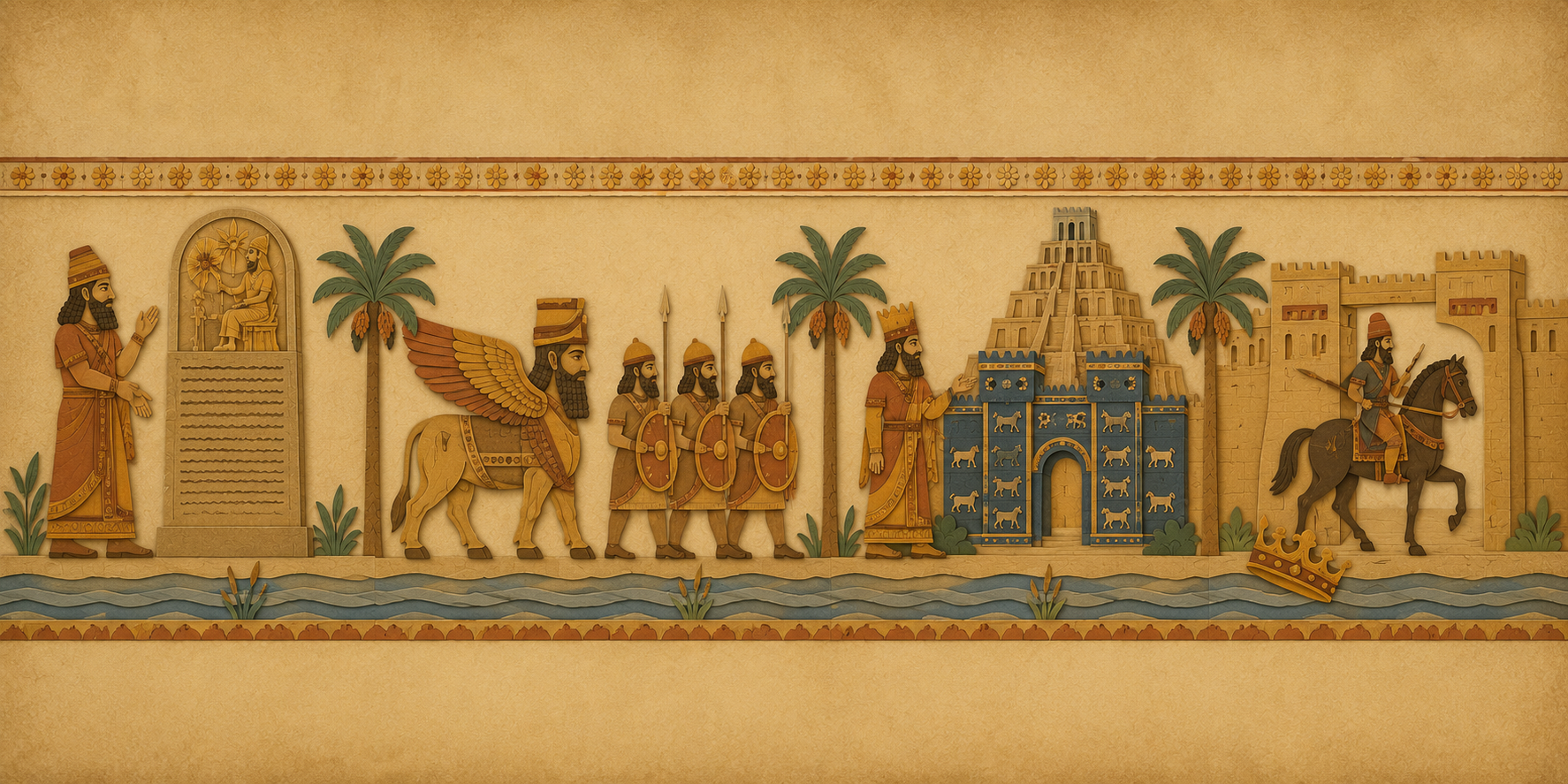
Timeline & Empires
Babylon was ancient before it was mighty — and mighty for barely a lifetime
Here is the surprise at the heart of Babylonian history. The empire that destroyed Jerusalem, carried Judah captive, and became scripture’s enduring symbol of worldly power was a great power for less than seventy years — almost exactly the span Jeremiah gave it (Jeremiah 25:11–12). But behind that brief empire stood a far older inheritance of prestige. When Nebuchadnezzar rebuilt Babylon, he was consciously restoring a city that was already ancient, more than a thousand years old before he laid a brick.
One note before we start. All dates before the first millennium BC are approximate — this guide follows the widely used “middle chronology”. But from the 8th century BC onward, Babylonian records let us date events to the day.
The whole arc at a glance — drag the slider from Hammurabi’s Babylon (1800 BC) through the Assyrian centuries to Nebuchadnezzar’s empire and its fall.
Periods at a Glance
| Period | Approximate Dates | Biblical Connection |
|---|---|---|
| Old Babylonian Empire | c. 1894–1595 BC | The patriarchal era — Hammurabi's law code preserves the legal world of Genesis |
| Kassite & Middle Babylonian | c. 1595–1000 BC | Exodus through the Judges — Babylon is a holy city, not a threat; Marduk rises to supremacy |
| Under Assyria’s Shadow | c. 900–626 BC | The divided kingdom’s world — Israel falls to Assyria (722); Merodach-baladan courts Hezekiah |
| Neo-Babylonian Empire | 626–539 BC | Judah’s final century — Carchemish, the deportations, Jerusalem’s fall, the exile, Daniel |
| Persian & Hellenistic Babylon | 539 BC–1st c. AD | The return — Cyrus’s decree; Babylon fades slowly into ruin, exactly as the prophets said |
Visual Timeline: From Hammurabi to the Fall
The First Babylon: Hammurabi’s Moment (c. 1792–1750 BC)
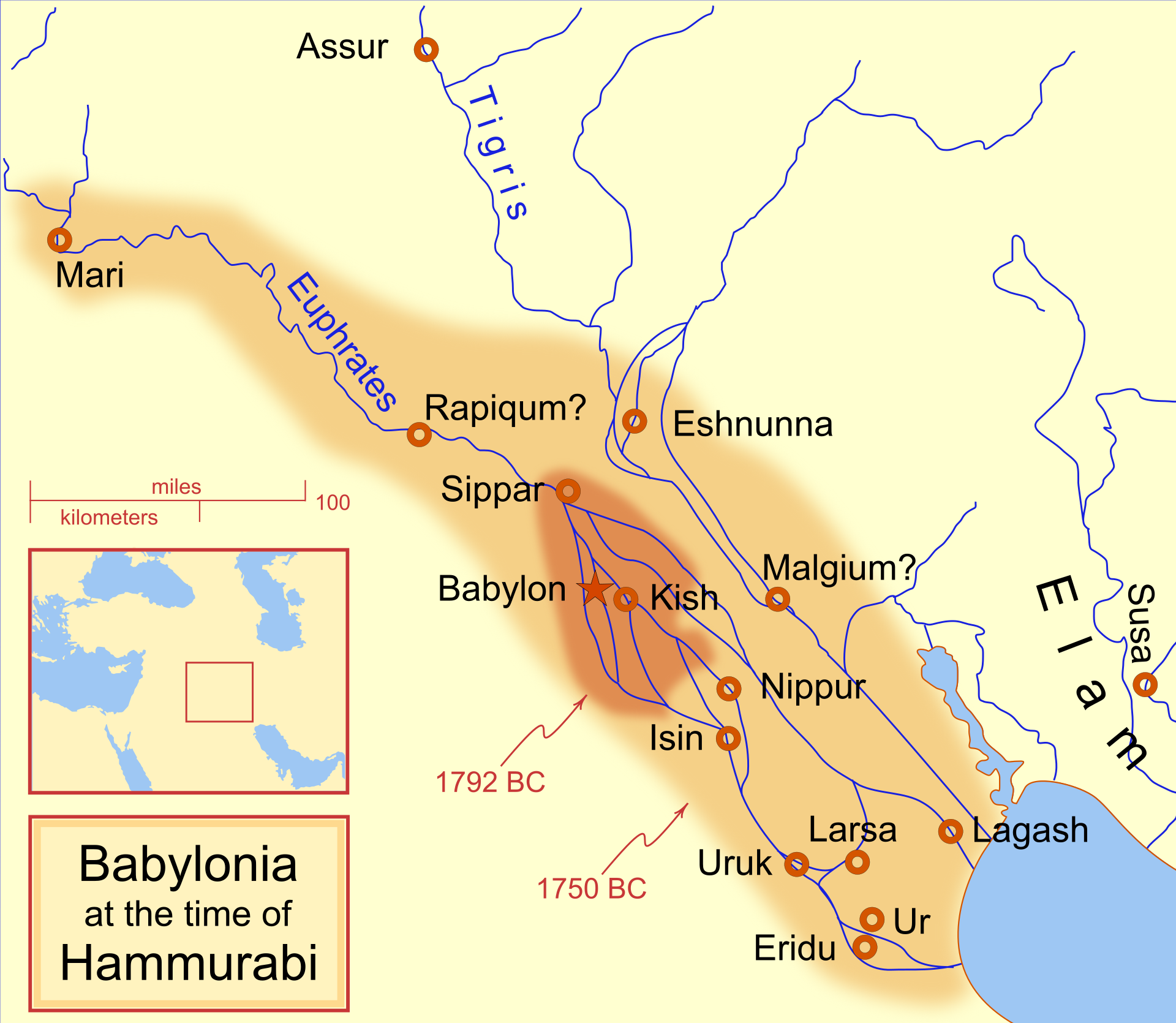
Babylon’s first rise was the work of one extraordinarily patient man. Hammurabi was the sixth king of an Amorite dynasty ruling a modest city-state. For thirty years he played the careful junior partner among stronger kings. Then, in a single decade, he outmaneuvered and absorbed every one of them, from Mari on the middle Euphrates to Larsa near the Gulf. For the first time since the great Sumerian dynasties, southern Mesopotamia answered to one ruler. And that ruler sat at Babylon — a city that never again let anyone forget it.

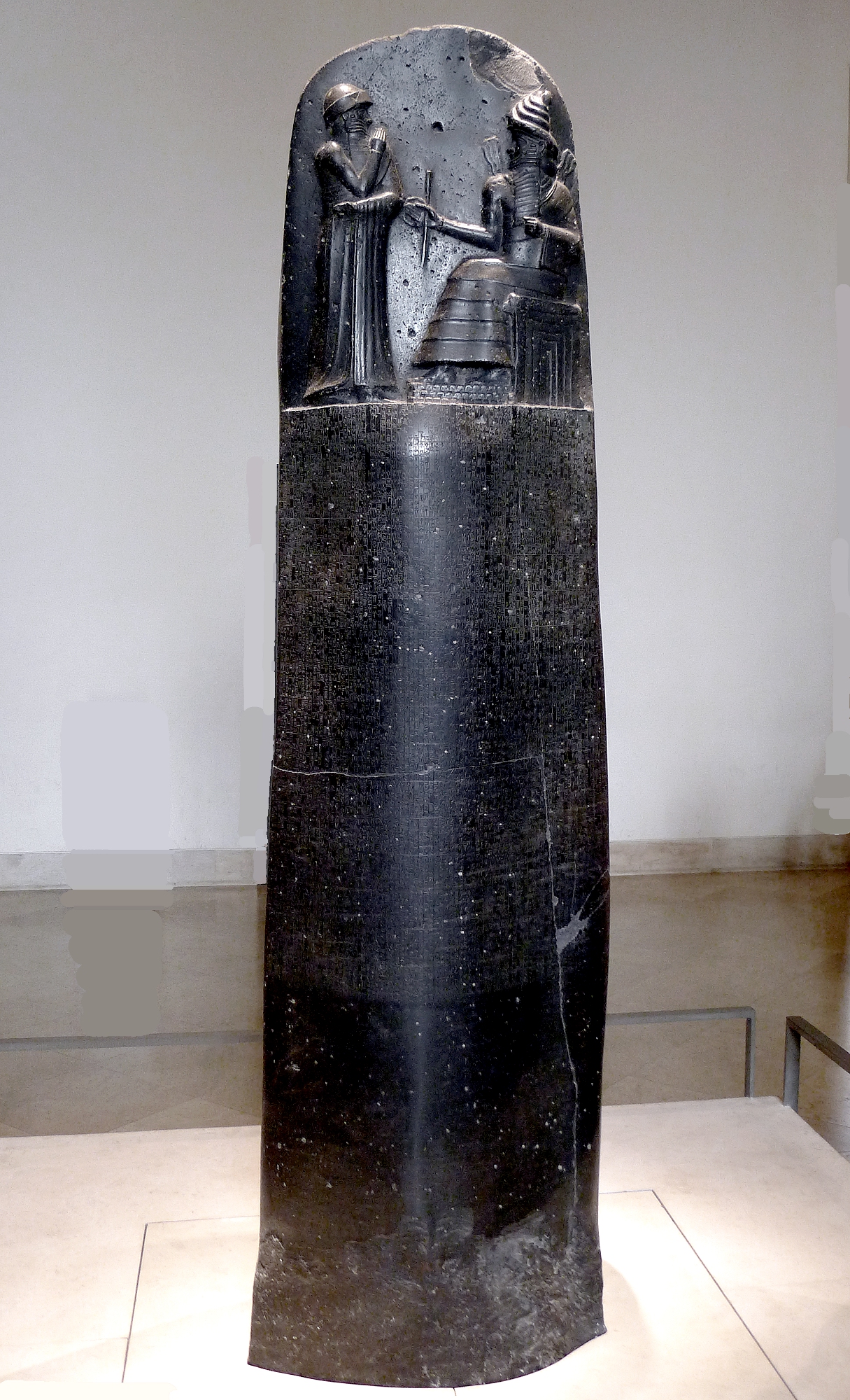
Hammurabi is best remembered for his law code: 282 judgments carved on a two-meter stele (a tall inscribed stone) of black diorite. Above the laws stands an image of the king receiving the symbols of justice from the sun god Shamash. The laws follow a simple case-by-case formula: if a man does X, then Y. That is the same style found in the covenant law of Exodus (compare Exodus 21:28–29 with the code’s famous goring-ox laws). And the code’s stated ideal, “that the strong might not oppress the weak,” echoes through all later Near Eastern law. The resemblances are real. So are the differences: biblical law grounds justice in covenant with God rather than royal boast, values persons over property more consistently, and applies one standard across social classes far more often. Scholars generally see both codes as drawing on a shared, older legal culture (the common law of the ancient Near East) rather than direct copying. (More on the scribal culture that produced it in Section 05.)

Politically, Hammurabi’s empire barely outlived him. But something more durable had happened. His dynasty made Babylon the seat of the god Marduk, and Marduk’s city became the religious and intellectual capital of Mesopotamia. It held that position, through conquest and catastrophe, for the next 1,700 years.
The Long Middle: Prestige Without Power (c. 1595–900 BC)
After the Hittite raid ended Hammurabi’s line, the Kassites, a people from the eastern mountains, took the throne and held it for four hundred years, the longest single dynasty in Babylonian history. Their era looks quiet in the chronicles, and that is the point. The Kassites became more Babylonian than the Babylonians. They tended the temples, supported the scribal schools, and wrote to Egypt’s pharaohs as acknowledged equals in the Amarna Letters. It was during and after this long middle period that Babylon’s scholars standardized the great works of Mesopotamian literature and science — and that Marduk, Babylon’s city god, rose from local patron to king of the gods (the story told in Section 04).
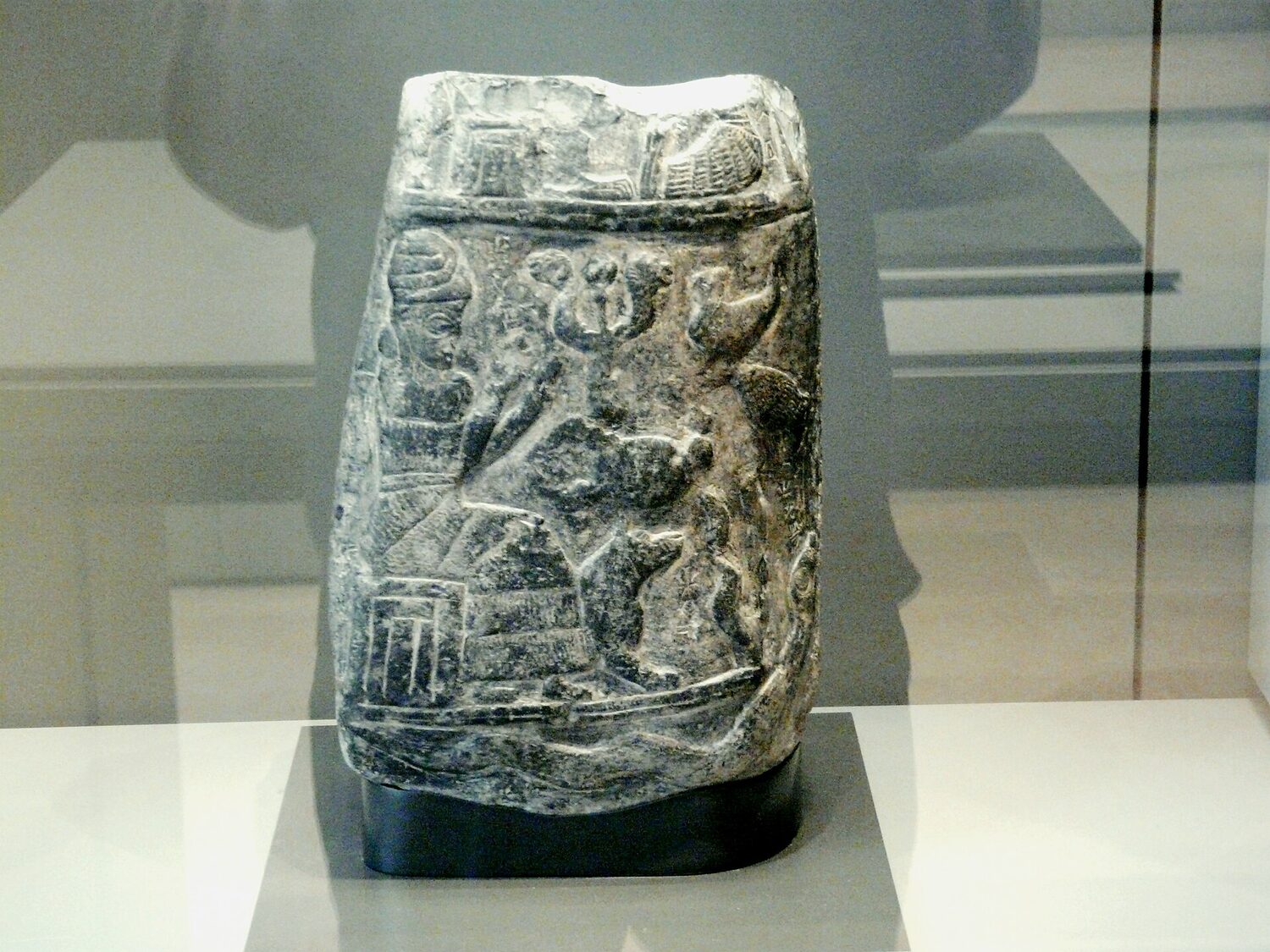

For Israel’s story, what matters most about this era is what Babylon was not. From the Exodus through David and Solomon, Babylon was no threat to anyone. The superpowers of that world were Egypt and the Hittites — and then, after the great Bronze Age collapse (c. 1200 BC), nobody at all. That power vacuum is the space where Israel’s united monarchy briefly flourished. When Babylon finally appears in the historical books, it enters not as an empire but as a holy city under someone else’s boot.
Babylon Under Assyria: A Century of Fire (729–626 BC)
From the ninth century BC the rising power was Assyria, Babylon’s northern sibling — and Assyria had a Babylon problem it never solved. Babylon was too holy to treat like other conquests. Assyrian kings shared its gods, honored its shrines, and craved coronation there. But Babylonia kept rising up. Stiffened by the Chaldean tribes of the southern marshes, it revolted with every change of Assyrian king. The result was a century-long cycle of revolt, punishment, and rebuilding:
- 729 BC — Tiglath-pileser III, the Assyrian king who forged the ancient world’s first great empire, had himself crowned king of Babylon as well, performing Babylon’s own coronation rite (“taking the hands of Bel”), so that from then on one man ruled both Assyria and Babylon directly, instead of leaving a puppet king on the southern throne.
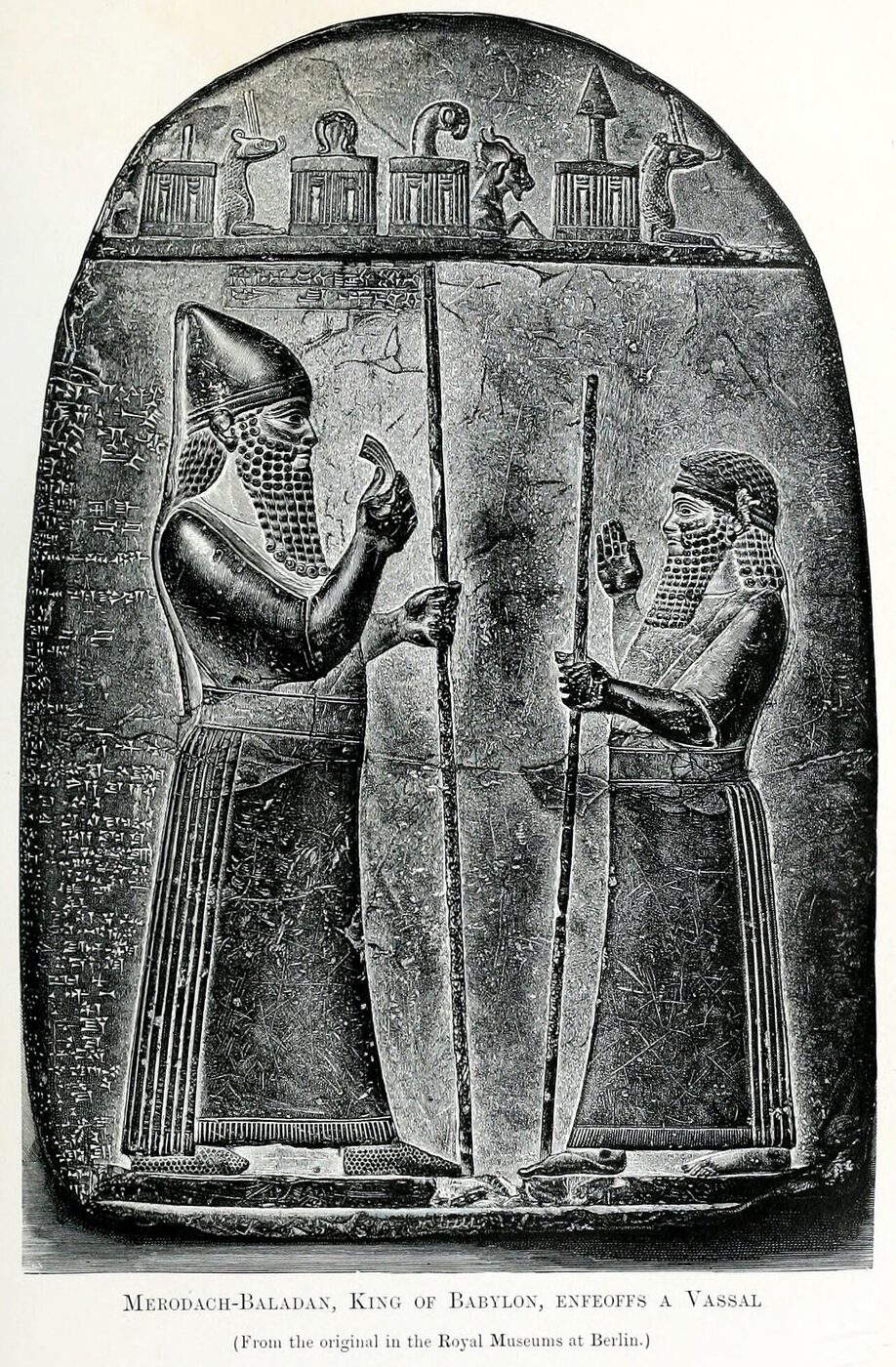
- 721–710 and 703 BC — the Chaldean chieftain Merodach-baladan twice seized the throne, holding it for over a decade the first time. His embassy to Hezekiah (2 Kings 20:12–19) belonged to this struggle: a rebel recruiting allies on Assyria’s western flank. Isaiah saw exactly where that flattery would lead (see Section 03).
- 689 BC — Sennacherib, the Assyrian king remembered for his siege of Jerusalem, exhausted by revolts (one cost him his crown prince, captured and carried to Elam), did the unthinkable: he razed Babylon, temples included, and diverted canals over the ruins. Later tradition may have regarded this as a sacrilege; his successors did not repeat the boast.
- 680–669 BC — Sennacherib’s son Esarhaddon rebuilt the holy city with conspicuous piety, presenting Babylon’s destruction as Marduk’s own decree of seventy years of desolation, mercifully shortened.
- 652–648 BC — the great civil war: Ashurbanipal of Assyria, the empire’s last great king, against his own brother Shamash-shum-ukin, whom their father had made king of Babylon. Babylon endured a brutal two-year siege before it fell. Assyria won — but the war so drained the victor that Assyria itself never truly recovered, and within a generation the empire was gone.
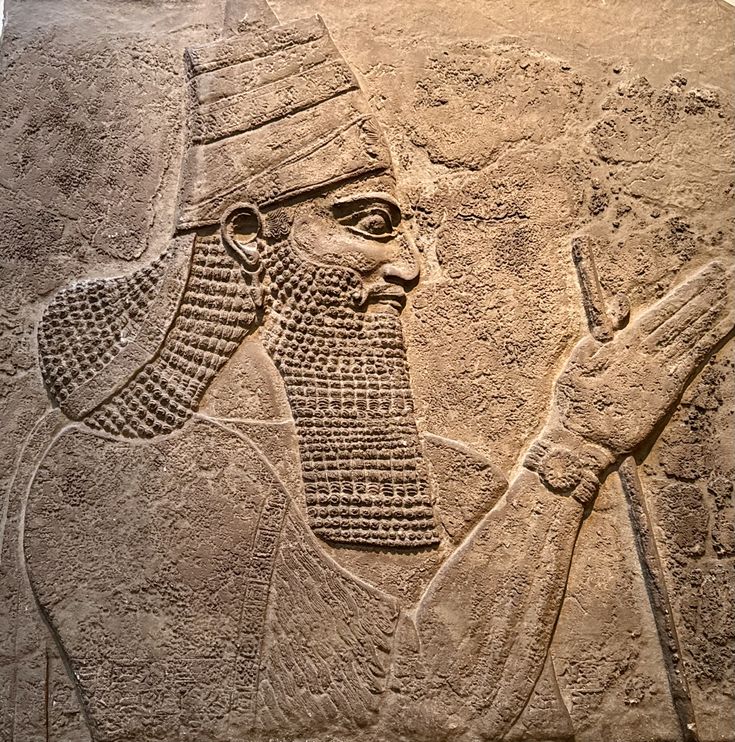

Why this matters for reading Kings: when Judah watched Assyria destroy Israel in 722 BC, Babylon was not the coming menace. It was a fellow victim, crushed again and again by the same empire. That is what makes Isaiah’s response to Merodach-baladan’s envoys so startling. With Assyria at the door, the prophet announced that the real judgment would come from Babylon, then a broken rebel state, and that Hezekiah’s own descendants would serve in its palace (2 Kings 20:17–18). A century later it happened exactly so.
The Neo-Babylonian Empire (626–539 BC)
Assyria’s fall was astonishingly fast. In 626 BC the Chaldean general Nabopolassar took Babylon’s throne. By 612, allied with the Medes, he had burned Nineveh itself. By 609 Assyria no longer existed. The victors divided the world: the Medes took the mountains, Babylon took the Fertile Crescent — on paper. In practice, Egypt under Necho II moved up the coast to grab the Assyrian west. So for four years it was Egypt, not Babylon, that ruled Judah, deposing one king and installing another as its tax collector (2 Kings 23:33–35).
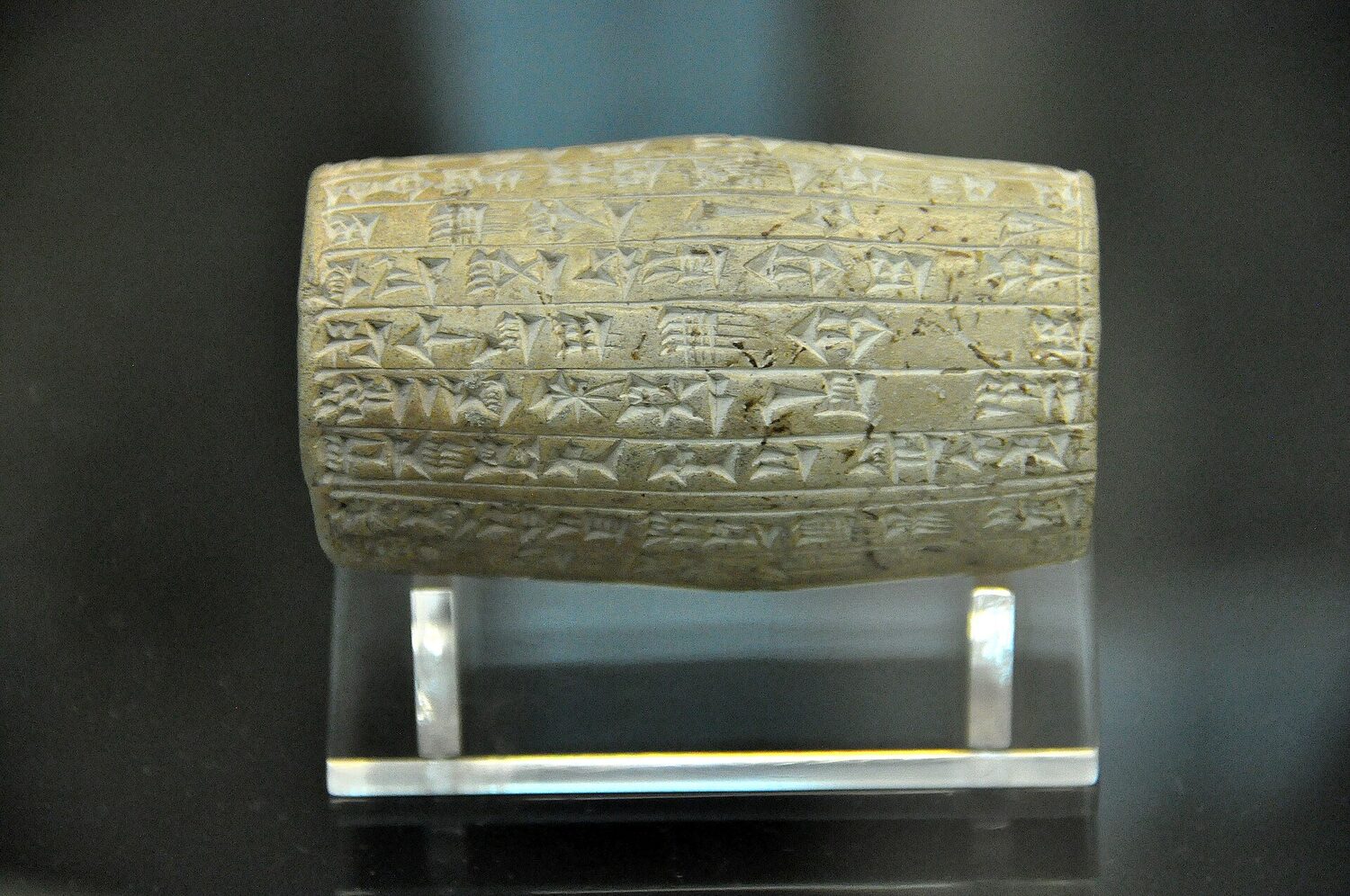

Then came Carchemish (605 BC). There the crown prince Nebuchadnezzar shattered the Egyptian army and chased its remnant south. Within months his father died, and Nebuchadnezzar crossed the desert by forced march to claim the crown. After that he returned west year after year to collect the tribute of “all the kings of Hatti-land,” as his chronicle calls Syria and Palestine. Judah’s last four kings lived and died inside that annual rhythm: submission, temptation from Egypt, revolt, and retribution. The cycle ran through the deportation of 597, the destruction of 586, and beyond. (The kings themselves, Babylon’s and Judah’s, are profiled in Section 03; the fall of Jerusalem as the Babylonian records tell it is in Section 08.)
And then, almost as fast as it rose, the empire ended. Nebuchadnezzar’s heirs lasted six years between them. The throne passed to Nabonidus, an elderly outsider devoted to the moon god Sin, a king who left Babylon for the Arabian oasis of Teima for a decade while his son Belshazzar governed at home. When Cyrus of Persia marched in 539 BC, Babylonia fell in a matter of weeks. One battle at Opis — and the gates of the greatest walled city on earth opened without a siege. The book of Daniel remembers the last night of that last regent (Daniel 5:30). The Babylonian chronicles and Cyrus’s own cylinder confirm the same picture: a capital that changed hands almost quietly, its priesthood alienated from its absentee king.
| Neo-Babylonian King | Reign | In Scripture |
|---|---|---|
| Nabopolassar | 626–605 BC | Unnamed; his war ends Assyria (Nahum, Zephaniah 2:13) |
| Nebuchadnezzar II | 605–562 BC | 2 Kings 24–25; Jeremiah; Ezekiel; Daniel 1–4 |
| Amel-Marduk (Evil-merodach) | 562–560 BC | Releases Jehoiachin (2 Kings 25:27–30) |
| Neriglissar | 560–556 BC | Likely the “Nergal-sharezer” of Jeremiah 39:3 |
| Labashi-Marduk | 556 BC (months) | — |
| Nabonidus (with Belshazzar as regent) | 556–539 BC | Belshazzar’s feast, Daniel 5 |
Seventy years: Jeremiah prophesied that the nations would “serve the king of Babylon seventy years” (Jeremiah 25:11). You can count that span two ways. Count from Babylon’s assumption of the west (605 BC) to Cyrus’s decree of return (538 BC). Or count from the temple’s destruction (586 BC) to its rededication (515 BC, Ezra 6:15). Either way the span is essentially seventy years. And whichever reckoning one prefers, the striking fact remains: the empire that seemed invincible from inside Jerusalem’s walls was, on history’s clock, a single lifetime long — and a prophet said so in advance, while it was still rising.
Sources and Further Reading
- Paul-Alain Beaulieu, A History of Babylon, 2200 BC–AD 75 (Wiley-Blackwell, 2018) — The current standard history across all periods covered on this page.
- Marc Van De Mieroop, King Hammurabi of Babylon: A Biography (Blackwell, 2005) — The patient diplomat behind the law code.
- Marc Van De Mieroop, A History of the Ancient Near East, ca. 3000–323 BC (Wiley-Blackwell, 3rd ed. 2016) — Framework for every era on this timeline.
- Eckart Frahm, Assyria: The Rise and Fall of the World’s First Empire (Basic Books, 2023) — The Assyrian side of the Babylon problem, including Sennacherib’s destruction of the city.
- D. J. Wiseman, Chronicles of Chaldaean Kings (626–556 B.C.) (British Museum, 1956) — The publication of the Babylonian Chronicle tablets that date Carchemish and the 597 capture of Jerusalem.
- A. K. Grayson, Assyrian and Babylonian Chronicles (J. J. Augustin, 1975) — Standard edition of the chronicle series.
- Paul-Alain Beaulieu, The Reign of Nabonidus, King of Babylon 556–539 B.C. (Yale University Press, 1989) — The definitive study of the last king and the Belshazzar regency.
- Oded Lipschits, The Fall and Rise of Jerusalem: Judah under Babylonian Rule (Eisenbrauns, 2005) — Judah’s final decades and the aftermath, from both biblical and Babylonian evidence.
Online Resources:
- WHE — Neo-Babylonian Empire (CC BY-NC-SA 4.0)
- WHE — Hammurabi
- Livius.org — Babylon — Jona Lendering’s well-sourced articles, including the chronicles in translation.