LDS-Specific Connections
Assyria began the scattering — and the Restoration is the answer to it
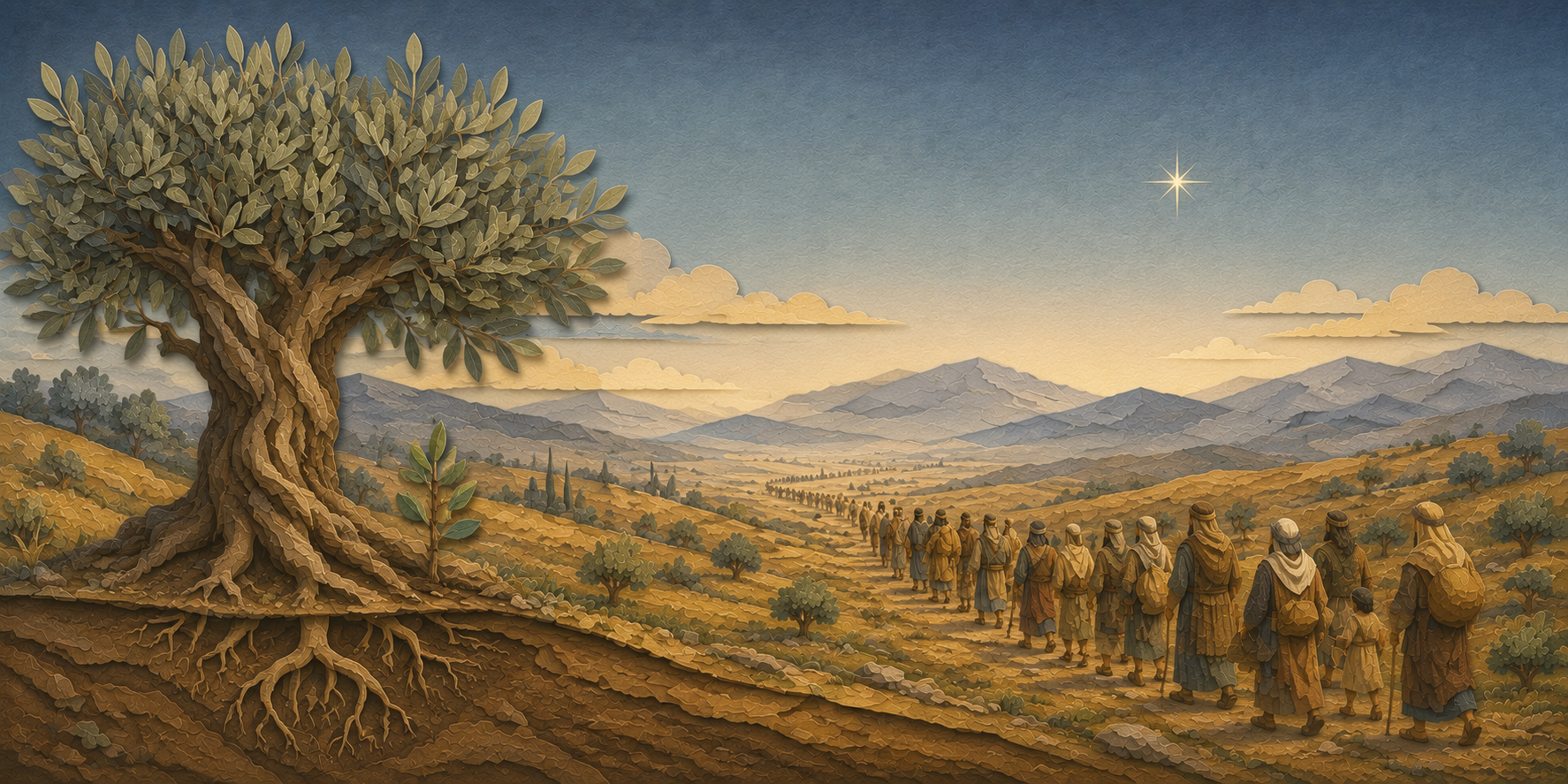
For Latter-day Saints, this is where the story begins. The Restoration talks constantly about the gathering of Israel — but you cannot gather what was never scattered. The scattering of Israel — the story the gathering exists to reverse — starts with the Assyrian deportations of the eighth century BC, when the ten northern tribes were marched off the map (see Section 07). And Assyria left Jerusalem something subtler and more dangerous too: the conviction, born at the wall in 701 BC, that Zion simply could not fall (see Section 08). A century later that conviction had curdled into the false security the Book of Mormon opens by confronting. This page follows both threads from Nineveh to the Restoration.
The Scattering of Israel: Assyria Fires the First Shot
The phrase “the scattering and the gathering of Israel” is not an abstraction. It is a description of history — and the history starts here. When the Assyrian king took Samaria, 2 Kings records the fate with a geographer’s precision: he “carried Israel away into Assyria, and placed them in Halah and in Habor by the river of Gozan, and in the cities of the Medes” (2 Kings 17:6), “until the LORD removed Israel out of his sight… So was Israel carried away out of their own land to Assyria unto this day” (2 Kings 17:23). Ten tribes went north and did not come back. That is the wound the whole doctrine of the gathering exists to answer.
The Book of Mormon, written by heirs of that scattered house, treats the loss as living memory rather than ancient news. Nephi tells his people that “the more part of all the tribes have been led away; and they are scattered to and fro upon the isles of the sea; and whither they are none of us knoweth, save that we know that they have been led away” (1 Nephi 22:4). Centuries later the risen Christ, ministering in the New World, speaks of the same tribes as a flock still out of reach: “I have other sheep, which are not of this land… neither in any parts of that land round about whither I have been to minister” (3 Nephi 16:1), whom the Father “hath led away out of the land” (3 Nephi 15:15). The Book of Mormon does not name Assyria in these verses, and it would overreach to claim it does. But the “led away” it mourns is the deportation this guide has traced — the first great dispersion. Every later scattering, Babylon included, is the sequel.
The Restoration then gives that dispersion a homeward direction. Revealed in 1831, the Lord’s great gathering revelation looks north to the same countries Assyria emptied: “And they who are in the north countries shall come in remembrance before the Lord; and their prophets shall hear his voice, and shall no longer stay themselves… and there shall they fall down and be crowned with glory, even in Zion” (D&C 133:26, 32). Five years later, in the Kirtland Temple, Moses appears and “committed unto us the keys of the gathering of Israel from the four parts of the earth, and the leading of the ten tribes from the land of the north” (D&C 110:11). The tribes Assyria drove into “the land of the north” are, in Latter-day Saint doctrine, precisely the tribes the last dispensation holds the keys to bring home.
Where the “lost tribes” language comes from: the popular phrase “the lost ten tribes” is a later coinage, not a biblical title — but the reality behind it is 2 Kings 17. Assyria’s deportation policy (see Section 07) was engineered precisely to dissolve a conquered people’s identity by resettlement — and it largely succeeded. The northern tribes vanish from the historical record as distinct communities. The Latter-day Saint claim is not that they ceased to exist, but that the Lord kept track of what the empire tried to erase — a covenant reading of a very concrete Assyrian administrative practice.
“None Evil Can Come Upon Us”: The False Security the Book of Mormon Confronts
Section 08 told the story of 701 BC, the night the Assyrian army broke before Jerusalem’s wall and the city was spared (2 Kings 19:34; 2 Kings 19:35). That deliverance was real, and it was the Lord’s. But over the following century it hardened into a belief that because Zion had been saved once, it could never fall. Micah mocked the leaders who said “none evil can come upon us” (Micah 3:11–12), and a century later Jeremiah heard the same confidence in the chant “The temple of the LORD” (Jeremiah 7:4). Section 08 tells both stories.
This is the exact air Lehi breathes on the first page of the Book of Mormon. The book dates itself “in the commencement of the first year of the reign of Zedekiah, king of Judah… there came many prophets, prophesying unto the people that they must repent, or the great city Jerusalem must be destroyed” (1 Nephi 1:4). Lehi joins them, reading from a book of prophecy: “Wo, wo, unto Jerusalem, for I have seen thine abominations!… that it should be destroyed… and many should be carried away captive into Babylon” (1 Nephi 1:13). And the city’s response is the response Micah and Jeremiah met: the reflex of people certain their Zion is untouchable: “the Jews did mock him… And when the Jews heard these things they were angry with him… and they also sought his life, that they might take it away” (1 Nephi 1:19–20).
Read against this guide, that is the through-line. The false security bred by Assyria’s failed siege in 701 is the same false security that put Lehi’s life in danger in about 600, until the Lord commanded him to take his family into the wilderness (1 Nephi 2:1–2). The Book of Mormon opens inside that argument, with the one family that believed the prophets and left. About fourteen years later, Lehi’s warning was vindicated and the city was gone. That is the sober counterweight to the miracle of 701: deliverance is a gift, never a guarantee, and a people can turn last century’s mercy into this century’s complacency.
Isaiah in the Book of Mormon: The Assyrian Crisis Becomes Nephite Scripture
There is a more literal way Assyria enters the Book of Mormon: Nephi copies Isaiah into it — and not just the comforting chapters, but the Assyrian ones. The long block of Isaiah 2–14 is reproduced almost in full as 2 Nephi 12–24. The two run in step, chapter for chapter: Isaiah 2 becomes 2 Nephi 12, and the sequence carries all the way through Isaiah 14, which becomes 2 Nephi 24. That span is the heart of Isaiah’s response to the Assyrian emergency — and so the empire this guide describes ends up woven, chapter by chapter, into Nephite scripture read across the ocean and across the centuries.
The pivot of the whole block is Isaiah’s startling image of Assyria as a tool in the Lord’s hand: “O Assyrian, the rod of mine anger” — a hostile empire wielded as an instrument of judgment and then held to account for its own arrogance. Nephi preserves the oracle intact: “O Assyrian, the rod of mine anger, and the staff in their hand is their indignation. I will send him against a hypocritical nation… to take the spoil, and to take the prey” (2 Nephi 20:5–6; compare Isaiah 10:5). The same chapter promises that the survivors will learn the lesson Hezekiah modeled — “the remnant of Israel… shall no more again stay upon him that smote them, but shall stay upon the Lord, the Holy One of Israel, in truth” (2 Nephi 20:20; compare Isaiah 10:20). For a Latter-day Saint reader, this is the doctrinal payoff of the Assyrian crisis carried forward in the Book of Mormon’s own words: empires rise and fall as the Lord’s instruments, and the enduring safety was never the wall — it was reliance on him. One note for careful teachers. The Book of Mormon text of these Isaiah chapters shows small wording differences from the King James text — here, “their indignation” where Isaiah 10:5 reads “mine indignation”. So quote each from its own page rather than blending them.
Hezekiah: A Pattern of Reliance Against the Odds
This section is offered as a devotional reading — a pattern drawn from the narrative rather than a doctrine the text states outright. Hezekiah stands in the Books of Kings as their model of trust: “He trusted in the LORD God of Israel; so that after him was none like him among all the kings of Judah… For he clave to the LORD, and departed not from following him” (2 Kings 18:5–6). What makes the portrait usable in a lesson is when he trusted: not in calm, but with the most efficient army on earth encamped at his gate and the Rabshakeh shouting that no god had ever saved a city from Assyria (see Section 08). The odds were, humanly, hopeless; the reliance was total; the deliverance came from a quarter no strategist could have planned (2 Kings 19:34).
Read devotionally, Hezekiah is the answer to the false security the rest of this page warns against — the difference between presuming on the Lord and actually leaning on him. His confidence was not that Jerusalem was magic, but that God was faithful. And the moment the crisis passed, the danger — as the following century proved — was that his people would remember the outcome and forget the trust. Taught carefully, the contrast is a gift to any class facing overwhelming odds of its own: the promise is not that the army goes away on our timetable, but that reliance on the Holy One of Israel is never misplaced.
What Assyria Scattered, the Lord Will Gather
Now the story comes full circle — because the doctrine of the gathering is what makes the whole Assyrian story bearable. In the very Isaiah block Nephi copied, the prophet looks past the scattering to its reversal — and names Assyria first among the places the exiles will be recovered from: “the Lord shall set his hand again the second time to recover the remnant of his people… from Assyria, and from Egypt… and from the islands of the sea. And he shall set up an ensign for the nations, and shall assemble the outcasts of Israel, and gather together the dispersed of Judah from the four corners of the earth” (2 Nephi 21:11–12; compare Isaiah 11:11–12). The empire that began the scattering is, by name, the first place the gathering undoes it.
The Book of Mormon carries that promise forward as its own hope. Nephi foresees that the Lord “will bring them again out of captivity, and they shall be gathered together to the lands of their inheritance” (1 Nephi 22:12); the resurrected Christ swears that “as surely as the Lord liveth, will he gather in from the four quarters of the earth all the remnant of the seed of Jacob, who are scattered abroad” (3 Nephi 5:24). This is the full sweep the Assyria guide has been building toward. The empire out of the north opened the age of scattering when it marched the ten tribes into Halah and Habor. The Restoration — holding the keys Moses restored for “the leading of the ten tribes from the land of the north” — is the age that gathers them home. From the first deportation to the final ensign, it is one story, and the Lord kept both ends of it.
Three threads worth pulling when teaching this material: (1) The scattering has a start date. When a class hears “gathering of Israel,” anchor it in 2 Kings 17: the ten tribes really were carried away into Assyria (2 Kings 17:6). In D&C 110:11, Moses commits the keys of “the leading of the ten tribes from the land of the north.” (2) 701 is a warning as well as a miracle. The deliverance was real, but the presumption it bred (“none evil can come upon us”) is what Lehi risked his life confronting on the first page of the Book of Mormon. Deliverance is a gift, not a guarantee. (3) The Book of Mormon is this guide’s sequel. When students open 1 Nephi, they are standing in a Jerusalem shaped by Assyria: falsely secure, rejecting its prophets, one siege away from the end. A few minutes on that connection will make 1 Nephi read differently.
Sources and Further Reading
Lehi’s Jerusalem & the Book of Mormon Setting:
- John W. Welch, David Rolph Seely & Jo Ann H. Seely, eds., Glimpses of Lehi’s Jerusalem (FARMS/BYU, 2004) — The essential essay collection on Jerusalem c. 600 BC, including the political and prophetic climate Lehi confronted and the long shadow of the Assyrian crisis on Judah’s sense of security.
- David Rolph Seely, “Nephi’s Use of Isaiah 2–14 in 2 Nephi 12–30,” in Donald W. Parry & John W. Welch, eds., Isaiah in the Book of Mormon (FARMS, 1998) — on Nephi’s use of the Isaiah 2–14 block (2 Nephi 12–24) and its wording relative to the King James text.
The Gathering of Israel & the Ten Tribes:
- Gospel Topics, “Gathering of Israel” (The Church of Jesus Christ of Latter-day Saints) — the doctrinal overview, tying the scattering of the tribes to the latter-day gathering and the keys restored in D&C 110.
- Guide to the Scriptures, s.v. “Israel — The Scattering of Israel” and “The Gathering of Israel” — concise scriptural surveys, with 2 Kings 17 and D&C 133 in view.
- Come, Follow Me — Old Testament, this year’s lessons on 2 Kings and Isaiah — and the companion Section 07 and Section 08 of this guide.
Scripture (verify wording at the source):
- 2 Kings 17–19; Micah 3; Isaiah 10–11; Jeremiah 7 (KJV) — the scattering, the false security, and the Assyrian “rod.”
- 1 Nephi 1; 22; 2 Nephi 20–21; 25; 3 Nephi 5; 15–16 — the Book of Mormon’s witness of the scattering and gathering.
- Doctrine and Covenants 110; 133 — the Restoration’s texts on the ten tribes and the land of the north.