Major Sites & Discoveries
How the empire the prophets buried came back into the light
For nearly two and a half thousand years, Assyria was a name without a face. The prophets had condemned it. The Greeks had half-remembered it. And travelers rode over the grassed mounds of its capitals without suspecting that a city lay beneath their horses’ hooves. The winged bulls were down there in the dark — the reliefs, the tens of thousands of tablets. But the script was unreadable and the sites were unmarked. For all practical purposes, the empire that had erased the northern kingdom of Israel had itself been erased. Then, in the space of a single astonishing generation in the middle of the nineteenth century, it all came back. The mounds were opened. The wedge-script was cracked. Assyria walked out of the ground and onto the walls of London and Paris. This page tells that story — who dug, what they found, and where you can stand in front of it today.
The Mounds Before the Spades
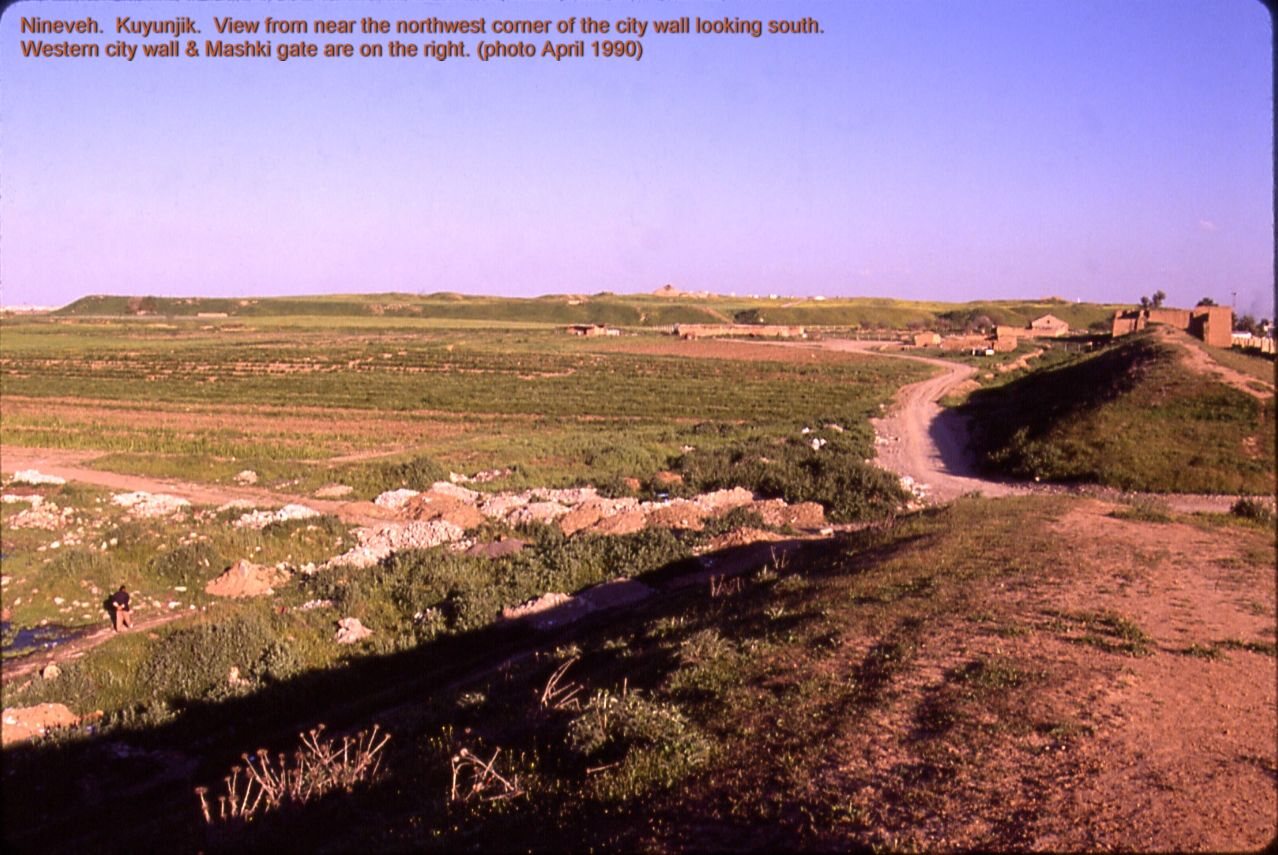
The first serious European to look hard at the mounds was Claudius James Rich. He was the British East India Company’s resident in Baghdad — the Company’s official representative there, not just a man who happened to live in the city — and a gifted linguist. He surveyed the ruins of Babylon (1811, 1817). Then, around 1820, he turned to the great tells — the mounded ruins of ancient cities — across the Tigris from Mosul that local tradition already called Nineveh. Rich mapped them, measured them, and collected inscribed bricks and cylinders. After his early death in 1821, that modest hoard passed to the British Museum, where it sat as almost the whole of Europe’s Assyrian collection: a few cases of objects no one could yet read. Rich did not excavate so much as reconnoiter. But he did the essential first thing. He established that something enormous was under those hills, and he wrote it down so persuasively that others eventually came to dig.
Botta at Khorsabad: The First Great Dig — and the First Great Mistake
The spade work began with a Frenchman. Paul-Émile Botta, the French consul at Mosul, started probing the mound of Kuyunjik (the true Nineveh) in 1842. He found little that rewarded the effort.
Then, in 1843, local villagers gave him a tip. Botta shifted his men a few miles north to a place called Khorsabad — and almost at once his diggers struck carved stone walls. Room after room of them, lined with reliefs and guarded by colossal human-headed bulls. It was the first great Assyrian excavation in history, and the sensation of its age.
What Botta had uncovered was the palace of Sargon II at Dur-Sharrukin (see Section 06). But Botta had no way yet to read the inscriptions that would have told him so. So he announced to the world that he had found Nineveh. He had not. He had found the one capital that had been built and abandoned in a single reign. The mistake is a fitting emblem of the whole early period: the finds came out of the ground years before anyone could read the labels the Assyrians had thoughtfully carved onto them.
Botta’s reliefs and one of his lamassu were floated down the Tigris and shipped to Paris. There they opened as the Louvre’s Assyrian galleries in 1847 — the first Assyrian museum on earth.
Layard at Nimrud and Nineveh: The Winged Bulls Come to London
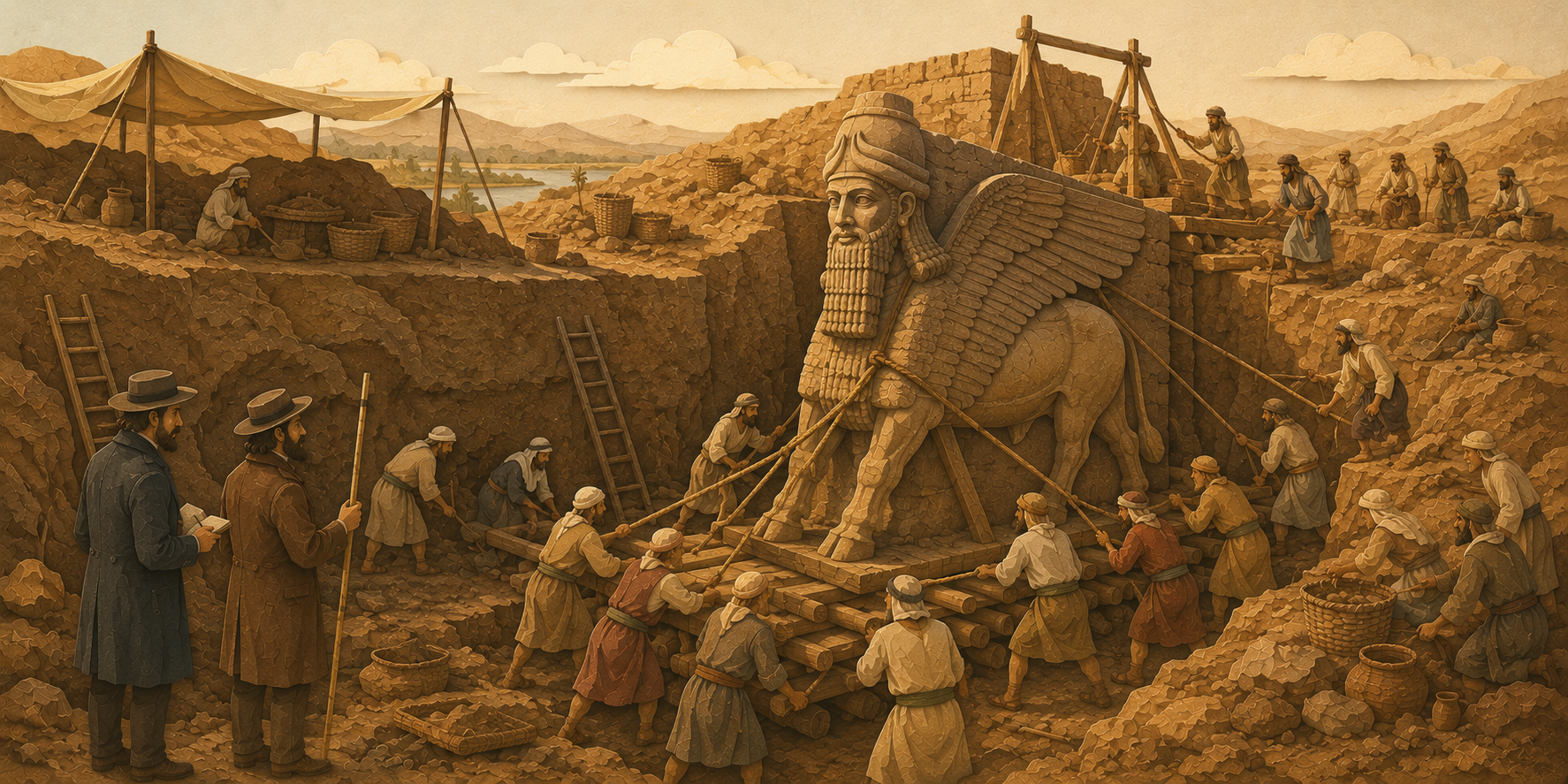
The figure who fixed Assyria in the popular imagination was a restless young Englishman named Austen Henry Layard. In November 1845, backed quietly by the British ambassador at Constantinople, Layard began to dig at the mound of Nimrud — the biblical Calah, the Kalhu of Ashurnasirpal II. Inside days he was walking into the alabaster-lined halls of the Northwest Palace. Over the next several years he uncovered relief cycle after relief cycle. And at the palace gates he found the guardians that would become the face of the empire: the great lamassu, the five-legged human-headed winged bulls, cut from single blocks weighing many tons.
Getting them home was an epic in itself. Layard had the colossi levered onto wooden rollers, dragged overland by gangs of laborers to the bank of the Tigris, loaded onto rafts buoyed by inflated goatskins, floated down to Basra, and there transferred to ships for the long voyage to London. That a pair of thirty-ton stone bulls made that journey at all, over desert and river and ocean, is a wonder of Victorian obstinacy.
When they were installed in the British Museum they caused a genuine popular sensation. Layard’s own books — Nineveh and Its Remains (1849) above all — became runaway bestsellers, read at the same firesides as the novels of the day. For a generation of Bible readers who had known Assyria only as a name of dread in Isaiah and Nahum, here suddenly were its kings, its armies, its very doorkeepers, hauled into the daylight.
Among Layard’s Nimrud finds was one object of singular biblical importance: the Black Obelisk of Shalmaneser III (found 1846). Its carved registers include a kneeling figure that its caption identifies as “Jehu, son of Omri,” the earliest known depiction of a named Israelite king (or, some scholars think, his envoy), bowing in tribute to an Assyrian one. Section 09 sets it beside the biblical account.
Layard later moved to Kuyunjik itself and broke into Sennacherib’s “Palace Without Rival” at the true Nineveh. Its walls carried the great narrative reliefs of the empire at war — including the panels of the siege of Lachish that we can read straight against the book of Kings (that confrontation is the subject of Section 08).
Rassam and the North Palace: The Lion Hunt and the Library
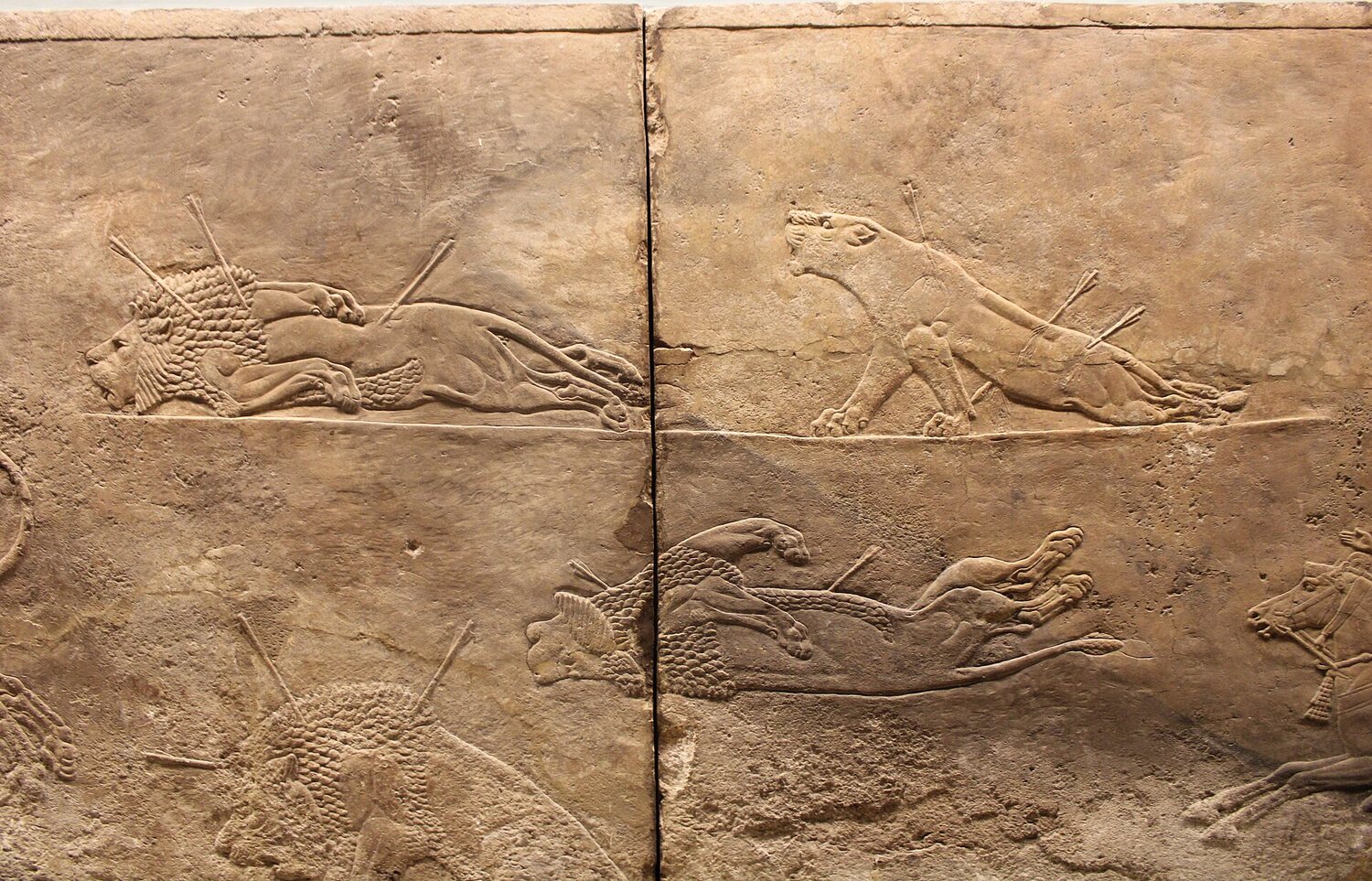
When Layard left archaeology for politics, the work passed to his former assistant, Hormuzd Rassam — a Mosul-born Assyrian Christian who had begun as Layard’s local agent and became, in his own right, one of the great excavators of the century. In 1853, digging at Kuyunjik, Rassam uncovered the North Palace of Ashurbanipal — and with it, two of the supreme treasures of Assyrian art and letters.
The first was the series of lion-hunt reliefs: the wounded lioness dragging her paralyzed hindquarters, the beasts released from cages into the king’s arena. The whole cycle is carved with an observation of animal agony that has no equal in ancient art, and it stops modern visitors in their tracks. The second was another cache of the royal library tablets — the collection whose most famous single fragment, the flood tablet, a self-taught engraver named George Smith would read out to a stunned London two decades later (that story, and the library itself, are Section 05).
Rassam’s career ran on to Babylon, where in 1879 he pulled the Cyrus Cylinder from the foundations. But his Nineveh year alone would have secured his place. It is worth naming him plainly, because the older tellings often folded his work into Layard’s: a great deal of what fills the Assyrian galleries was found by an Iraqi.
Reading the Cliff: The Decipherment of Cuneiform
All of this came out of the ground while the inscriptions on it were still mute. The lost empire and its lost language were recovered together — and the key to the script was found not in a museum but on a cliff face in western Persia. There, at Behistun, the Persian king Darius I had carved a monumental trilingual inscription — the same royal boast in Old Persian, Elamite, and Babylonian cuneiform — a hundred meters up a sheer rock. Between 1835 and the mid-1840s, a British army officer named Henry Creswicke Rawlinson repeatedly scaled that rock, dangling on ladders and ropes to copy the signs.
Why did that matter? Because Old Persian used a far simpler cuneiform, it could be worked out first (building on earlier guesses by the German scholar Georg Friedrich Grotefend). And once the Old Persian text could be read, the inscription became a bilingual key — a stone Rosetta, a language scholars could read standing beside one they could not, so that the known one unlocked the unknown. It opened the far harder Babylonian version beside it, and from there the whole body of Akkadian texts pouring in from Botta’s and Layard’s digs. The breakthrough was not Rawlinson’s alone; the Irish clergyman Edward Hincks made some of the sharpest structural insights, and others contributed.
The test of 1857. Cuneiform was so complex — hundreds of signs, each with several possible values — that skeptics reasonably wondered whether the “decipherers” were reading the tablets or merely inventing them. So the Royal Asiatic Society ran an experiment. It sent an unpublished inscription of Tiglath-Pileser I to four scholars: Rawlinson, Hincks, the scientist W. H. Fox Talbot, and the Frenchman Jules Oppert. Each worked independently and mailed back a sealed translation. When the seals were opened together, the four versions substantially agreed. Cuneiform could be read. A dead script and a dead empire had genuinely been recovered. From that moment the annals of the Assyrian kings, and the library of Nineveh, could be made to speak — and much of what they said turned out to touch the Bible directly.
The Great Finds — and Where They Are Now
The upshot of that century of digging is that the empire the prophets condemned now hangs on the walls of the world’s great museums. If you want to stand in front of Assyria, here is where its story is kept:
A museum guide to Assyria.
- British Museum, London — the richest Assyrian collection anywhere: the Lachish reliefs in their own room; the Black Obelisk of Shalmaneser III with its bowing “Jehu”; the lion-hunt reliefs from Ashurbanipal’s North Palace; the tens of thousands of tablets of Ashurbanipal’s library, including the flood tablet; and colossal lamassu flanking the gallery doorways as they once flanked palace gates.
- Louvre, Paris — Botta’s Khorsabad finds: a colossal winged bull and the relief cycles from the palace of Sargon II, the first Assyrian sculptures ever put on public display.
- Institute for the Study of Ancient Cultures (ISAC, formerly the Oriental Institute), Chicago — a colossal Khorsabad lamassu of its own and, among the tablets, a Sennacherib prism recording the king’s campaigns (its account of shutting Hezekiah up in Jerusalem “like a bird in a cage” is discussed in Section 08).
- Iraq Museum, Baghdad — the homeland collection, holding much of what was excavated in the twentieth century and recovering from the looting of 2003.
Other keystones are scattered further. The British Museum also holds a Sennacherib prism (the Taylor Prism) and much else. Comparable prisms are at the Israel Museum in Jerusalem. And Assyrian reliefs were distributed to institutions from the Metropolitan Museum in New York to smaller university collections that received individual slabs in the nineteenth century. But the four rooms above hold the heart of it. Between London and Paris alone you can meet nearly every object this whole Assyria guide has described.
The Chronicle That Matched the Prophet
Among the plainer-looking tablets in the British Museum sits one that carries more evidential weight than any winged bull: the “Fall of Nineveh Chronicle,” a Babylonian chronicle tablet that records, year by year in dry administrative prose, the campaigns that brought the Assyrian empire down. Its central entry describes the allied Medes and Babylonians marching on Nineveh and taking the great city in 612 BC — the fall itself, dated and sourced from the enemy’s own records.
For readers of scripture the tablet is remarkable, because a Judahite prophet had devoted an entire book to announcing exactly this. Nahum’s oracle opens, “The burden of Nineveh” (Nahum 1:1). It calls Nineveh “the bloody city” (Nahum 3:1). And it foretells that “all they that look upon thee shall flee from thee, and say, Nineveh is laid waste” (Nahum 3:7).
The chronicle does not quote Nahum, of course. The honest point is narrower and better than any forced “proof”: an event the prophets said was coming is independently dated in the archives of the people who made it happen. The city that Jonah was sent to warn (Jonah 1:2) and Nahum was given to condemn fell when and as the Bible said — and then vanished so utterly that its very site had to be rediscovered before the chronicle recording its end could be dug back up and read.
The Modern Chapter: Loss, and the Work of Keeping
The story does not end in the reading rooms of the nineteenth century, and its most recent chapter is a hard one to write. In 2015, the militants of the so-called Islamic State, who then held Mosul, turned deliberately on the Assyrian heritage in their reach. In February they filmed themselves smashing sculptures in the Mosul Museum and defacing the lamassu at Nineveh’s ancient Nergal Gate. The following month they bulldozed and detonated the palace mounds of Nimrud — the very site where Layard had found the winged bulls and the Black Obelisk. Reliefs and colossi that had stood for nearly three thousand years, and had survived the burning of their own empire, were destroyed in an afternoon. It is right to say this soberly and without spectacle: a real and irreversible wound was done to the ground itself. Some of what stood at Nimrud can now be seen only in the museums that received it long ago, and in the photographic record.
But the same modern world that recorded the loss has also gone to work against it. Because Assyria’s objects were documented so thoroughly — drawn by Layard’s artists, catalogued by generations of curators, photographed from every angle — a great deal can be reconstructed even where the original is gone. Crowd-sourced projects have gathered tourists’ old snapshots to rebuild smashed statues in three dimensions. Museums have put their Assyrian holdings online in high resolution. And full-scale replicas of destroyed lamassu have been carved and displayed in public squares from London to New York as acts of deliberate defiance. None of it brings back the stone that was lost. But it says something true about the whole two-hundred-year arc of this page: an empire can be buried for millennia and still be recovered. And the labor of keeping — the patient copying, cataloguing, and guarding of what the past left behind — is itself a kind of resistance to oblivion.
The long view. There is a strange symmetry to Assyria’s afterlife. The prophets said the empire would fall and be forgotten, and it was — so completely that Nineveh became a grassy hill men rode over without knowing. Then it came back, not on its own terms but on history’s. Its boasts in stone were dug out of the ruin the prophets foretold. Its own reliefs of conquered peoples are now studied by the descendants of those peoples. Its winged guardians stand watch over museum doorways instead of palace gates. The city that “made itself great” is remembered today largely because its end was recorded, its palaces were preserved by the fire that destroyed them, and careful people in a later age chose to bring it back to light. Whether in triumph or in judgment, Assyria kept, in the end, exactly the memorial the Bible assigned it.
How the empire rose and fell in the first place — the war machine, the capitals, the confrontation with Judah, and the sudden collapse — is the story the rest of this guide has told, from Section 01 onward.
Sources and Further Reading
The Empire & Its Rediscovery:
- Eckart Frahm, Assyria: The Rise and Fall of the World’s First Empire (Basic Books, 2023) — The current standard narrative history, with a strong closing account of the empire’s rediscovery and modern afterlife.
- Mogens Trolle Larsen, The Conquest of Assyria: Excavations in an Antique Land, 1840–1860 (Routledge, 1996) — The definitive history of the Botta–Layard–Rassam era: the rivalries, the digs, and the winged bulls’ journey to Europe.
- David Damrosch, The Buried Book: The Loss and Rediscovery of the Great Epic of Gilgamesh (Henry Holt, 2007) — George Smith, the library tablets, and the drama of decipherment, told backward from the present to Nineveh.
- Austen Henry Layard, Nineveh and Its Remains (John Murray, 1849) — The Victorian bestseller itself, in the excavator’s own vivid voice.
Online Resources:
- British Museum Collection Online — the Lachish reliefs, the Black Obelisk, the lion hunt, the Ashurbanipal library, and the lamassu, most with photographs.
- Louvre Collections — the Khorsabad winged bull and the reliefs of Sargon II’s palace.
- Livius — Nineveh & Assyrian sites — concise, well-sourced articles on the cities and their excavation.
- ORACC — the Open Richly Annotated Cuneiform Corpus: the Assyrian royal inscriptions and chronicles, transliterated and translated, free to explore.