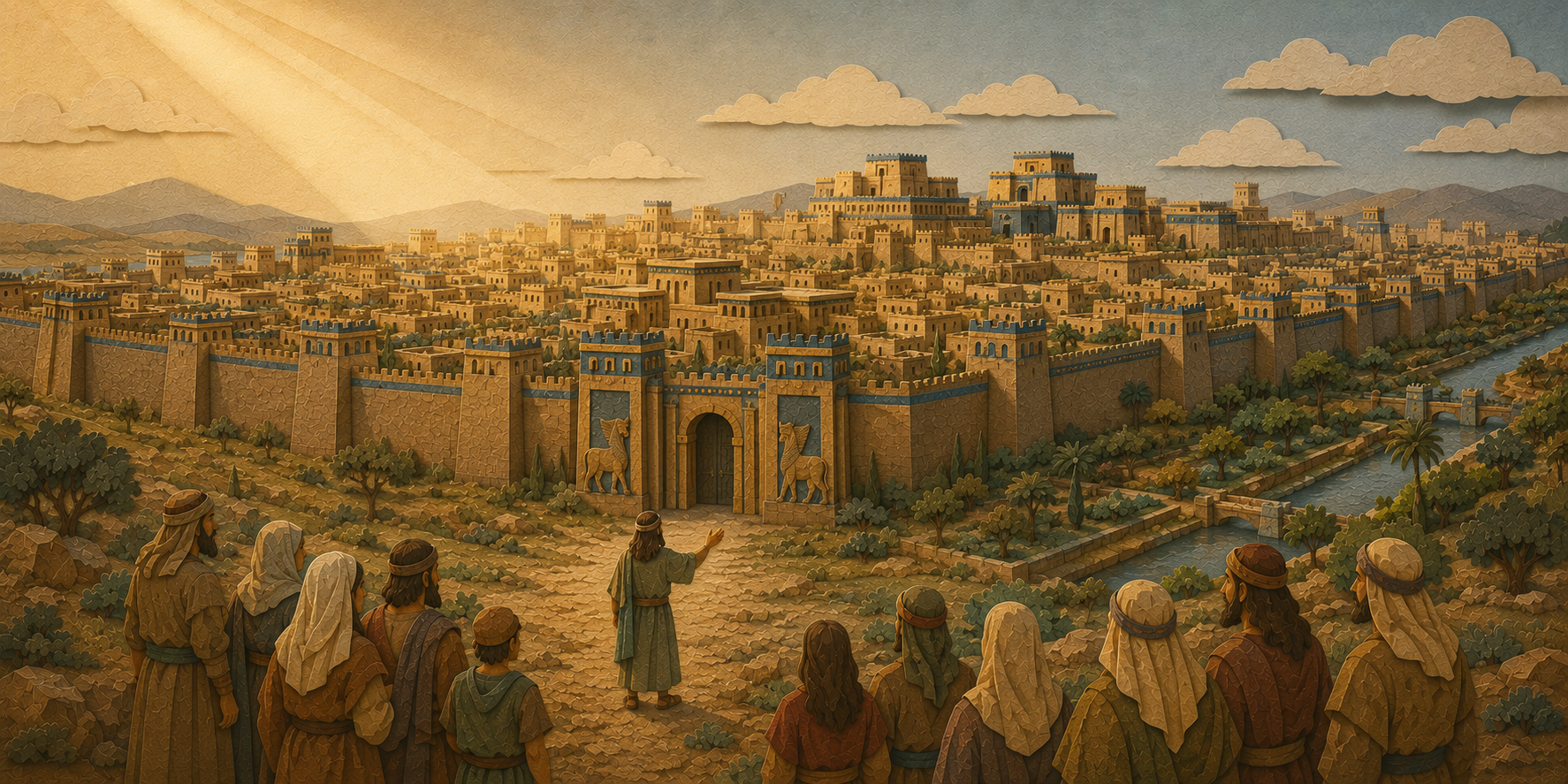
Assyria & the Bible
The empire scripture cannot stop arguing with — rod, defendant, and object of both judgment and mercy
For most of two centuries the prophets of Israel and Judah wrote in Assyria’s shadow, and scripture speaks of it in more than one voice, each with a purpose. Assyria is the empire God calls a tool in His own hand and then puts on trial for arrogance; the city He sends a prophet to warn and then, to that prophet’s fury, spares; the “bloody city” whose fall fills an entire book of the Bible, and the “great city” God says He cannot help but pity. No other foreign power draws so many responses from the Hebrew Scriptures, held in such deliberate tension. And none is more thoroughly corroborated by its own monuments, which name the very Israelite kings the Bible names. This page surveys what the Bible as a whole says about Assyria — the big prophetic picture. For the historical destruction of the northern kingdom and the siege of 701 BC, the deep dives are next door in Section 07 and Section 08.
Jonah: Grace to the Empire of Terror
The strangest thing scripture ever says about Assyria is that God loved it. The book of Jonah opens with a commission that would have struck any Israelite as absurd, even offensive: “Arise, go to Nineveh, that great city, and cry against it” (Jonah 1:2). Nineveh was the capital of the empire that had erased the ten northern tribes from the map — the machine whose calculated cruelty its own kings advertised on their palace walls (see The War Machine). To send a Hebrew prophet there, with a word that might lead to its rescue, was to name the unthinkable.
Jonah’s response is to run in the opposite direction — the famous storm, the sailors, the great fish. Only after that detour does the word come a second time: “Arise, go unto Nineveh, that great city, and preach unto it the preaching that I bid thee” (Jonah 3:2). This time he goes. The book stresses the city’s sheer scale — “an exceeding great city of three days’ journey” (Jonah 3:3) — and then delivers his message in a single, unadorned Hebrew sentence: “Yet forty days, and Nineveh shall be overthrown” (Jonah 3:4).
What happens next is the reversal at the heart of the book. Assyria repents. “So the people of Nineveh believed God, and proclaimed a fast, and put on sackcloth, from the greatest of them even to the least of them” (Jonah 3:5). And God relents: “God saw their works, that they turned from their evil way; and God repented of the evil, that he had said that he would do unto them; and he did it not” (Jonah 3:10).
The prophet is not relieved. He is livid. “But it displeased Jonah exceedingly, and he was very angry” (Jonah 4:1) — and in his complaint the book shows its hand. Jonah had fled, he now admits, precisely because he feared this outcome: “I knew that thou art a gracious God, and merciful, slow to anger, and of great kindness, and repentest thee of the evil” (Jonah 4:2). Jonah did not doubt God’s mercy. He objected to its reach — that it should extend even to Assyria.
“And should not I spare Nineveh, that great city, wherein are more than sixscore thousand persons that cannot discern between their right hand and their left hand; and also much cattle?”
— Jonah 4:11, the last verse of the book
The book ends there, on a question. God asks it, Jonah never answers it, and the book leaves it for the reader to answer. It turns on one Hebrew verb, chus: Jonah had “pity” on a gourd he never laboured over (Jonah 4:10); should not God “spare” (the same word) a city full of people, “and also much cattle”? The Hebrew describes the “sixscore thousand” (more than 120,000) themselves as people who cannot tell their right hand from their left. Many readers take them to be young children, who in scripture’s idiom do not yet “know to refuse the evil, and choose the good” (Isaiah 7:16). Others take them to be the whole city, a people never taught the difference, as in “A wise man’s heart is at his right hand; but a fool’s heart at his left” (Ecclesiastes 10:2). Either way, the people God names are those who did not know better. The Book of Mormon names the same two groups as the ones mercy reaches: “all little children are alive in Christ, and also all they that are without the law” (Moroni 8:22). God’s final word about the capital of the cruelest empire of its age is not a threat but a plea for pity. It is scripture’s most surprising sentence about Assyria: that the God of Israel would grieve to destroy even Nineveh. Whatever else the book is doing, it refuses to let its readers — ancient or modern — keep their enemies safely outside the circle of mercy.
Nahum: The Mirror Image
If Jonah is grace to Nineveh, Nahum is its judgment. The two books were bound into the same scroll that holds the twelve Minor Prophets — the collection’s two Nineveh books, grace and judgment, two panels of one picture. Where Jonah is all narrative and no oracle, Nahum is all oracle and no narrative: three chapters that are nothing but the fall of the Assyrian capital, announced from the first line. “The burden of Nineveh. The book of the vision of Nahum the Elkoshite” (Nahum 1:1). This is a whole book aimed at a single city.
Nahum writes with the repentance of Jonah’s generation long spent and forgotten. The Assyria of his oracle is unrepentant, gorged on plunder, and doomed. His verdict opens with a cry that has echoed ever since:
“Woe to the bloody city! it is all full of lies and robbery; the prey departeth not.”
“The bloody city” — the phrase is exact justice, turned back on an empire that had made bloodshed a tool of statecraft. And then the sentence itself: “Nineveh is laid waste: who will bemoan her? whence shall I seek comforters for thee?” (Nahum 3:7). No one will mourn her, Nahum says — the very pity Jonah’s God had extended is now withdrawn. History proved the oracle right. In 612 BC, a coalition of Babylonians and Medes stormed and burned Nineveh, and the Assyrian empire was gone within a few years, never to rise again. The prophecy and the archaeology of that fall meet in Section 10, where the burn layers Nahum foretold still lie in the ground.
Isaiah’s Assyria: The Rod of Mine Anger
Isaiah gives Assyria its deepest theological treatment, and the paradox its sharpest form. In chapter 10 the prophet names the empire with a title no reader forgets:
“O Assyrian, the rod of mine anger, and the staff in their hand is mine indignation. I will send him against an hypocritical nation… to take the spoil, and to take the prey.”
Assyria is a rod — an instrument in the hand of God, sent to discipline a faithless people (Isaiah 10:5–6). But a rod that begins to imagine itself the arm that swings it has forgotten what it is. Isaiah exposes exactly that self-deception: “Howbeit he meaneth not so, neither doth his heart think so; but it is in his heart to destroy and cut off nations not a few” (Isaiah 10:7). Assyria thinks it conquers by its own strength — “By the strength of my hand I have done it, and by my wisdom” (Isaiah 10:13) — and for that arrogance it will itself be judged: “I will punish the fruit of the stout heart of the king of Assyria, and the glory of his high looks” (Isaiah 10:12).
Isaiah’s image for the reversal is one of the most quoted in all the prophets — the tool that mistakes itself for the craftsman:
“Shall the axe boast itself against him that heweth therewith? or shall the saw magnify itself against him that shaketh it? as if the rod should shake itself against them that lift it up.”
This is the theological heart of scripture’s whole quarrel with Assyria. God can use an unjust empire to accomplish a just purpose without excusing the empire’s injustice — the axe is still answerable for its pride. In a landmark study of Isaiah’s language, the scholar Peter Machinist showed how closely the prophet’s portrait of the boasting Assyrian tracks the actual rhetoric of the Assyrian royal inscriptions. The very self-glorification the kings carved into their own monuments becomes, in Isaiah, the evidence for the case against them. Assyria was so vivid a presence that it became scripture’s archetype: the arrogant world-power judged for forgetting whose hand it was in.
Isaiah also grounds all of this in datable fact. In one verse he names an Assyrian king by his own name and a specific campaign: “In the year that Tartan came unto Ashdod, (when Sargon the king of Assyria sent him,) and fought against Ashdod, and took it” (Isaiah 20:1). “Sargon” here is Sargon II, and this is the only mention of him by name in the entire Bible — a king so obscure to later readers that some once doubted he existed, until his vast palace at Dur-Sharrukin (Khorsabad) was unearthed in the nineteenth century.
The Northern Prophets, Preaching Under the Shadow
Assyria is the unnamed weather in the background of the eighth-century prophets — the storm gathering while Amos, Hosea, and Micah preach. Each of them knows where the northern kingdom is heading, and each says so.
Amos, a Judean shepherd sent north to Israel at the height of its prosperity, warns that the coming exile will carry the nation past Damascus — that is, into the Assyrian heartland: “Therefore will I cause you to go into captivity beyond Damascus, saith the LORD” (Amos 5:27). His logic is the terrible privilege of the chosen: “You only have I known of all the families of the earth: therefore I will punish you for all your iniquities” (Amos 3:2).
Hosea, prophesying to the last decades of the north, names the destination outright: “the Assyrian shall be his king, because they refused to return” (Hosea 11:5). His book aches with a God torn between wrath and love for a people about to be swallowed.
Micah, working in Judah to the south, watches Samaria’s fall as a warning to Jerusalem and pronounces the northern capital’s doom in a single stroke: “Therefore I will make Samaria as an heap of the field… and I will pour down the stones thereof into the valley” (Micah 1:6). Later he turns the empire’s own name into shorthand for every threat God’s promised deliverer will overcome — “when the Assyrian shall come into our land… then shall we raise against him seven shepherds” (Micah 5:5).
Even after the empire’s peak, the shadow lingers in the prophets: Zephaniah, writing in Josiah’s day as Assyria weakened, foretells the very desolation Nahum sang — “he will… destroy Assyria; and will make Nineveh a desolation, and dry like a wilderness” (Zephaniah 2:13). From Amos to Zephaniah, the arc is one continuous argument: Assyria is real, Assyria is God’s instrument, and Assyria will answer for itself.
Archaeology Confirms the Cast
The books of Kings read like a roll-call of Assyrian monarchs, and here the empire’s own monuments do something remarkable: they name the same men, and in several cases the same events, from the other side. This is where honest study earns its confidence. The artifacts do not “prove the Bible” in any wholesale sense — they carry no covenant and no theology — but they establish that the historians of Israel and Judah knew exactly who was on the Assyrian throne, and when.
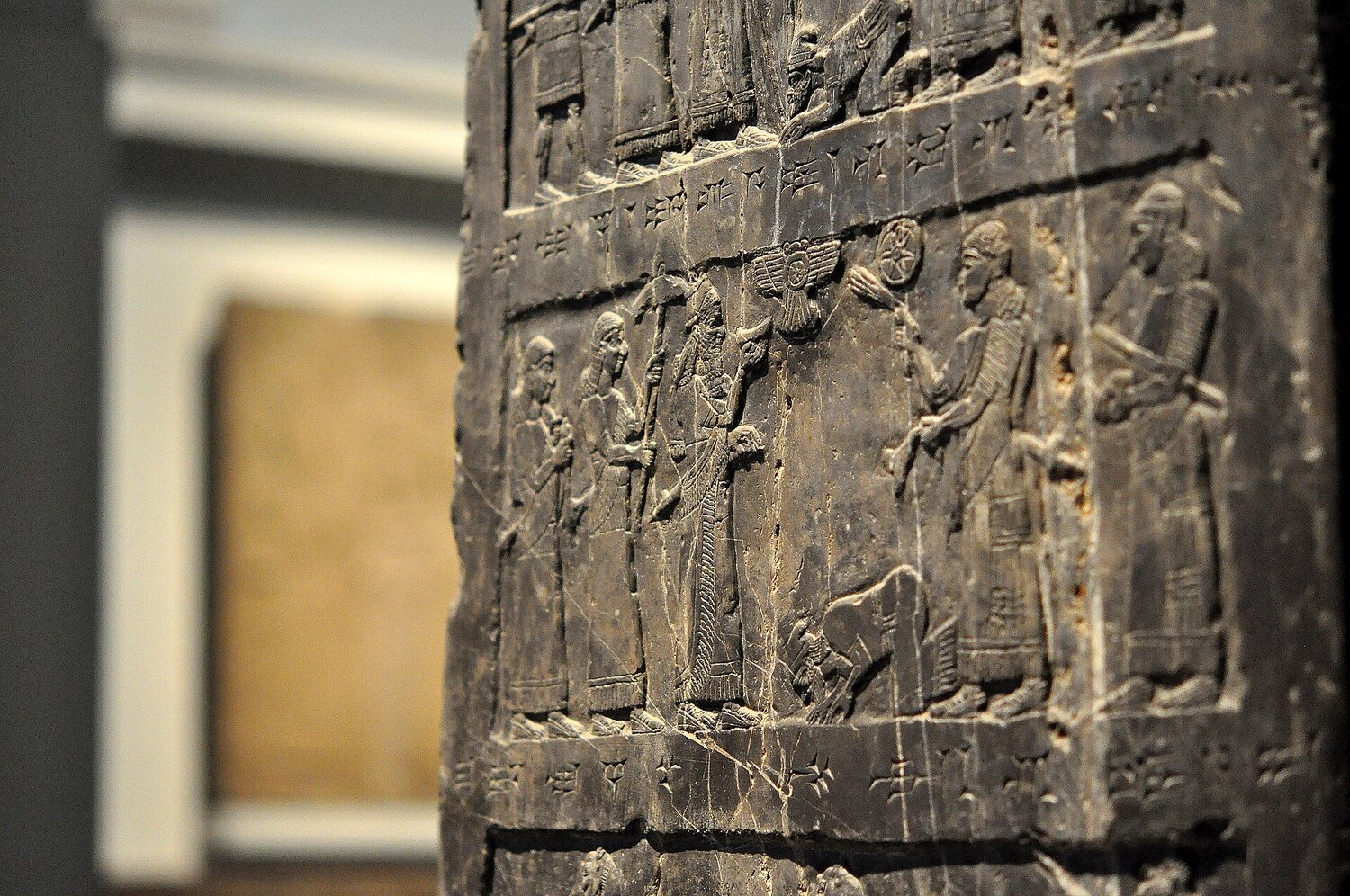

Jehu on the Black Obelisk
The single most striking convergence is a black limestone monument of Shalmaneser III, found at Nimrud in 1846 and now in the British Museum: the Black Obelisk. One of its carved registers shows a figure bowing to the ground before the Assyrian king. The cuneiform caption above it, in the standard scholarly translation, reads: the tribute of “Jehu, son of Omri.” Jehu was king of Israel (2 Kings 9–10). The relief is dated to 841 BC. It is the earliest surviving image believed to depict a named Israelite king, or at the least his official envoy. A responsible caveat: the Assyrian caption calls Jehu “son of Omri,” using Omri’s name as the standing Assyrian label for the whole kingdom of Israel, though Jehu was not of Omri’s line. What the stone establishes is not a Bible verse but a person: an Israelite king the Bible names, kneeling in Assyrian stone within a few years of his reign.
Ahab at the Battle of Qarqar
An earlier inscription of the same Shalmaneser III — the Kurkh Monolith — lists the enemy coalition he fought at the Battle of Qarqar in 853 BC, and among the allied kings it names “Ahab the Israelite,” credited with fielding a large force of chariots. The Bible never mentions Qarqar; the Assyrian record never mentions the theology of Ahab’s reign (1 Kings 16:29). But the two independent sources place the same king on the same throne in the same decade — each preserving what the other omits.
The kings named in Kings
Down the list of Assyrian monarchs, the Bible’s names line up with the king-lists carved in Assyria’s own annals:
| Named in the Bible | Attested in Assyrian records |
|---|---|
| Pul / Tiglath-pileser takes tribute from Menahem & Israel (2 Kgs 15:19, 15:29) | Tiglath-pileser III (ruled 745–727 BC); his annals name “Menahem of Samaria” among tributaries |
| Shalmaneser besieges Samaria (2 Kgs 17:3; 18:9) | Shalmaneser V (ruled 727–722 BC), successor of Tiglath-pileser |
| Sargon (the fall of Samaria; Ashdod campaign) (Isa 20:1) | Sargon II (ruled 722–705 BC); his palace at Khorsabad and annals claim the capture of Samaria |
| Sennacherib invades Judah, besieges Jerusalem (2 Kgs 18–19; Isa 36–37) | Sennacherib (ruled 705–681 BC); his prism records shutting up Hezekiah “like a bird in a cage” |
| Esarhaddon succeeds the murdered Sennacherib (2 Kgs 19:37) | Esarhaddon (ruled 681–669 BC), son and successor of Sennacherib |
The Bible itself quietly notes that “Pul” and “Tiglath-pileser” are one man — “the God of Israel stirred up the spirit of Pul king of Assyria, and the spirit of Tilgath-pilneser king of Assyria” (1 Chronicles 5:26) — and the Assyrian and Babylonian records confirm exactly this: Pul was the Babylonian throne-name of Tiglath-pileser III. That the biblical writers knew a detail this fine about Assyrian royal names is a small, telling mark of how close to the ground they stood.
The convergence extends to the great turning point of the north. Kings dates and narrates the three-year siege that ended the northern kingdom — Samaria taken “in the ninth year of Hoshea” and Israel “carried away… into Assyria” (2 Kings 17:6) — and the fall of Samaria in 722/721 BC is claimed, from the Assyrian side, by Sargon II. Which Assyrian king actually took the city is one of the genuinely unsettled questions of the period — the evidence turns on a single broken sign, and no single source records two conquests. The full account of that catastrophe and its deportations is the subject of Section 07; the drama of Sennacherib’s later failure at Jerusalem’s walls — where the two records agree that the city never fell, and differ over how to tell it — is told in Section 08. For the cities where all of this was carved and buried, see The Great Cities.
Rod, Defendant, and the Reach of Mercy
Assyria is the empire scripture wrestles with most before Babylon — and scripture does so with an honesty that refuses easy answers. It is the rod, raised in God’s hand against a faithless people, and it is the defendant, tried and condemned for imagining the hand was its own. It is the target of Nahum’s unflinching “woe” and the object of Jonah’s reluctant, world-enlarging grace. When Babylon rose to take Assyria’s place, scripture would inherit these same categories and apply them to the new power — instrument and idol, rod and Babylon-the-great. But it was Assyria that taught the prophets the pattern: that the God of Israel is sovereign even over the empires that terrorize His people, that He will judge their pride without pretending they were not His instrument, and that His mercy may reach farther than His own prophets wish it would — all the way to a great and cruel city that could not tell its right hand from its left.
Sources and Further Reading
- Eckart Frahm, Assyria: The Rise and Fall of the World’s First Empire (Basic Books, 2023) — The current standard narrative history, judicious on the biblical intersections.
- Peter Machinist, “Assyria and Its Image in the First Isaiah,” Journal of the American Oriental Society 103, no. 4 (1983): 719–737 — The classic demonstration that Isaiah’s “Assyrian” language mirrors the Assyrian royal inscriptions.
- Mordechai Cogan & Hayim Tadmor, II Kings: A New Translation with Introduction and Commentary (Anchor Bible 11, Doubleday, 1988) — The standard critical commentary aligning Kings with the Assyrian sources.
- Jack M. Sasson, Jonah: A New Translation with Introduction, Commentary, and Interpretation (Anchor Bible 24B, Doubleday, 1990) — The fullest scholarly treatment of the book’s theology of mercy.
- Duane L. Christensen, Nahum: A New Translation with Introduction and Commentary (Anchor Bible 24F, Yale University Press, 2009) — On the oracle against Nineveh and its historical fall.
- K. Lawson Younger Jr., “The Deportations of the Israelites,” Journal of Biblical Literature 117 (1998) — On the Assyrian records of Samaria’s fall and the biblical account.
Online Resources: