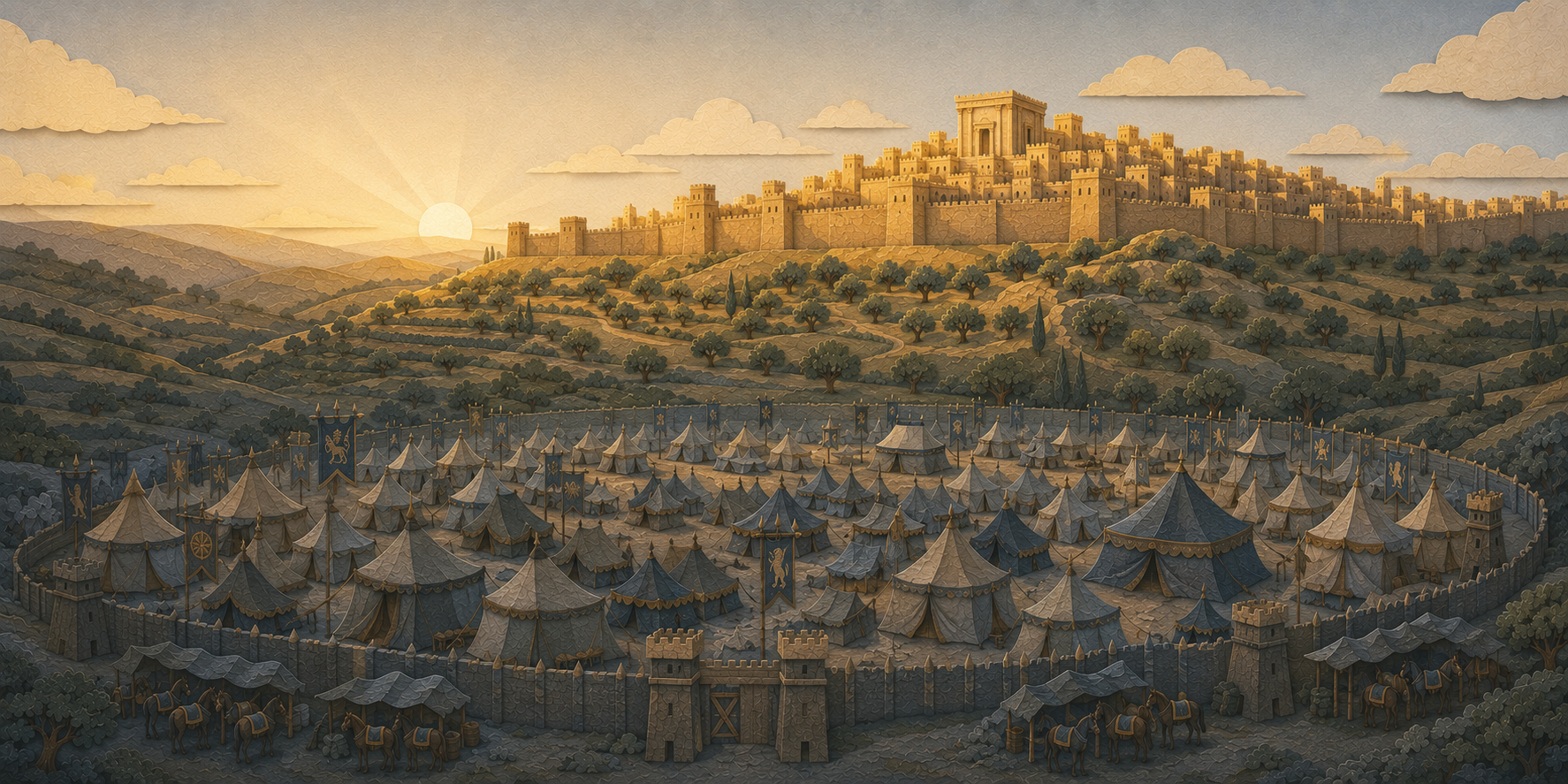
Sennacherib & Hezekiah
The one campaign Assyria could not turn into a conquest — and the confidence it left behind
Assyrian kings did not write about their failures. Their annals are victory monuments in prose — cities burned, kings flayed, tribute weighed, the enemy’s land “turned into ruin-heaps and mounds.” So when the great hexagonal clay prism of Sennacherib reaches the year 701 BC and the little kingdom of Judah, something remarkable happens. The record boasts, at length and with relish, about everything the Assyrians did to Hezekiah — and then, at the one moment the reader waits for, it goes conspicuously quiet. It never says Sennacherib took Jerusalem. On this single event, Assyria’s own scribes and the books of Kings and Isaiah tell the same story. They agree on the humiliation. And they agree on the strangest part: the city did not fall. This page sets the two records side by side and lets the honest gaps stand where they stand. Then it follows the deliverance forward — because the memory of 701 became one of the most consequential ideas in the Old Testament.
Hezekiah Prepares: Water, Walls, and a Rebellion
Hezekiah of Judah was a reformer and, eventually, a rebel. After the northern kingdom of Israel had been swallowed by Assyria in 722 BC (see Section 07), Judah survived as a vassal — paying tribute, keeping its head down. Hezekiah changed that. He trusted an alliance with Egypt. He trusted a wave of anti-Assyrian revolt sweeping the Levant — the eastern-Mediterranean lands. So he “rebelled against the king of Assyria, and served him not” — and he prepared his capital for the reckoning he knew would come.
The Chronicler describes the preparations in vivid engineering detail. Sennacherib was coming, “purposed to fight against Jerusalem,” and Hezekiah moved first. He “took counsel with his princes and his mighty men to stop the waters of the fountains which were without the city” — deny the besiegers water. Then he “built up all the wall that was broken, and raised it up to the towers, and another wall without, and repaired Millo in the city of David, and made darts and shields in abundance” (2 Chronicles 32:2–5). A later verse names the water project precisely: “This same Hezekiah also stopped the upper watercourse of Gihon, and brought it straight down to the west side of the city of David” (2 Chronicles 32:30). The book of Kings files the same accomplishment among Hezekiah’s deeds: “how he made a pool, and a conduit, and brought water into the city” (2 Kings 20:20).
These are among the few Bible verses you can still walk through. Hezekiah’s Siloam Tunnel survives. It is a 533-meter channel carved through solid rock beneath the City of David, dug to bring the Gihon spring’s water safely inside the walls — and you can wade its length today. Near its outlet, workmen cut an inscription in Old Hebrew. It describes the dramatic moment when the two digging teams, tunneling from opposite ends, heard each other through the stone and broke through “pickaxe against pickaxe.” And along the western hill, Nahman Avigad’s excavations uncovered a massive defensive wall about seven meters thick. It was hastily built — and built through houses that had to be demolished to raise it. Isaiah had scolded exactly that panic: “ye have numbered the houses of Jerusalem, and the houses have ye broken down to fortify the wall” (Isaiah 22:10). The Broad Wall is now a stop on a Jerusalem walking tour. Rarely does the archaeology of a siege sit so plainly under the modern city.
701 BC: Forty-Six Cities and the Siege of Lachish
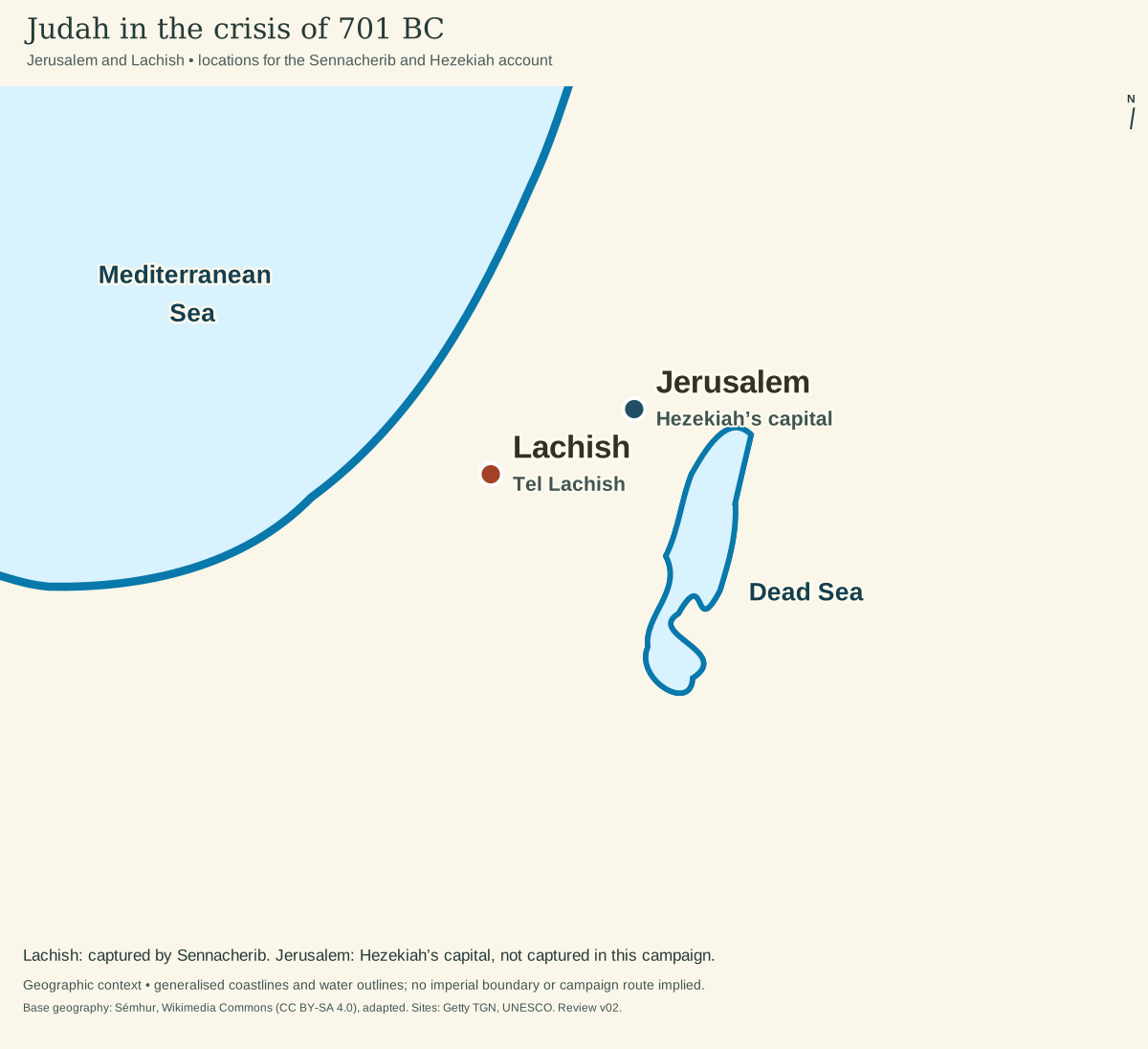
Coordinates: Getty TGN: Tel Lachish and UNESCO: Jerusalem. Historical context: Penn Museum, Lachish and The Metropolitan Museum, Sennacherib and Jerusalem. Terrain adapted from Sémhur, Wikimedia Commons under CC BY-SA 4.0; cropped, relabeled, and terrain shading removed. Generalized water outlines are geographic context, not a reconstruction of the shoreline in 701 BC.

Then Sennacherib came. The Bible states the scale bluntly: “Now in the fourteenth year of king Hezekiah did Sennacherib king of Assyria come up against all the fenced cities of Judah, and took them” (2 Kings 18:13). Sennacherib’s own prism supplies the number the Bible leaves at “all”: forty-six of Hezekiah’s walled cities, plus countless villages, conquered by siege-ramps and battering. He claims 200,150 people were driven out as spoil. Judah was systematically dismantled, fortress by fortress, until only Jerusalem was left.
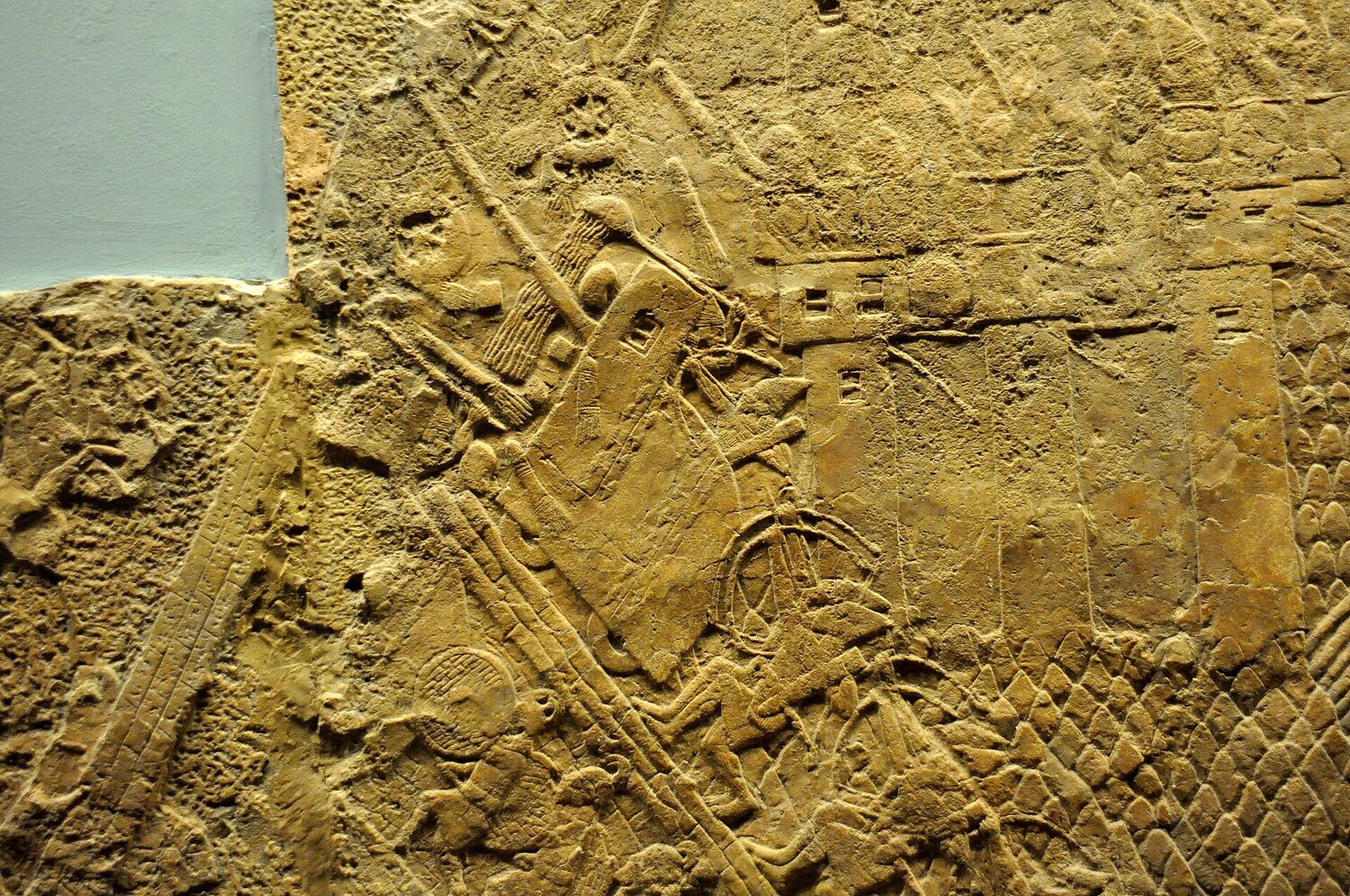

The centerpiece of that campaign was the siege of Lachish, Judah’s second city and the great fortress guarding the approach from the coastal plain. The Bible mentions it almost in passing — Sennacherib is “at Lachish” and sends his officers “from Lachish” (2 Kings 18:14, 17) — but Sennacherib thought the conquest worth an entire room. When Austen Henry Layard excavated Sennacherib’s “Palace Without Rival” at Nineveh, he found a suite whose walls were carved, floor to ceiling, with one continuous panorama: the storming of Lachish. Siege-engines climb earthen ramps. Archers and slingers fire. Defenders hurl firebrands from the towers. Then comes the grim aftermath — captives filing out, families with their carts, prisoners impaled, and the king himself enthroned to receive the spoil. Beneath him runs a caption: “Sennacherib, king of the world… sat upon a throne and the booty of Lachish passed before him.” No other biblical city has its fall preserved in such photographic Assyrian detail. The reliefs are now in the British Museum (they are toured in Section 06). And the archaeology on the ground matches the picture stone for stone. At the site of Lachish, excavators found the Assyrian siege-ramp still heaped against the southwest corner — the only Assyrian siege-ramp ever recovered — along with arrowheads, sling-stones, and the scorch of the burning.
Facing annihilation, Hezekiah did what vassals do: he sued for terms. “I have offended,” he sent word to Lachish; “return from me: that which thou puttest on me will I bear.” Sennacherib fixed the price at “three hundred talents of silver and thirty talents of gold,” and Hezekiah stripped the temple to pay it. He gave “all the silver that was found in the house of the LORD” and even the gold he had himself overlaid on the temple doors (2 Kings 18:14–16). Here again the two records nearly touch. Sennacherib’s prism lists Hezekiah’s tribute as thirty talents of gold — the very figure. It also lists eight hundred talents of silver, along with ivory, thrones, and Hezekiah’s own daughters and palace women, sent after Sennacherib to Nineveh. The gold agrees to the talent. The silver differs — and honest readers note it rather than smoothing it over. The round numbers may reflect different accounting, or the two sides may be tallying the payment at different moments of a drawn-out negotiation.
Two Records, One Silence: “Shut Up Like a Bird in a Cage”
Now comes the famous passage — the one line of Assyrian royal prose that every student of the Bible learns by heart. Having reduced Judah and taken the tribute, Sennacherib turns to Hezekiah himself:
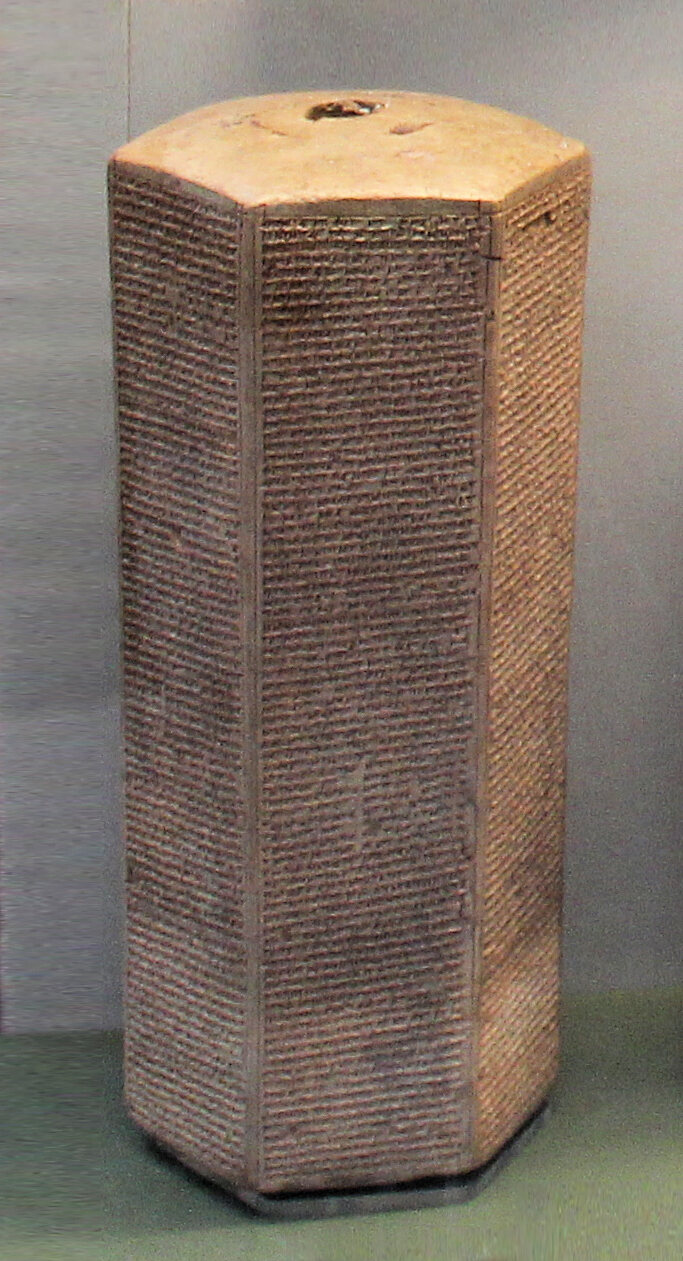

“As for Hezekiah the Judahite, who did not submit to my yoke: forty-six of his strong, walled cities… I besieged and took… He himself, like a caged bird I shut up in Jerusalem, his royal city. I threw up earthworks against him — the one coming out of the city-gate, I turned back to his misery.”
— The Sennacherib Prism (Oriental Institute / Taylor Prism), col. iii, trans. after Luckenbill
Read it slowly, because the boast is doing something no other entry in the annals does. An Assyrian king describing any other rebel city would have the sentence continue: I besieged it, I conquered it, I burned it, I carried off its people. That is the formula, repeated hundreds of times across the royal inscriptions. Here the formula breaks. Sennacherib says he penned Hezekiah in “like a bird in a cage,” threw up siege-works, and turned back those who came out. Then the account simply moves on to the tribute Hezekiah sent afterward. He never claims to have taken Jerusalem. For a monarch whose entire genre exists to trumpet conquests, that omission is not modesty; it is the loudest thing in the text. On the one point where a captured Jerusalem would have crowned the whole campaign, the record that never admits defeat declines to claim victory. The Bible and the prism thus agree on the essential, astonishing fact from opposite directions: Sennacherib besieged Jerusalem and did not take it.
The Rabshakeh at the Wall
Between the tribute and the deliverance the Bible slows down for one of the Old Testament’s most gripping set-pieces: a war of words at the wall of Jerusalem. Sennacherib sends a delegation of senior officers: the Tartan (field marshal), the Rabsaris (chief eunuch), and the Rabshakeh (chief cupbearer, here a kind of chief herald). They come “from Lachish to king Hezekiah with a great host against Jerusalem,” and they take up position “by the conduit of the upper pool, which is in the highway of the fuller’s field” (2 Kings 18:17). Quite possibly, that is the very waterworks Hezekiah had labored to secure. Isaiah tells the same scene almost word for word (Isaiah 36:1–2). That is why the two books read like a documentary shot from two cameras.
The Rabshakeh’s speech is a masterclass in psychological warfare. He mocks Judah’s hope in Egypt as “a bruised reed,” and he taunts that Hezekiah could not field two thousand riders even if Assyria gave him the horses. Then comes the most cutting move: he claims Assyria comes with the LORD’s own blessing. “Am I now come up without the LORD against this place to destroy it? The LORD said to me, Go up against this land, and destroy it” (2 Kings 18:25). Hezekiah’s officials beg the Rabshakeh to switch languages — “Speak, I pray thee, to thy servants in the Syrian language… and talk not with us in the Jews’ language in the ears of the people that are on the wall” (2 Kings 18:26). It is exactly what the Rabshakeh wants. He refuses. Instead he deliberately raises his voice “in the Jews’ language” so the ordinary defenders on the wall — not their diplomats — will hear him. He promises them vines and fig trees if only they will abandon their king (2 Kings 18:28–32). This is propaganda aimed over the leaders’ heads at the morale of the besieged — and the narrator knows precisely what it is.
Then the Rabshakeh makes his fatal theological move. Assyria’s empire ran on the claim that its god Ashur was simply stronger than every local god (the theology is unpacked in Section 04). Now the herald recites the empire’s scoreboard: “Hath any of the gods of the nations delivered at all his land out of the hand of the king of Assyria? Where are the gods of Hamath, and of Arpad?… Who are they among all the gods of the countries, that have delivered their country out of mine hand, that the LORD should deliver Jerusalem out of mine hand?” (2 Kings 18:33–35). It is an argument from an unbroken record — and by any imperial logic it was a good one. Every other god had failed. The Rabshakeh files the LORD on the same list as the beaten gods of Hamath and Sepharvaim. The people, under orders, “held their peace, and answered him not a word” (2 Kings 18:36). Hezekiah’s officers came back to him with their clothes torn. The entire crisis has now been reframed as a contest between the God of Israel and the gods of the nations — which is precisely the frame the deliverance will answer.
Isaiah’s Oracle and the Deliverance
Hezekiah takes the Rabshakeh’s letter into the temple, spreads it before the LORD, and prays — not for rescue as such, but for vindication: “that all the kingdoms of the earth may know that thou art the LORD God, even thou only.” Isaiah answers with a long, contemptuous oracle against Sennacherib. First comes the taunt: Assyria’s conquests were granted, not seized (“hast thou not heard long ago how I have done it…?”). Then comes the flat promise. The Assyrian king “shall not come into this city… by the way that he came, by the same shall he return,” for the LORD would defend the city “for mine own sake, and for my servant David’s sake.” And then, in a single verse, the siege ends:
“And it came to pass that night, that the angel of the LORD went out, and smote in the camp of the Assyrians an hundred fourscore and five thousand: and when they arose early in the morning, behold, they were all dead corpses.”
— 2 Kings 19:35 (parallel Isaiah 37:36)
“So Sennacherib king of Assyria departed, and went and returned, and dwelt at Nineveh” (2 Kings 19:36). The account is honest about what it does and does not report: it does not say the Assyrians assaulted the walls and were repulsed. It says the army was struck in the night and the king went home. What struck it? The Greek historian Herodotus, a couple of centuries later, preserved a garbled Egyptian version of the story. In his telling, a plague of field-mice gnawed the Assyrians’ bowstrings — a folk-memory some read as pointing to disease. Historians have long noted that a sudden catastrophe in a crowded siege camp would be consistent with an epidemic sweeping the encampment. The Bible names the cause an angel; a naturalistic reading names a plague. Both accounts agree on the outcome, and neither Assyrian nor biblical record has Jerusalem falling. Where the sources are silent — on the mechanism — the honest thing is to say so. And the silence does not touch the one fact everyone attests.
The narrative then closes Sennacherib’s own arc with a grim postscript: “as he was worshipping in the house of Nisroch his god… Adrammelech and Sharezer his sons smote him with the sword… and Esarhaddon his son reigned in his stead” (2 Kings 19:37). This is well attested: Sennacherib was indeed assassinated by a son, and Esarhaddon did succeed him — but in 681 BC, twenty years after 701. The Bible telescopes the two events into adjoining verses, as ancient historiography often compresses a consequence next to its cause. Scholars notice that compression. The majority hold to the single 701 campaign that all the hard evidence records. But some argue the biblical account may have fused two Assyrian campaigns against Hezekiah — a documented one in 701 and a hypothetical later one — into a single narrative. It is a genuine, unresolved historical debate, and it belongs in the open rather than papered over. What is not in dispute is the shape of the ending: Assyria took forty-six cities, penned the king in his capital, extracted his gold — and left without the prize.
The Long Shadow: How a Miracle Became a Presumption
Here is why this section exists. The deliverance of 701 was not merely a battle Judah survived; it was an idea Judah carried for the next century. Jerusalem had stood against the most terrifying army on earth. The temple had not been touched. The Rabshakeh had filed the LORD among the beaten gods of the nations — and the LORD had answered by breaking Assyria at the very gates. Out of that night grew a conviction that hardened, over generations, into doctrine: Zion is inviolable. The LORD dwells here; he will never let his city and his temple fall. It was a true memory of a real deliverance — and it curdled into a false security.
The prophets watched it happen and named it. Micah, a contemporary of Hezekiah, had already diagnosed the presumption in its early form. He saw leaders who oppress and take bribes “yet will they lean upon the LORD, and say, Is not the LORD among us? none evil can come upon us”. And he answered it with the most shocking sentence a Judean prophet could utter: “Therefore shall Zion for your sake be plowed as a field, and Jerusalem shall become heaps, and the mountain of the house as the high places of the forest” (Micah 3:11–12). The temple mount plowed like a field. It was nearly unthinkable — and it was remembered. A century later, elders would quote this exact oracle to defend Jeremiah’s life.
For by Jeremiah’s day the inviolability doctrine had become a wall people hid behind. Standing in the temple gate around 609 BC, Jeremiah confronts it in the single most famous phrase of the whole controversy: “Trust ye not in lying words, saying, The temple of the LORD, The temple of the LORD, The temple of the LORD, are these” (Jeremiah 7:4). The threefold chant is the sound of misplaced confidence — the memory of 701 turned into a charm. You may murder, steal, and burn incense to Baal, Jeremiah says, and then “come and stand before me in this house… and say, We are delivered?” He points them, pointedly, to Shiloh — the earlier sanctuary God had already abandoned to ruin. The LORD is not a hostage to his own address. The very deliverance that had proved God would defend his city was now being used to prove God must defend it no matter what its people did. The miracle had become a presumption, and the presumption had become a snare.
The paradox in one line: the night that saved Jerusalem in 701 planted the confidence that helped doom it in 586. A true deliverance, wrongly generalized into a guarantee, became the exact false security the later prophets spent their lives trying to shatter — and the city that Assyria could not take, Babylon eventually burned.
Where the Book of Mormon Opens
It is precisely into this hardened confidence that the Book of Mormon begins. Its opening verse sets the scene with historical care: “in the commencement of the first year of the reign of Zedekiah, king of Judah… there came many prophets, prophesying unto the people that they must repent, or the great city Jerusalem must be destroyed” (1 Nephi 1:4). Lehi is one of them. He is a man of Jerusalem, and he takes up the same unwelcome message as Jeremiah, his contemporary: this city, temple and all, will fall. And he meets the same reception. When he warns of Jerusalem’s destruction and captivity in Babylon, “the Jews did mock him… and they also sought his life” (1 Nephi 1, cf. v. 13, 19–20). To a people still leaning on 701 — still certain the LORD would never let his own city fall — a prophet who said otherwise sounded like a traitor or a fool. He was neither. Within a few years the presumption broke against the Babylonian siege-wall, exactly as Micah, Jeremiah, and Lehi had said it would.
That is the thread the deliverance of Sennacherib’s day handed forward: a genuine miracle, misremembered as a guarantee, setting the stage for the rejection of the prophets who saw the end coming. The full Book of Mormon treatment of Lehi’s Jerusalem — and how the Assyrian and Babylonian record illuminates it — is taken up in Section 11. For now it is enough to see the whole shape of it: the God who would not let Assyria take Jerusalem was never a God who could be presumed upon. And the same voice that broke the Rabshakeh at the wall spoke, a century later, through the prophets a comfortable city would not hear.
Sources and Further Reading
- William R. Gallagher, Sennacherib’s Campaign to Judah: New Studies (Brill, 1999) — The fullest modern reconstruction, weighing the Assyrian, biblical, and classical sources against one another.
- Mordechai Cogan & Hayim Tadmor, II Kings, Anchor Bible 11 (Doubleday, 1988) — The standard critical commentary on 2 Kings 18–19, with the Assyrian parallels laid out in full.
- Eckart Frahm, Assyria: The Rise and Fall of the World’s First Empire (Basic Books, 2023) — Current narrative history of the empire and of Sennacherib’s reign.
- Daniel D. Luckenbill, The Annals of Sennacherib, Oriental Institute Publications 2 (University of Chicago Press, 1924) — The edition and translation of the prism inscriptions (the “bird in a cage” passage).
- David Ussishkin, The Conquest of Lachish by Sennacherib (Tel Aviv University, 1982) — The excavator’s account of the siege-ramp and its match to the Nineveh reliefs.
- Nadav Na’aman, “Sennacherib’s Campaign to Judah and the Date of the lmlk Stamps,” Vetus Testamentum 29 (1979) — On the archaeology of Hezekiah’s defensive preparations.
Online Resources:
- WHE — Sennacherib (CC BY-NC-SA 4.0)
- British Museum — the Lachish reliefs from Sennacherib’s palace at Nineveh
- Livius.org — Sennacherib — with the prism inscription and the campaign of 701 in translation.