The Fall of the North & the Lost Tribes
The night ten tribes marched out of history — and the hope that has refused, ever since, to let them stay lost
Israel had twelve tribes. Ten of them — the whole northern kingdom — disappear from the historical record in the space of a single generation. They did not die out in a plague. They did not fade away in a slow decline. They were removed — deliberately, administratively — by the Assyrian empire, and scattered so thoroughly across its provinces that no one has ever been able to point to their descendants with certainty since. This page tells how it happened, and why the Bible says it happened. It follows the peoples on both ends of the road — the Israelites marched out and the strangers marched in — including the tangled origin of the Samaritans, and the long, stubborn hope that the lost tribes are only lost, not gone.
How did Assyria make whole nations disappear? The mechanics of deportation — the two-way population engineering that dissolved conquered nations — are the subject of Section 03: The War Machine. Here we watch that machine do its most consequential single piece of work. And we listen to how Israel’s own prophets and historians made sense of the wreckage.
The North Falls in Pieces, Not at Once
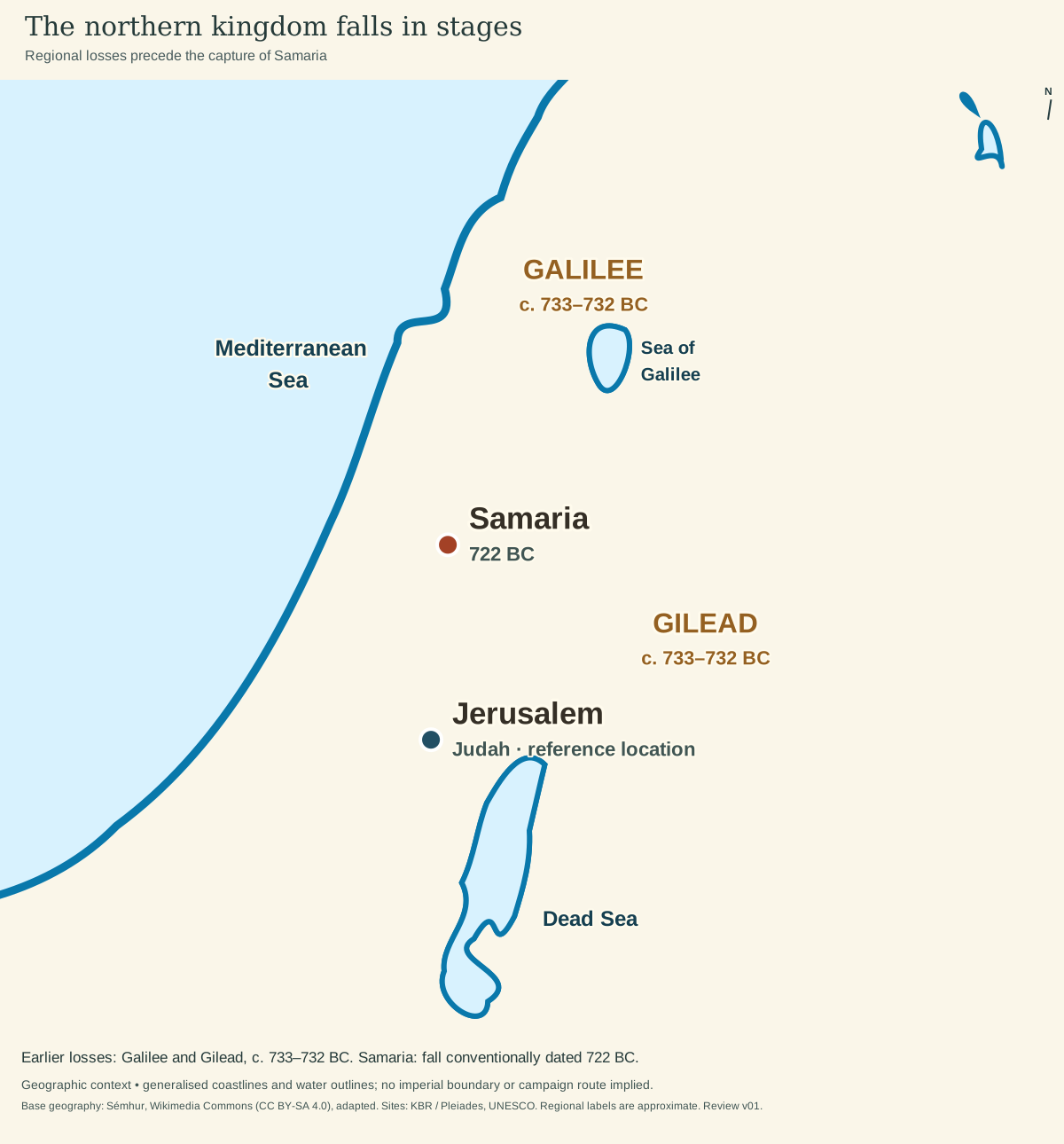
Chronology: ORACC, Israel: the House of Omri; 2 Kings 15:29 and 17:5–6. Samaria’s capture is conventionally dated 722 BC; the chronology and Sargon’s subsequent actions remain subjects of scholarly discussion. Coordinates: KBR / Pleiades: Samaria, UNESCO: Jerusalem. Base adapted from Sémhur, CC BY-SA 4.0; cropped, relabeled, terrain shading removed. Generalized water outlines are not ancient-shoreline reconstructions.

The northern kingdom did not fall in one blow. It was a decade-long amputation, limb by limb. It began under Tiglath-pileser III, the king who rebuilt the Assyrian war machine in the mid-eighth century BC. Around 733–732 BC, an anti-Assyrian coalition drew him into the region — and he sheared off Israel’s entire northern and eastern territory. The record is unusually specific about which towns and regions went first:
“In the days of Pekah king of Israel came Tiglath-pileser king of Assyria, and took Ijon, and Abel-beth-maachah, and Janoah, and Kedesh, and Hazor, and Gilead, and Galilee, all the land of Naphtali, and carried them captive to Assyria” (2 Kings 15:29).
The loss was staggering. In one campaign the north lost Galilee and the whole of Transjordan — the land east of the Jordan River: Gilead. Only the highland core around the capital was left. Tiglath-pileser’s own annals confirm and extend the biblical note, adding the Jezreel corridor — the valley country around the city of Jezreel — and listing the plunder of the region and the deportation of its people. The Assyrians had begun eating Israel from the edges inward. What remained was a rump state — a leftover stub of a kingdom — around Samaria, ruled by Hoshea, its last king. He paid tribute until he gambled on rebellion. And Assyria did not forgive a broken oath.
The Three-Year Siege of Samaria, 722 BC
When Hoshea withheld tribute and sent to Egypt for help, the empire came for the capital itself. Samaria was built to resist — strongly sited, ringed with walls — and it held out with grim endurance:
“Then the king of Assyria came up throughout all the land, and went up to Samaria, and besieged it three years” (2 Kings 17:5).
Three years. One city. The whole apparatus of Assyrian siegecraft — rams, ramps, sappers, and the slow strangulation of a blockade; see Section 03 — grinding away at one hilltop. When the wall finally gave, the deportation followed the standard pattern. And the scribe of Kings records the destination with the precision of a shipping manifest:
“In the ninth year of Hoshea the king of Assyria took Samaria, and carried Israel away into Assyria, and placed them in Halah and in Habor by the river of Gozan, and in the cities of the Medes” (2 Kings 17:6).
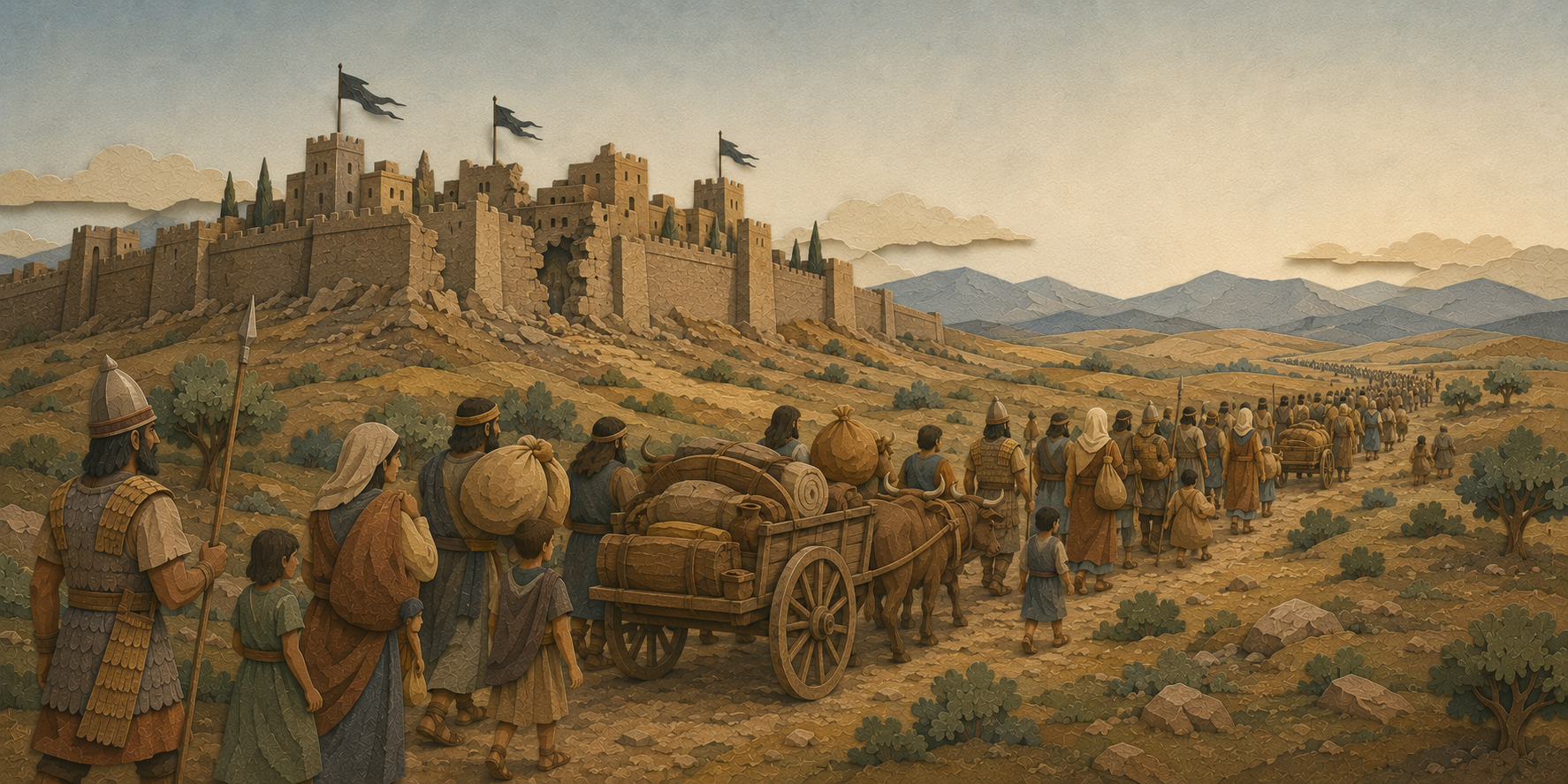
Those are real places, scattered on purpose. Halah and the Habor lay in the far north of Mesopotamia, around the headwaters of a tributary of the Euphrates. And “the cities of the Medes” lay hundreds of miles farther east, on the Iranian plateau. Notice what did not happen. The northern tribes were not resettled together in one exile colony where they might keep their cohesion, as Judah later would be in Babylonia. They were dispersed — split into fragments and planted among unrelated peoples at opposite ends of the empire. That was exactly the outcome Assyrian policy was designed to produce.
The Scattering of the North
Judah went down one road to Babylon. Israel was broken off in pieces and scattered on purpose — the policy that made the ten tribes “lost.” Step through it.
The map traces the scattering in three steps. First, around 733–732 BC, Tiglath-pileser III took Galilee, the Jezreel corridor, and Gilead, and carried their people to Assyria (2 Kings 15:29), leaving only the highland core around Samaria. Then, in 722 BC, after a three-year siege, the Assyrians took Samaria and carried Israel away (2 Kings 17:6). Finally, the deportees were resettled far from home and far from each other, in Halah, by the Habor, and in the cities of the Medes, where many were absorbed among the peoples around them.
Which king took Samaria? Oddly, the Bible names the campaign but leaves the conqueror unnamed at the moment of capture — and the Assyrian sources let us see why. Shalmaneser V laid and pressed the siege, and a second biblical account credits the fall to his reign (2 Kings 18:9–11). He died about the time the city fell. His successor, Sargon II, claimed the victory for himself, boasting that he “besieged and conquered Samaria” and carried off its people. Which of them actually took it is genuinely unsettled — specialists have argued for one conquest by Shalmaneser, one by Sargon, and two separate conquests, and the question turns on a single broken sign in one inscription that can be restored two ways. As Shuichi Hasegawa summarises the problem, “no single available source relates two consecutive conquests of Samaria.” The reading given here — Shalmaneser took the city, and Sargon, who claimed the victory, carried out the deportation — is a current and respectable one, and Eckart Frahm, who holds it, calls it provisional.
Sargon’s inscriptions also put a number on the deportation: one copy of his display inscription reads 27,290 inhabitants, along with their chariots and gods — though other copies differ, and on the broken annals slab the figure is a modern restoration rather than a surviving number. That figure is the empire’s own accounting of a nation erased. Like all such royal totals, it is a claim to be weighed, not a census to be trusted. But it gives the scale — and it names the human beings behind the Bible’s bare phrase “carried Israel away.”
Why the North Fell: Scripture’s Verdict
Here 2 Kings does something no Assyrian inscription ever does. It stops the narrative and delivers a long, unsparing explanation of why. The historian is not interested in Assyrian strategy as a cause. For him, the armies were only the instrument. The cause was covenant failure, spelled out across seventeen verses (2 Kings 17:7–23). The indictment opens plainly:
“For so it was, that the children of Israel had sinned against the LORD their God, which had brought them up out of the land of Egypt… and had feared other gods” (2 Kings 17:7).
The charge sheet is specific: idolatry and the worship of “other gods,” the high places and the golden calves. Above all comes the founding sin of the northern kingdom — “the sins of Jeroboam,” the state-sponsored rival temples and golden calves set up when the north broke from the house of David. “For the children of Israel walked in all the sins of Jeroboam which he did; they departed not from them,” the writer of Kings records (2 Kings 17:22). And running underneath the whole account is a second charge — the one that gives this guide its throughline: they would not listen to the prophets.
“Yet the LORD testified against Israel, and against Judah, by all the prophets, and by all the seers… Notwithstanding they would not hear, but hardened their necks” (2 Kings 17:13–14).
The theological summary is delivered without softening: “Therefore the LORD was very angry with Israel, and removed them out of his sight: there was none left but the tribe of Judah only” (2 Kings 17:18). In this reading, the deportation was not Assyria’s triumph. It was Israel’s judgment — the covenant curses arriving on schedule, the warnings of a century of prophets coming true. It is important to hear this verdict for what it is: scripture written in Judah, looking north — grieving and accusing at once. It is not neutral chronicle. It is one side’s account in a long rivalry over which temple and which priesthood were legitimate. That rivalry began when Jeroboam set up his own shrines and priests (1 Kings 12:28–31), and the next section follows it into the Samaritan question.
The Strangers Who Moved In — and the Samaritan Question
The land did not stay empty. The inbound half of Assyrian policy followed at once. As the Israelites went out, other conquered peoples were marched in to take their place.
“And the king of Assyria brought men from Babylon, and from Cuthah, and from Ava, and from Hamath, and from Sepharvaim, and placed them in the cities of Samaria instead of the children of Israel” (2 Kings 17:24).
What the chapter tells next is one of the strangest episodes in Kings. The new settlers “feared not the LORD,” and so — in the account’s telling — “the LORD sent lions among them, which slew some of them” (2 Kings 17:25). The colonists drew the obvious conclusion: they had offended “the God of the land” whose customs they did not know (2 Kings 17:26). So Assyria sent back a deported Israelite priest to teach them how the LORD was to be worshipped. The result was a religious hybrid: “They feared the LORD, and served their own gods” (2 Kings 17:33) — each imported nation keeping its own idols alongside the God of Israel. That blend of worships, the chapter says, persisted “unto this day” (2 Kings 17:41).
For later readers, this passage became the biblical charter for viewing the Samaritans as a people of foreign, half-pagan origin. And that is exactly where honesty requires care. The passage is doing polemical work — argumentative writing, taking one side’s part — and it should not be quietly turned into settled history.
Whose account is this? The “imported foreigners” story of 2 Kings 17 is the Judahite account — written from Jerusalem’s standpoint, in a centuries-long dispute between two communities that each claimed to be true Israel. The Samaritans themselves have never accepted it. They identify as descendants of Ephraim and Manasseh — the sons of Joseph, genuine Israelite tribes — who remained in the land and kept the ancient worship on Mount Gerizim. In their telling, it is the Jerusalem temple, not their own faith, that is the deviation.
Modern scholarship complicates both older certainties. Assyrian deportation was selective, never total, and a substantial Israelite population certainly remained in the land. So the community that emerged was very likely a mixture — surviving Israelites and resettled newcomers together — rather than either a pure remnant or a purely foreign transplant. Genetic and textual studies of the small Samaritan community that survives today (still worshipping on Gerizim near Nablus) point to deep and real Israelite roots, with signs of later admixture as well — the very mixture just described.
The wise course, then, is to present 2 Kings faithfully as what it is — one side’s theological history — while granting that the Samaritans’ own self-understanding, and the archaeology, tell a fuller and more human story than the polemic allows. The long enmity that flows from this moment outlived the empire that caused it: centuries later it is still audible in the Gospels, in a Samaritan woman’s surprise that a Jew would even ask her for a drink (John 4:9).
The Lost Tribes: What History Knows, and What Hope Keeps
So what actually became of the ten tribes carried into Halah, Habor, and the cities of the Medes? Here two honest answers sit side by side. And it does no service to either to collapse them into the other.
What the historian can see
The sober historical picture is assimilation, the outcome Assyrian deportation was engineered to produce (see Section 03). Scattered in fragments among Medes and Mesopotamians, the deportees would within a generation or two have been absorbed into the peoples around them. But that is only half the story. A significant number of northerners never left at all, or fled south into Judah before and after the fall — Jerusalem itself expanded sharply in this era, apparently absorbing refugees from the north. So much of the “lost” population was, in plain fact, folded into Judah and preserved there. King Hezekiah’s Passover appeal, sent north after Samaria fell, is addressed to precisely these survivors: “turn again unto the LORD… and he will return to the remnant of you, that are escaped out of the hand of the kings of Assyria” (2 Chronicles 30:6). On the historical evidence, the ten tribes were not spirited away to a hidden country. They were, for the most part, absorbed — some into the nations of the empire, many into Judah, which carried their blood and their memory forward.
What the tradition keeps alive
And yet the tribes were never simply written off. From the beginning, the prophets who announced the exile also promised a gathering — and Judaism and, later, the Restoration have held that promise open for twenty-seven centuries. The hope is not naive. It rests on the covenant. Amos, even as he foretold the captivity, insisted the scattering was a sifting, not an annihilation: “I will sift the house of Israel among all nations, like as corn is sifted in a sieve, yet shall not the least grain fall upon the earth” (Amos 9:9). The people would be dispersed — but not one grain would be lost. Later prophets built whole visions on that seed: the reuniting of the two sticks of Ephraim and Judah, the gathering of the outcasts of Israel “from the four corners of the earth.” Judaism preserved the ten tribes as a live expectation of the age to come. Latter-day Saints inherited and sharpened that hope, making the gathering of scattered Israel — including the lost tribes — a central article of faith and a defining work of the last days. That thread is followed in full in Section 11: LDS Connections.
The two answers are not really rivals. History describes the means: assimilation, absorption, the quiet survival of a scattered people inside other peoples. Faith describes the meaning: that a God who counts grains does not lose them, and that a people mixed into all nations is a people positioned, not erased. What looks from the outside like the end of ten tribes can be read, from within the covenant, as their seeding across the whole earth — against a harvest still to come.
The Prophets Who Saw It Coming
Scripture’s charge that Israel “would not hear” the prophets is not a rhetorical flourish. We still have the sermons they refused. Two northern prophets in particular — Amos and Hosea — preached to Israel in its last decades. They named the coming ruin with painful exactness, decades before it arrived.
Amos was a Judean shepherd sent north to the prosperous, complacent court of Jeroboam II. He announced captivity in a single unadorned sentence: “Therefore will I cause you to go into captivity beyond Damascus, saith the LORD, whose name is The God of hosts” (Amos 5:27) — “beyond Damascus” meaning up the northern road and off into the empire, precisely the direction the deportees would go. He sang Israel’s funeral while the nation still thought itself secure: “The virgin of Israel is fallen; she shall no more rise” (Amos 5:2).
Hosea was a northerner himself, and he prophesied straight through the chaos of Israel’s final kings. He diagnosed the fatal reflex — a nation lurching between foreign patrons instead of returning to God: “Ephraim also is like a silly dove without heart: they call to Egypt, they go to Assyria” (Hosea 7:11). He foretold both the coming Assyrian master — “the Assyrian shall be his king, because they refused to return” (Hosea 11:5) — and the scattering that would follow: “My God will cast them away, because they did not hearken unto him: and they shall be wanderers among the nations” (Hosea 9:17). Yet Hosea, the prophet of the broken marriage between God and Israel, also refused to make the verdict final. His most piercing line holds the whole tragedy and the whole hope in one breath: “O Israel, thou hast destroyed thyself; but in me is thine help” (Hosea 13:9).
That is the fall of the north in a sentence. The ruin was self-inflicted and long foretold. The help was never withdrawn. Ten tribes marched out of history down the Assyrian road — and the same prophets who watched them go left, in the covenant, the promise that the road runs both ways. The reckoning Assyria itself would face, and the fuller scriptural accounting of the empire, come in Section 09: Assyria & the Bible; the gathering still ahead, in Section 11.
Sources and Further Reading
- K. Lawson Younger Jr., “The Deportations of the Israelites,” Journal of Biblical Literature 117 (1998) — The careful study of the Assyrian records of the northern deportations and the fate of the exiles; essential on what the sources do and do not say.
- Mordechai Cogan & Hayim Tadmor, II Kings (Anchor Bible 11; Doubleday, 1988) — The standard critical commentary; verse-by-verse on the fall of Samaria, the deportation formula, and the resettlement of chapter 17.
- Bustenay Oded, Mass Deportations and Deportees in the Neo-Assyrian Empire (Reichert, 1979) — The definitive study of the policy that dissolved the northern tribes, with the collected royal figures.
- Eckart Frahm, “Samaria, Hamath, and Assyria’s Conquests in the Levant in the Late 720s BCE: The Testimony of Sargon II’s Inscriptions,” in Shuichi Hasegawa, Christoph Levin & Karen Radner, eds., The Last Days of the Kingdom of Israel (BZAW 511; De Gruyter, 2018), 55–86 — The study behind the reading this chapter follows, and the one that calls it provisional.
- Shuichi Hasegawa, Christoph Levin & Karen Radner, eds., The Last Days of the Kingdom of Israel (BZAW 511; De Gruyter, 2018) — The standard multi-author treatment of who took Samaria and when; open access.
- Grant Frame, The Royal Inscriptions of Sargon II, King of Assyria (721–705 BC) (RINAP 2; Eisenbrauns, 2021) — The current standard edition of the inscriptions, with the variant deportation figures in its apparatus.
- Eckart Frahm, Assyria: The Rise and Fall of the World’s First Empire (Basic Books, 2023) — The current standard history; excellent on Tiglath-pileser III, Shalmaneser V, and Sargon II’s claim to Samaria.
- K. Lawson Younger Jr., “The Fall of Samaria in Light of Recent Research,” Catholic Biblical Quarterly 61 (1999) — On the Shalmaneser-versus-Sargon problem and the deportation numbers.
- Gary N. Knoppers, Jews and Samaritans: The Origins and History of Their Early Relations (Oxford University Press, 2013) — A judicious account of Samaritan origins that weighs the biblical polemic against the archaeological and textual evidence.
Online Resources:
- WHE — Assyria (CC BY-NC-SA 4.0)
- Livius.org — Samaria — a concise, sourced history of the city and its capture by Assyria.
- British Museum — the Assyrian galleries — reliefs and inscriptions of the kings who dismantled the northern kingdom.