The Great Cities
“Out of that land went forth Asshur, and builded Nineveh…”
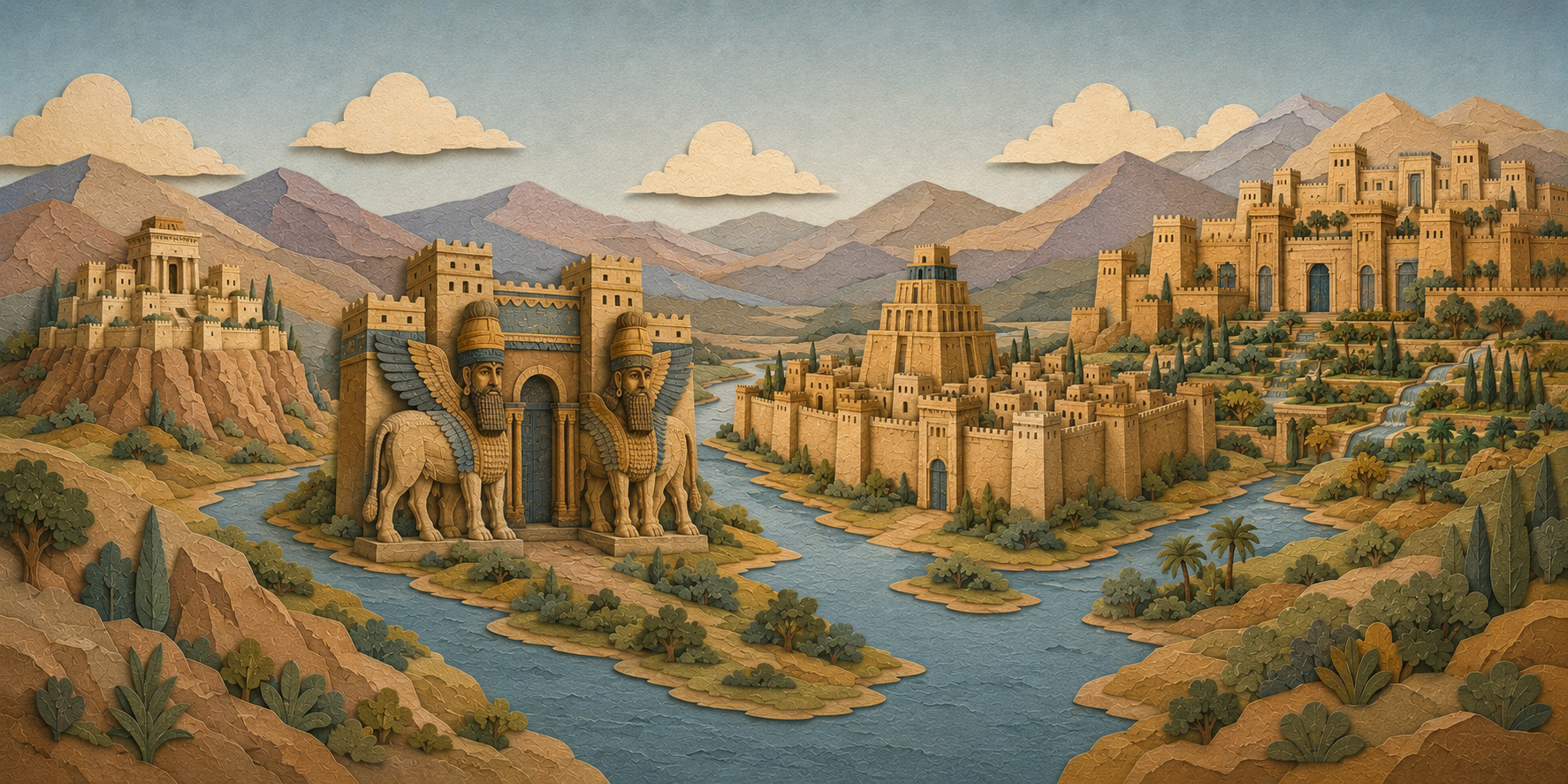
Assyria did not have a capital. It had a succession of them — and every move was a sermon in stone. Babylon poured its whole imagination into one city on the Euphrates. The Assyrian kings did the opposite. They built and abandoned capitals up and down the Tigris, and each new one was a fresh king’s announcement that the empire had outgrown the last. Ashur. Kalhu. Dur-Sharrukin. Nineveh. Four cities, four reigns, one relentless upward reach. One note before we set out: if you remember the four corner cities from Section 01 — Ashur, Kalhu, Nineveh, and Arbela — you may notice Arbela is missing here. It was a great and holy city, but no king ever made it his capital, so it sits out this tour. Walk the other four in order and you can watch a kingdom talk to itself about power — and arrive, at the end, at the city the Bible knew best.
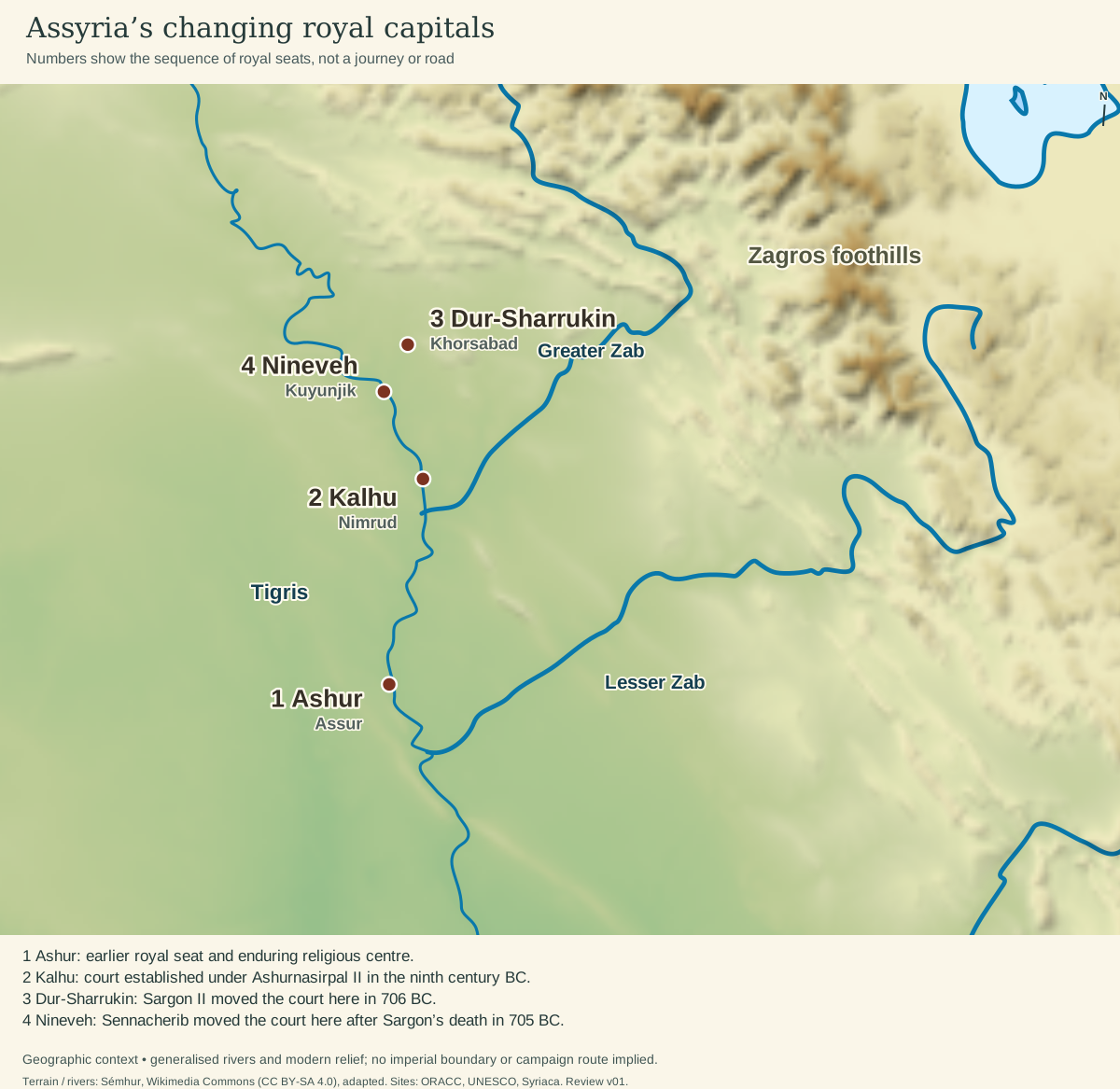
Adapted from Sémhur’s terrain and river map, CC BY-SA 4.0; cropped and relabeled. Modern relief and generalized rivers; exact ancient banks are not reconstructed. Coordinates: ORACC: Dur-Sharrukin, Nineveh, Kalhu, UNESCO: Ashur. Chronology: Sargon’s new capital and Eleanor Robson, Ancient Knowledge Networks.

Ashur: The God’s Own City
Start with a strange fact. The empire took its name from a city, and the city took its name from a god — and in Assyrian, all three are the same single word: Aššur. The oldest of the capitals stood on a rocky spur above the Tigris, a settlement already ancient when the other capitals were still open fields. And Ashur was never chiefly a fortress or an office of government. It was a holy city — the earthly home of the national god — and that gave it a hold on the Assyrian conscience long after the court had moved elsewhere. The great temple of Ashur and its ziggurats anchored the skyline. Nearby rose the temple of Anu and Adad with its twin towers, and the sanctuary of Ishtar, whose earliest levels reach back into the third millennium BC.
Above all, Ashur was where the kings came home to be buried. Beneath the Old Palace, German excavators under Walter Andrae (1903–1914) found the vaulted royal tombs — the resting place of Assyria’s monarchs. A king might reign from a glittering new capital, but he was laid at last in the city of the god who had made him king. Even when Kalhu and then Nineveh eclipsed it in size and splendor, Ashur remained the coronation and burial heart of the realm. It was the place an Assyrian king could never quite leave, because it was where his legitimacy came from. The Bible remembers the name in the person of “Asshur” (Genesis 10:11) — at once the ancestor, the land, and the god-city from which the northern power took its identity.
Kalhu (Biblical Calah): The City of the Winged Bulls
In the ninth century BC, Ashurnasirpal II (r. 883–859 BC) did what Assyrian kings would do again and again. He refused to rule from his predecessors’ city — and built his own. He chose Kalhu (the Calah of Genesis, modern Nimrud) and turned a provincial town into a capital fit for a world power. Scripture names it in the Table of Nations, in the very verses that catalogue Assyria’s founding cities: Nineveh, “the city Rehoboth, and Calah, and Resen between Nineveh and Calah: the same is a great city” (Genesis 10:11–12).
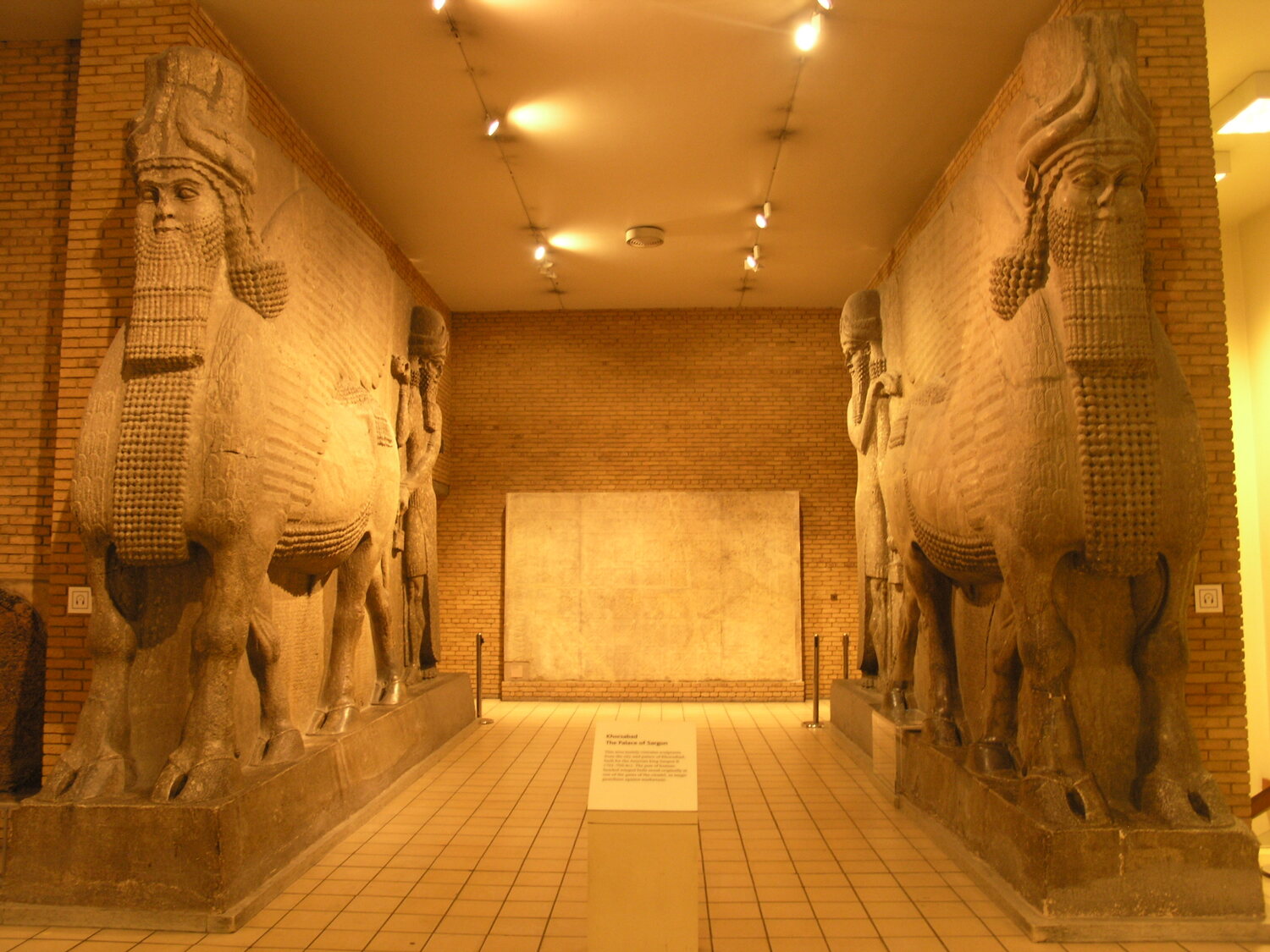
The centerpiece was the Northwest Palace — and it is one of the reasons the modern world knows Assyria at all. Room after room, its state apartments were lined with carved alabaster relief cycles: slab upon slab of the king at war, at the hunt, and before the gods. The figures are still crisp. Many were originally painted. Several carry the “Standard Inscription” of Ashurnasirpal, running straight across the images. When Austen Henry Layard began digging here in the 1840s and shipped these reliefs to London, they reshaped Europe’s picture of the biblical world overnight (the excavations are the story of Section 10). And at the palace and temple gateways stood the guardians that have become the face of Assyria: the lamassu.
What is a lamassu? The colossal figures flanking Assyrian gates are lamassu (also šēdu) — protective spirits carved as a walking summary of the empire’s ideals. The body of a bull or lion: strength. The wings of an eagle: swiftness and the divine. The bearded head of a man in the royal horned crown: wisdom and sovereignty. Each was cut in high relief from a single block weighing many tons — and given five legs. Look at one head-on and you see four legs, standing still. Look from the side and you see four legs, striding forward. From every angle, the guardian is complete. They stood at thresholds to bless those who entered rightly and to terrify those who did not: stone doorkeepers of an empire that wanted every visitor to feel small.
Kalhu gave up another treasure, one that has become legendary among archaeologists: the Nimrud ivories. Thousands of delicately carved ivory panels turned up in the palace and storerooms — furniture inlays, plaques, and fittings, many in Phoenician and Syrian styles, gathered as tribute and booty from across the Levant (the eastern-Mediterranean lands to Assyria’s west). Some had tumbled into a well, where the damp had preserved them. They are among the finest small-scale art to survive from the ancient Near East — and a vivid witness to how wealth flowed from the conquered west into the Assyrian heartland.
A modern loss: in 2015 the archaeological site of Nimrud was deliberately destroyed — palace reliefs and lamassu that had stood for nearly three thousand years were demolished. Much survives in the world’s museums, and painstaking documentation and reconstruction work continues; but the ground itself, where Ashurnasirpal’s guardians once flanked their gate, suffered a real and irreversible wound. It is worth naming plainly, without spectacle: some of what this page describes can now be seen only in London, Baghdad, and the photographic record.
Dur-Sharrukin (Khorsabad): A City Built and Abandoned
The most extravagant capital was the one that barely lived. Sargon II (r. 722–705 BC), who claimed the conquest of Samaria and the deportation of its people (see Section 07), declined to inherit a city at all. Instead, on empty ground northeast of Nineveh, he ordered an entire capital raised from nothing and named it for himself: Dur-Sharrukin, “Fortress of Sargon” (modern Khorsabad). Picture it going up: a perfect walled square nearly two kilometers on a side, built in roughly a decade, with a palace on a raised terrace, temples, a ziggurat, and lamassu-guarded gates. The whole thing was planned at once and paid for by the plunder of an empire at its height.
Sargon dedicated his city and moved in around 706 BC. The next year he was killed on campaign — and, catastrophically in Assyrian eyes, his body was never recovered. To understand why that mattered so much, you need one piece of Mesopotamian belief: a king left unburied was a horror, because his ghost could find no rest. An unrecovered royal body was an omen of divine displeasure so grave that Sargon’s own son read it as a verdict on the whole project. The court promptly abandoned Dur-Sharrukin and shifted the capital to Nineveh. The gleaming new city, scarcely broken in, was left to the wind. It is one of history’s cleaner parables of imperial vanity: a monarch who built a metropolis to outlast the ages, and did not survive to keep a single New Year festival — the king’s most important annual ceremony — in it. (The Khorsabad excavations, and the famous loss of a colossal lamassu in the Tigris, belong to Section 10.)
Nineveh: The Palace Without Rival
And so to the last and greatest of them all — the city whose name the Bible speaks more than any other Assyrian place. When Sennacherib (r. 705–681 BC) turned from his father’s abandoned dream, he chose an old Tigris city with deep roots and made it the capital of the world. Under Sennacherib, Nineveh swelled to enclose roughly seven square kilometers behind a great wall pierced by fifteen named gates, with a population that may have approached the largest the world had yet seen. Its two mounds — Kuyunjik and Nebi Yunus (“the Prophet Jonah”) — still rise above the modern city of Mosul.
At its heart Sennacherib built what he himself called, without a shred of modesty, the “Palace Without Rival.” Its reliefs raised Assyrian carving to its peak: sprawling narrative panels of siege engines, marching armies, and captive peoples, carved with a documentary precision unmatched in the ancient world. The most famous of them shows the fall of a Judahite city. These are the Lachish reliefs — a scene we can read against the pages of Kings and Isaiah (the whole confrontation is the subject of Section 08). And in another wing of this same royal complex — and in the palace of his grandson Ashurbanipal — sat the tens of thousands of cuneiform tablets of the great royal library, the single richest hoard of Mesopotamian literature ever found (see Section 05).
The Water Empire
A city of that size on the Tigris floodplain faced a hard problem: enough water, reliably delivered, for a huge population — and for the parks and orchards a great king was expected to plant. Sennacherib answered with engineering that still astonishes. He built a network of canals drawing water from the hills to the north. And to carry one of them across a valley, he raised the Jerwan aqueduct — a stone-built water bridge some hundreds of meters long, made of roughly two million dressed blocks and lined to hold the flow. It is among the earliest monumental aqueducts known anywhere, and it bore Sennacherib’s own confident inscription. Think about what that means: this was a king who could carry a river over a valley. He did not stop at defenses. He watered a paradise.
The Gardens — and a Wonder in the Wrong City?
Where did all that water go? Sennacherib’s inscriptions describe a great royal garden beside his palace at Nineveh — a “wonder for all peoples,” planted with trees gathered from across the empire, laid out on raised terraces, and watered by a mechanism the king says he cast in bronze to lift water continually to the height of the plantings. Hold that picture in your mind: terraced greenery rising in tiers above a Mesopotamian capital, fed by hidden hydraulic machinery.
Now, that picture may sound familiar — for the wrong reason. The classical world remembered the Hanging Gardens as one of the Seven Wonders, and attached them to Babylon. Here is the puzzle: the abundant Babylonian records never mention such gardens, and no site has been agreed upon there. The Assyriologist Stephanie Dalley has argued, in a detailed and much-discussed case, that the wonder was real but misfiled. On her reading, the terraced, machine-watered garden of the Greek tradition is in fact Sennacherib’s garden at Nineveh, whose fame drifted over the centuries onto the more familiar name of Babylon — the two cities and empires easily confused by later writers. Her case marshals Sennacherib’s own texts, the water engineering that could actually have supplied such a garden, and a relief that appears to show terraced plantings watered from above.
It is a fascinating thesis — and it is genuinely contested. Other specialists are unpersuaded. Some hold to a Babylonian location; some judge the classical accounts too tangled to pin down. The debate is live and unresolved. As with the gardens in the Babylon guide, honesty asks us to present this as an open question rather than a settled discovery: a serious, well-argued hypothesis that has not won the field. Here is what is not in doubt: Sennacherib built a spectacular terraced garden at Nineveh. Whether it is the Hanging Gardens is exactly the kind of question the tablet and the spade keep the right to reopen.
Nineveh in Scripture
No Assyrian city looms larger in the Bible. Its founding stands at the head of the Table of Nations: “Out of that land went forth Asshur, and builded Nineveh” (Genesis 10:11–12). Centuries later, it is the reluctant destination of a runaway prophet. The book of Jonah gives it a phrase no reader forgets: “Now Nineveh was an exceeding great city of three days’ journey” (Jonah 3:3). Jonah is sent to “that great city” because “their wickedness is come up before me” (Jonah 1:2). And the book ends, unexpectedly, with God’s mercy on its “more than sixscore thousand persons that cannot discern between their right hand and their left hand” (Jonah 4:11).
But the mercy Jonah resented did not last forever. A later prophet, Nahum, devotes his entire book to Nineveh’s coming ruin — “The burden of Nineveh” (Nahum 1:1), “Woe to the bloody city! it is all full of lies and robbery” (Nahum 3:1). Zephaniah joins him, foretelling that God would “make Nineveh a desolation, and dry like a wilderness” (Zephaniah 2:13). In 612 BC the great city fell to the Medes and Babylonians. And it fell so completely that within a few centuries, travelers could stand on its buried mounds without knowing a city was under their feet (the fall of the empire is Section 02; its scriptural echoes, Section 09).
Four capitals, one lesson: stand back from Ashur, Kalhu, Dur-Sharrukin, and Nineveh, and a pattern emerges. Each king reached higher, built larger, and insisted more loudly that his city would never end. Sargon’s pristine capital outlived him by a year. Sennacherib’s “Palace Without Rival” became a mound that hid a library no one knew was there. And the “exceeding great city” that Jonah walked, and that Nahum said would be “laid waste” (Nahum 3:7), vanished so thoroughly that its very existence passed, for a time, out of memory. The prophets read these skylines the way they read Babylon’s: as monuments to a glory that was always, from the first brick, on its way to becoming dust.
How those mounds were lost — and how, in the 1840s, spades and a few obstinate men brought the winged bulls back into the light — is the story that Section 10 takes up.
Sources and Further Reading
- Eckart Frahm, Assyria: The Rise and Fall of the World’s First Empire (Basic Books, 2023) — The current authoritative narrative history; excellent on the succession of capitals and their meaning.
- Karen Radner, Ancient Assyria: A Very Short Introduction (Oxford University Press, 2015) — A concise, reliable overview of the cities, kings, and institutions of the empire.
- Stephanie Dalley, The Mystery of the Hanging Garden of Babylon: An Elusive World Wonder Traced (Oxford University Press, 2013) — The full argument for Nineveh, not Babylon, as the true home of the Hanging Gardens; the contested thesis discussed above.
- Joan Oates & David Oates, Nimrud: An Assyrian Imperial City Revealed (British School of Archaeology in Iraq, 2001) — The definitive account of Kalhu, the Northwest Palace, and the Nimrud ivories.
- Julian Reade, Assyrian Sculpture (British Museum Press, rev. ed. 1998) — A clear guide to the palace reliefs and the lamassu, richly illustrated.
- Austen Henry Layard, Nineveh and Its Remains (John Murray, 1849) — The excavator’s own famous account of uncovering Kalhu and the winged bulls.
Online Resources:
- WHE — Nineveh (CC BY-NC-SA 4.0)
- WHE — Nimrud (Kalhu) (CC BY-NC-SA 4.0)
- British Museum — the Assyrian galleries — home of the Nimrud reliefs, lamassu, and the Lachish panels.