Religion & the God Ashur
The god who was a city, a nation, and a war
Every empire tells a story about why it deserves to rule. Assyria’s story was theological. Its armies did not merely conquer for a king or for plunder. They marched, the royal inscriptions insist, to extend the dominion of a god — and that god was, uniquely in the ancient world, the deified state itself. That one idea explains a great deal. It explains why Assyrian kings could describe the sack of a city as an act of worship. It explains why the Rabshakeh — the Assyrian king’s field spokesman — could stand at Jerusalem’s wall and sneer that no nation’s god had ever escaped the king of Assyria’s hand. To understand any of it, we have to begin with the strangest deity in the Near East.
Ashur: The God Who Was the State
Most Mesopotamian gods governed a domain — sky, storm, sun, the sweet water (fresh water) under the earth. Ashur governed nothing so specific. He had no myth of his own, no fixed sphere, no consort in the oldest layers of the tradition. What he had was a name. And that name belonged, all at once, to a god, to a city on the west bank of the Tigris, and to the land and people that grew out from it. God, city, and nation were a single word: Aššur. When Assyrians said “Ashur,” the context alone told you whether they meant the deity in his temple, the ancient capital, or the empire itself. The three were theologically inseparable.
This is not a scholarly abstraction; it is the engine of Assyrian history. Watch how concrete it gets. Assyrian royal annals often take the literary form of a letter to the god Ashur, describing the year’s campaign as tribute laid at his feet. The king reported his conquests back to the god like a servant rendering accounts. Now follow the logic. If the god simply is the state, then to worship him and to enlarge the state are the same act. The god’s glory grows as his borders grow. Warfare becomes liturgy — holy war in the most literal sense, waged to bring more of the world under the peace and order of Ashur (the campaigns themselves are the subject of Section 03). The king was Ashur’s chief priest and earthly viceroy, the god’s appointed steward who ruled “by the command of Ashur” — and rebellion against Assyria was therefore not politics but sacrilege. The king punished it as a priest purges a defilement.
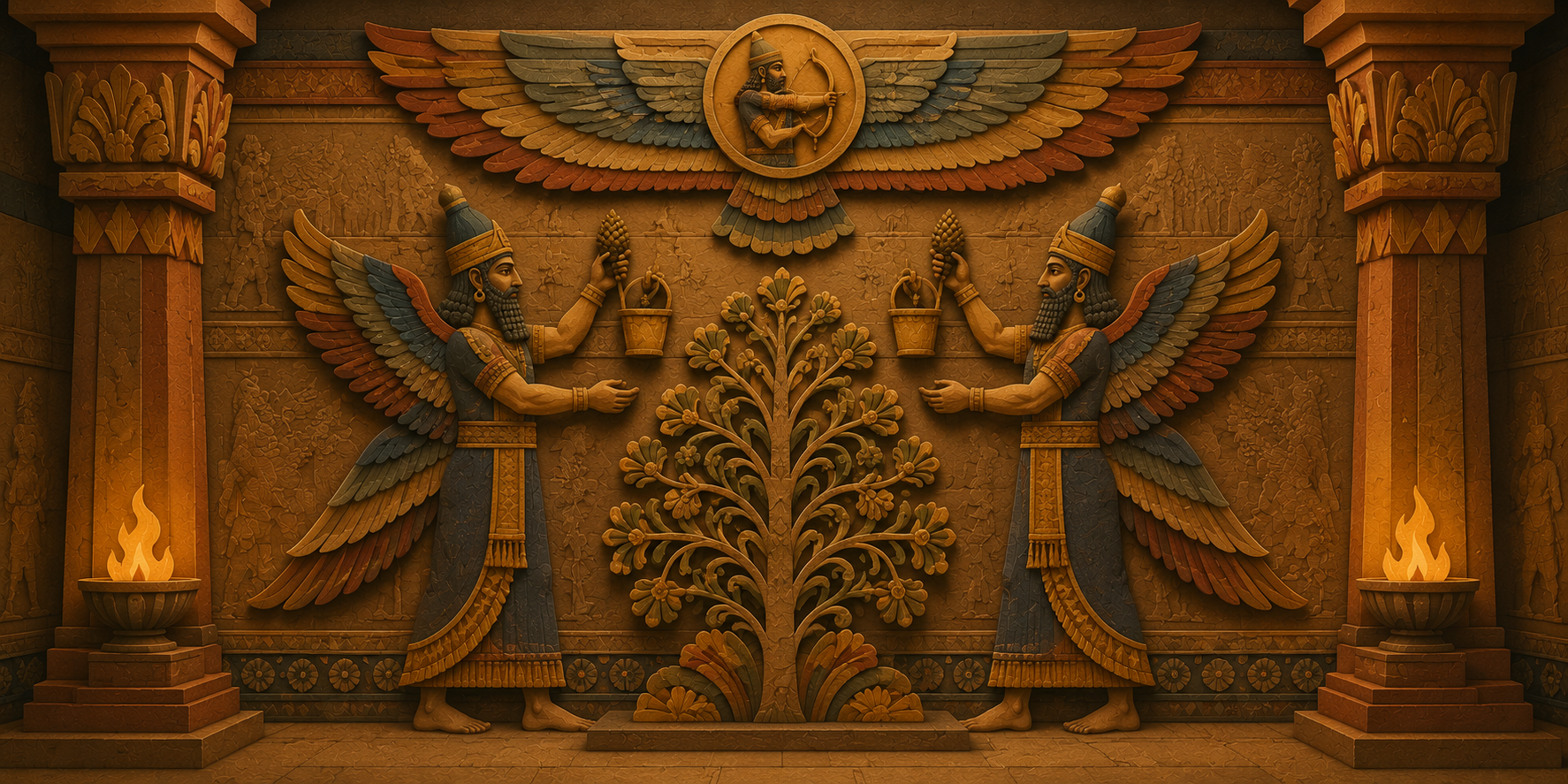
Over time Ashur absorbed the trappings of greater gods to match his people’s ambitions. Assyrian theologians recast him as the true king of the gods, and in a remarkable move a version of the Babylonian creation epic was rewritten with Ashur’s name swapped in for Marduk’s (a move eased by Ashur’s likeness to Anshar, a primordial god already in the story) — the cosmos re-founded, on fresh clay, under a northern king. You can see this theology in the palace reliefs, too. A winged disk hovers over Assyrian kings, an archer within its ring. It is most often understood as Ashur (or the sun-god Shamash) accompanying the monarch into battle: the god riding to war above his viceroy.
The Shared Pantheon
Above and around Ashur stood a crowd of gods Assyria had inherited, almost wholesale, from the older civilization of the south. Assyrian and Babylonian religion drew on one Mesopotamian tradition. The great deities of Babylon were worshipped in the north under the same names and offices. What Assyria added was a martial coloring: the same gods, armed.
No deity shows this more clearly than Ishtar. Throughout Mesopotamia she was the goddess of love and war and the planet Venus. In Assyria she was above all the ferocious lady of battle, worshipped in two great northern shrines with two distinct personalities — the Ishtar of Nineveh and the Ishtar of Arbela (modern Erbil). It was Ishtar of Arbela who, in the surviving prophetic oracles, speaks reassurance to kings like Esarhaddon on the eve of war: “Fear not,” the goddess says through her prophets, “I am with you.” Beside her stood the familiar company. There was Nabu, god of writing and wisdom, whose cult grew enormously in the empire’s last centuries. There was Shamash, the sun, guarantor of justice and — crucially for a divining culture — the god who answered the oracle-questions. There were Sin, the moon; Adad, the storm; and Ninurta and Nergal, the war-gods whose violence suited the empire’s temper. The great cities each guarded a god’s house. And beside the temples rose the stepped ziggurats that were Mesopotamia’s signature — at Ashur, at Nimrud (Calah), at Nineveh — the artificial mountains where heaven and earth were imagined to touch.
The Sacred Tree and the Winged Genies
Anyone who has stood before the Assyrian reliefs in the British Museum has met the empire’s most haunting religious image, usually without a caption to explain it. A stylized sacred tree — a network of interlaced branches and palmettes — stands flanked by towering winged figures. Some are eagle-headed. Some are human-faced with elaborate beards. In one hand they hold a cone, in the other a small bucket. Scholars call these beings apkallu — the primeval sages of Mesopotamian tradition, sometimes half-fish, sometimes bird-headed, the antediluvian (before-the-flood) bringers of civilization, here recast as protective genies. The gesture with cone and bucket seems to be one of purification or blessing: sprinkling the sacred tree — and, on the palace walls, the king who stands within the scene.
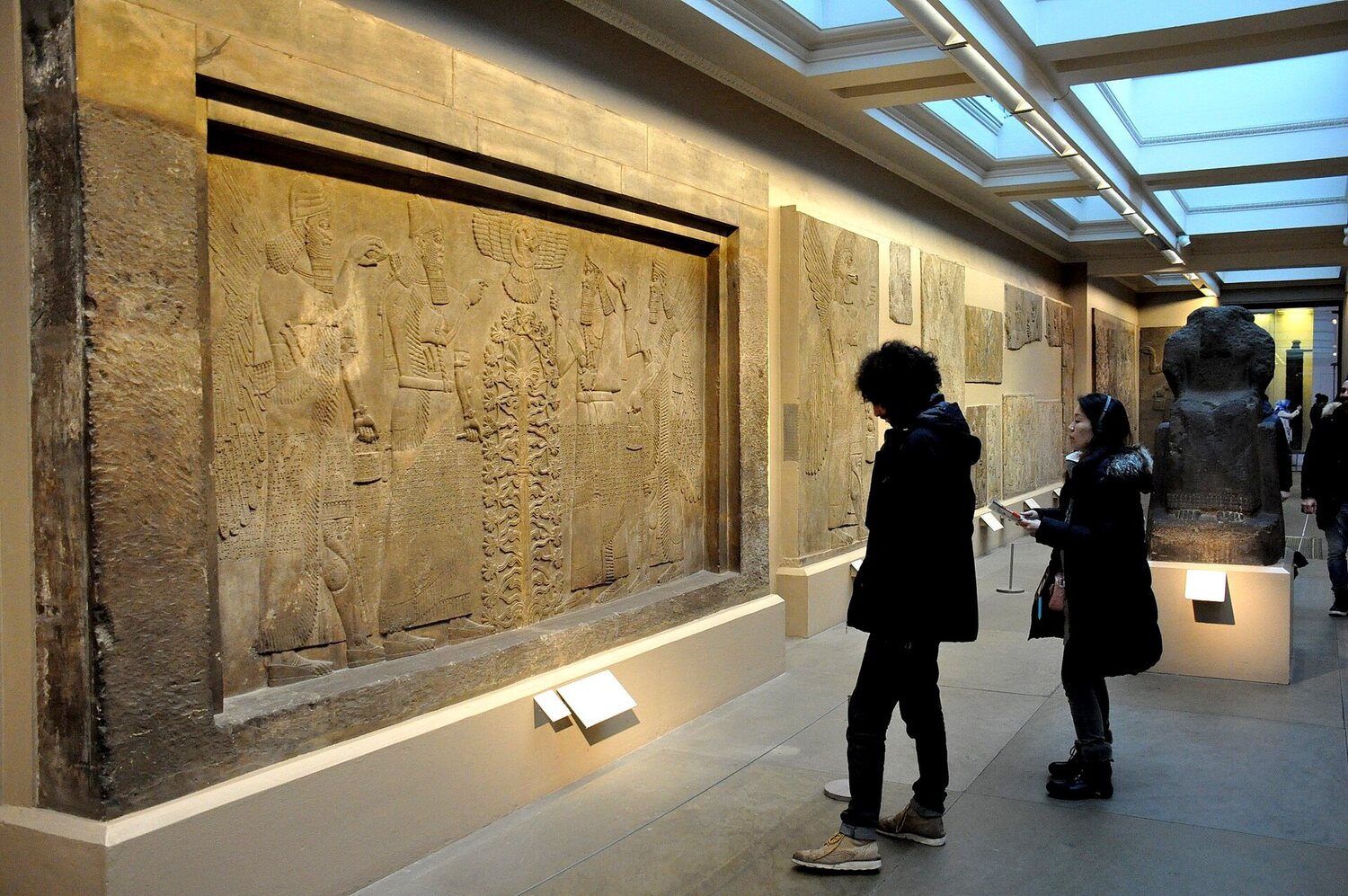

What the tree itself meant is still debated: a symbol of cosmic order, of the fertility the king’s rule secured, perhaps of the divinely sustained life of the nation. Whatever its precise sense, its placement is not decorative. It clusters at the throne-room and the doorways — the points that most needed guarding. And again and again the composition centers on the king, tended by the winged sages, sometimes doubled and mirrored around him. The message is the same one Ashur’s theology preached in stone: the monarch stands at the axis of the sacred order, sustained by heaven, the human hinge between the gods and the world they had entrusted to Assyria.
Reading the Will of the Gods
If the gods governed the world, then knowing their intentions was the highest practical art — and no state pursued it more systematically than Assyria. Divination here was not folk superstition. It was a branch of government, staffed by learned professionals who reported directly to the king. Their letters and reports survive in the thousands, and they open a window onto the daily anxiety of ruling by the gods’ consent.
Their most trusted method was extispicy — reading the entrails, above all the liver, of a sacrificed sheep. A trained diviner (the bārû) would put a yes-or-no question to the sun-god Shamash and the storm-god Adad. Then he inspected the organ against a vast catalogue of ominous marks, each feature a letter in a divine script. Kings put nothing important to chance. Whether to campaign, whom to appoint, whether a prince would recover from illness — all were referred to the liver, and important questions were checked and rechecked. Alongside extispicy ran celestial divination: the systematic watching of moon, planets, and stars against the great omen series. An eclipse or a planetary conjunction became a coded warning that a wise king could act upon. And when the omens threatened the king personally, Assyria could even enthrone a substitute king — a stand-in to absorb the predicted doom while the true monarch waited quietly in reserve.
The men who did this work were the same scholars who built and curated the great royal library. The omen compendia, the astronomical diaries, the ritual and medical texts were all part of one body of expertise — and the tablets themselves are the subject of Section 05. It was, in its way, a genuine intellectual achievement. The centuries of careful sky-watching that Assyria and Babylon compiled in the service of omens laid real groundwork for astronomy. But the frame remained religious to the end. The stars were not laws to be discovered; they were a message to be read — and the reader worked for the king.
The Theology of Empire
How far did Assyria press its god upon the peoples it ruled? Popular retellings often assume that conquered nations were forced to worship Ashur. The reality, as Mordechai Cogan showed in his careful study Imperialism and Religion, was more measured — and more interesting. Territories fully annexed as Assyrian provinces did take on cultic obligations to the imperial gods. And the deported foreigners resettled in the emptied land of Samaria brought and kept their own gods, in a religious patchwork the biblical historian describes with something close to disgust (2 Kings 17:29–33). But vassal kingdoms that kept their thrones — Judah among them — were generally not compelled to install Ashur in their temples. What bound a vassal was the loyalty oath, the adê, sworn before the gods of both parties. To break faith with Assyria was to break faith with heaven, and to call down the curses the treaty spelled out in gruesome detail.
Yet the theology behind the empire did not need a statute to make itself felt. It announced itself, unforgettably, at the wall of Jerusalem in 701 BC. There Sennacherib’s field commander — the Rabshakeh — stood within earshot of the defenders and preached the gospel of Assyrian power. His argument was purely theological, and it is worth hearing in full:
“Hath any of the gods of the nations delivered at all his land out of the hand of the king of Assyria? Where are the gods of Hamath, and of Arpad? where are the gods of Sepharvaim, Hena, and Ivah? have they delivered Samaria out of mine hand? Who are they among all the gods of the countries, that have delivered their country out of mine hand, that the LORD should deliver Jerusalem out of mine hand?” (2 Kings 18:33–35)
Notice the shape of the reasoning. The Rabshakeh does not deny that Judah has a god. He simply files the LORD in a long list of national gods, every one of which has already failed to save its people from Assyria. The unspoken premise is the whole Assyrian worldview: the god of the strongest empire is the strongest god, and the record of conquest is the scoreboard of heaven. Ashur has beaten every god he has faced; the LORD will be no exception. It is imperial theology stated as plainly as it ever was — and how Jerusalem answered it is the story of Section 08.
The God Who Is the Empire, and the God Who Judges It
Here two theologies stand face to face, and the difference is the whole point. Assyria’s god was the empire. His will and the state’s ambitions could never diverge, because they were the same thing. A god who is the nation can never rebuke the nation. He rises and falls with its armies — and when the armies fall, so does he. That is exactly what the prophet Nahum promised over doomed Nineveh: “out of the house of thy gods will I cut off the graven image… I will make thy grave; for thou art vile” (Nahum 1:14).
Israel’s God is of another order entirely, and the book of Isaiah says so precisely by turning Assyria’s own logic inside out. Yes, Assyria conquers — but not because Ashur outranks the LORD. Assyria conquers because the LORD is using it: “O Assyrian, the rod of mine anger, and the staff in their hand is mine indignation” (Isaiah 10:5). The empire that thought itself the arm of its god is, unknowingly, a tool in the hand of Another. And a tool that boasts against the hand that wields it will be broken for its pride: “Shall the axe boast itself against him that heweth therewith?” (Isaiah 10:15). The same God who raises the empire to discipline his people will judge the empire for the cruelty it enjoyed along the way. That is a claim Assyria’s theology had no category for: a god who commands the nations, and then holds even his own instrument to account.
There is a smaller irony, and scripture savors it. The king who mocked the gods of the nations died, the text notes, at prayer to his own: “as he was worshipping in the house of Nisroch his god… his sons smote him with the sword” (2 Kings 19:37). And when God sent Jonah to that same great city (Jonah 1:2), the point of the whole book was that Nineveh — the empire built on holy war — was not beyond the reach of a mercy its own theology could never have imagined: a God who spared the city its prophet wanted destroyed. Assyria built an empire in which the god was the state. Israel bore witness to a God the empire, in the end, could only serve.
Sources and Further Reading
Assyrian Religion:
- Eckart Frahm, Assyria: The Rise and Fall of the World’s First Empire (Basic Books, 2023) — The current authoritative history, excellent on Ashur, the imperial theology, and the scholars of the court.
- Karen Radner, Ancient Assyria: A Very Short Introduction (Oxford University Press, 2015) — A crisp, reliable overview of the state, its gods, and its administration.
- A. Leo Oppenheim, Ancient Mesopotamia: Portrait of a Dead Civilization (University of Chicago Press, rev. ed. 1977) — The classic treatment of Mesopotamian religion, divination, and the care of the gods.
Empire, Vassals, and the Bible:
- Mordechai Cogan, Imperialism and Religion: Assyria, Judah and Israel in the Eighth and Seventh Centuries B.C.E. (Scholars Press, 1974) — The careful study that reframed the question of whether Assyria imposed its cult on its vassals.
- Simo Parpola, Assyrian Prophecies (State Archives of Assyria 9; Helsinki University Press, 1997) — The oracles of Ishtar of Arbela to the Assyrian kings.
Online Resources:
- WHE — Assyria (CC BY-NC-SA 4.0)
- Livius.org — Ashur (city and god)
- Oracc / SAAO — State Archives of Assyria Online — the scholars’ letters, oracle-queries, and omen reports in edition and translation.