The War Machine
The first empire built to conquer — and the first to advertise its own terror
Assyria was not the first kingdom to fight wars, nor the first to build an empire. What Assyria did — over roughly three centuries in the early first millennium BC — was turn conquest itself into a permanent institution of the state. It fielded the ancient world’s first standing professional army, mastered the engineering needed to crack walled cities, and then did something no earlier power had attempted at that scale: it made terror a deliberate policy and mass deportation a routine administrative tool. The result was the first true military superpower, and the empire that swallowed the northern kingdom of Israel whole.
The uncomfortable thing about the Assyrian machine is that we do not have to guess at its cruelty. The Assyrians documented it themselves — in their kings’ own annals (the year-by-year royal war records) and on the carved stone reliefs that lined their palace walls. This page reads that self-portrait soberly, and then turns to the way the prophets read it: as a rod in the hand of God, wielded and then broken.
The First Professional Army
Earlier Near Eastern armies were seasonal — farmers called up after the harvest, disbanded before planting. Assyria’s genius was to build a core that never went home. By the height of the Neo-Assyrian empire, the king commanded a standing force built around the kiṣir šarri, the “royal cohort,” supplemented each campaign season by provincial levies and by contingents drawn from conquered peoples. It was paid, provisioned from imperial granaries, and organized into recognizable arms of service.
Three technical advantages compounded that organization. The first was iron. From the ninth century BC onward, Assyria equipped its infantry with iron weapons and armor on a scale earlier bronze-age powers could not match — iron was cheaper once the metallurgy spread, and abundant enough to arm tens of thousands. The second was the chariot and, increasingly, the cavalry: Assyrian reliefs trace a shift over time from the heavy chariot to mounted archers and lancers who could range far ahead of the main column, screen its advance, and run down a broken enemy. The third — and the most decisive — was siege warfare.
Why the siege mattered: In the ancient Near East, a walled city was the unit of power. Break the wall and you took the state; fail to, and a campaign dissolved into a season of raiding. Most powers could not reliably take a fortified city at all — they blockaded and waited, sometimes for years. Assyria’s ability to storm walls turned every fortress from a refuge into a trap, and it is the single capability that best explains why the empire kept growing.
The Engineers of the Wall
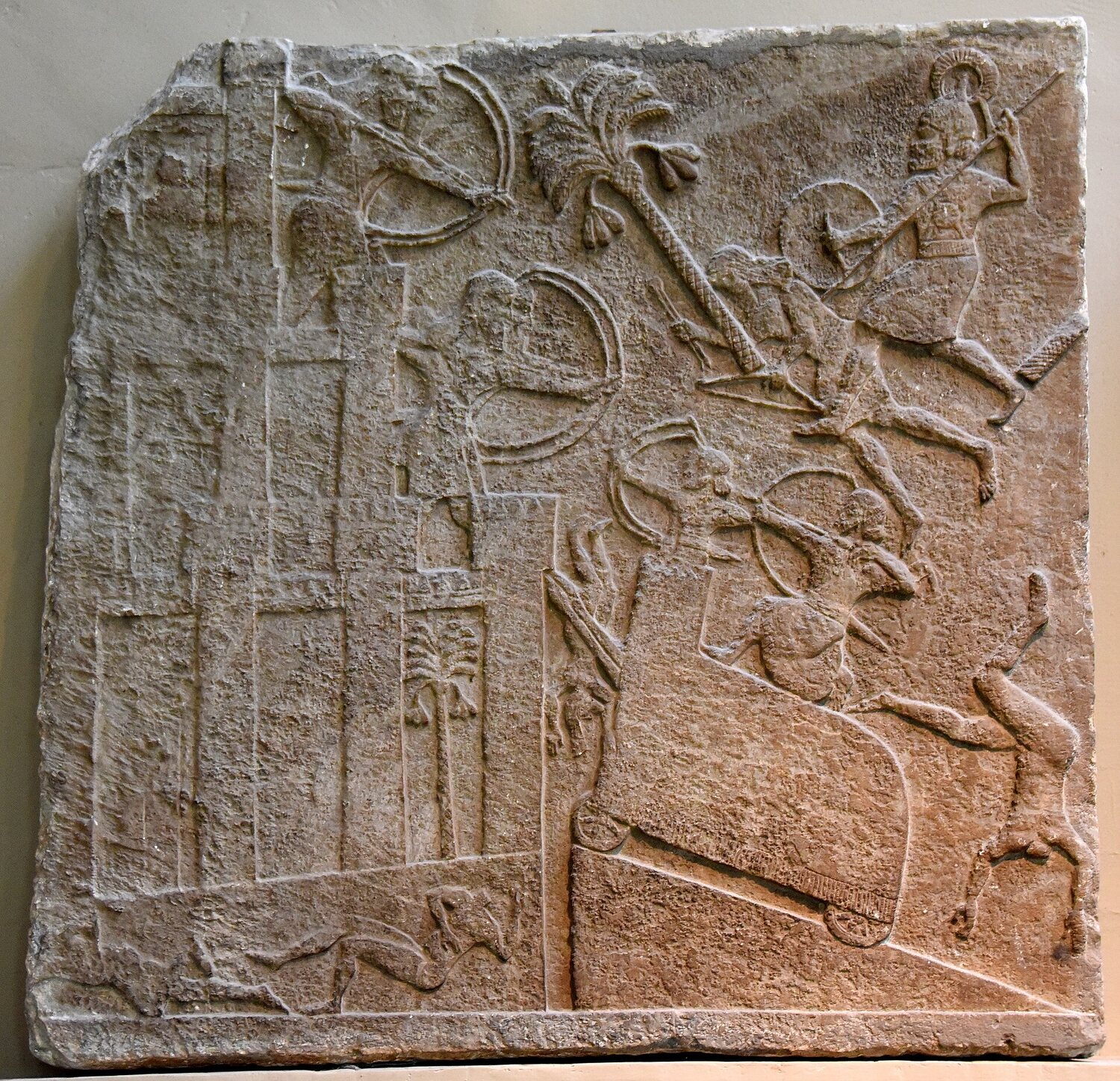
Assyrian siegecraft was a system, not a stunt. Its palace reliefs — especially the great Lachish series carved for Sennacherib, which we walk through in Section 08 — show the whole apparatus at work at once, like a technical diagram in stone.
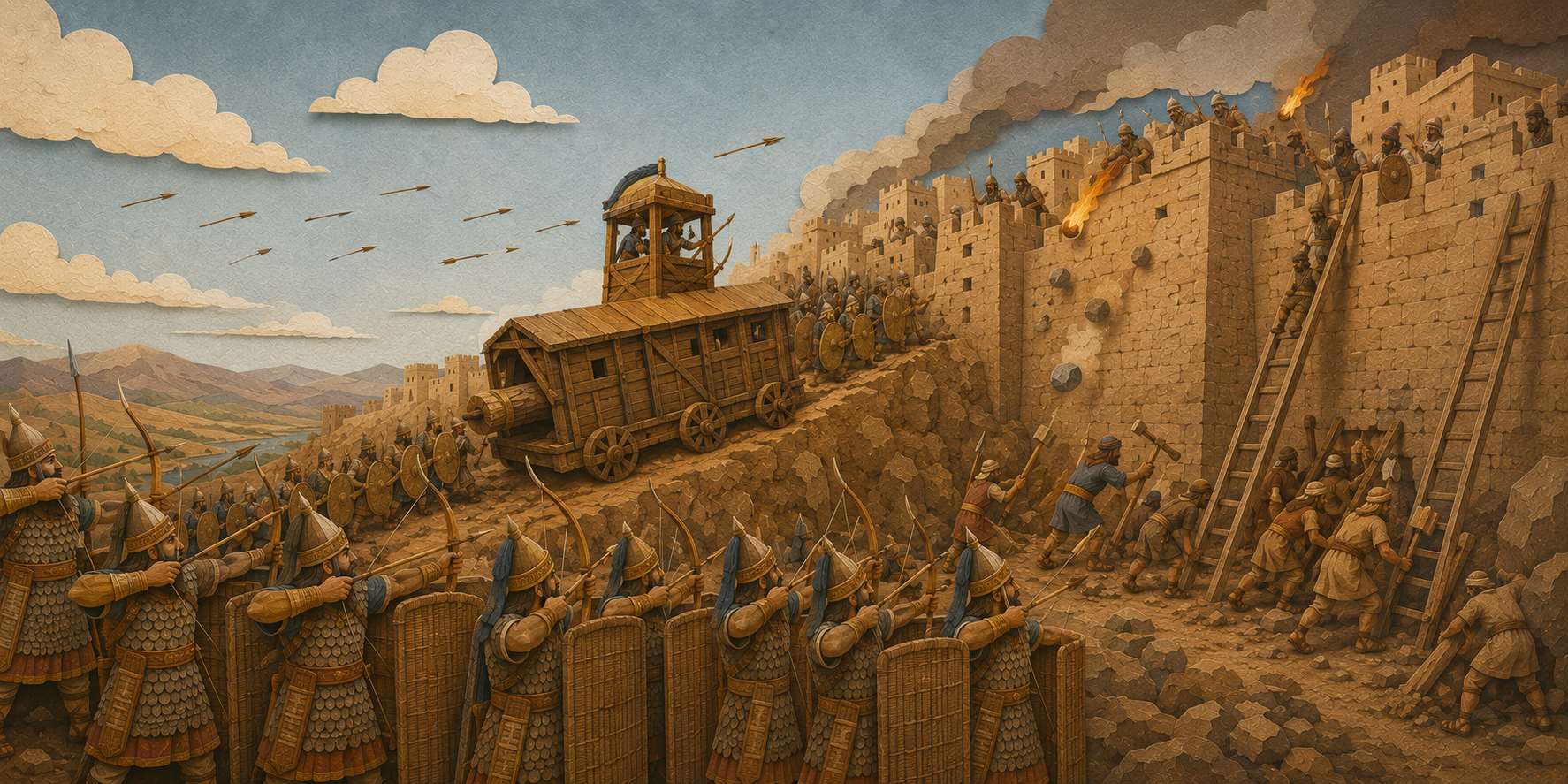
At the center is the siege ram: a wheeled, armored engine housing a heavy beam tipped in metal. It was pushed up against the wall to lever out stones or batter a breach. A roof of wickerwork and hides shielded its crew from above. To bring the ram to the wall, an engineering corps built ramps: vast graded causeways of earth, rubble, and timber. These raised the machines to the height of the defenses. (At Lachish, the archaeologists found the ramp itself: a real embankment of some 13,000–19,000 tons of stone and soil, the oldest siege ramp yet excavated anywhere.) Meanwhile sappers worked at the base of the wall with crowbars and picks to undermine it. Archers laid down covering fire from behind tall wicker screens. And scaling ladders went up wherever the wall could be reached. It was combined-arms engineering of a kind the world had not seen — every specialty working the same wall at once, each covering the others. And it was the ancestor of every siege train, every army’s rolling kit of wall-breaking gear, for the next two thousand years.
Nothing in the biblical record contradicts this picture; it fills it in. When the Rabshakeh — the Assyrian king’s chief spokesman — stands before Jerusalem’s wall and taunts Hezekiah, he is the herald of exactly this machine — a machine that had, in the same campaign, already reduced the fortified towns of Judah one after another (see Section 08).
Terror as Policy
The Assyrian kings did not merely commit atrocities in the heat of war; they boasted of them afterward, in carefully composed royal inscriptions meant to be read and reread. Ashurnasirpal II’s ninth-century annals, for example, record in the king’s own voice the flaying of rebel leaders, the impaling of captives, and the building of pillars of severed heads before conquered cities — presented not as regrettable excess but as the just and glorious punishment rebels deserved. These are the empire’s own words about itself.
The key to understanding this is that the cruelty was a message, not a mood. The horrors were concentrated on cities that had revolted after submitting — on oath-breakers — and they were publicized precisely so that the next city would calculate the cost of resistance and open its gates instead. The palace reliefs served the same function. They were not private art; they lined the throne rooms and audience halls where the king received tribute-bearers and foreign envoys. A delegation arriving to negotiate walked a corridor of carved conquest — walls breached, defenders impaled, captives led away in endless lines — before ever reaching the king. The message was inescapable and intentional: this is what awaits those who break faith with Assyria; choose.
Propaganda, aimed two ways: The reliefs and annals worked on two audiences at once. To subjects, they broadcast the futility of revolt. To the Assyrian court itself, they framed the king as the god Ashur’s appointed agent of order, imposing cosmic right on a chaotic world. Modern scholars are careful to note that some of the boasting is formulaic — a genre with its own conventions, not a literal daily record — but the reliefs are not idle threats. Archaeology and the destruction layers of real cities confirm that Assyria did what it said it would do. Nahum, standing over the ruin of the empire, called Nineveh simply “the bloody city” (Nahum 3:1) — and he was quoting the empire’s own reputation back at it.
The Signature Invention: Two-Way Deportation
Terror broke a city’s will; something else broke a nation’s identity. Assyria’s most consequential military innovation was not a weapon at all but a policy of population engineering: systematic, two-way mass deportation.
The logic was ruthless and effective. A conquered people rooted in its own land, with its own sanctuaries, elites, and memory, could always rebel again. So Assyria uprooted them — marching whole communities hundreds of miles across the empire and resettling them among strangers — and then imported other deported peoples into the emptied land to replace them. Cut off from their homeland and surrounded by foreigners who did not share their language or gods, the transplanted population lost the cohesion needed to revolt. Within a generation or two, distinct nations dissolved into the imperial mass. Deportation was, in effect, the empire’s way of digesting what its army had swallowed.
The scale is staggering. In the standard scholarly study of the practice, Bustenay Oded collected the deportation figures the Assyrian kings themselves recorded and counted references to well over four million people moved across the roughly three centuries of the empire — and since many campaigns give no numbers at all, the true total was higher still. This was not an occasional punishment; it was a running administrative program, generation after generation.
The deportees were not simply discarded. Skilled workers, scribes, and soldiers were redistributed where the empire needed them; farmers were resettled on imperial land to work it. The reliefs show the marches with grim bureaucratic calm — families with ox-carts and bundles, scribes tallying the count — the visual language of an empire treating human populations as a resource to be reallocated.
How the Ten Tribes Were Lost
This is the exact machinery that fell on the northern kingdom of Israel. When Samaria finally fell after a three-year siege, the record is precise: “the king of Assyria took Samaria, and carried Israel away into Assyria, and placed them in Halah and in Habor by the river of Gozan, and in the cities of the Medes” (2 Kings 17:6; the same is restated at 2 Kings 18:11). That is the outbound half of the policy — and it is why we speak of the “lost” ten tribes: not slaughtered, but scattered and absorbed by design.
The inbound half followed at once: “the king of Assyria brought men from Babylon, and from Cuthah, and from Ava, and from Hamath, and from Sepharvaim, and placed them in the cities of Samaria instead of the children of Israel” (2 Kings 17:24). Five foreign populations, themselves deported from elsewhere, resettled in the emptied land. The mixed people that resulted — and the mixed worship the chapter goes on to describe — is the deep origin of the community later known as the Samaritans. In a single stroke of imperial policy, one covenant nation was dispersed and another population planted in its place. The theological and historical fallout of that event is the subject of Section 07: The Fall of the North.
Scripture registers the terror of it even before the end came. Hosea, prophesying to the north in its last decades, names Assyria as the coming master — “the Assyrian shall be his king, because they refused to return” (Hosea 11:5) — and Tiglath-pileser III had already begun the process a generation earlier, carrying off Galilee and Gilead (2 Kings 15:29). The machine did not arrive all at once; it ground north to south over decades.
“O Assyrian, the Rod of Mine Anger”
The prophets watched this empire and drew a startling theological conclusion: the terror-state was, in the hand of God, an instrument. Isaiah addresses the superpower directly: “O Assyrian, the rod of mine anger, and the staff in their hand is mine indignation” (Isaiah 10:5). Then he lets the empire boast in its own voice: “By the strength of my hand I have done it, and by my wisdom” (Isaiah 10:13). That boast is almost a paraphrase of the royal annals themselves. Isaiah had heard how Assyria talked about itself, and he turned it into the empire’s indictment. Section 09: Assyria & the Bible traces the full argument, from the rod that forgets whose hand it is in to the axe that boasts against the one who swings it.
Nahum: the mirror image. If Isaiah shows the rod raised, the book of Nahum shows it broken. Nahum’s entire oracle is “the burden of Nineveh” (Nahum 1:1) — and the prophet turns the empire’s own instruments against it. The city that piled corpses is promised “a multitude of slain, and a great number of carcases… none end of their corpses” (Nahum 3:3); the war machine that burned others hears, “I will burn her chariots in the smoke, and the sword shall devour thy young lions… the voice of thy messengers shall no more be heard” (Nahum 2:13). And the terror-state that everyone feared becomes, in the end, the state everyone is glad to see fall: “all that hear the bruit of thee shall clap the hands over thee: for upon whom hath not thy wickedness passed continually?” (Nahum 3:19). The measure Assyria used was measured back to it.
An Empire That Ran on Fear
Set the pieces together and the shape of the thing is clear. The standing army and its iron made Assyria strong; the siege engineers made its strength decisive against the walled cities that had checked every earlier power; terror as advertised policy made resistance look suicidal; and two-way deportation dissolved the conquered before they could rise again. It was a machine engineered, end to end, to conquer and to hold — and it worked, for the better part of three centuries, more completely than anything before it.
Yet the same book of Jonah that sends a reluctant prophet to “Nineveh, that great city” (Jonah 1:2) insists that even the terror-capital was not beyond the reach of mercy — God asks, at the book’s close, “should not I spare Nineveh, that great city, wherein are more than sixscore thousand persons that cannot discern between their right hand and their left hand?” (Jonah 4:11). The empire that ran on fear was, to the prophets, two things at once: a rod God was willing to wield against a faithless people, and a city God was willing to spare when it turned. When at last it would neither relent nor stop boasting, the rod was broken — and the reliefs that had terrified a hundred envoys were buried under the ash of Nineveh, waiting twenty-five centuries for archaeologists to read them again (see Section 06: The Great Cities for the palaces and their reliefs, and Section 09: Assyria & the Bible for the full scriptural reckoning).
Sources and Further Reading
- Eckart Frahm, Assyria: The Rise and Fall of the World’s First Empire (Basic Books, 2023) — The current standard narrative history; excellent on the army, the ideology of conquest, and the function of the reliefs.
- Bustenay Oded, Mass Deportations and Deportees in the Neo-Assyrian Empire (Reichert, 1979) — The definitive study of the deportation policy, with the collected figures from the royal inscriptions that anchor the scale given above.
- Karen Radner, Ancient Assyria: A Very Short Introduction (Oxford University Press, 2015) — A concise, authoritative entry point to the empire and how it governed.
- Marc Van De Mieroop, A History of the Ancient Near East, ca. 3000–323 BC (Wiley-Blackwell, 3rd ed. 2016) — Clear synthesis of Assyrian military organization and imperial administration in context.
- A. Kirk Grayson, Assyrian Rulers of the Early First Millennium BC (Royal Inscriptions of Mesopotamia; University of Toronto Press) — The royal annals themselves, in critical translation — where the kings’ own boasts can be read directly.
- David Ussishkin, The Conquest of Lachish by Sennacherib (Tel Aviv University, 1982) — The excavation of the Lachish siege ramp and the reliefs’ correspondence to the ground.
Online Resources:
- WHE — Assyria (CC BY-NC-SA 4.0)
- Livius.org — Assyria — with translated royal inscriptions and campaign accounts.
- British Museum — the Assyrian palace reliefs, including the Lachish and lion-hunt series in Room 10.