LDS-Specific Connections
The return from exile as the Bible’s great pattern of gathering, restoration, and providence
For Latter-day Saints, the Persian period is not a distant footnote — it is a working model of how God gathers His people, prepares kings and nations for His purposes, and rebuilds what has fallen. The Restoration reads its own mission in these very terms: a gathering of scattered Israel, a building of temples, a re-centering on scripture, and a divine hand moving quietly through the politics of empires. This page draws those threads together.
Cyrus and the Kings God Raises Up
Isaiah describes Cyrus as a ruler the Lord would use to restore His covenant people. Cyrus is called “my shepherd” and “his anointed” (Isaiah 44:28; 45:1), although the Lord also says, “though thou hast not known me” (Isaiah 45:5; see Section 05).
Latter-day Saint readers may see a parallel in the Lord’s words about the Constitution of the United States: “And for this purpose have I established the Constitution of this land, by the hands of wise men whom I raised up unto this very purpose” (D&C 101:80). The common theme is God preparing conditions in which His people can build, worship, and gather. Cyrus’s decree offers an Old Testament example of the Lord working through rulers He raises up for His work (see Section 03).
Two instruments, one Lord: set Persia beside Babylon and the lesson sharpens. Babylon’s Nebuchadnezzar was called the Lord’s “servant” to judge Judah (Jeremiah 25:9; see the Babylon guide); Persia’s Cyrus was called the Lord’s “anointed” to restore her. The same God who used one empire to scatter used the next to gather — sovereign over both, bending the rise and fall of superpowers to the good of His covenant. That is precisely the doctrine of Daniel’s dream: kingdoms come and go, but “the most High ruleth in the kingdom of men, and giveth it to whomsoever he will” (Daniel 4:17).
The Return as the Pattern of the Gathering
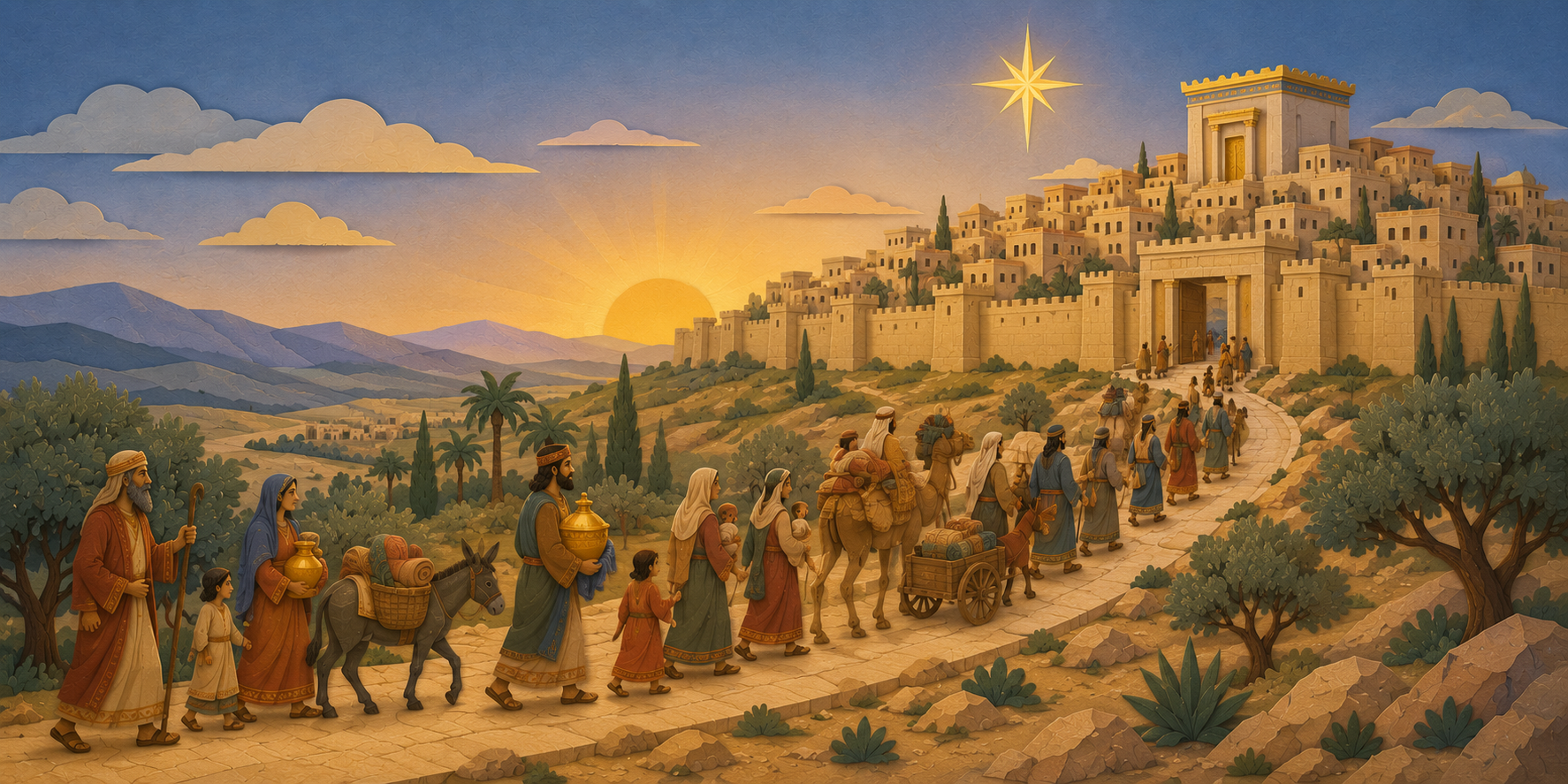
The single richest Latter-day Saint connection is the gathering of Israel. The tenth Article of Faith declares, “We believe in the literal gathering of Israel and in the restoration of the Ten Tribes” (Articles of Faith 1:10). And the return from Babylon under Persia is the Old Testament’s clearest working example of exactly that: a scattered, exiled people brought home by the hand of God to rebuild their worship and their city. The Book of Mormon frames the whole sweep of covenant history as scattering-and-gathering — “the Lord God has led away from time to time from the house of Israel, according to his will and pleasure” and remembers “all them who have been broken off” (2 Nephi 10:22). And it promises that “the Lord will set his hand again the second time to restore his people” (2 Nephi 25:17). The return under Cyrus was the first time in miniature; the latter-day gathering is that same covenant faithfulness on a global scale.
The keys that direct this latter-day gathering were restored in the Kirtland Temple, when “Moses appeared… and committed unto us the keys of the gathering of Israel from the four parts of the earth, and the leading of the ten tribes” (D&C 110:11). For Latter-day Saints, then, Ezra’s caravans on the road from Babylon and Nehemiah’s builders on the walls of Jerusalem are not merely ancient history — they are the ancestors, in type, of the missionary work and temple-gathering the Restoration understands itself to be carrying out.
Temple Restoration, Then and Now
The heart of the return was a temple. Everything in Ezra bends toward rebuilding the house of the Lord (see Section 06). And Haggai’s promise over that modest Second Temple — “the glory of this latter house shall be greater than of the former” (Haggai 2:9) — speaks directly to a people whose own restoration began with the command to build temples, and whose scripture calls this “a marvelous work and a wonder” (2 Nephi 25:17). The parallels a Latter-day Saint teacher can draw are natural and unforced:
- Opposition and discouragement stalling the work.
- Prophets (Haggai, Zechariah) stirring the people to finish.
- Sacrifice and scarcity, given to build God’s house before one’s own “cieled” (finished, paneled) houses (Haggai 1:4).
- The tears of those who remember former glory, giving way to the promise of greater glory to come.
The Second Temple restoration is a template for every gathered people who has ever had to rebuild the house of the Lord against odds.
Ezra and the Return to the Word
The exile turned Israel into a people of the book (see the Babylon guide), and the return produced its exemplary teacher: Ezra, who “prepared his heart to seek the law of the LORD, and to do it, and to teach” (Ezra 7:10). He read the scriptures aloud to the whole assembled people and gave “the sense” so they could understand (Nehemiah 8:8). That scene — an entire covenant community gathered to hear, understand, and covenant around the word of God — is deeply resonant for a church built on scripture study, on “seek, do, teach” as a pattern of discipleship, and on the conviction that a people are renewed when they return to the word. Ezra’s covenant-renewal assembly is, in its way, an ancient general conference.
Daniel: Words Preserved for the Latter Days
Daniel looks beyond the empires of his own day to a kingdom God will establish that will endure forever (Daniel 2:44–45). Restoration revelation takes up his image of a stone cut from the mountain without hands, connecting it with the gospel going forth to fill the earth (D&C 65:2).
The book also looks forward to a time of greater understanding. Daniel is told to “shut up the words, and seal the book” until “the time of the end.” He admits that he does not understand everything he has heard, yet receives the promise that “the wise shall understand” (Daniel 12:4, 8–10). His words are preserved for people whose understanding will come later.
The Restoration gives Latter-day Saints a familiar way to think about that promise. Nephi describes a book carrying the words of people who have “slumbered in the dust,” with further revelation reserved for the Lord’s own time (2 Nephi 27:6–11). The Lord also explains that He gives His commandments to His servants in their weakness, “after the manner of their language, that they might come to understanding” (D&C 1:24). Preserving words and helping people understand them belong together. A record can survive for centuries, yet remain inaccessible until its language and script can be read.1
The recoveries explored in these field guides help us see that process at work. Egyptian monuments, Persian royal inscriptions, and Mesopotamian clay tablets preserved histories, laws, letters, and prayers that later generations could no longer read. Through excavation and decipherment, these records began to speak again. Words recovered from buried ruins—or made understandable after centuries in plain sight—could once more teach future generations. The scriptural image of voices speaking from the dust takes on particular meaning against that background.
These scholarly breakthroughs unfolded during the same broad era as the beginnings of the Restoration. Joseph Smith’s First Vision occurred in 1820 (Joseph Smith—History 1:14); two years later, Champollion made his breakthrough in reading Egyptian hieroglyphs, drawing on the Rosetta Stone and other texts. Over the following decades, work on Darius’s inscriptions and other cuneiform records helped open the written worlds of Persia, Assyria, and Babylon.2
For Latter-day Saints, the timing of these recoveries can suggest God’s hand at work. Alongside the coming forth of restored scripture, knowledge from the ancient world was becoming accessible again. Each discovery adds to a growing storehouse of history, language, and experience. We may recognize in this continuing recovery a fulfillment of Daniel’s promise that knowledge would increase and the wise would understand (Daniel 12:4, 10).
Esther: Providence and “Such a Time as This”
The book of Esther offers a different but equally Latter-day lesson: how God works when He is not visibly working (see Section 07). Esther never names God, yet its every turn testifies to His hidden hand. And Mordecai’s question to the hidden queen — “who knoweth whether thou art come to the kingdom for such a time as this?” (Esther 4:14) — has become one of the most-quoted summons to purpose in Latter-day Saint teaching. It speaks to the doctrine that God places His children in particular times, families, and circumstances for reasons that matter — that we are “come to the kingdom” on purpose, and are asked, like Esther, for the courage to act when our moment comes. And the deliverance the book records — the preservation of the covenant people from one of the earliest empire-wide attempts to destroy them — is one more instance of the promise that the Lord remembers “them who have been broken off” (2 Nephi 10:22) and will not let His covenant fail.
Teaching this material: three through-lines carry the whole Persian period for a class. (1) God governs the nations. He raised up Cyrus exactly as He later raised up “wise men” for the Constitution, preparing the world for His work. (2) Scattering is never the end. The return from Babylon is the pattern of the gathering the Restoration is still carrying out, temple by temple and convert by convert. (3) Providence is often quiet. From Esther’s unnamed God to Ezra’s “good hand of his God upon him” (Ezra 7:9), this era teaches students to recognize the Lord’s hand in circumstances that look, from inside, like mere history. The Old Testament does not end in the ashes of exile. It ends with a decree of return, a rebuilt temple, and a people gathered home. That is exactly the shape of the hope the Restoration proclaims.
Notes
- The wording about language comes from a revelation dated November 1, 1831, as the heading to D&C 1 explains. The Church’s cross-references for Daniel 12:9 also connect its sealed words with 2 Nephi 27:10 and Ether 4:4–7. ↩
- These breakthroughs unfolded over several decades: Grotefend made an important start on Old Persian in 1802; Champollion’s breakthrough came in 1822; Rawlinson copied the Old Persian text at Behistun in 1836–1837; and an independent comparison of Akkadian translations demonstrated substantial agreement in 1857. See Cambridge University Library on the Rosetta Stone, K. J. Cathcart’s research on cuneiform decipherment, and the University of Hamburg’s account. The connection with Daniel is offered as a Latter-day Saint interpretation of this broader recovery; Daniel does not identify these particular discoveries or dates. ↩
Sources and Further Reading
Persia, the Return, and Latter-day themes:
- Edwin Yamauchi, Persia and the Bible (Baker, 1990) — The fullest correlation of Persian history with the biblical books of the return.
- David Rolph Seely & others, in the Old Testament volumes of the Latter-day Saint scholarly literature (e.g. the Religious Studies Center at BYU, rsc.byu.edu) — on Ezra, Nehemiah, and the post-exilic restoration for LDS readers.
- Come, Follow Me — Old Testament, the Ezra–Nehemiah–Esther and Daniel lessons — and the companion Babylon Field Guide on this site for the exile that precedes the return.
Scripture:
- Isaiah 44–45; Ezra 1; 6; 7; Nehemiah 1–2; 8; Esther 4 — the biblical spine of this guide.
- Doctrine & Covenants 101:80; 110:11; Articles of Faith 1:10; 2 Nephi 10:22; 25:17 — the Restoration texts read on this page.