Writing & Records
How the Persian empire wrote itself down — and how a cliff in Iran unlocked the ancient Near East
The Persians wrote in several scripts and languages at once. That habit turns out to matter enormously — both for understanding the empire and, unexpectedly, for our ability to read the entire ancient Near East. The books of Ezra and Esther are steeped in this documentary world of decrees, archives, and multilingual correspondence — and their accuracy about it is one more sign of how close their authors stood to the events. This page follows the empire’s writing from the king’s monumental cuneiform down to the humble Aramaic of everyday administration.
Old Persian Cuneiform — a King’s Script
For their grandest royal inscriptions, the Achaemenid kings used Old Persian cuneiform — and it is a curiosity worth pausing on. Mesopotamian cuneiform was a sprawling, centuries-old system of hundreds of signs (see the Babylon guide). Old Persian cuneiform was nothing like that. It was a compact, mostly alphabetic system of only about forty signs — and it appears to have been more or less invented under Darius the Great for display purposes: a deliberate, prestige script for carving the king’s words into stone. It was rarely used for daily business. For that, the empire relied on Aramaic and on the older scripts of its subject peoples.
The great royal inscriptions almost always appear in three languages at once — Old Persian, Elamite (the old language of the Susa region), and Babylonian (Akkadian). This was the empire announcing itself trilingually to its most important literate audiences. And that trilingual habit was about to become one of the most consequential facts in the history of scholarship.
Behistun: The Cliff That Cracked the Code
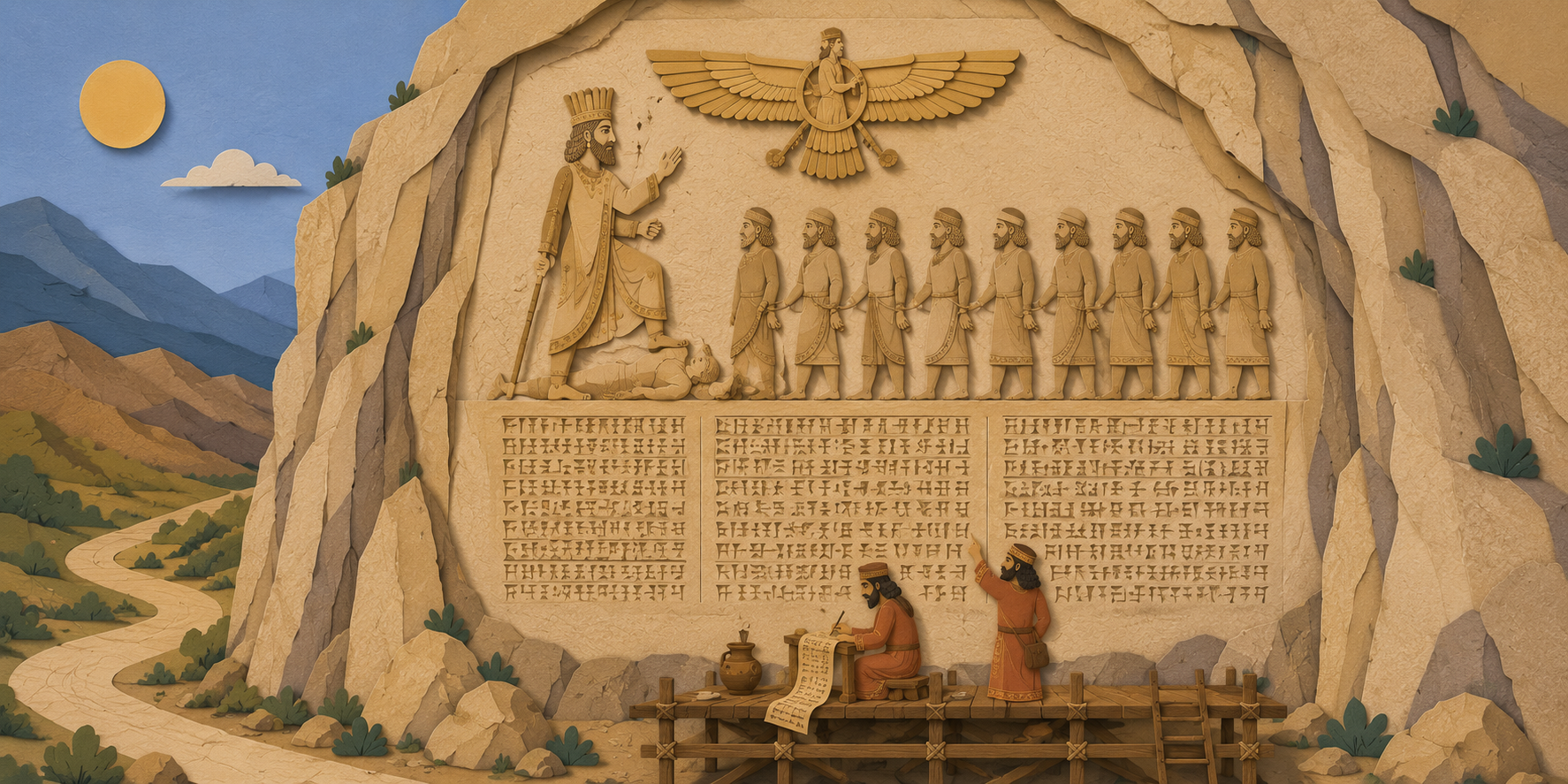
High on a limestone cliff on the old road between Babylon and Ecbatana, Darius the Great carved the most important inscription of the ancient Near East — the Behistun Inscription (c. 520 BC). In a giant relief, Darius stands triumphant over the rebels he defeated to seize the throne, the winged symbol of Ahura Mazda above him. Around and below, a long text tells the story of his victory — in Old Persian, Elamite, and Babylonian, the same account three times over.
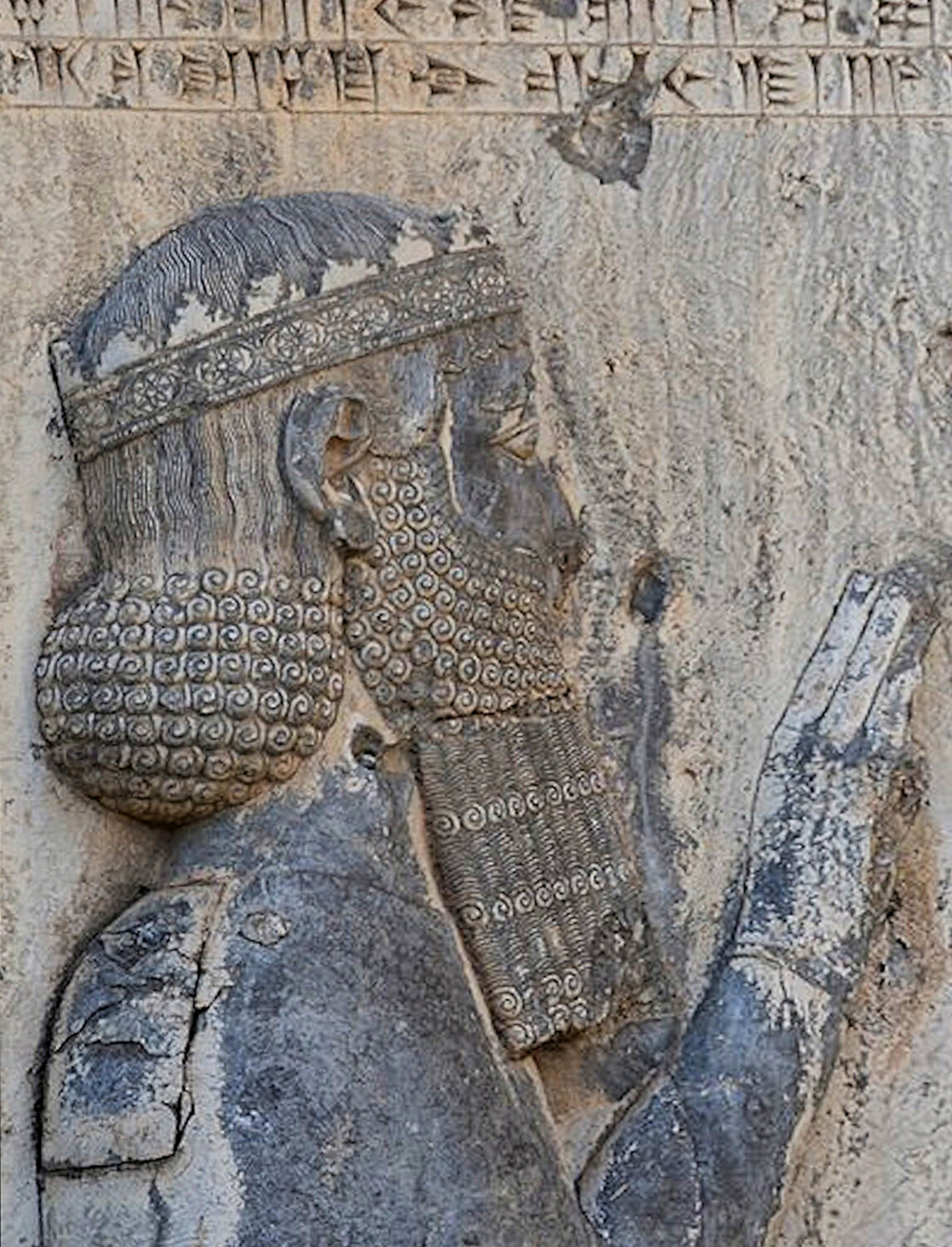

Behistun’s inscription gave scholars three versions of the same royal account to compare. As they worked out Old Persian, those parallel texts helped them decipher the other versions. Like the Rosetta Stone, it provided a way into scripts that scholars could no longer read.
In the 1830s–40s, Henry Rawlinson climbed the cliff to copy the inscription. His copies contributed to the work that made Babylonian and Assyrian texts readable again, including the chronicles, ration tablets, and flood epic discussed in the Babylon guide.
For readers who see providence in history, there is a striking connection: Persia helped Judah return home, and Darius’s inscription later helped scholars recover records of Babylon, the empire that had carried Judah away.
Darius’s own testimony: the Behistun text is also the fullest first-person statement of Achaemenid ideology we have. In it, Darius repeatedly credits Ahura Mazda for his kingship and victories, and rails against “the Lie” (drauga) embodied in the rebels (see Section 04). It shows a king who genuinely believed a high creator-god had appointed him — the mindset that made a ruler able to fund the temple of a foreign “God of heaven” without discomfort.
The Persepolis Tablets — the Empire’s Paperwork
Grand inscriptions tell us what kings wanted remembered; administrative records tell us how the empire actually ran. Excavations at Persepolis recovered tens of thousands of clay tablets — the Persepolis Fortification Archive (c. 509–493 BC) and the smaller Treasury Archive — mostly in Elamite, with some in Aramaic. They are not glamorous: they record rations of grain, wine, and livestock issued to workers, officials, priests, and travelers moving on the king’s business across the heartland. But that is precisely their value. They show a vast, literate, meticulous bureaucracy in motion — women in the workforce receiving rations, religious offerings for many gods funded side by side, and authorized travelers drawing provisions along the road with sealed documents. That last detail should sound familiar: it is exactly the kind of royal travel-authorization Nehemiah requests in Nehemiah 2:7. The world of Persian administration that Ezra–Nehemiah describes from the receiving end, these tablets document from the issuing end.
Aramaic: The Language That Carried the Empire — and Ezra
Beneath the monumental Old Persian and the regional Elamite ran the real connective tissue of the empire: Imperial Aramaic, the chancery language in which decrees and letters actually traveled (see Section 03). It is written on the Elephantine papyri (see Section 06), on leather documents from Bactria (modern Afghanistan) at the empire’s eastern edge, and on countless ostraca — the same standardized official Aramaic from Egypt to Afghanistan.
This is why the Bible itself goes bilingual in exactly the Persian-document sections. The books of Ezra reproduce official correspondence in Aramaic — the accusation letter to Artaxerxes and his reply, the exchange with Darius, and Artaxerxes’s commission to Ezra (Ezra 4:8–6:18; 7:12–26). The text preserves the documents in the very language they were issued in, then switches back to Hebrew for the narrative. Portions of Daniel are likewise in Aramaic. Far from a defect, this bilingual texture is a mark of authenticity: the compilers had real Persian-era documents in hand and quoted them as they stood. And the story runs further still. The Jews carried this Aramaic home, and it remained the daily speech of Judea for centuries — so that the language of the Persian bureaucracy became, in time, the mother tongue of Jesus of Nazareth.
The archive habit and the Bible: Royal records shape several biblical accounts set in the Persian period. A search of the archives confirms Cyrus’s decree concerning the temple (Ezra 6:1–2), and a court chronicle is read aloud to the king in Esther (Esther 6:1). Written decrees and preserved records are part of the setting in which Ezra serves as a scribe. His work of reading and teaching scripture is explored in Section 06.
Sources and Further Reading
- Amélie Kuhrt, The Persian Empire: A Corpus of Sources (Routledge, 2007) — The inscriptions, tablets, and documents in translation, with commentary.
- Rüdiger Schmitt, The Bisitun Inscriptions of Darius the Great: Old Persian Text (Corpus Inscriptionum Iranicarum, 1991) — The scholarly edition of Behistun.
- Matthew W. Stolper & the Persepolis Fortification Archive Project (University of Chicago / ISAC) — ongoing publication of the fortification tablets.
- Bezalel Porten & Ada Yardeni, Textbook of Aramaic Documents from Ancient Egypt — the imperial Aramaic corpus.
- Peter T. Daniels & William Bright, eds., The World’s Writing Systems (Oxford University Press, 1996) — on Old Persian cuneiform and the decipherment of Behistun.
Online Resources: