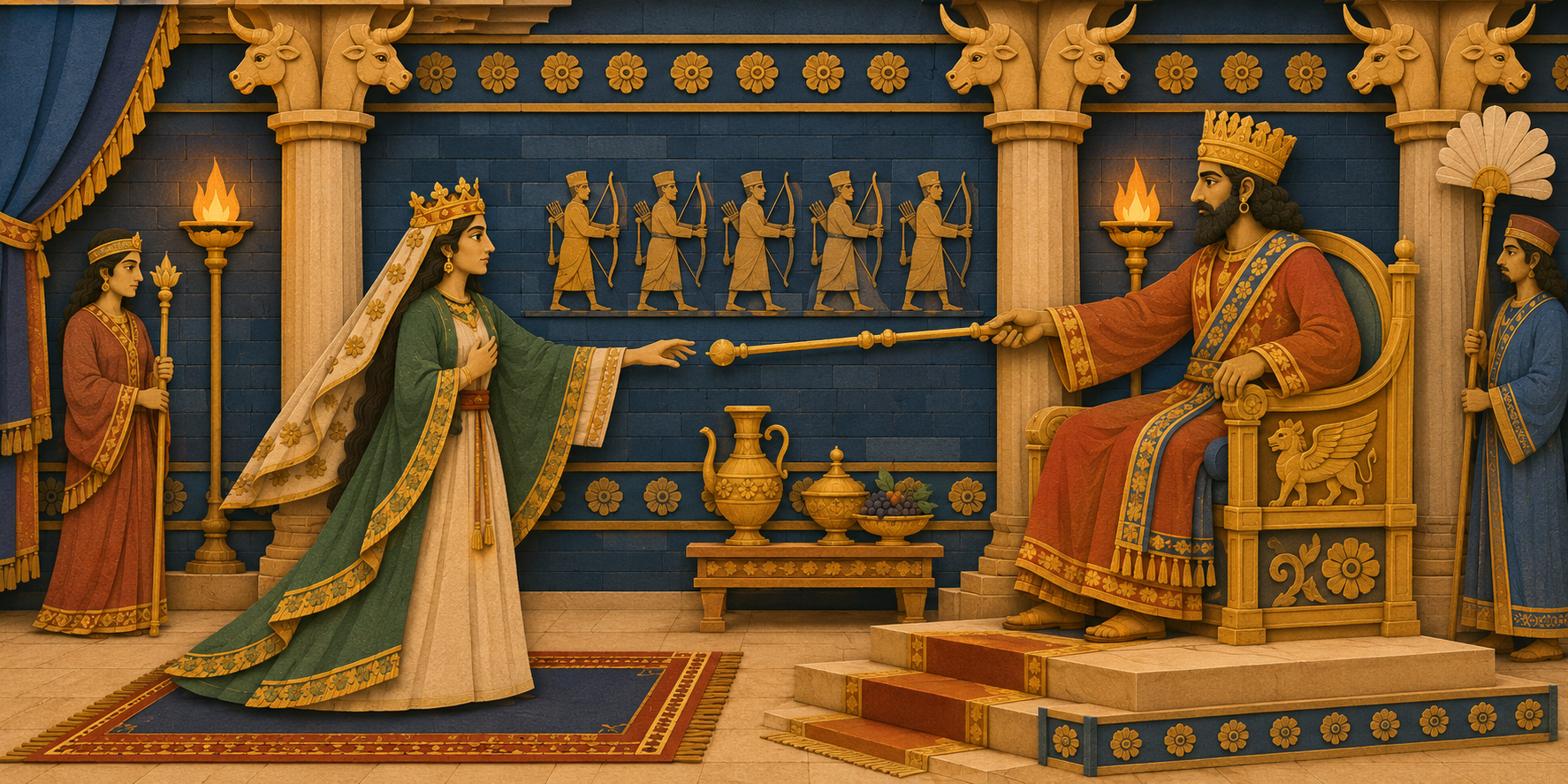
Esther’s World
Inside the Persian court at Susa, where a hidden Jewish queen saved her people
Not every Jewish family returned to Judah when Cyrus permitted the exiles to go home. Many continued living elsewhere in the empire. Esther takes us into this diaspora—Jewish communities outside the homeland—and follows a young woman whose concealed identity becomes central to her people’s survival.
Susa the Palace
Esther opens in “Shushan the palace” (Esther 1:2), or Susa, one of Persia’s royal residences in southwestern Iran. The kings also used residences at Babylon, Ecbatana, and Persepolis (see Section 09). The story distinguishes the royal citadel from the surrounding city: when the king and Haman sit down to drink, “the city Shushan was perplexed” by their decree (Esther 3:15). The contrast matters. A decision made inside the palace threatens people living beyond its walls.
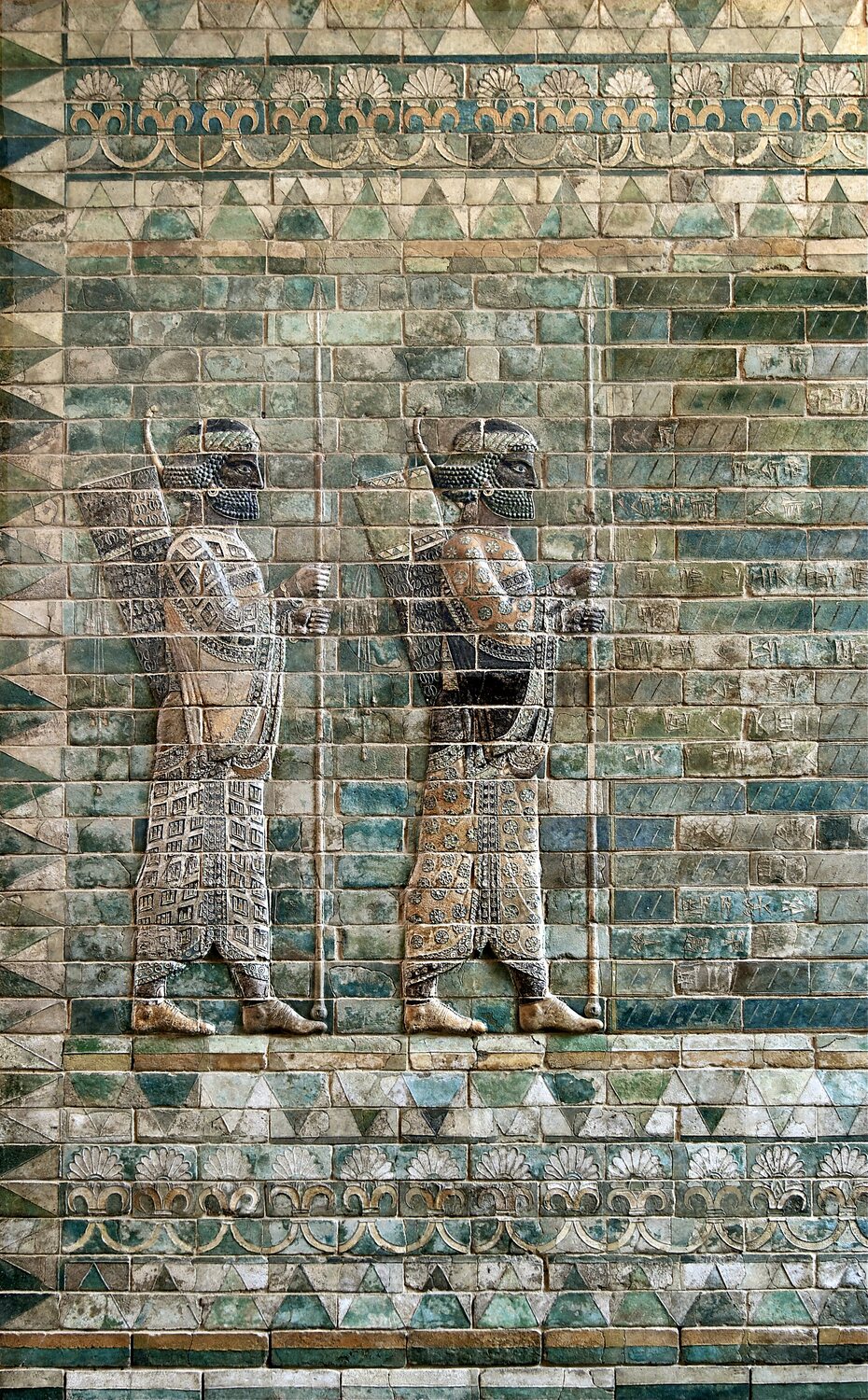

This is also the Susa where Nehemiah serves the king (Nehemiah 1:1) and where Daniel places his vision beside the river Ulai (Daniel 8:2). Excavations have uncovered Darius’s palace, its columned audience hall, glazed-brick decorations, and inscriptions describing the workers and materials gathered from across the empire. These remains help us picture the royal setting of Esther’s story.1
The King of the Book
Esther’s Ahasuerus is usually identified with Xerxes I (486–465 BC). The Hebrew name Aḥashwerosh corresponds to the Old Persian Xšaya-ṛšā, rendered “Xerxes” in Greek. Esther dates the opening feast to his third year (Esther 1:3) and Esther’s arrival as queen to his seventh (Esther 2:16). These dates place the story in the period of Xerxes’s campaigns against Greece.2
The court is a world of restricted access and concentrated power. Seven counselors enjoy privileged access to the king (Esther 1:14); approaching him uninvited can mean death (Esther 4:11). Royal chronicles preserve acts of service (Esther 6:1), while Haman’s fate shows how swiftly royal favor can turn into fatal punishment (Esther 7:10). Decrees travel in the languages and scripts of the empire (see Section 03). These details, together with Persian words in the Hebrew text, give the story its distinctive setting.2
The Court, the Harem, and the Peril
Esther enters this world through the royal harem, the guarded quarters of the king’s wives and concubines, overseen by eunuch officials. After Vashti refuses the king’s summons, she loses her position (Esther 1:12). Young women are then brought to the palace so that a new queen can be chosen. Among them is Esther, a Jewish orphan raised by her cousin Mordecai. At his instruction, she keeps her ancestry hidden (Esther 2:10). She wins the king’s favor and becomes queen.
Esther introduces Haman as “the Agagite” (Esther 3:1). Jewish tradition identifies him as a descendant of Agag, the Amalekite king whom Saul spared against God’s command (1 Samuel 15:8–9). The Talmud explicitly connects Haman’s threat to the Jewish people with Saul’s earlier disobedience. In this reading, a decision made generations before becomes part of the story behind Esther’s crisis (Megillah 13a).9
The danger comes when the king promotes Haman above the other officials. Mordecai refuses to bow to him, and Haman directs his anger against Mordecai’s entire people. With the king’s authorization, he orders the destruction of the Jews throughout the empire. Haman has already been promoted when lots are cast to choose the time for the attack. The word pur, “lot,” gives Purim its name (Esther 3:1–7; 3:7).
“For Such a Time as This”
Mordecai urges Esther to act: “who knoweth whether thou art come to the kingdom for such a time as this?” (Esther 4:14). Her position offers an opportunity, but no guarantee of safety. She asks her community to fast with her before she approaches the king: “if I perish, I perish” (Esther 4:16).
Through two banquets, Esther exposes Haman’s plot and pleads for her people. Within the story, a decree sealed with the king’s ring cannot be revoked, so a second decree authorizes the Jews to defend themselves (Esther 8:8–11). The intended day of destruction becomes a day of deliverance, remembered through Purim (Esther 9:26–28).
Purim: Remembering through Reversal
Mordecai directs the people to remember their deliverance with feasting, gifts of food to one another, and gifts to the poor. Celebration strengthens the community that survived (Esther 9:20–22).
The lot also connects the story with older Mesopotamian practices. Assyrians used a pūru in designating the līmu, the official after whom a year was named. An inscribed clay lot belonging to the official Yaḫalu survives. Bible scholar Amitai Baruchi-Unna proposes that Purim preserves a memory of festivities associated with this practice, reshaped around Jewish deliverance. His reconstruction offers a possible background to the festival’s name and its concern with the coming year.3
Reversal gives Purim much of its character. Haman expects royal honors for himself, but instead must lead Mordecai through the city in the king’s clothing and on the king’s horse (Esther 6:6–11). Later celebrations extend this theme through costumes, performances, and, in some communities, a temporary “Purim rabbi” who playfully presides over the festivities. Persian New Year celebrations also included a temporary ruler, the mīr-e nowrūzī. These customs provide a cultural comparison for the reversal of ordinary rank and authority.4
Purim and Yom Kippur
Jewish mystical and Hasidic teachers also read Purim and Yom Kippur together. The biblical name Yom ha-Kippurim means “Day of Atonements” (Leviticus 23:27). In a traditional wordplay, Kippurim is heard as ke-Purim, “like Purim.” The days offer complementary ways of drawing near to God: Yom Kippur through fasting and repentance; Purim through celebration, generosity, and gratitude.5
The connection extends beyond their names. Lots appear in both accounts: they determine the roles of the two goats in the Day of Atonement ritual and the time of Haman’s planned attack (Leviticus 16:8–10; Esther 3:7). Tikkunei Zohar, a Jewish mystical work, reads Esther’s royal clothing and approach to the king’s inner court alongside the high priest’s garments and entrance into the sanctuary. In that reading, Esther stands before the king as an intercessor seeking life for her people. The passage also invokes God’s enduring covenant, connecting her appeal with the hope of mercy and renewal.5
Esther, Psalm 22, and the Cross
Another Jewish interpretation connects Esther’s intercession with Psalm 22. In Megillah 15b, Rabbi Levi pictures Esther entering the palace’s chamber of idols, experiencing the withdrawal of the Divine Presence, and crying out with the psalm’s opening words: “My God, my God, why hast thou forsaken me?” (Psalm 22:1).10
Jesus quotes these same words from the cross (Matthew 27:46; Mark 15:34). For listeners familiar with the psalm, its opening could also recall its movement toward deliverance: God hears the afflicted, praise returns to the congregation, and future generations proclaim His righteousness (Psalm 22:24–31). Read together, the accounts offer Christian readers a comparison between Esther risking her life for her people and Christ giving His life for the world. Our article The Savior’s Sermon From the Cross explores that connection further.
Hadassah and the Hope of Renewal
The characters’ names also reflect the cultures surrounding the Jewish community. Mordecai is widely connected with Marduk, the chief Babylonian god; Esther has also been connected with Ishtar. These are Mesopotamian associations within the wider Persian Empire. Familiar names could belong to Jewish people who retained their own identity. Scholar Adam Silverstein proposes further connections between Esther and Mesopotamian stories. On that reading, familiar names and court imagery could become the outer clothing of a story preserving Jewish memory.6
Esther’s Hebrew name is Hadassah (הֲדַסָּה), “myrtle” (Esther 2:7). This gives renewal a direct scriptural image. Isaiah pictures the myrtle replacing the brier as part of a promise of restoration (Isaiah 55:12–13). The Talmud applies this passage to Esther: Vashti, associated there with the dynasty that destroyed Jerusalem’s temple, is the brier; Esther is the myrtle rising in its place. This Jewish interpretation brings the story into the memory of destruction and the hope of renewed life.7
As interpretive wordplay, we can also hear Hadassah beside ḥadash (חָדָשׁ), “new”—an echo of renewal and covenant hope.7 Isaiah describes that hope through marriage: the Lord gathers His forsaken people with mercy and rejoices over restored Zion as a bridegroom rejoices over his bride (Isaiah 54:5–8; 62:4–5). Read beside those promises, Esther’s emergence from hiddenness and her people’s deliverance can evoke renewed covenant belonging. This is a theological comparison with the prophets’ restoration imagery.8
Hidden Providence
In the Hebrew form of Esther, God is never explicitly named. Yet readers can recognize His sustaining care in the story’s timing: a sleepless night, a remembered act of loyalty, a queen in place before the crisis, and a date far enough away to allow time for rescue. Mordecai’s confidence that deliverance will come “from another place” leaves that help unnamed (Esther 4:14).
Read in faith, Esther invites us to recognize God’s work through ordinary courage, communal care, and people willing to act. A community far from Jerusalem could still fast together, protect one another, remember its deliverance, and pass that memory to its children. The God who is not named in the story can still be present in its unfolding.
Notes
- Rémy Boucharlat, “Susa iii. The Achaemenid Period”, describes the residences, excavations, palace, and building inscriptions. The Louvre’s object record documents the archers frieze’s provenance and date. These establish the setting; they do not independently verify Esther’s events. ↩
- W. S. McCullough, “Ahasuerus”, explains the royal name; Shaul Shaked, “Esther, Book of”, discusses Persian features and historical questions. The Greek campaigns provide background, including Thermopylae and the attack on Athens; Esther does not mention them or identify its banquet as a war council. The court transition appears in Esther 1 and Esther 2. The statement about irrevocable decrees is attributed here to the narrative. ↩ ↩
- I. L. Finkel and J. E. Reade, “Lots of Eponyms,” Iraq 57 (1995), 167–172, discuss the surviving lot and possible procedures. Placing named lots in a vessel and shaking them out is a reconstruction; Esther does not describe Haman’s equipment. Amitai Baruchi-Unna, “On the Origins of Purim and Its Assyrian Name”, proposes a festival background for which direct Assyrian documentation is lacking. The year-naming official, a temporary festival ruler, and Haman’s promotion are separate institutions or events. ↩
- Shifra Epstein, “Purim: The Upside-Down Holiday”, describes Purim rabbis and festive role reversal. Michele Epinette, “Mīr-e Nowrūzī”, discusses the Persian temporary ruler. The surviving accounts of these particular customs are later than Esther’s setting; their resemblance does not establish direct transmission from Achaemenid Persia. For costume history, see Yosef Sharbat, “Purim Masquerade: Unmasking the Origins,” pp. 38–41. ↩
- The biblical plural is visible in the Hebrew of Leviticus 23:27. The “like Purim” reading is interpretive wordplay, not the dictionary derivation of kippurim. See Tikkunei Zohar 57b:6–10 for garments, inner-court imagery, covenant, and the paired observances; and Al Kein Kar’u, chapter 2 and note 2 for the later Hasidic formulation. The latter distinguishes its “Yom Kippur is like Purim” wording from Tikkunei Zohar’s reverse association. Eliyahu Kitov, “Purim Allusions”, explains fasting and feasting as complementary paths. Yaakov Medan, “Purim and Yom Kippur”, develops Esther’s intercession in this comparison. These are later Jewish readings of the biblical texts. ↩ ↩
- Mayer I. Gruber, “Judeo-Persian Communities ii. Achaemenid Period”, discusses the names and Jewish life within the empire. Adam Silverstein, “The Book of Esther and the Enūma Eliš,” BSOAS 69.2 (2006), 209–223, proposes literary relationships; the linked institutional record includes his abstract. His model is presented as a proposal, rather than an established account of Esther’s composition. ↩
- Hadassah and ḥadash are distinct words with different consonants. The sound association in this draft is our interpretive wordplay. The Talmud’s explicit restoration reading instead rests on the myrtle of Isaiah 55:13: Megillah 10b:19–23. Vashti’s connection with Nebuchadnezzar’s dynasty belongs to that rabbinic interpretation, not to an explicit statement in Esther. ↩ ↩
- Isaiah supplies the restoration and marriage imagery. Applying it to Esther is the proposed theological reading here. Esther describes a royal marriage but supplies no quoted marriage contract, and the cited rabbinic passage does not explicitly identify Vashti as “old Jerusalem.” ↩
- Esther names Haman an Agagite; Megillah 13a:1 explicitly identifies the descent and draws the connection with Saul. 1 Samuel 15:32–33 subsequently records Samuel’s execution of Agag. The connection to Haman is presented here as the rabbinic understanding of the earlier event. ↩
- Megillah 15b supplies Esther’s prayer in its interpretation of Esther 5:1; the biblical book itself does not quote that prayer. This is Psalm 22:1 in the KJV and 22:2 in Hebrew numbering. The Gospels establish Jesus’ quotation but do not tell us that witnesses understood it as an Esther reference. The comparison draws on the psalm, the Gospel accounts, and the Jewish interpretation preserved in the Talmud. ↩
Sources and Further Reading
- Adele Berlin, Esther (JPS Bible Commentary, 2001) — A literarily sensitive, historically informed commentary.
- Jon D. Levenson, Esther: A Commentary (Old Testament Library, 1997) — Excellent on the book’s theology of hidden providence.
- Karen H. Jobes, Esther (NIV Application Commentary, 1999) — Strong on the Persian setting and application.
- Amélie Kuhrt, The Persian Empire: A Corpus of Sources (Routledge, 2007) — For the court institutions and Susa inscriptions behind the book.
- Herodotus, Histories, Books 7–9 — the Greek portrait of Xerxes and his court, invaluable background to Ahasuerus.
Online Resources:
- WHE — Susa (CC BY-NC-SA 4.0)
- WHE — Xerxes I
- Sefaria — Esther with classical Jewish commentary and the Purim tradition.
- CFM Corner — Purim: Hidden Providence, Unlikely Deliverance
- CFM Corner — The Savior’s Sermon From the Cross