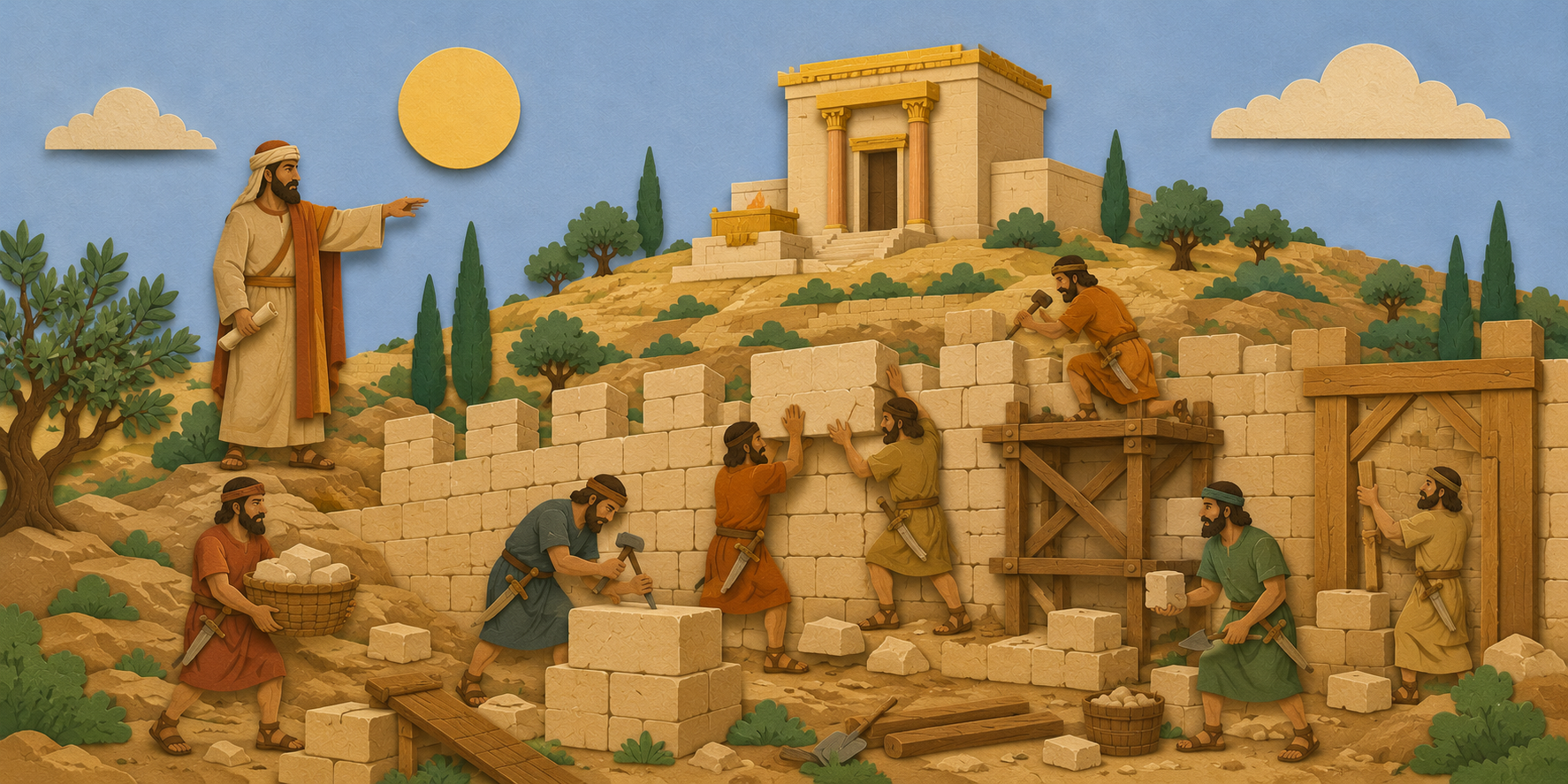
Rebuilding Jerusalem
Temple, law, and wall — the long, contested work of restoration
The decree of Cyrus opened the door; walking through it took a century. The return was not a single triumphant homecoming but a slow, difficult, often discouraging rebuild — interrupted by opposition, poverty, and internal drift, and carried by a handful of remarkable leaders across four Persian reigns. Three things had to be restored to make Judah a people again: the temple (its worship), the law (its identity), and the wall (its security and dignity). This page follows all three.
The Second Temple (538–515 BC)
The first returnees under Sheshbazzar and then Zerubbabel rebuilt the altar and laid the temple’s foundation within a couple of years (Ezra 3:8–10). Then the work stalled — for about fifteen years. Local peoples, rebuffed when they offered to help build (Ezra 4:1–5), “weakened the hands of the people of Judah, and troubled them in building,” hiring counselors to frustrate the project. Discouragement and hard times did the rest; the people turned to their own houses and let God’s house lie waste.
Two prophets broke the paralysis. In 520 BC, in the second year of Darius, Haggai and Zechariah confronted the community: “Is it time for you, O ye, to dwell in your cieled houses, and this house lie waste?” (Haggai 1:4). In other words: you live in your cieled (finished, paneled) houses — while God’s house lies waste? The work resumed. When a Persian official challenged their right to build, the community appealed to Cyrus’s original decree. Darius ordered the royal archives searched, and the memorandum was found filed at Ecbatana (Ezra 6:2; see Section 09). Darius not only confirmed the permit — he ordered the project funded and protected from provincial taxes (Ezra 6:8–12). The temple was finished on the third of Adar, in Darius’s sixth year — 515 BC (Ezra 6:15), “through the prophesying of Haggai the prophet and Zechariah” (Ezra 6:14).
Smaller, but not lesser: the Second Temple was humbler than Solomon’s — those who remembered the first wept at the sight of the second’s foundation (Ezra 3:12). But Haggai gave it a promise that reached far beyond its modest stones: “The glory of this latter house shall be greater than of the former… and in this place will I give peace” (Haggai 2:9). This is the temple that stood, much later enlarged by Herod, when the Messiah walked its courts — so that the “greater glory” was, in the end, a Person. This Second Temple period lasted from 515 BC until the Romans destroyed the rebuilt structure in AD 70.
Ezra the Scribe (458 BC)
About sixty years after the temple was finished, Ezra arrived from Babylon with a royal commission from Artaxerxes. He was “a ready scribe in the law of Moses” (Ezra 7:6). Scripture describes the purpose behind his work: “Ezra had prepared his heart to seek the law of the LORD, and to do it, and to teach in Israel statutes and judgments” (Ezra 7:10). Studying, living, and teaching the Law belonged together.
The king provided silver and gold for the temple, granted tax exemptions to its servants, and authorized Ezra to appoint judges and teach God’s law (Ezra 7:12–26). This gave Ezra practical support for his work as a teacher and leader among the returning people.
Years later, after Nehemiah had led the rebuilding of Jerusalem’s wall, Ezra stood on a wooden platform before the people gathered at the Water Gate, beside a public square in Jerusalem. He read the Book of the Law aloud from morning until midday. The Levites helped the people understand: “they read in the book… distinctly, and gave the sense, and caused them to understand the reading” (Nehemiah 8:8).
That explanation was part of the work of rebuilding the community. The people were learning together by listening, with teachers helping them follow the meaning. Later Jewish teachers associated this scene with reading the Hebrew text, translating it into Aramaic, and dividing the reading into meaningful phrases. An Aramaic translation of scripture is known as a Targum. It could help listeners who were more familiar with Aramaic than with the Hebrew of the scroll.1
The way a passage is spoken also helps us understand it. A pause, a change of emphasis, or the grouping of words can make a sentence easier to follow. In Jewish worship, cantillation carries out this work through chanting: inherited patterns guide the reader’s phrasing and emphasis. These patterns are called taʿamei ha-miqra, the accents of scriptural reading. Some Jewish accounts remember Ezra as restoring forgotten details of this reading tradition. The familiar system of vowel points and accent marks took shape much later, during the early Middle Ages.2
The congregation’s response shows what understanding could lead to. After first weeping as they heard the Law, the people were encouraged to rejoice and share food with those who had none prepared. Nehemiah says they celebrated because they had understood what was taught (Nehemiah 8:9–12). They also kept the Feast of Tabernacles, living in temporary shelters as the Law directed. The account says they had not celebrated it in this way since the days of Joshua (Nehemiah 8:17). Understanding scripture led to shared worship and action.
Later Jewish tradition compares Ezra’s importance as a teacher with that of Moses.3 His story brings reading, explanation, worship, and daily conduct together. That connection remains familiar whenever a congregation gathers around scripture: we listen, seek understanding, and consider how to live what we have learned. The Babylon guide explores how scripture helped sustain Jewish community life during and after exile.
Nehemiah’s Wall (445 BC)
Thirteen years after Ezra, word reached Susa that Jerusalem still lay open — its wall broken, its gates burned, its people “in great affliction and reproach” (Nehemiah 1:3). Nehemiah, a Jew serving as cupbearer to Artaxerxes — a position of intimate trust at the royal table — wept, prayed, and then made a bold request: leave to go and rebuild, with letters of safe passage and an order to the keeper of the royal forest for timber (Nehemiah 2:7–8). Appointed governor of Yehud, he arrived, surveyed the ruins by night, and rallied the people: “Let us rise up and build” (Nehemiah 2:18).
The book of Nehemiah is a masterclass in leadership under opposition. Against ridicule, threats, and plots from Sanballat, Tobiah, and Geshem, Nehemiah organized the whole population to build family by family, section by section, with a tool in one hand and a weapon in the other (Nehemiah 4:17). The wall was finished — astonishingly — in fifty-two days (Nehemiah 6:15), and even Judah’s enemies “perceived that this work was wrought of our God” (Nehemiah 6:16). Nehemiah then governed for years with conspicuous integrity, refusing the governor’s food-allowance so as not to burden the people (Nehemiah 5:14–18), and pressing reforms on Sabbath-keeping and the support of the temple. With the wall and the law both restored, Judah was, for the first time since 586 BC, a functioning covenant community again.
The Surprise Witness: The Elephantine Papyri
Jerusalem was not the only place where Jews worshipped Israel’s God in a temple. At Elephantine, near modern Aswan in Egypt, a Jewish military community left Aramaic letters, contracts, and records of family and religious life. Its sanctuary was dedicated to Yahu, a form of the name Yahweh.
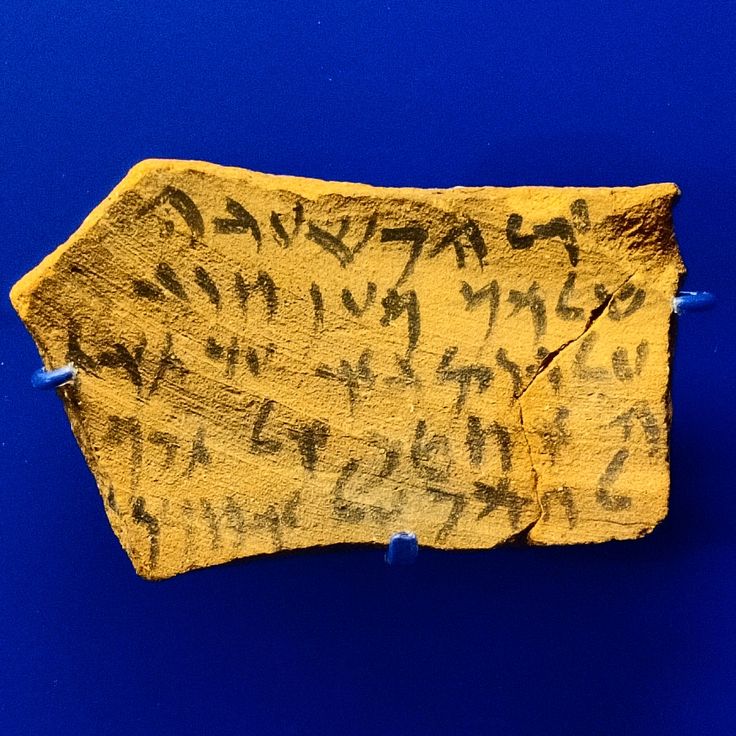

In a petition dated 407 BC, its priests asked Bagohi, the governor of Judah, for help rebuilding their temple, which had been destroyed in 410 BC. They said their ancestors had built it before Persia conquered Egypt in 525 BC. They described stone pillars, a cedar roof, gold and silver vessels, and offerings of grain, incense, and burnt sacrifices. They had already appealed to Jerusalem’s high priest without receiving an answer, and also wrote to the sons of Sanballat, governor of Samaria. This was an established temple community seeking help through the same religious and political networks that appear in Ezra and Nehemiah. Read the Elephantine petition.
These records show that Jerusalem’s claim to be the sole legitimate sanctuary was not uniformly reflected in Jewish practice. An earlier temple excavated at Tel Moẓa, near Jerusalem, adds archaeological evidence that Judah’s worship had not always centered on a single sanctuary. Jerusalem’s claim to exclusive authority therefore needs a history of its own: when was that claim promoted, and how widely was it accepted? Tel Moẓa excavation report.
For Latter-day Saint readers, the Nephite temples make the question especially relevant. Nephi says his people kept the law of Moses, then describes building a temple patterned after Solomon’s (2 Nephi 5:10, 16). Later, Alma and Amulek preach in the people’s temples and other places of worship (Alma 16:13). Within that record, keeping the Mosaic law and building temples outside Jerusalem belong together. This gives Latter-day Saint readers a scriptural reason to question whether a Jerusalem-only requirement applied universally.
On the historical question, scholars have argued that centralizing worship also consolidated political and priestly authority. Requiring sacrifice at one sanctuary concentrated authority over offerings, priestly service, and community life. Some Jerusalem-only mandates may therefore reflect the priorities of authorities who were collecting, editing, and establishing the authority of sacred texts. The timing remains debated: efforts to centralize worship preceded the Persian period, and the biblical collection developed over centuries. The Nephite account offers a Latter-day Saint comparison; the historical argument rests on the ancient documents, archaeology, and study of the biblical texts. William S. Morrow on centralization, Ernest Nicholson’s study of Deuteronomy.
Why the frontier archive matters: Elephantine both illuminates the biblical setting and preserves community experiences that complicate a uniform picture.
Notes
- Megillah 3a:7–8 and Nedarim 37b:5 interpret Nehemiah 8:8 in relation to the Hebrew text, Targum, verse divisions, and accent divisions. Joshua R. Jacobson discusses these interpretations in Chanting the Hebrew Bible, second expanded edition (2017), pp. 444–445. The Hebrew קרא (qara) means to call or read aloud; מקרא (miqra) here refers to the reading. The expression translated “gave the sense” uses שכל (sekhel, understanding). The technical name טעמי המקרא (taʿamei ha-miqra) belongs to the later reading tradition. ↩
- Jacobson, Chanting the Hebrew Bible, pp. 2–3, explains how cantillation conveys phrasing and meaning. Rabbi Baruch S. Davidson’s account of the Torah-reading tradition describes Ezra as reintroducing forgotten details. Eric Werner, The Sacred Bridge (1959; 1963 printing), pp. 110–112, distinguishes evidence for oral chanting from evidence for written accent signs and does not treat Nehemiah 8:8 alone as proof of a musical performance. The Ezra connection is presented here as Jewish interpretive tradition.
Niqqud refers to vowel pointing; cantillation accents guide stress, phrasing, and chanting. The Masoretes developed written systems over several centuries to preserve older oral reading traditions. The familiar Tiberian system survives in manuscripts from the ninth century AD onward. See Geoffrey Khan, “The languages of the Old Testament,” pp. 4–5.
Werner also explored possible earlier musical cues. He proposed that marginal signs in the Great Isaiah Scroll (1QIsaᵃ) might represent musical notation, comparing them with Slavonic and Bulgarian chant signs (“Musical Aspects of the Dead Sea Scrolls,” 1957, pp. 22–25). Separately, The Sacred Bridge, pp. 419 and 466, compares Lithuanian Jewish chant with Gregorian psalm tones. Werner presented the Scrolls comparison as a hypothesis.
↩ - In Sanhedrin 21b:24–25, Rabbi Yosei describes Ezra as worthy of transmitting the Torah had Moses not preceded him. The comparison emphasizes Ezra’s role in teaching and renewing the community’s commitment to the Law. ↩
Sources and Further Reading
- H. G. M. Williamson, Ezra, Nehemiah (Word Biblical Commentary, 1985) — The standard scholarly commentary.
- Joseph Blenkinsopp, Ezra–Nehemiah: A Commentary (Old Testament Library, Westminster John Knox, 1988) — Thorough on the history and the sources.
- Bezalel Porten, Archives from Elephantine: The Life of an Ancient Jewish Military Colony (University of California Press, 1968) — The foundational study of the papyri.
- Bezalel Porten & Ada Yardeni, Textbook of Aramaic Documents from Ancient Egypt (multiple vols., 1986–) — The documents themselves, in translation.
- Lester L. Grabbe, A History of the Jews and Judaism in the Second Temple Period, Vol. 1: Yehud (T&T Clark, 2004) — The Persian-period province in full context.
Online Resources:
- WHE — The Second Temple (CC BY-NC-SA 4.0)
- WHE — Elephantine
- Bible Odyssey — SBL articles on Ezra, Nehemiah, and the Elephantine community.