Cyrus & the Return
The decree that ended the exile — in the Bible and in Cyrus’s own words
The book of Kings ends in the dark. Jerusalem burned, the temple destroyed, the people carried to Babylon (see the Babylon guide). But the Hebrew Bible, in its own arrangement, does not end there. It ends with a door swinging open. The very last words of 2 Chronicles are the decree of a Persian king telling the exiles to go home: “The LORD God of heaven… hath charged me to build him an house in Jerusalem… let him go up” (2 Chronicles 36:23). This page is about that decree — the single most important act of the entire Persian period for the Bible. It is also about the remarkable object that lets us hear Cyrus’s policy in his own voice.
The Decree of Cyrus (538 BC)
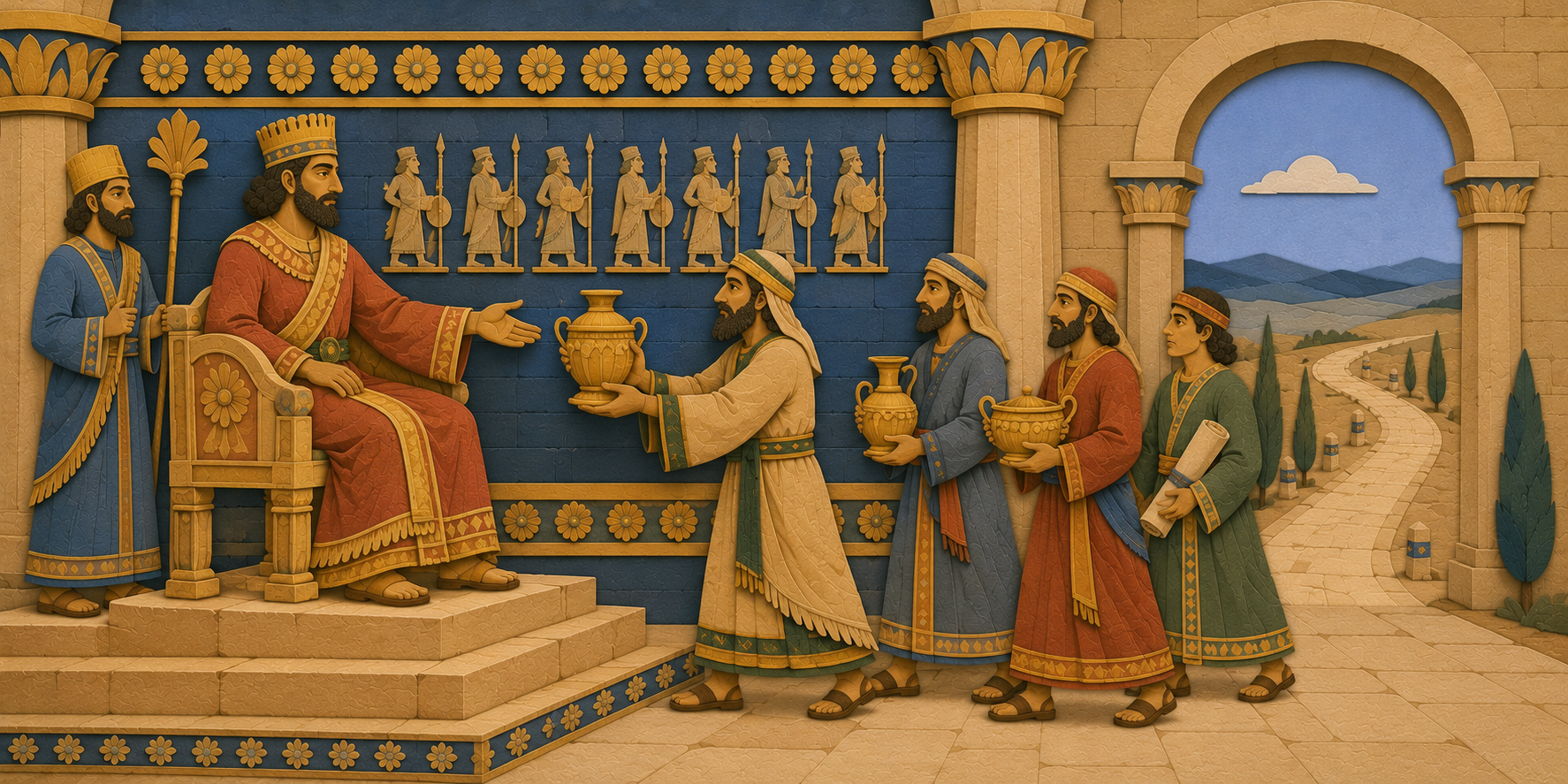
In his first year as ruler of Babylon, Cyrus issued a proclamation. There was the announcement people actually heard — a public heralding in Hebrew (Ezra 1:2–4). There was also the file copy the clerks kept — an Aramaic administrative memorandum, later found in the royal archive (Ezra 6:3–5). Ezra quotes both. The public version:
“Thus saith Cyrus king of Persia, The LORD God of heaven hath given me all the kingdoms of the earth; and he hath charged me to build him an house at Jerusalem, which is in Judah. Who is there among you of all his people? his God be with him, and let him go up to Jerusalem… and build the house of the LORD God of Israel.”
The decree did four concrete things: it authorized the return of any Judean who wished to go; it ordered the temple rebuilt; it directed that the work be funded from the royal treasury (Ezra 6:4); and it restored the temple vessels that Nebuchadnezzar had looted — 5,400 items of gold and silver, counted out to a prince of Judah named Sheshbazzar (Ezra 1:7–11). A first wave of about 50,000 returned (Ezra 2:64–65). They rebuilt the altar and laid the temple’s foundation. It was a day of shouting and weeping mixed together — the old men who remembered Solomon’s temple weeping aloud while the young shouted for joy (Ezra 3:12–13).
Ezra frames the decree, unmistakably, as the fulfillment of prophecy. It happened “that the word of the LORD by the mouth of Jeremiah might be fulfilled” (Ezra 1:1) — Jeremiah’s seventy years of Babylon (Jeremiah 29:10) now expired. Daniel, reading those same seventy years, had prayed toward exactly this moment (Daniel 9:2).
The Cyrus Cylinder — Persia’s Own Voice
In 1879, excavators at Babylon unearthed a barrel-shaped clay cylinder covered in Akkadian cuneiform. It was a foundation deposit — following the old custom of burying an inscription inside a building’s walls — which Cyrus had buried in the city’s walls after taking it in 539 BC. The Cyrus Cylinder, now in the British Museum, is the king’s own account of his conquest and his policy. And it independently confirms the kind of ruler the Bible describes.
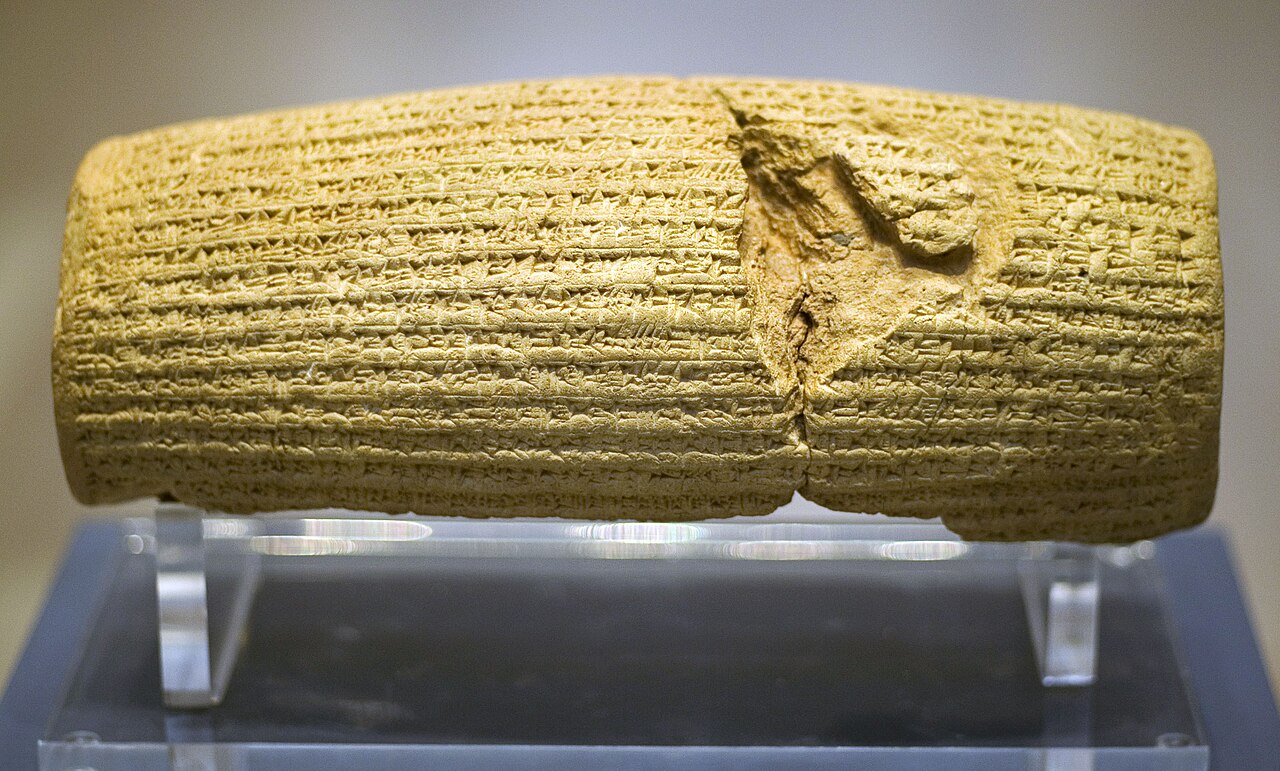

On the cylinder, Cyrus presents himself not as a foreign conqueror but as the legitimate king chosen by Babylon’s own god Marduk. Marduk, Cyrus claims, took him by the hand and delivered the city to him without a battle, because its last king had neglected the gods. And then comes the policy that matters. Cyrus declares that he returned the images of the gods that had been gathered into Babylon to their own cities and sanctuaries, and restored their peoples to their dwellings. In his own words, he “gathered all their inhabitants and returned to them their dwellings.”
What the cylinder does and doesn’t prove: it is important to be precise here, because the cylinder is sometimes over-claimed. It has even been called “the first charter of human rights,” which reads modern ideals back into an ancient royal boast.
The cylinder does not mention Judah or Jerusalem — it is about Babylon and Mesopotamian gods. What it establishes is that releasing captive peoples and restoring their temples was Cyrus’s documented, empire-wide policy — exactly the policy the Bible says he applied to Judah.
Notice how Cyrus speaks. Addressing Babylonians, he credits Marduk, Babylon’s chief god. Addressing (or through) Judeans, the decree credits “the LORD God of heaven.” A king running this policy across many peoples would naturally frame it in each people’s own theological language — which is just what we find.
The cylinder doesn’t prove the biblical decree; it shows the biblical decree fits its author perfectly.
“His Anointed”: Isaiah and Cyrus
The theological daring of this moment is easy to miss. Isaiah 44–45 had spoken of Cyrus in language reserved, everywhere else, for Israel’s own kings and ultimately for the Messiah. Cyrus is the LORD’s “shepherd” (Isaiah 44:28). He is the LORD’s “anointed” — mashiach, messiah — whose hand the LORD holds “to subdue nations before him” (Isaiah 45:1). The LORD “raised him up in righteousness” for one purpose above all: “he shall build my city, and he shall let go my captives, not for price nor reward” (Isaiah 45:13).
And crucially, Isaiah says the LORD does this for a king who does not know Him: “I girded thee, though thou hast not known me” (Isaiah 45:5). Cyrus worships his own gods; the God of Israel employs him anyway. The same passage that honors the Persian king also draws the sharpest possible line against Persian dualism — “I form the light, and create darkness… I the LORD do all these things” (Isaiah 45:7; see Section 04). The point is total sovereignty. There is one God — and even the emperor who does not know His name is a tool in His hand for the good of His people.
The ancient Jewish historian Josephus preserved a striking tradition — that Cyrus was actually shown Isaiah’s prophecies naming him, and was moved by reading his own name, written generations before, to fulfill them. Whether or not that meeting happened, it captures the wonder the returning exiles clearly felt: that the God they had feared was silenced by Babylon had, all along, been writing the name of their deliverer into the scroll.
Why the Return Matters
Everything downstream in the Bible depends on this decree. Without the return there is no Second Temple — and so no temple for Zechariah and Malachi to prophesy in, none for Ezra to teach in, none standing when Jesus is presented as an infant and later teaches in its courts. Without the return there is no restored Jerusalem for Nehemiah to wall, no re-gathered people to receive the law, no continuous community to carry the scriptures forward to the meridian of time — the time of Christ’s mortal ministry. The exile could have ended Israel the way Assyria’s deportations ended the northern kingdom — scattered and absorbed. Instead, a Persian decree turned the exile into a return, and the return became the Bible’s enduring template of hope. Captivity is not the end of the covenant story. God can move the heart of the most powerful man on earth to bring His people home (Section 10 follows this thread into Latter-day Saint thought).
Sources and Further Reading
- Irving Finkel, ed., The Cyrus Cylinder: The King of Persia’s Proclamation from Ancient Babylon (I. B. Tauris, 2013) — The British Museum curator’s edition, with translation and essays on use and misuse.
- Amélie Kuhrt, “The Cyrus Cylinder and Achaemenid Imperial Policy,” Journal for the Study of the Old Testament 25 (1983) — The classic careful assessment of what the cylinder does and doesn’t establish.
- H. G. M. Williamson, Ezra, Nehemiah (Word Biblical Commentary, 1985) — On the two forms of the decree and the return.
- Edwin Yamauchi, Persia and the Bible (Baker, 1990) — Cyrus, the decree, and the Isaiah question.
- Josephus, Antiquities of the Jews 11.1 — the ancient tradition of Cyrus reading Isaiah’s prophecy of himself.
Online Resources:
- British Museum — the Cyrus Cylinder (with full translation)
- WHE — The Cyrus Cylinder (CC BY-NC-SA 4.0)
- Livius.org — Cyrus Cylinder (text and commentary)