One of the most persistent tensions in modern religious discourse is the apparent conflict between the biblical creation account and contemporary scientific models of deep time and evolution. This tension, however, does not arise from the biblical text itself. Rather, it emerges from a mismatch of mathematical languages—from reading an ancient cosmological narrative through the assumptions of modern numerical systems.
To understand Genesis more faithfully, we must first understand how the ancient world understood number, time, and scale, and how radically different that understanding was from our own.
The Modern Assumption: Time as Uniform Units
Modern readers instinctively assume that time consists of uniform, measurable units: seconds, minutes, hours, days, and years. In this framework, a "day" is always twenty-four hours, and larger spans of time are constructed by stacking identical units—one thousand years equals exactly one thousand solar cycles.
This way of thinking depends on three mathematical concepts that feel obvious to modern readers but were not available to the biblical world:
- Positional decimal notation
- Zero as a placeholder
- Zero as a number
These concepts developed slowly—and very late.2
Zero Was Not Always a Number
Ancient civilizations were highly numerate, but they did not share modern mathematical abstractions.
In the ancient Mediterranean world, Hebrew, Greek, and Roman cultures used letters to represent numbers, employing additive or symbolic systems rather than positional notation.3 There was no symbol for zero, and no concept of an empty numerical place.
Ancient Alphabetic Numeral Systems
Hebrew and Greek used their full alphabets as numerals; Roman numerals used only seven letters (I, V, X, L, C, D, M). None had a symbol for zero.
As a result, numbers often carried qualitative meaning in addition to quantity. A "thousand" frequently represented magnitude, fullness, or completeness rather than a precise count.
Hebrew אֶלֶף (eleph)
In Biblical Hebrew, the term ʾeleph (plural alpayim) can denote:
- a thousand
- a clan or military unit
- a large organized group under a single leader4
Numbers functioned relationally and socially, not abstractly.
Mesopotamia: Advanced Mathematics Without Zero
Ancient Mesopotamia developed one of the most sophisticated mathematical traditions of the ancient world. Babylonian scribes employed a base-60 (sexagesimal) positional system as early as the second millennium BC, a system still preserved today in our divisions of time and space.5
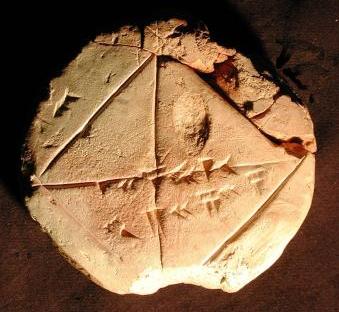
Learn more →
Using this system, Mesopotamian astronomers calculated:
- planetary motions
- eclipse cycles
- extremely large astronomical periods
Yet for most of their history, they had no symbol for zero. Numerical meaning was inferred from context—tables, units, and cosmological frameworks clarified scale.6
By the late first millennium BC, Babylonian scribes introduced a placeholder symbol to indicate an empty position within a number. This symbol, however, was not a number. It could not be added, subtracted, or treated independently. It merely marked absence.7
Zero Becomes a Number—Very Late
Zero as a true mathematical number—capable of participating in arithmetic—emerges only in late antiquity. The decisive step occurs in the 7th century AD, when Indian mathematician Brahmagupta articulated formal rules for zero in his Brāhmasphuṭasiddhānta.8
This conceptual leap made possible:
- decimal place-value arithmetic
- exponential notation
- modern calculations of vast time scales
A Crucial Timeline
The biblical texts were written more than a millennium earlier than zero became a number.
Reading Genesis as though it presupposes decimal notation and zero-based arithmetic is therefore historically anachronistic.9
"One Day Is as a Thousand Years"
With this numerical background in view, biblical statements about time take on clearer meaning.
Psalm 90:4 declares that "a thousand years" in God's sight are like a single day, while 2 Peter 3:8 reverses the expression, stating that one day is as a thousand years.10
These verses do not offer a conversion formula. They express a relational truth:
- divine time is not human time
- duration collapses relative to divine perspective
- scale is flexible rather than fixed
In ancient numerical language, "a thousand" signifies fullness or completeness, not a precise chronological measurement.11
The Meaning of Yom in Genesis
The Hebrew word יוֹם (yom), translated "day" in Genesis 1, does not intrinsically mean a twenty-four-hour period. Throughout the Hebrew Bible, yom may refer to:
- daylight hours
- a full day-night cycle
- an unspecified period
- an extended era12
Genesis itself uses yom flexibly. Genesis 2:4 speaks of "the day" in which God made heaven and earth—summarizing the entire creation sequence in a single yom.13
The insistence that each creation "day" must equal a modern solar day is therefore not grounded in the Hebrew text, but in later interpretive assumptions.
Creation as Ordered Phases, Not Timed Events
The creation account in Genesis is structured not as a scientific report, but as a theological and liturgical narrative. Its repeated phrases, ordered progressions, and climactic rest pattern resemble temple dedication texts and covenantal liturgy.14
The "days" function as creative phases, each introducing a new level of order and purpose. The text specifies sequence and meaning, not duration.
A Harmonic Model of Creation Time
A musical analogy helps illuminate this structure.
In the harmonic overtone series:
- a fundamental tone establishes identity
- overtones emerge in ordered relationship
- each overtone has a different wavelength and duration
- yet all belong to one coherent system15
Applied to creation, this suggests that the "days" of Genesis are not equal temporal units but harmonically related stages. Each phase is complete in itself, yet integrated into a unified creative whole.
Creation unfolds harmonically, not mechanically.
Science and Scripture: No Necessary Conflict
Modern science investigates mechanisms, processes, and durations. Scripture proclaims order, purpose, and meaning. These are different questions, addressed through different languages.
When Genesis is read within its ancient numerical and temporal framework, it does not conflict with scientific models of deep time or biological development. It was never attempting to describe how long creation took, but how creation was ordered.16
Conclusion: Recovering an Ancient Language of Time
The biblical creation account was composed in a world without zero, without decimal place value, and without uniform units of time. Its numbers are symbolic and relational; its "days" are ordered phases of divine activity rather than measured intervals.
Read this way, Genesis does not compress creation into six short days—it expands our understanding of time itself. Creation becomes a divine composition, unfolding in ordered movements, each complete in purpose, each harmonically related to the whole.
The problem was never the text.
The problem was the math we brought with us.
Footnotes
- John H. Walton, The Lost World of Genesis One (Downers Grove, IL: IVP Academic, 2009).
- Georges Ifrah, The Universal History of Numbers (New York: Wiley, 2000).
- Eleanor Robson, Mathematics in Ancient Iraq (Princeton: Princeton University Press, 2008).
- Ludwig Koehler and Walter Baumgartner, Hebrew and Aramaic Lexicon of the Old Testament, s.v. אֶלֶף.
- Otto Neugebauer, The Exact Sciences in Antiquity (Providence: Brown University Press, 1957).
- Eleanor Robson, "Place Value and the Absence of Zero," Historia Mathematica 29 (2002).
- Christine Proust, "Babylonian Mathematical Reasoning," Cambridge Companion to Ancient Mathematics (2014).
- Brahmagupta, Brāhmasphuṭasiddhānta, trans. Colebrooke (1817).
- Florian Cajori, A History of Mathematical Notations (Chicago: Open Court, 1928).
- Psalm 90:4; 2 Peter 3:8.
- Umberto Cassuto, A Commentary on the Book of Genesis (Jerusalem: Magnes Press, 1961).
- Brown-Driver-Briggs Hebrew Lexicon, s.v. יוֹם.
- Genesis 2:4.
- Margaret Barker, Temple Theology (London: SPCK, 2004).
- Hermann von Helmholtz, On the Sensations of Tone (New York: Dover, 1954).
- N.T. Wright, Scripture and the Authority of God (New York: HarperOne, 2013).