How Hebrew Sounds Are Made
Places & Manners of Articulation in Biblical Hebrew
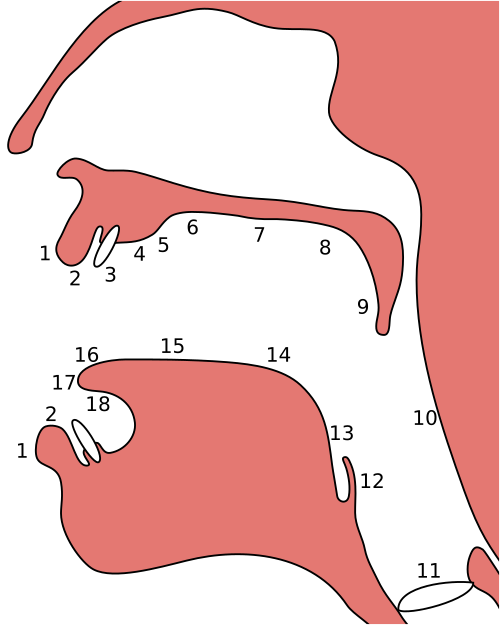
Where Sounds Are Formed
Click or tap a region on the diagram to see which Hebrew letters are produced there.
Select a region
Click or hover over a colored region on the diagram to explore which Hebrew consonants are formed there.
How Sounds Are Shaped
The manner of articulation describes how airflow is controlled to produce each sound.
Voiced vs. Voiceless
Every consonant is either voiced or voiceless. The difference is whether your vocal cords vibrate when you make the sound. Place your fingers on your throat and try it:
Say /b/ or /z/ and feel the buzz in your throat
Say /p/ or /s/ — just air, no vibration
In the cards below, voiced sounds and voiceless sounds are color-coded so you can see the pairs.
Plosive (Stop)
Airflow is completely blocked, then released in a burst.
Fricative
Airflow is narrowed but continues flowing, creating friction.
Nasal
Air flows through the nose while the mouth is blocked.
Lateral
Air flows around the sides of the tongue.
Trill / Tap
The tongue vibrates rapidly against the ridge or uvula.
Affricate
A stop and fricative combined into one sound.
Approximant
Minimal obstruction -- the sound glides through.
The Begadkephat Connection
Six Hebrew letters change their sound depending on whether they carry a dagesh (dot). With the dagesh, they are plosives (air is stopped). Without it, they become fricatives (air flows continuously).
* In modern Israeli Hebrew, only three pairs are still distinguished: Bet/Vet, Kaf/Khaf, and Pe/Fe. The ancient distinctions for Gimel, Dalet, and Tav are preserved in some Yemenite and Sephardic traditions.
Hebrew Consonant Classification
All 22 Hebrew consonants organized by where and how they are produced.